10 punkti 1944
“w serial #”
About This Note
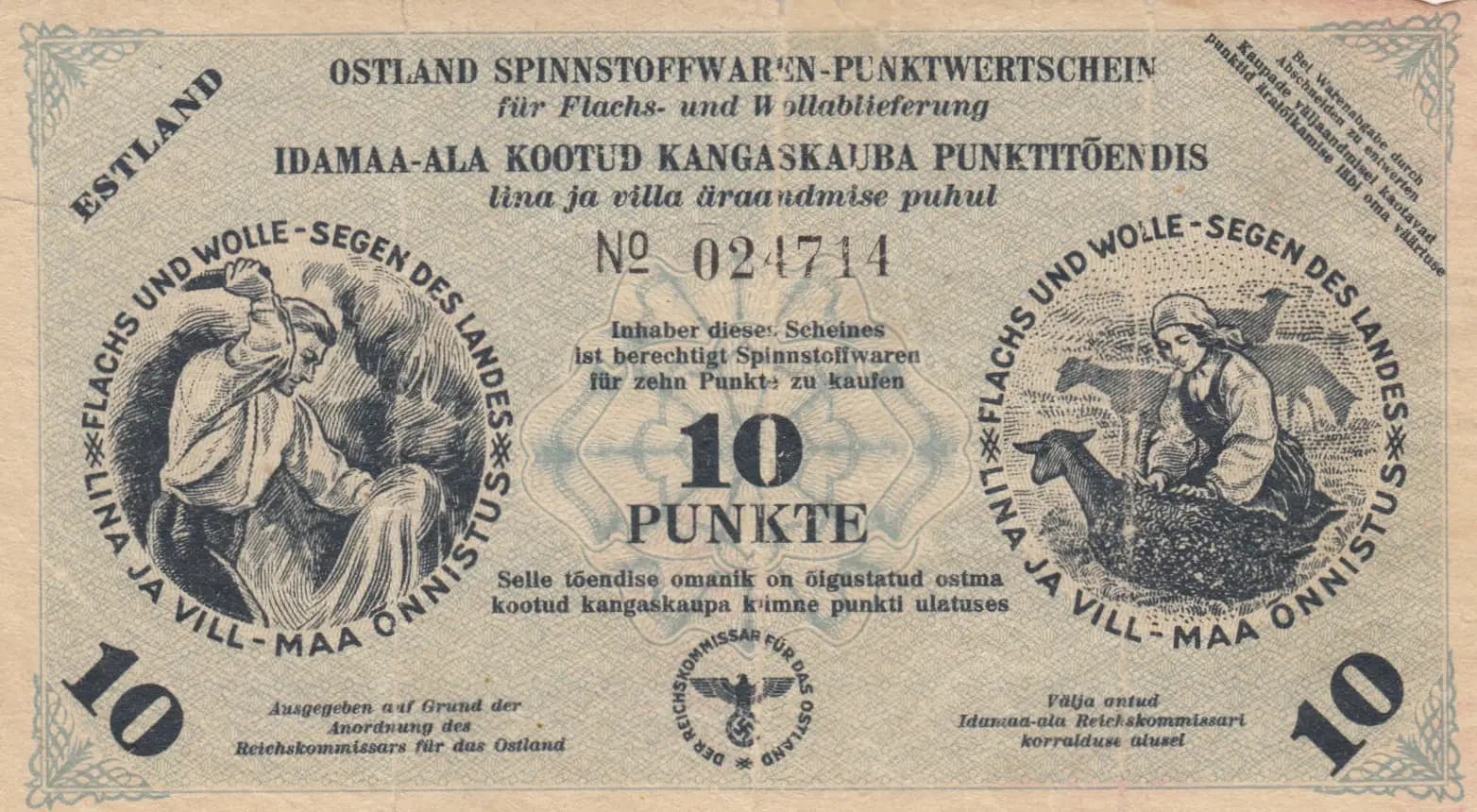
This is a 10 Punkte textile rationing voucher issued by German occupation authorities in Estonia during 1944, featuring bilingual German-Estonian text and allegorical female figures engaged in textile work. The note displays moderate aging with visible creasing and fold lines consistent with its 80-year history, and remains in Fair condition with clear serial number NO 024714. This unlisted Pick number represents a specialized wartime rationing document rather than conventional currency, making it a significant artifact of WWII occupation economics in the Baltic region.
Common. This note represents a mass-issued wartime rationing voucher distributed throughout occupied Estonia in early 1944. The 10-point denomination was likely the most frequently circulated unit of this textile rationing system, with substantial print runs necessary to serve the civilian population. Rationing vouchers of this type were typically produced in quantities far exceeding conventional banknotes, and many were destroyed through use, redemption, or post-war document disposition programs. The unlisted Pick number reflects the specialized nature of occupation vouchers rather than numismatic rarity—such documents were not historically cataloged by the Pick Standard during their period of issue. Survival in Fair condition with visible use wear is entirely consistent with common distribution. The presence of a serial number is standard for administrative accountability, not an indicator of scarcity.
This voucher was issued under the authority of the Reich Commissioner for the East (Reichskommissar für das Ostland) to manage the distribution of textile goods in occupied Estonia during 1944. The bilingual German-Estonian format and emphasis on flax and wool delivery reflect Nazi economic policy in the Baltic territories, which were administratively grouped as 'Ostland.' The validity date of April 30, 1944, and the decorative imperial eagles with swastikas underscore the official nature of this rationing instrument during the final year of German occupation before Soviet re-conquest.
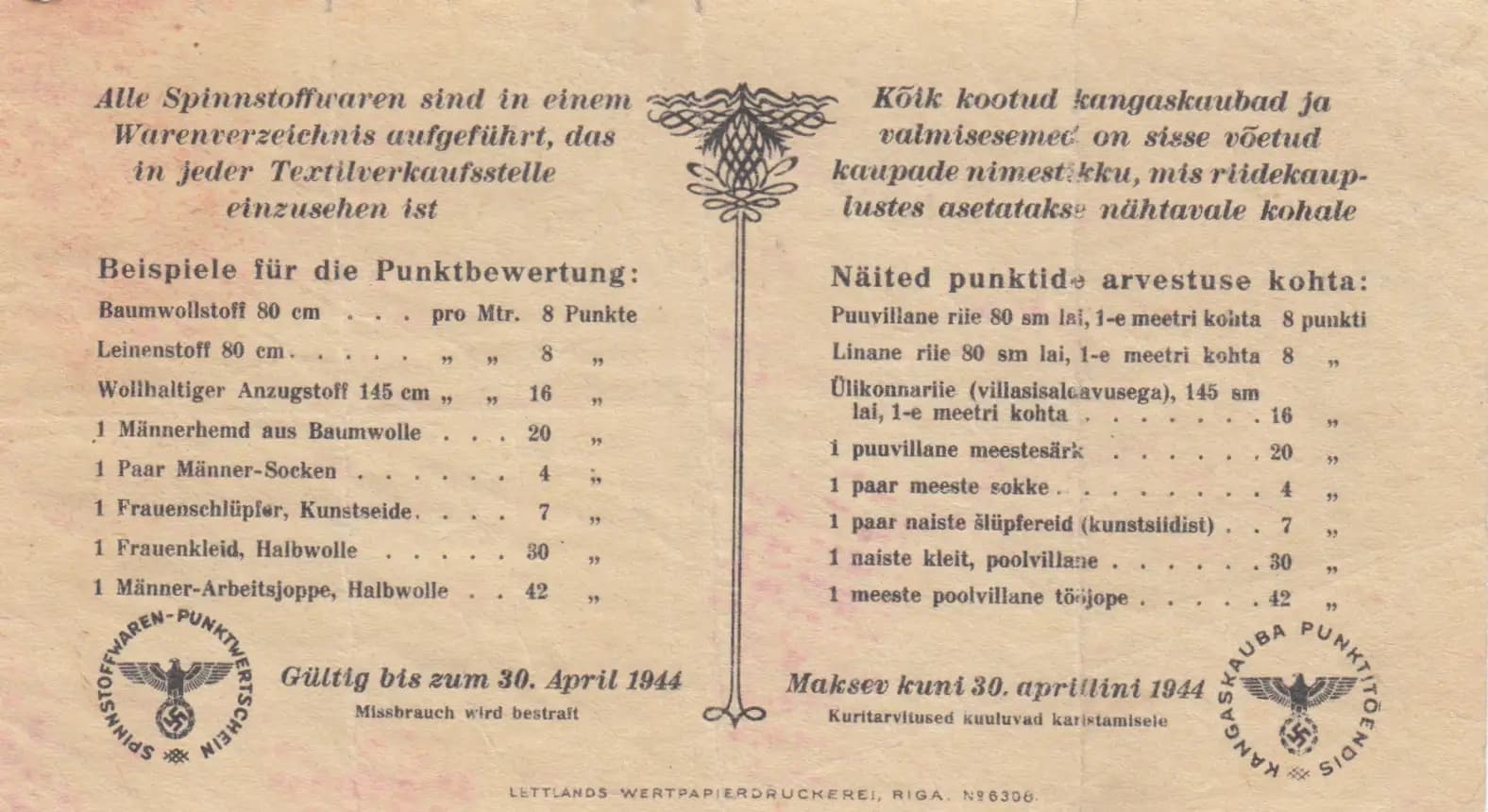
The note features a sophisticated two-column bilingual design typical of Nazi occupation administrative documents. The obverse showcases two allegorical female figures in classical style positioned symmetrically—the left figure depicted spinning or carding textile fibers, the right figure similarly engaged in wool or flax preparation—representing the productive feminine labor idealized by Nazi propaganda. Both figures are rendered in refined line engraving with subtle shading in gray-blue tones. Ornamental borders with floral and geometric patterns frame all four corners of the front design. The denomination '10' is prominently displayed in the center, flanked by the word 'PUNKTE' in bold serif typography. The reverse side abandons figural imagery entirely, presenting instead a dense informational layout listing specific textile goods with their corresponding point values, organized in parallel German-left and Estonian-right columns separated by a decorative flourish. Imperial eagles bearing swastikas appear as security emblems in the lower corners of both sides. The color palette remains deliberately austere: tan-beige paper with black letterpress text and gray-blue decorative accents, lending the document an official, bureaucratic appearance appropriate to wartime rationing administration.
FRONT SIDE: 'OSTLAND SPINNSTOFFWAREN-PUNKTWERTSCHEIN für Flachs- und Wollablieferung' (Ostland Spun Materials Points Voucher for Flax and Wool Delivery) / 'IDAMAA-ALA KOOTUD KANGASKAUBA PUNKTITÖENDIS tina ja villa äraandmise puhul' (East Land Woven Fabric Materials Points Certificate for Tin and Wool Delivery). Main denomination text: '10 PUNKTE' (10 Points). Serial number: 'NO 024714'. Authorization text: 'Inhaber dieses Scheines ist berechtigt Spinnstoffwaren für zehn Punkte zu kaufen' (The holder of this certificate is entitled to purchase spun materials for ten points) / 'Selle tõendise omanik on õigustatud ostma kootud kangaskaupa kümme punkti ulatuses' (The holder of this certificate is entitled to purchase woven materials up to ten points). Issuing authority: 'Ausigegeben auf Grund der Anordnung des Reichskommissars für das Ostland' (Issued pursuant to the order of the Reich Commissioner for the East) / 'Välja antud Rietskomissari korraluduse alusel' (Issued by order of the Reich Commissioner). REVERSE SIDE: Heading text: 'Beispiele für die Punktbewertung' (Examples for Point Evaluation) / 'Näited punktide arvestuse kohta' (Examples for Point Calculation). Goods listing examples include: Cotton fabric 80 cm, per meter 8 points / Linen fabric 80 cm, per meter 8 points / Wool-containing suit fabric 145 cm, per meter 16 points / Men's cotton shirt 20 points / Men's socks (pair) 4 points / Women's artificial silk slip 7 points / Women's half-wool dress 30-50 points / Men's half-wool work jacket 42 points. General notes: 'Alle Spinnstoffwaren sind in einem Warenverzeichnis aufgeführt, das in jeder Textilverkaufsstelle einzusehen ist' (All spun materials are listed in a goods register which can be viewed at every textile retail store). Validity: 'Gültig bis zum 30. April 1944' / 'Maksey kuni 30. aprillini 1944' (Valid until April 30, 1944). Warning: 'Missbrauch wird bestraft' / 'Kuritarvitus on karistamisele' (Misuse will be punished). Printer attribution: 'LITTLANDS WERTPAPIERDRUCKEREI, RIGA. N°6306.' (Littland Securities Printing Works, Riga. No. 6306.)
The note was produced using multiple printing techniques characteristic of 1940s German security printing. The text throughout appears to be letterpress printing (relief printing), evidenced by the sharp, crisp quality of the typeface and the uniform impression visible in the visual analysis. The allegorical figures and decorative border elements on the obverse were executed using line engraving or steel engraving techniques, producing fine detail and subtle tonal gradations through cross-hatching and stippling. The security emblems (imperial eagles with swastikas) also show characteristics of engraved work. The bilingual text layout suggests the use of compositor-set type combined with engraved vignettes, a common practice for German occupation currency and vouchers. The printer, Littlands Wertpapierdruckerei of Riga (indicated as 'N°6306'), was a German-controlled Baltic printing facility specializing in securities and official documents during the occupation period.
This note is cataloged as Pick-unlisted due to its classification as a specialized occupation rationing voucher rather than conventional currency. The specific variety observed is characterized by serial number NO 024714 and bears the printer attribution N°6306 from Littlands Wertpapierdruckerei, Riga. The April 30, 1944 validity date represents the standard expiration date for this voucher issue. No multiple varieties of this specific 10-point denomination are documented in standard references; however, the rationing system likely produced variations across different denominations (likely 5, 10, 25, 50, and higher point values) and possibly different print batches or revisions. The bilingual German-Estonian format remained consistent throughout the occupation period for all official documents issued to Estonia. Collectors should note that serial number sequence and batch numbers from Littlands Wertpapierdruckerei may vary, providing potential markers for different production runs or allocation batches to specific regional distribution centers within the Ostland administrative region.