10 punkt 1945
“w serial #”
About This Note
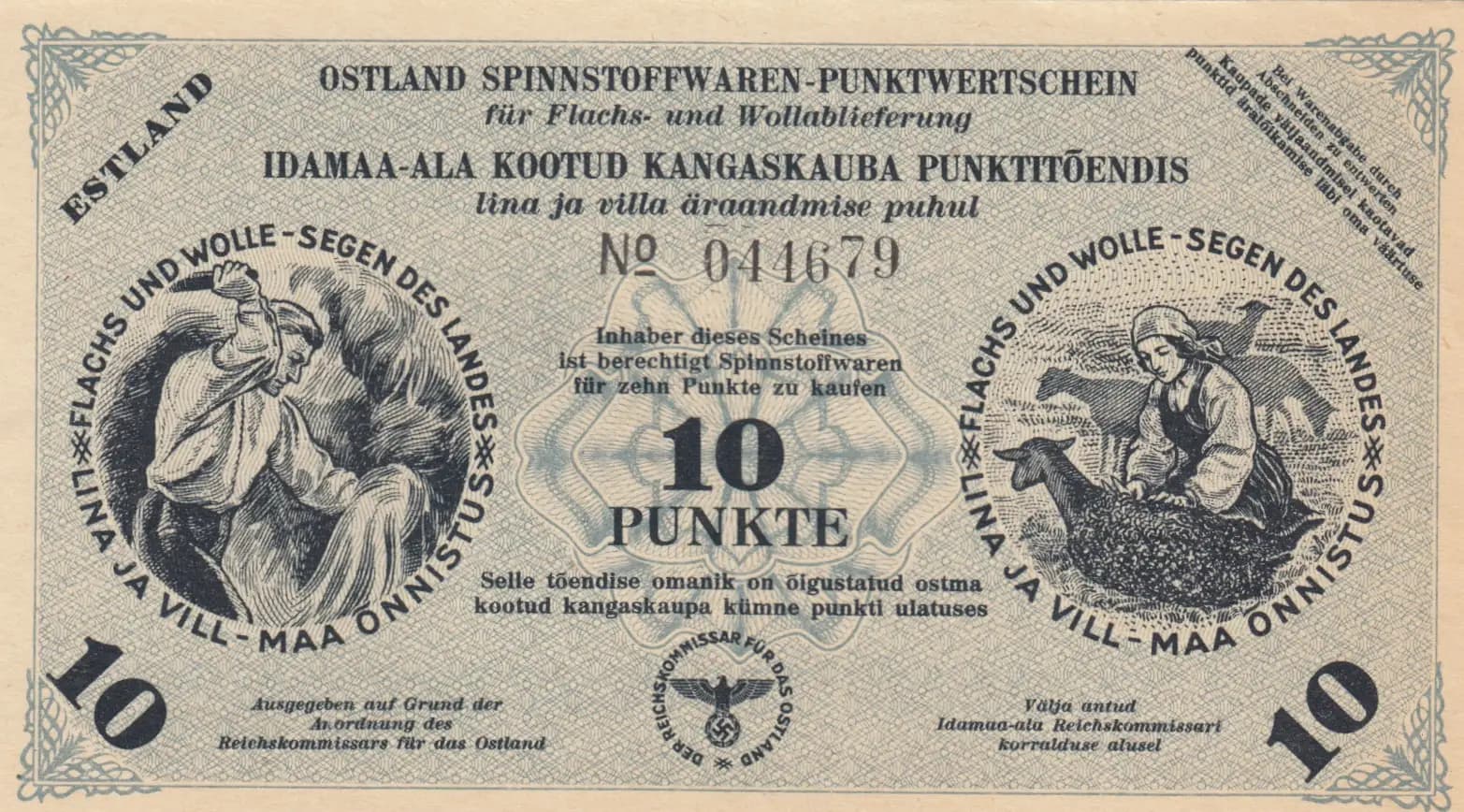
This is an exceptional UNC example of a German-issued Estonian textile rationing voucher from 1945, denominated at 10 points (Spinnstoffwaren-Punktwertschein). The note exhibits pristine condition with no visible creases, tears, or foxing, displaying only appropriate aged patina consistent with its 79-year age. The bilingual German-Estonian design with allegorical female figures, ornate heraldic shield, and Nazi iconography makes this a compelling artifact of WWII occupation currency, particularly notable for its utilitarian purpose in managing textile distribution under the Ostland administration.
common. This textile rationing voucher, while historically significant as a Nazi occupation artifact, was issued in substantial quantity as a functional document for civilian use during 1945. The wide distribution required for the rationing system's implementation across the Ostland territory, combined with the fact that such documents were not typically preserved as currency collectibles (unlike banknotes), means surviving examples are encountered with reasonable frequency in specialized collections and dealers' stock focusing on WWII occupation materials. The UNC condition grade elevates its collector appeal but does not change the fundamental commonality of the issue.
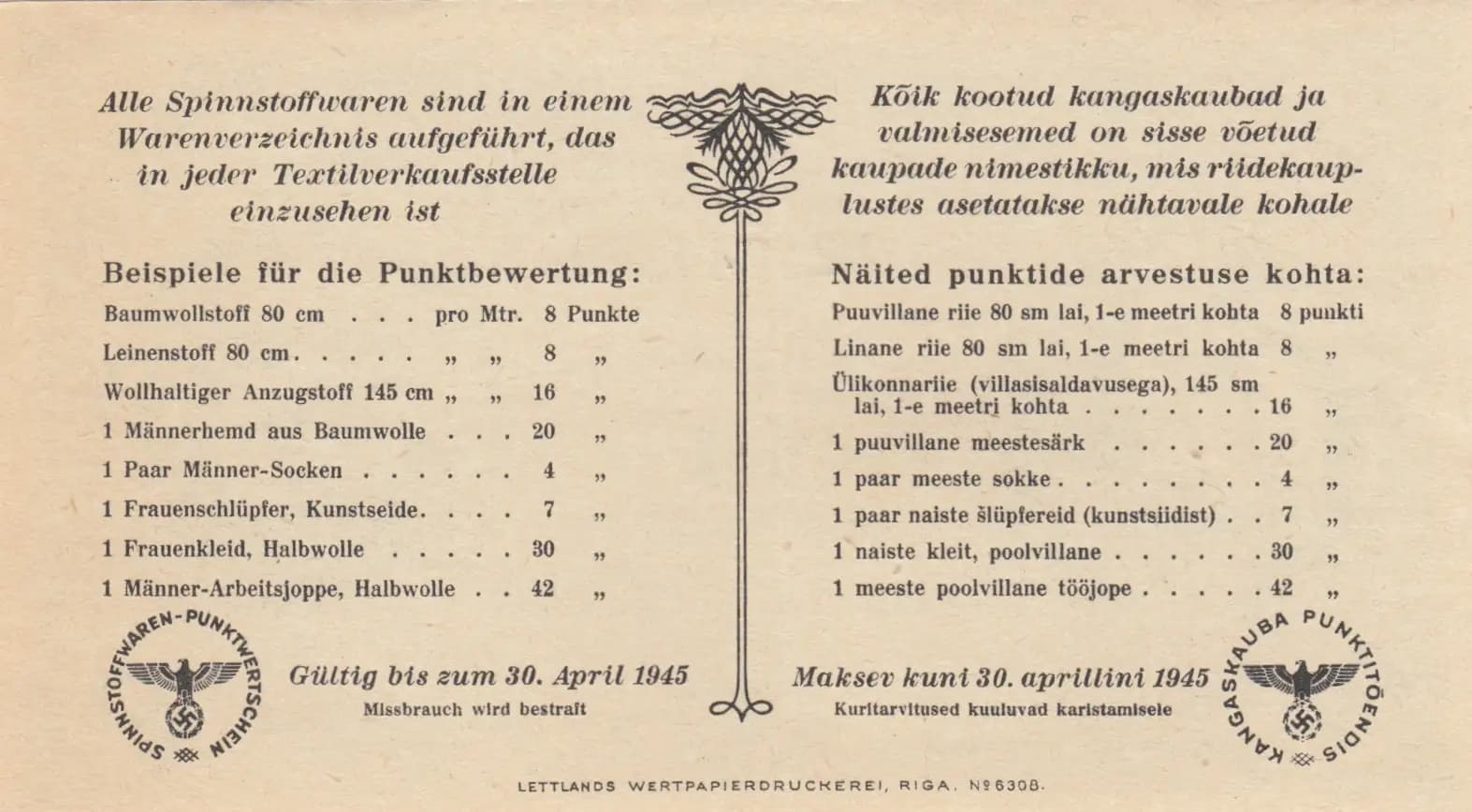
This voucher was issued by German occupation authorities administering the Ostland territory (which included Estonia) during the final months of WWII in 1945. The note's bilingual presentation and references to the Reich Commissioner for Ostland reflect the Nazi administrative structure imposed over Estonia during occupation. The textile rationing system and point-based purchasing scheme depicted on the reverse side exemplify the wartime economic controls and material scarcity of the collapsing Third Reich, with validity limited to April 30, 1945—weeks before Germany's surrender.
The note features a formal, symmetrical design centered on a heraldic shield bearing the denomination '10' and the word 'PUNKTE.' Flanking the shield are two allegorical female figures in classical Greco-Roman style, representing prosperity and virtue—the figure on the left holds bundled flax or hemp fibers while the right figure holds similar textile materials, symbolizing the agricultural products requisitioned under German occupation. Both figures are surrounded by circular inscriptions blessing the land's flax and wool production. Below the central composition is a German imperial eagle with outstretched wings bearing the Nazi swastika, serving as the official seal of the occupying authority. The design is framed by an ornate geometric border pattern. The reverse side maintains the beige and black color scheme while presenting instructional text in parallel German and Estonian columns, separated by a decorative botanical ornament (hop cone motif). The overall design emphasizes both the bureaucratic nature of the Nazi occupation and its utilitarian economic controls over a subjugated territory.
FRONT SIDE: Title inscription reads 'OSTLAND SPINNSTOFFWAREN-PUNKTWERTSCHEIN' (Ostland Textile Goods Point Value Certificate) with Estonian equivalent 'IDAMAA-ALA KOOTUD KANGASKAUBA PUNKTITÖENDIS' (Ostland Woven Textile Goods Point Certificate). Subtitle: German 'für Flachs- und Wollablieferung' and Estonian 'lina ja villa äraandmise puhul' (for flax and wool delivery). Serial number: NO 041679. Central denomination: '10 PUNKTE' (10 points). Bearer authorization: German 'Inhaber dieses Scheines ist berechtigt Spinnstoffwaren für zehn Punkte zu käufen' and Estonian 'Selle töendise omanik on õigustatud ostma koodud kangaskaupa kümne punkti ulatuses' (The bearer of this certificate is entitled to purchase textile goods for ten points). Circular inscriptions flanking the shield: 'FÜR FLACHS UND WOLLE-SEGEN DES LANDES' (For flax and wool—blessing of the land). Authority: 'Ausgegeben auf Grund der Verordnung des Reichskommissars für das Ostland' / 'Väljaantud Idamaa-ala Reichskommissari korraldusel alusel' (Issued by order of the Reich Commissioner for Ostland). BACK SIDE: Regulatory text: German 'Alle Spinnstoffwaren sind in einem Warenverzeichnis aufgeführt, das in jeder Textilverkaufsstelle einzusehen ist' and Estonian equivalent (All textile goods are listed in a commodity register). Point evaluation examples listed for both languages, including cotton fabric (8 points per meter), linen fabric (8 points), wool-containing suit fabric (16 points), men's cotton shirt (20 points), men's socks (4 points), ladies' slip in artificial silk (7 points), ladies' half-wool dress (30 points), and men's half-wool work jacket (42 points). Validity: 'Giltig bis zum 30. April 1945' / 'Maksev kunt 30. aprillini 1945' (Valid until April 30, 1945). Warning: 'Missbrauch wird bestraft' / 'Kuritarvutused kuuluvad karistatamisele' (Misuse will be punished). Printer attribution: 'LETTLANDS WERTPAPERDRUCKEREI, RIGA. N°6308' (Latvia's Valuable Paper Printing Office, Riga, Number 6308).
This note was produced using intaglio engraving (steel plate engraving), a security printing technique evident from the fine line background patterns, intricate border details, and sharp definition of the allegorical figures and heraldic elements. The printer's mark identifies the work as produced by Lettlands Wertpaperdruckerei (Latvia's Valuable Paper Printing Office) in Riga under number 6308, confirming production at a centralized Nazi security printer facility. The precise registration of bilingual text and the uniform quality of fine lines throughout both sides are consistent with professional intaglio/engraving methodology employed for official occupation currency and ration documents.
The observed variety is identified by serial number NO 041679. No major varieties are documented for this Pick-unlisted issue; however, the serial number sequence and specific printer attribution (Lettlands Wertpaperdruckerei Riga, N°6308) should be noted for cataloging purposes. The validity date of April 30, 1945 is consistent across all known examples of this design, as this represents the official expiration date set by the occupying authorities for the entire issue.