10 punkt 1945
“w/o serial #”
About This Note
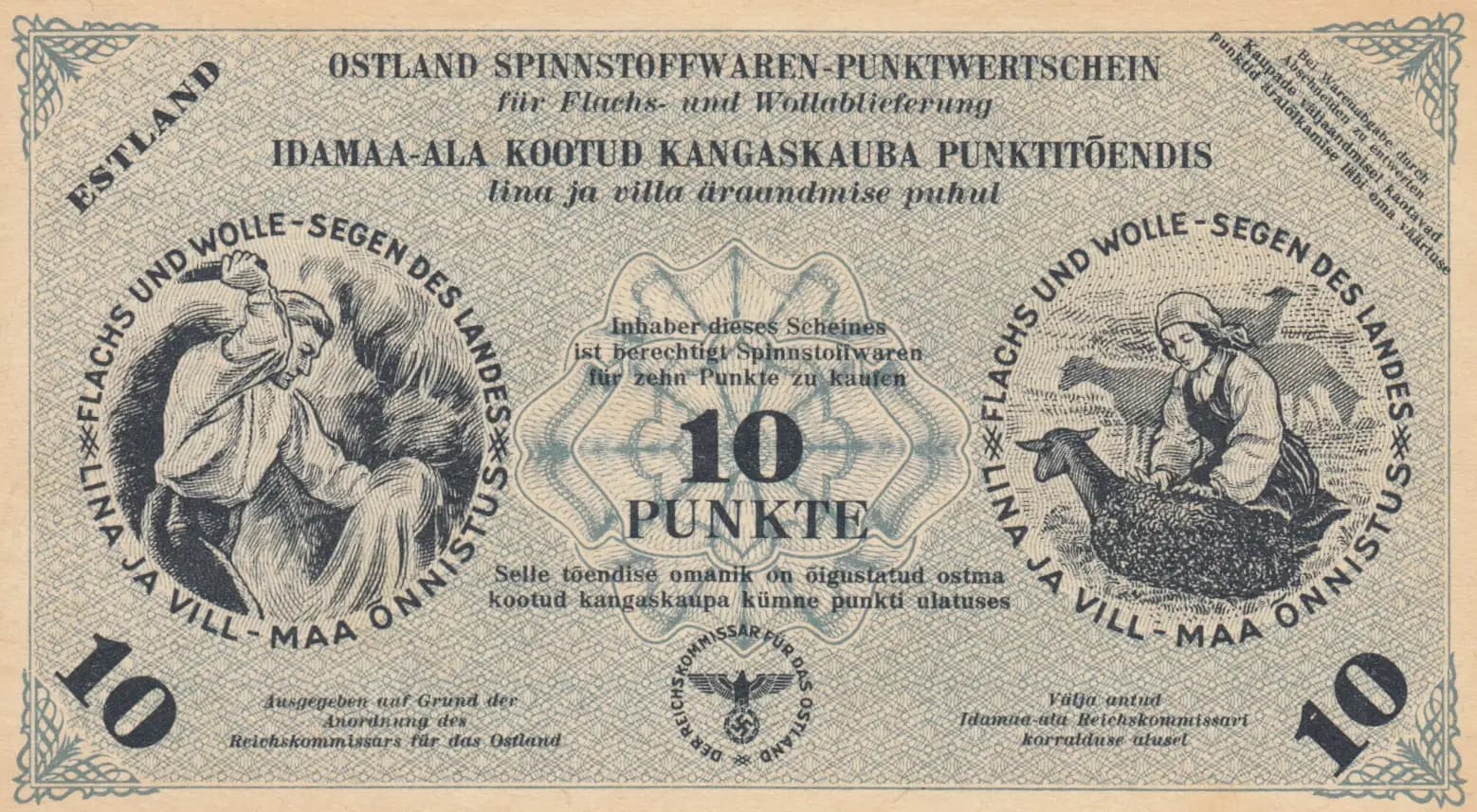
This is a 10 Punkte textile rationing voucher issued by German occupation authorities in Estonia during 1945, presented in uncirculated condition. The note features exceptional graphic design with allegorical female figures representing textile production (flax worker and spinner) flanking a decorative shield cartouche, rendered in fine line engraving on cream stock. As an unlisted Pick number representing a specialized occupation scrip rather than traditional currency, this piece documents the economic control mechanisms of the Reichskommissariat Ostland and remains historically significant for understanding wartime resource management in the Baltic region.
Common. This Punktwertschein represents a mass-produced occupational scrip issued during the final months of Nazi rule in the Baltic region. The explicit expiration date of April 30, 1945—coinciding with the imminent Soviet re-conquest of Estonia and the collapse of German occupation—suggests substantial circulation within the brief validity period. No evidence of a restricted print run or special scarcity conditions exists. As an unlisted Pick number, it reflects the incomplete cataloging of occupation-era Baltic scrip rather than genuine rarity. Such vouchers survive in modest quantities in institutional and private collections focused on WWII ephemera and regional currency.
This Punktwertschein (point voucher) was issued under the authority of the Reichskommissar for Ostland, the Nazi administrative region encompassing the occupied Baltic states and Belarus. The imagery celebrating flax and wool production reflects the Third Reich's emphasis on controlling textile supply chains and rationing civilian access to clothing materials during the final months of World War II. The parallel German-Estonian text and explicit reference to linen and wool delivery highlight the occupying regime's exploitation of local agricultural and manufacturing resources while maintaining a veneer of administrative legitimacy through bilingual documentation.
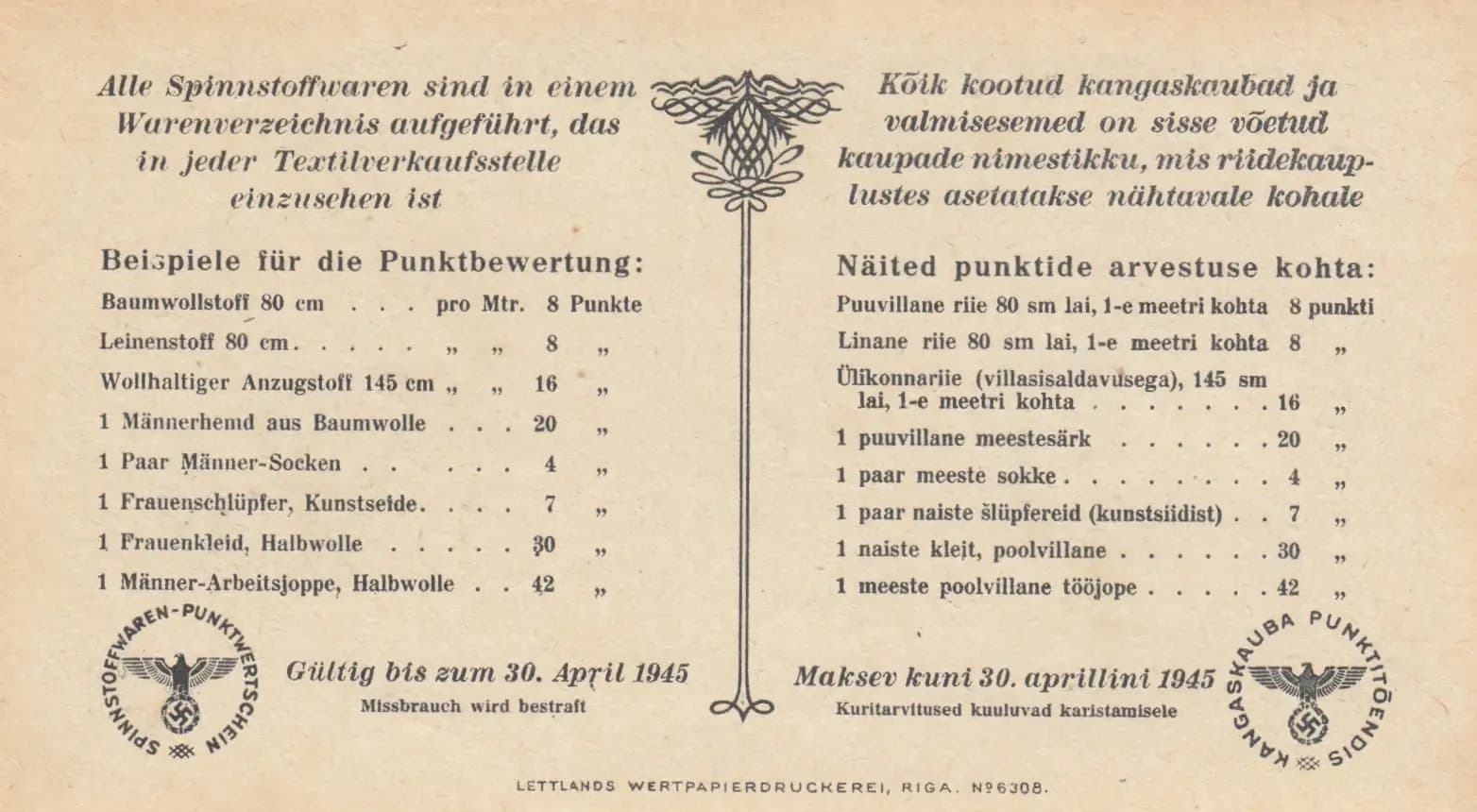
The obverse features a masterfully executed allegorical design celebrating textile production within the Ostland region. On the left stands a woman dressed in classical style, depicted actively working with flax or linen fibers, representing the agricultural source of textile materials. On the right, a female figure operates a spinning wheel, symbolizing the transformation of raw fibers into thread. These allegorical representations are framed by ornamental borders with geometric patterns typical of official German wartime scrip design. The central denomination cartouche, rendered in shield form, prominently displays '10 PUNKTE' and serves as the focal point. At the base, the Reichskommissar eagle emblem reinforces official authority. The reverse side abandons figurative imagery in favor of practical administrative content: a decorative thistle or floral emblem centers the page between parallel German and Estonian text columns listing specific textile commodities with their point valuations. Official seals bearing eagle emblems and Nazi insignia appear at the bottom corners, with printer attribution to Lettlands Wertpaperdruckerei (Latvia's Security Paper Printing) in Riga and serial reference N°6308. The entire composition employs fine line engraving work characteristic of German occupation-era financial documents.
FRONT SIDE: (German) 'OSTLAND SPINNSTOFFWAREN-PUNKTWERTSCHEIN' (Ostland Textile Goods Point Voucher); 'für Fläche- und Wollablieferung' (for Linen and Wool Delivery); 'PUNKTE' (Points); 'Inhaber dieses Scheines ist berechtigt Spinnstoffwaren für zehn Punkte zu kaufen' (The holder of this certificate is entitled to purchase textile goods for ten points); 'A FLACHS UND WOLLE-SEGEN DES LANDES' (The blessing of flax and wool of the land). (Estonian) 'IDAMAA-ALA KOOTUD KANGASKAUBA PUNKTITOENDIS' (East Land Woven Fabric Goods Point Certificate); 'lina ja villa draadmise puhul' (in case of linen and wool spinning); 'Selle töendise omanik on õigustatud ostma kootud kangaskaupa kümnе punkti ulatuses' (The holder of this certificate is entitled to purchase woven goods up to ten points). BACK SIDE: (German) 'Alle Spinnstoffwaren sind in einem Warenverzeichnis aufgeführt, das in jeder Textilverkaufsstelle einzusehen ist' (All textile goods are listed in a merchandise inventory that can be viewed at every textile sales outlet); 'Beispiele für die Punktbewertung:' (Examples for Point Valuation); Detailed commodity pricing examples including cotton fabric (8 points per meter), linen fabric (8 points per meter), wool-containing suit fabric (16 points per meter), men's cotton shirt (20 points), men's socks (4 points), women's slip in artificial silk (7 points), women's half-wool dress (30 points), men's half-wool work jacket (42 points); 'Gültig bis zum 30. April 1945' (Valid until April 30, 1945); 'Missbrauch wird bestraft' (Misuse will be punished); 'ausgegeben auf Grund der Anordnung des Reichskommissars für das Ostland' (issued under the order of the Reichskommissar for the Ostland); 'LETTLANDS WERTPAPERDRUCKEREI, RIGA. N°6308' (Latvia's Security Paper Printing, Riga. No. 6308). (Estonian) 'Kõik kootud kangaskaubad ja valmisesemed on sisse võetud kaupade nimeistikku, mis rüdekauplus asetatakse nähtavale kohale' (All woven goods and finished items are included in the merchandise list, which is placed visibly in every store); corresponding translations of all commodity examples; 'Maksee kuni 30. aprilini 1945' (Valid until April 30, 1945); 'Kuritarvitused kuuluvad karistamisele' (Misuse will be prosecuted); 'Idamaa-ala Reichskommissari korralduse alusel' (under the order of the Reichskommissar for the East Land).
This voucher was produced using intaglio engraving (line engraving), evident from the fine detail work, precise linework, and tonal gradations visible throughout both sides. The printer, Lettlands Wertpaperdruckerei (Latvia's Security Paper Printing) in Riga, specialized in security printing and employed advanced engraving techniques typical of official German wartime documentation. The consistent ink application, sharp definition of text and allegorical figures, and the fine parallel lines used for shading indicate professional-grade intaglio production rather than lithography or letterpress methods.
This example is noted as lacking a serial number ('w/o serial #'), which represents a significant identifying characteristic. The collector note indicates the absence of serial number printing, distinguishing this from potentially numbered varieties. The printer attribution to Lettlands Wertpaperdruckerei, Riga, and internal reference number N°6308 suggest this may represent a specific printing lot. The fixed expiration date of April 30, 1945, eliminates date variations. No signature or control mark varieties are evident from the visual analysis. Further research into Reichskommissariat Ostland scrip production records would be necessary to identify additional varieties or print run information.