10 marka 1919
About This Note
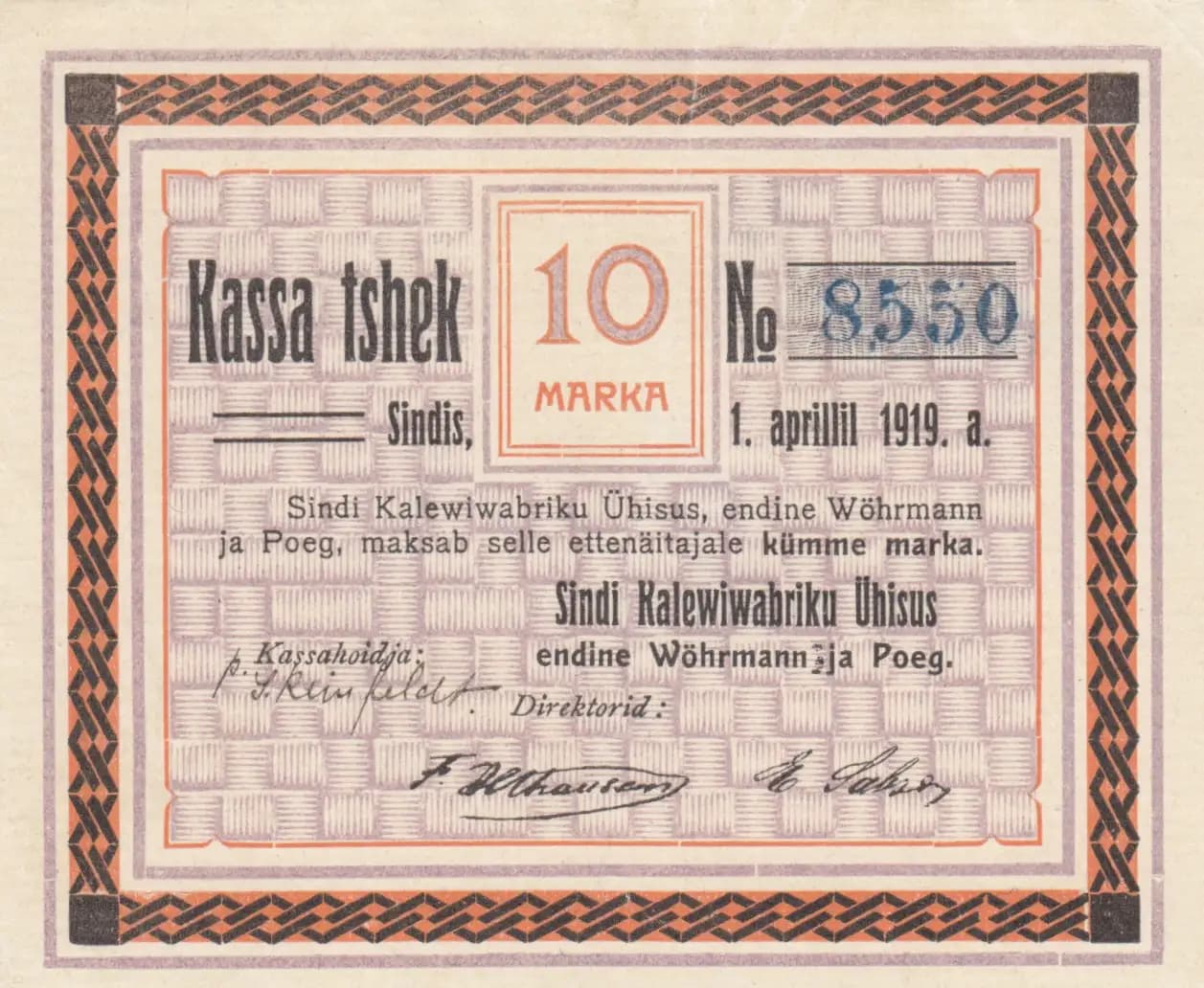
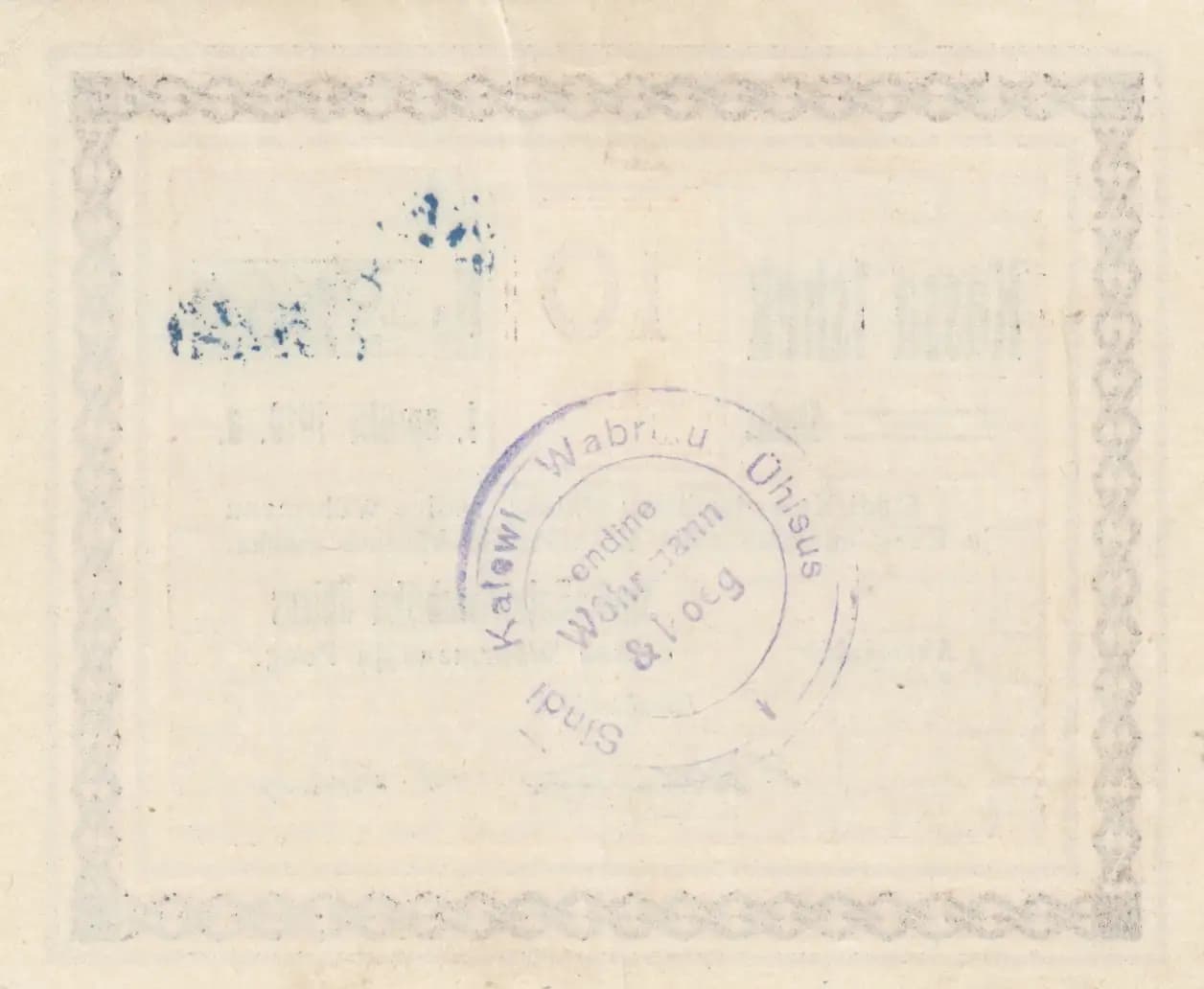
This is a 10 marka emergency note issued by the Sindi Kalewiwabriku (Kalevivabrik factory cooperative) on April 1, 1919, during Estonia's early independence period. The note features an ornate orange and black geometric design with nested rectangular frames and a central oval cartouche, and displays three authorized signatures (A Reinfeldt, F Wellmann, K Arthur). In EF condition, the note shows expected age-related wear including foxing and creasing consistent with a century-old banknote, with the reverse bearing a faint circular organizational stamp.
Uncommon. This is a private/municipal emergency issue from a specific factory cooperative with a limited geographic circulation (Sindi region of Estonia). The Pick catalogue lists it as 'unlisted' in standard reference works, indicating it falls outside the primary cataloguing system for national banknotes, which is typical for local emergency currency. However, the note is not exceptionally rare as factory cooperatives issued multiple denominations during this period. The survival of this specific note in EF condition suggests moderate scarcity rather than rarity, as many such local issues were subsequently withdrawn or lost to circulation. The narrow window of issue (April 1, 1919 in the early independence period) and limited issuing authority naturally restrict the surviving population.
This note represents a critical period in Estonian history immediately following independence from the Russian Empire in February 1919. Factory cooperatives and municipalities issued emergency currency during the transition period when official Estonian currency was not yet established, reflecting the economic chaos of the early independence period. The use of Estonian language and the identification of the issuer as 'Sindi Kalewiwabriku Ühisus, endine Wöhrmann ja Poeg' (formerly Wöhrmann and Poeg) documents the organizational continuity and economic structures of the region during this tumultuous period.
The note employs a classical 19th-century emergency currency design with no portraits or landmarks depicted. The primary design elements include: an ornate border composed of nested rectangular frames in orange and black, diagonal hatching patterns in the corners serving both decorative and security purposes, and a central oval cartouche prominently displaying the denomination '10 MARKA'. The color scheme utilizes orange, black, cream, and purple/mauve tones. The reverse is predominantly blank with a decorative border frame visible at the edges and a circular organizational stamp in the center-right. The overall aesthetic reflects the formal commercial printing standards of early 20th-century Central European financial documents.
FRONT: 'Kassa Isinek' (Cash desk/Cashier); 'Sindis,' (In Sindi); '10' (numeral); 'MARKA' (Mark currency); 'No 8550' (serial number); '1. aprilii 1919. a.' (1st April 1919); 'Sindi Kalewiwabriku Ühisus, endine Wöhrmann ja Poeg, maksab selle ettenäitajale kümme marka.' (Sindi Kalewiwabriku Union, formerly Wöhrmann and Poeg, pays the bearer ten marks); 'Sindi Kalewiwabriku Ühisus endine Wöhrmann ja Poeg.' (Sindi Kalewiwabriku Union formerly Wöhrmann and Poeg); 'Kassahoidja:' (Cashier:); 'Direktorid:' (Directors:); signatures 'A Reinfeldt', 'F Wellmann', 'K Arthur'. BACK: Circular stamp impression containing 'Kalgwi Wabriuu Ühisus' (Kalgwi Factory Union - likely variant spelling of Kalevivabrik), 'Wöhrmann ja Poeg' (Wöhrmann and Poeg), and '31.0.19' (date notation).
The note was produced using letterpress (relief) printing, evidenced by the crisp geometric borders, the uniform application of color blocks in orange and black, and the characteristic impression depth visible in the hatched patterns. The ornamental frames and security-oriented line work are typical of multi-block letterpress production. The circular stamp on the reverse appears to have been applied separately, likely using a rubber or metal stamp. The printer identity is not explicitly stated on the visible inscriptions; however, the sophisticated geometric design and execution suggest a regional European printer capable of quality security printing during the 1919 period.
This specific example bears serial number No 8550 dated 1. aprilii 1919. The signatures of A Reinfeldt (Cashier), F Wellmann, and K Arthur (Directors) appear as authorized signatories. Varieties for this issue would include different serial numbers and potentially different signature combinations, as multiple authorized officials would have signed notes during the cooperative's circulation period. The reverse circular stamp shows variant spellings/notations ('Kalgwi Wabriuu Ühisus' vs. standard 'Kalewiwabriku'), suggesting different stamp applications or printing states may exist. No major variety subclassifications are documented in standard references due to the note's unlisted Pick status.