1 rubla 1941
“blank w #”
About This Note
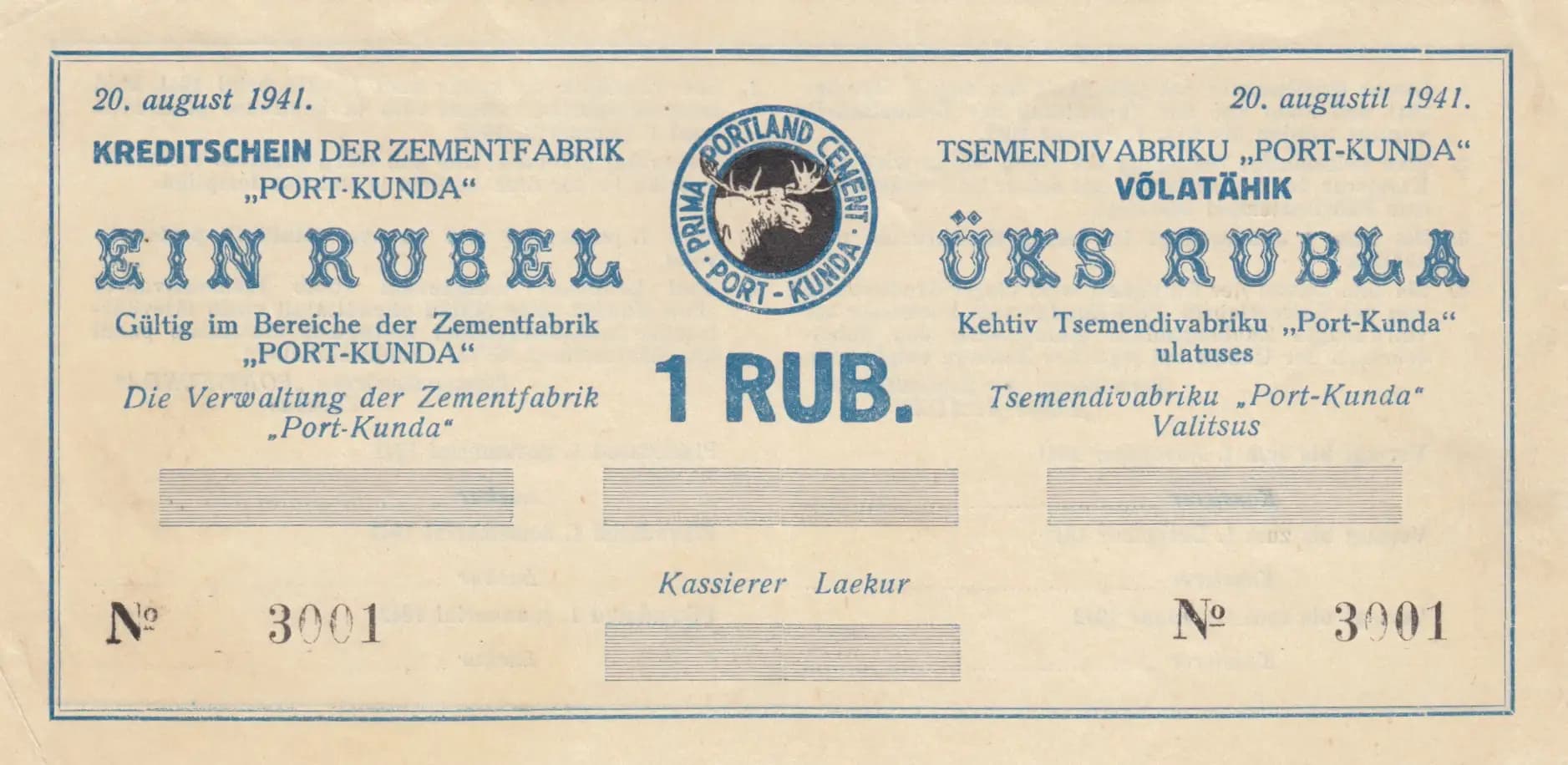
A remarkable bilingual credit note (Kreditschein) issued by the Port-Kunda cement factory on 20 August 1941, denominated at 1 ruble and numbered 3001. The note is presented in outstanding AU condition with crisp printing, no wear or tears, and only minimal age-related yellowing typical of early 1940s documents. This is a fascinating example of occupation-era emergency currency from Estonia during the German administration period, featuring a distinctive circular emblem with a moose/elk head and detailed terms and conditions printed on the reverse for validity extensions through January 1942.
Common. Port-Kunda factory credit notes from 1941 were issued as internal circulation currency for a specific industrial facility during the German occupation. While such notes are not frequently encountered in modern collections, they were produced in quantities sufficient for regular workplace use. The lack of a Pick catalog listing does not indicate rarity but rather reflects the focus of standard catalogs on official national currencies; this note falls into the category of emergency and scrip currency, which was produced in significant quantities across occupied territories. No historical evidence suggests an extremely limited print run or subsequent recall that would elevate rarity status. Serial number 3001 indicates this was part of a numbered series, suggesting multiple printings.
This credit note represents a unique artifact from Estonia's occupation period in 1941, when the Port-Kunda cement factory issued its own internal currency under German administration. The bilingual German-Estonian text reflects the German occupation authority's pragmatic approach to local governance, while the note's structure as a short-term credit instrument—with specific validity periods extendable monthly by factory administration—reveals how industrial enterprises maintained economic function during wartime disruption. The explicit equivalence to Soviet ruble notes demonstrates the occupying power's efforts to maintain currency stability and worker confidence in the regional economy.
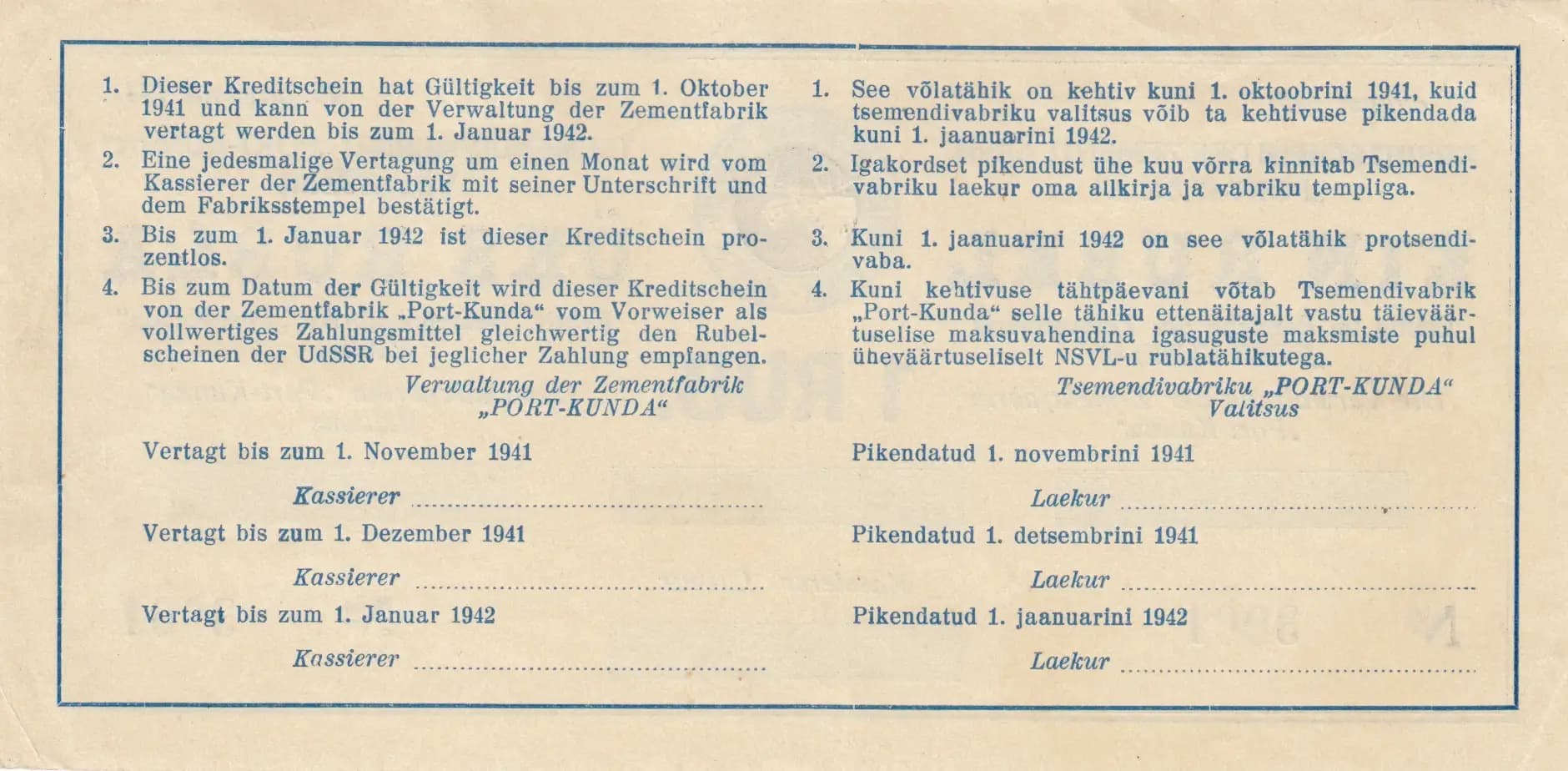
The note features a clean, functional design typical of industrial credit certificates rather than ornamental currency. The obverse is dominated by a cream/beige field with blue text and borders creating clear visual hierarchy. A circular emblem at the center-top depicts a moose or elk head in profile—the chosen symbol likely referencing the natural resources and strength of the region—surrounded by the text 'Prima Portland Cement Port-Kunda.' The denomination '1 RUB.' is prominently centered in large text. The bilingual layout places German text on the left and Estonian on the right, reflecting the dual-language administrative structure of the occupation period. Three blank horizontal lined sections occupy the middle portion, reserved for signatures, stamps, or official markings. Serial number 3001 appears in both bottom corners. The reverse presents the terms and conditions in a two-column format with German and Estonian text, providing four specific conditions governing the note's validity and acceptance. Extension signature lines with printed dates (November 1941, December 1941, January 1942) demonstrate the note's intended use as renewable short-term credit. No portraits or national insignia are present; the design prioritizes functional clarity and administrative detail over aesthetic decoration.
FRONT SIDE: 'Credit note of the cement factory Port-Kunda' (German: Kreditschein der Zementfabrik "Port-Kunda"; Estonian: Tsemendivaabriku "Port-Kunda" Võlatähik). Denomination: 'One ruble' (German: Ein Rubel; Estonian: Üks Rubla), displayed as '1 RUB.' Date: '20 August 1941' (German: 20. august 1941; Estonian: 20. augustil 1941). Validity statement: 'Valid in the area of the cement factory Port-Kunda' (German: Gültig im Bereiche der Zementfabrik "Port-Kunda"; Estonian: Kehtiv Tsemendivaabriku "Port-Kunda" ulatuses). Issuer attribution: 'The administration of the cement factory Port-Kunda' (German: Die Verwaltung der Zementfabrik "Port-Kunda"; Estonian: Tsemendivaabriku "Port-Kunda" Valitsus). Signature line: 'Cashier/Treasurer' (German: Kassierer; Estonian: Laekur). Serial number: 'N° 3001'. Emblem text: 'Prima Portland Cement Port-Kunda'. REVERSE SIDE: Four numbered conditions: (1) Valid until 1 October 1941, extendable by factory administration until 1 January 1942; (2) Monthly extensions confirmed by cashier signature and factory stamp; (3) Interest-free until 1 January 1942; (4) Accepted as fully valid payment equivalent to USSR ruble notes. Extension dates listed: 'Extended until 1 November 1941' (Pikendatud 1. novembrini 1941), 'Extended until 1 December 1941' (Pikendatud 1. detsembrini 1941), 'Extended until 1 January 1942' (Pikendatud 1. jaanuarini 1942), each with signature lines for Cashier/Laekur.
Letterpress printing, characteristic of 1941-era industrial and commercial documents. The sharp, uniform impression quality observed throughout both sides, combined with the crisp blue text lines and borders, indicates professional printing equipment capable of handling bilingual composition. The precision of text placement and the clarity of the circular emblem suggest a commercial printer experienced in administrative and financial document production, likely a Baltic or German printing house active during the occupation period. No security features such as watermarks, security threads, or color-shifting inks are apparent—consistent with the note's function as an internal factory credit instrument rather than official state currency.
This specific note is variety serial number 3001, dated 20 August 1941. The reversal shows blank signature lines and unfilled extension dates, indicating this is an unvalidated/uncirculated specimen. Known varieties for Port-Kunda notes likely include different serial number ranges and potentially different printing dates, though without access to comprehensive Port-Kunda emissions data, specific variety designations cannot be confirmed. The three blank extension lines on the reverse (extending through January 1942) represent the standard format for all issued notes, with individual validation occurring through cashier signatures and factory stamps during actual circulation use. The condition being AU/uncirculated without any extension signatures or stamps marks this as an example that remained in reserve or was archived rather than circulated.