1 rubla 1941
“blank”
About This Note
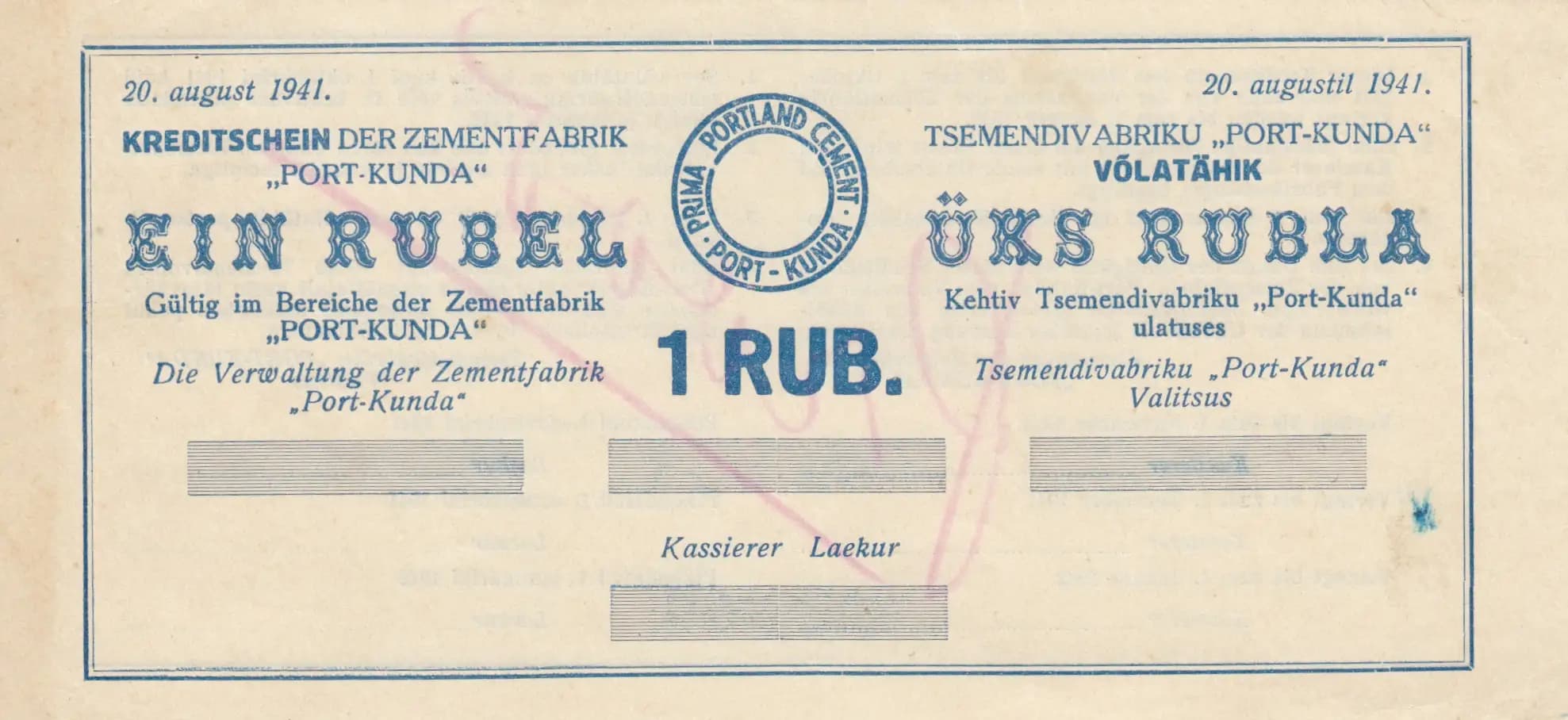
This is a 1 Rubla credit note (Kreditschein) issued by the Port-Kunda cement factory in Estonia on 20 August 1941, representing a fascinating artifact of the German occupation period during World War II. The note is printed in blue ink on cream-colored paper and features bilingual German-Estonian text, reflecting the administrative structure of the occupation. In UNC condition, the note shows minimal wear despite its age, though it bears a red/pink curved stamp mark across both sides, likely applied during post-issue processing or subsequent handling.
Uncommon. While Port-Kunda's credit notes were issued during the occupation period, the specific survival rate of individual denominations and issue dates is limited. The fact that this note is unlisted in Pick catalog suggests either a very limited scholarly documentation or modest print runs. However, the note's UNC condition and the presence of historical extension endorsements increase its collector appeal. Industrial credit notes from this period were often destroyed or lost, making surviving examples in premium condition scarce. This particular note's documented extension history (through January 1942) also makes it a complete example of the intended usage pattern.
Issued during the Nazi occupation of Estonia (1941-1944), this credit note reflects the German wartime economy and the establishment of German industrial control over Estonian resources. The Port-Kunda cement factory, a strategic industrial facility, issued this note as an internal currency equivalent to Soviet rubles, demonstrating how German administrators maintained economic operations in occupied territories while nominally respecting Soviet monetary values. The bilingual presentation in German and Estonian indicates the dual administrative structure, with German oversight and Estonian local cooperation in the industrial economy.
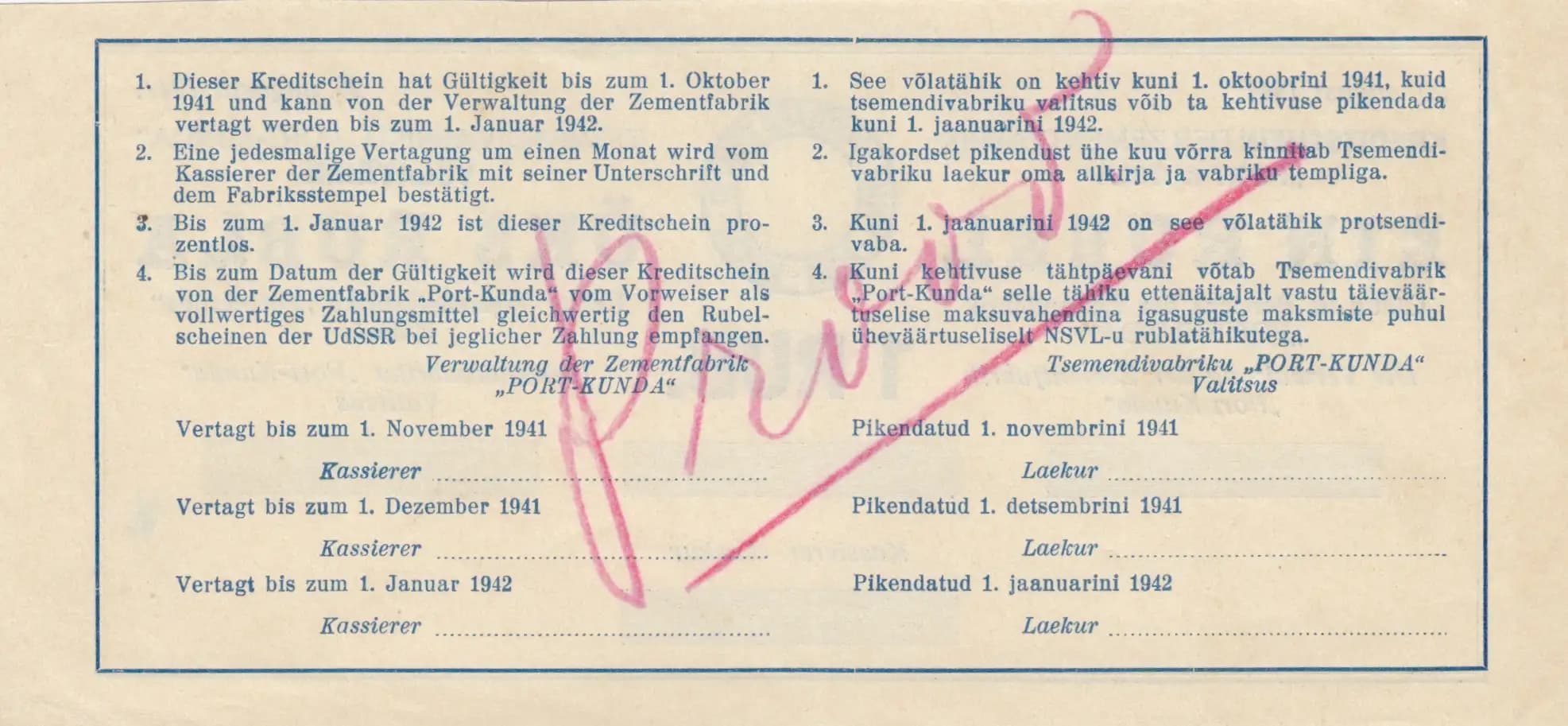
This is a standardized German-issued credit note (Kreditschein) from an occupied Estonian industrial facility. The obverse features a symmetrical layout with a prominent circular seal bearing the text 'Portland Cement Fabrik Port-Kunda' at its center, emphasizing the industrial issuer. The denomination '1 RUB.' is displayed prominently in the center field. The design employs a bilingual German-left, Estonian-right layout, typical of official German occupation documents in the Baltic region. The reverse side is dedicated to four numbered conditions of validity and acceptance, with blank spaces for multiple dated endorsement stamps and cashier signatures, allowing the note to be extended monthly until January 1942. No portraits or landmarks are depicted; instead, the design emphasizes the factory's seal and official language text as security and authenticity measures. Decorative border patterns frame the note, and fine line work appears in the blank signature areas. The cream-colored paper and blue ink printing provide clear contrast and legibility.
FRONT SIDE: Title: 'Credit note of the cement factory Port-Kunda' (German: Kreditschein der Zementfabrik 'Port-Kunda'; Estonian: Tsemendivabriku 'Port-Kunda' Võlatähik). Date: '20 August 1941' (both languages). Denomination: 'One ruble' (German: Ein Rubel; Estonian: Üks Rubla) and '1 RUB.' Central seal: 'Portland Cement Fabrik Port-Kunda'. Validity statement: 'Valid in the area of the cement factory Port-Kunda' (German: Gültig im Bereiche der Zementfabrik 'Port-Kunda'; Estonian: Kehtiv Tsemendivabriku 'Port-Kunda' ulatuses). Issuer: 'The administration of the cement factory Port-Kunda' (German: Die Verwaltung der Zementfabrik 'Port-Kunda'; Estonian: Tsemendivabriku 'Port-Kunda' Valitsus). Signature line: 'Cashier' (German: Kassierer; Estonian: Laekur). BACK SIDE: Condition 1: 'This credit note is valid until 1 October 1941 and can be extended by the cement factory administration until 1 January 1942' (both languages provided). Condition 2: 'Each extension by one month is confirmed by the cement factory cashier with their signature and factory stamp' (both languages). Condition 3: 'Until 1 January 1942, this credit note bears no interest' (both languages). Condition 4: 'Until the expiration date, this credit note will be accepted by the cement factory Port-Kunda from the bearer as a valid payment medium equivalent to ruble notes of the USSR for any payment' (both languages). Extension endorsements visible: 'Extended until 1 November 1941', 'Extended until 1 December 1941', 'Extended until 1 January 1942' (all bilingual).
Letterpress (relief printing), executed on cream-colored paper stock with blue-colored ink. The circular seal appears to have been impressed or printed as part of the main printing operation. The fine line patterns and text were produced using movable type and line blocks. No security printer is documented for this unlisted issue; production was likely handled locally or by German occupation authorities' printing facilities in Estonia. The printing quality is consistent with mid-level wartime industrial printing practices, prioritizing functionality over elaborate security features.
This note represents the standard bilingual German-Estonian format of Port-Kunda credit notes issued on 20 August 1941. The specific variety can be identified by the presence of three consecutive extension endorsements visible on the reverse: extended to 1 November 1941, 1 December 1941, and 1 January 1942. No known serial numbers or signature varieties have been documented. Variations may exist in the quality and placement of extension stamps applied by different cashiers, as these were hand-applied with individual signatures. The red/pink curved stamp mark visible on both sides may represent a later collector or archival marking rather than an original variety distinction.