1 rubla 1941
About This Note
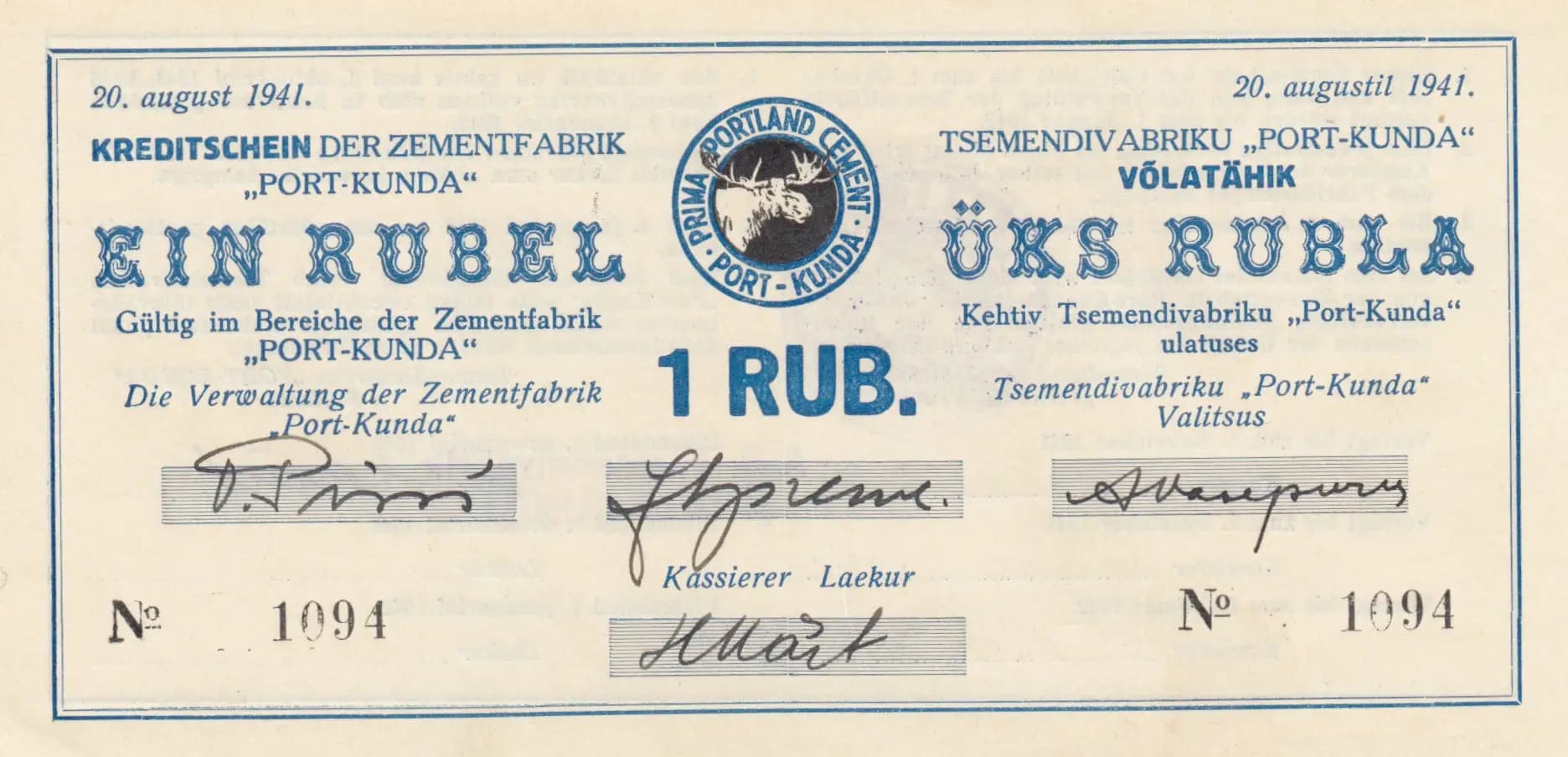
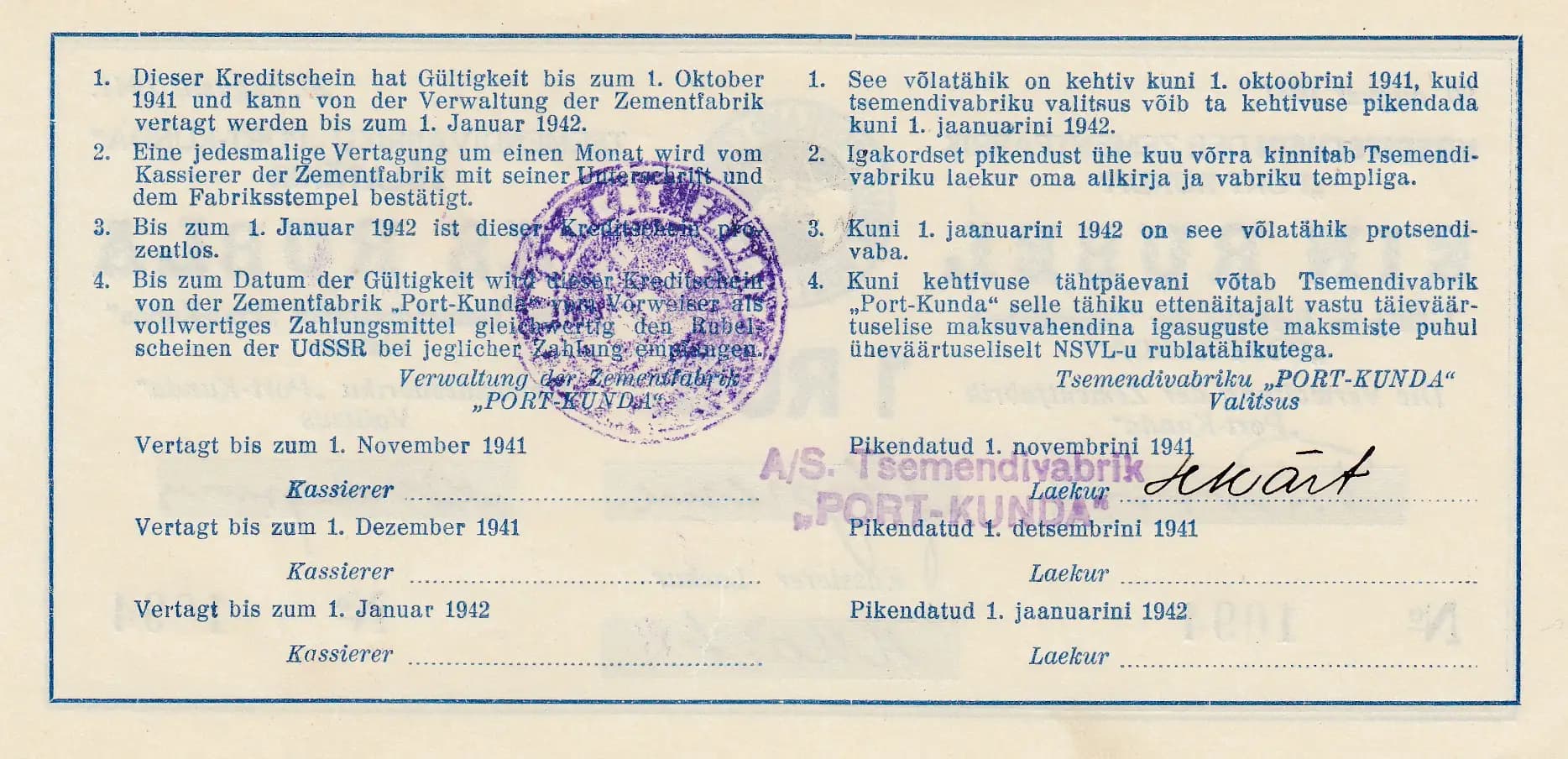
This is a Kreditschein (credit certificate) issued by the Port-Kunda Cement Factory on August 20, 1941, denominated in 1 ruble and presented in exceptional UNC condition. The bilingual German-Estonian document features a distinctive circular seal depicting a moose/elk head with 'PRIMA PORTLAND CEMENT PORT-KUNDA' text, elegant Gothic-style lettering for the denomination, and three signature lines. The reverse contains terms and conditions with a large purple administrative stamp and evidence of monthly extensions through January 1942, making this a fascinating example of localized wartime scrip issued during the German occupation of Estonia.
common
This certificate represents a unique artifact of the 1941-1942 German occupation of Estonia, when the Port-Kunda Cement Factory—a major industrial facility in northeastern Estonia—issued its own credit notes to facilitate internal commerce. The bilingual German-Estonian format reflects the occupation period's administrative structure, while the explicit validity terms (initially through October 1, 1941, extendable to January 1, 1942) and interest-free status demonstrate the temporary financial measures employed by industrial concerns during wartime. The factory's assertion that the ruble would be accepted 'equivalent to USSR ruble notes' shows the complex monetary situation in occupied Estonia, where German occupation authorities permitted certain enterprises to issue localized currency substitutes.
This is a company scrip certificate rather than a traditional banknote, issued by an industrial enterprise during the German occupation of Estonia. The obverse features a formal layout with the Port-Kunda Cement Factory's corporate seal—a circular emblem depicting a moose or elk head (symbolizing the forests and natural resources of Estonia) surrounded by the text 'PRIMA PORTLAND CEMENT PORT-KUNDA,' emphasizing the factory's premium product quality. The denomination '1 RUB' is prominently displayed in the center in large Gothic-style letters, typical of German-language documents of the 1940s. A decorative rectangular border frames the entire document. Three signature lines appear in the lower section for authorized officials (Kassierer/Laekur). The reverse contains detailed terms and conditions printed in two columns (German on the left, Estonian on the right), demonstrating the bilingual administrative requirement under occupation. A large circular purple administrative stamp occupies the upper-center portion of the reverse, serving as the issuing authority's seal. Below the terms are signature lines for monthly extension endorsements, with dates from November 1941 through January 1942; one signature is visible for the December 1941 entry. The color scheme consists of blue and black printing on cream/beige paper stock.
FRONT SIDE: Title: 'KREDITSCHEIN DER ZEMENTFABRIK "PORT-KUNDA"' (Credit certificate of the Port-Kunda cement factory) / 'TSEMENDIVABRIKU "PORT-KUNDA" VÕLATÄHIK' (Port-Kunda cement factory debt certificate). Date: '20. august 1941' / '20. augustil 1941' (August 20, 1941). Denomination: 'EIN RUBEL' / 'ÜKS RUBLA' (One ruble) and '1 RUB.' Validity statement: 'Gültig im Bereiche der Zementfabrik "PORT-KUNDA"' / 'Kehtiv Tsemendivabriku "Port-Kunda" ulatuses' (Valid in the area of the Port-Kunda cement factory). Issuer: 'Die Verwaltung der Zementfabrik "Port-Kunda"' / 'Tsemendivabriku "Port-Kunda" Valitsus' (The administration of the Port-Kunda cement factory). Serial number: 'N° 1094'. Officer designation: 'Kassierer / Laekur' (Cashier). BACK SIDE: Term 1: 'Dieser Kreditschein hat Gültigkeit bis zum 1. Oktober 1941 und kann von der Verwaltung der Zementfabrik vertagt werden bis zum 1. Januar 1942.' / 'See võlatähik on kehtiv kuni 1. oktoobrini 1941, kuid tsemendivabriku valitsus võib ta kehtivuse pikendada kuni 1. jaanuarini 1942.' (This credit certificate is valid until October 1, 1941 and can be extended by the cement factory administration until January 1, 1942). Term 2: 'Eine jedesmalige Vertragung um einen Monat wird vom Kassierer der Zementfabrik mit seiner Unterschrift und dem Fabriksstempel bestätigt.' / 'Igakordset pikendust iihe kuu võrra kinnitab Tsemendivabriku laekur oma allkirja ja vabriku templiga.' (Each monthly extension will be confirmed by the cement factory cashier with his signature and factory stamp). Term 3: 'Bis zum 1. Januar 1942 ist dieser Kreditschein prozentos.' / 'Kuni 1. jaanuarini 1942 on see võlatähik protsendivaba.' (This credit certificate is interest-free until January 1, 1942). Term 4: 'Bis zum Datum der Gültigkeit wird dieser Kreditschein von der Zementfabrik "Port-Kunda" als vollwertiges Zahlungsmittel angenommen. Der Rubel scheinen der UdSSR bei jeglicher Zahlung entgegen.' / 'Kuni kehtivuse tähtpäevani võtab Tsemendivabriku "Port-Kunda" selle tähtliku ettenäitajalt vastu täieväärtuseliste maksuvahendrite maksuvaherendina puhul üheväärtusellselt NSVL-u rublatähikutega.' (Until the date of validity, this credit certificate will be accepted by the Port-Kunda cement factory as a full-value means of payment, equivalent to USSR ruble notes). Extension notation entries: 'Vertagt bis zum 1. November 1941' / 'Pikendatud 1. novembrini 1941' (Extended until November 1, 1941), 'Vertagt bis zum 1. Dezember 1941' / 'Pikendatud 1. detsembrini 1941' (Extended until December 1, 1941), 'Vertagt bis zum 1. Januar 1942' / 'Pikendatud 1. jaanuarini 1942' (Extended until January 1, 1942).
Letterpress printing on laid paper, characteristic of official German occupation-era administrative documents. The sharp, clear impression of the denomination text, border elements, and bilingual text indicates traditional relief printing technology. The circular corporate seal and administrative stamp were applied separately, suggesting the use of embossing or separate seal presses for these elements. The purple/violet ink used for the administrative stamp indicates a stamp pad application rather than integrated printing. No security features beyond the official stamps and signatures were employed, typical of wartime localized scrip issued for internal factory use.
Serial number 1094 indicates this is from a numbered series. The certificate shows evidence of monthly extensions through January 1942, with at least one signature visible for the December 1941 extension period. Varieties may exist based on: (1) different serial number ranges, (2) presence or absence of extension signatures, (3) different extension dates filled in, and (4) variations in stamp impressions. The single visible signature in the December 1941 line represents one documented state; unmarked extension lines would constitute another variety. No Pick catalog number exists for this issue, indicating it remains outside standard international banknote catalogs and may have limited documented variety information in numismatic literature.