1 rubla 1941 pair
About This Note
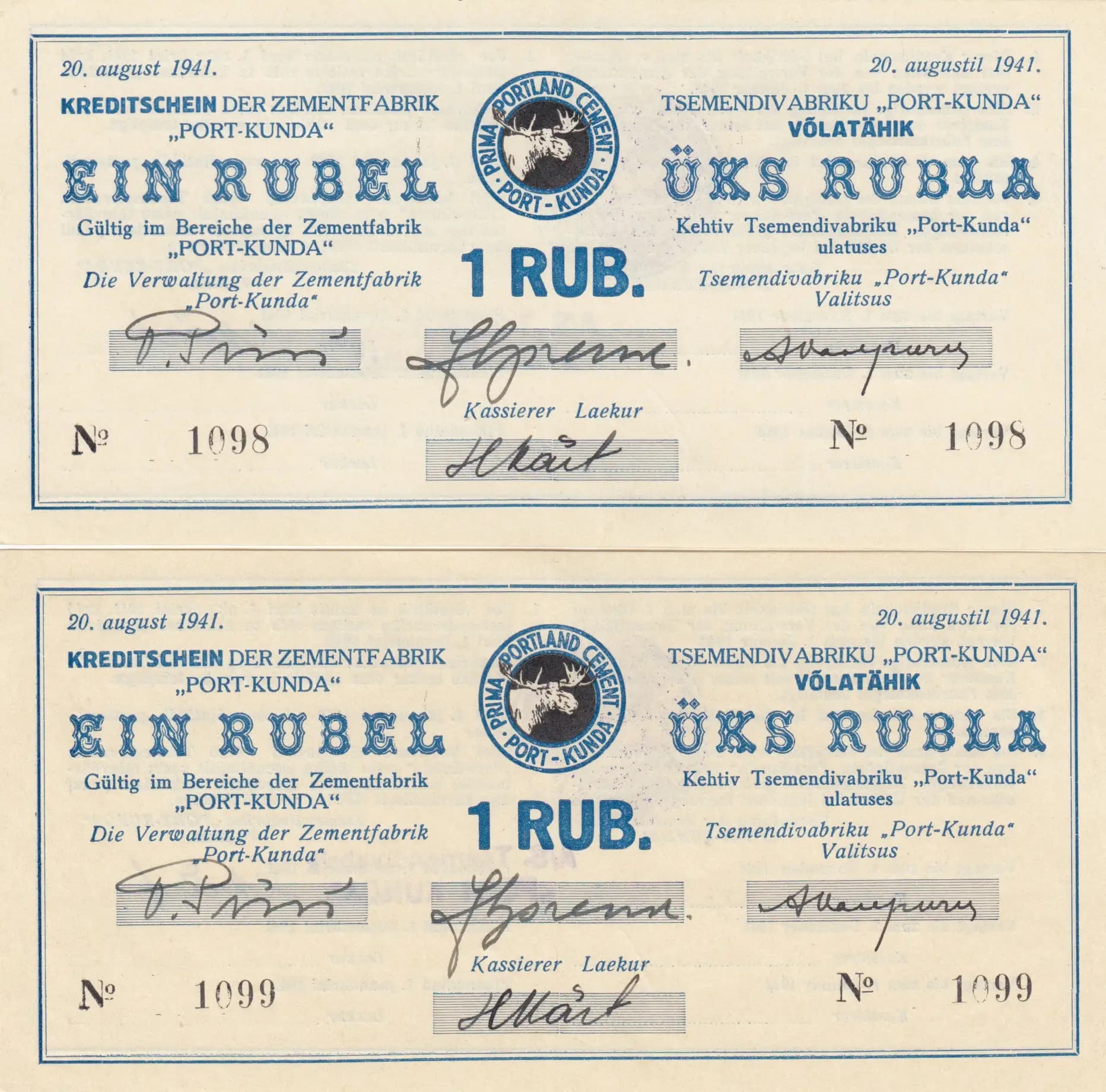
A pair of bilingual Kreditschein (credit vouchers) issued by the Port-Kunda cement factory on 20 August 1941, denominated in 1 rubla each, numbered 1098 and 1099. Both notes are presented in uncirculated condition with crisp printing, clean margins, and no visible damage. These are historically significant documents from Estonia's German occupation period, featuring bilingual German-Estonian text and a distinctive circular seal depicting a moose or elk head, the factory's symbol.
Uncommon. Port-Kunda cement factory credit notes from 1941 are not widely encountered in the numismatic market, as these were functional industrial instruments rather than official state currency, and most were likely removed from circulation or destroyed after the German occupation ended in 1944. The survival of an uncut pair in uncirculated condition is noteworthy, as such vouchers typically saw heavy use and wear. While not extremely rare, the specific combination of the pair, UNC condition, and historical significance from this brief and tumultuous period makes these notes more difficult to locate than common banknotes, positioning them in the uncommon range for serious collectors of occupation currency and Estonian numismatica.
These credit notes were issued during Estonia's occupation by Nazi Germany (1941-1944) when the Port-Kunda cement factory, a major Baltic industrial facility, issued internal currency for worker wages and local transactions. The bilingual German-Estonian format reflects the Nazi occupation's administrative structure, while the continued use of rubles as the denomination reflects the monetary system inherited from Soviet occupation (1940-1941). The notes' validity terms extending through early 1942 suggest the factory's operation under German industrial control during the initial phase of the Eastern Front campaign.
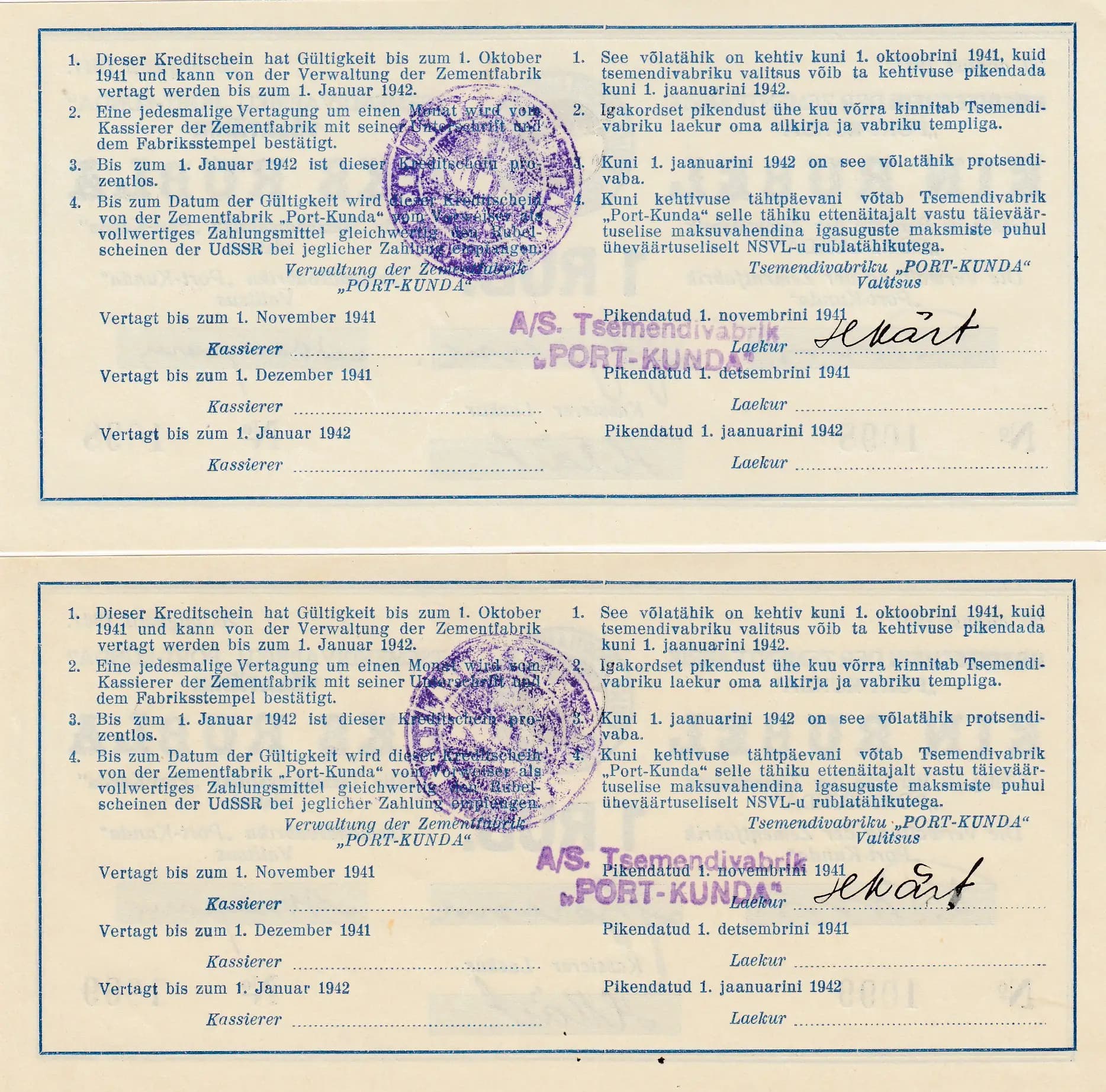
A two-sided credit voucher system issued as a pair (serially numbered 1098-1099). The obverse features a bilingual layout with German on the left and Estonian on the right, centered around the denomination '1 RUB.' and the issuing body's name. The dominant visual element is a circular seal or company logo depicting a moose or elk head in profile, symbolizing strength and the Baltic industrial heritage, with 'PORTLAND CEMENT PORT-KUNDA' inscribed around the perimeter. The design employs a simple, clean layout typical of industrial credit instruments, with blue and cream coloring providing contrast. The reverse side contains the terms and conditions in both languages, printed in four numbered paragraphs, with provision for extension stamps and cashier signatures. Purple rubber stamps reading 'A/S. Tsemendivabrik PORT-KUNDA' were applied to certify extensions, with handwritten dates and signatures filled in by authorized personnel. The overall aesthetic reflects German occupation-era administrative practices, combining German printing standards with Estonian linguistic requirements.
FRONT SIDE: Title: 'Kreditschein der Zementfabrik 'Port-Kunda' / Tsemendivabrik 'Port-Kunda' Võlatähik' (Credit note of the cement factory 'Port-Kunda' / Cement factory 'Port-Kunda' debt note). Date: '20. august 1941 / 20. augustil 1941' (20 August 1941). Denomination: 'Ein Rubel / Üks Rubla' (One ruble) and '1 RUB.' Serial numbers: 'N° 1098' and 'N° 1099'. Validity clause: 'Gültig im Bereiche der Zementfabrik 'PORT-KUNDA' / Kehtiv Tsemendivabrik 'Port-Kunda' ulatuses' (Valid in the area of the cement factory 'Port-Kunda'). Issuer: 'Die Verwaltung der Zementfabrik Port-Kunda / Tsemendivabrika 'Port-Kunda' Valitsus' (The administration of the cement factory Port-Kunda). Signature line: 'Kassierer / Laekur' (Cashier/Treasurer). BACK SIDE: Four terms and conditions: '1. Dieser Kreditschein hat Gültigkeit bis zum 1. Oktober 1941 und kann von der Verwaltung der Zementfabrik vertagt werden bis zum 1. Dezember 1942 / 1. See võlatähik on kehtiv kuni 1. oktoobril 1941, kuid isemendivabrik valitsus võib ta kehtivuse pikendada kuni 1. jaanuaril 1942' (This credit note is valid until 1 October 1941 and can be extended by the cement factory administration until 1 January 1942). '2. Eine jedesmaligte Vertragung um einen Monat erfordert den Stempel der Kassierer der Zementfabrik mit seiner Unterschrift auf dem Fabriksstempel bestätigt / 2. Igakordset pikendust ühe kuu võrra kinnitab tsemendivabrikul laekur oma sealkirja ja fabrikul templiga' (Each extension for one month requires the stamp and signature of the cement factory cashier on the factory seal). '3. Bis zum 1. Januar 1942 ist dieser Kreditschein zenntlos / 3. Kuni 1. jaanuaril 1942 on see võlatähik protsendivaba' (Until 1 January 1942 this credit note is interest-free). '4. Bis zum Datum der Gültigkeit wird das Geschäft von der Zementfabrik 'Port-Kunda' vollwertigen Zahlungsmittel gleichwertig scheinen der UdSSR bei jeglicher Zahlung / 4. Kuni kehtivuse tähtpäevani võtab Tsemendivabrik 'Port-Kunda' selle tähtsa ettennäitajalt vastu täieväärtusliku maksuvahendina igasuguste maksimste puhul' (Until the validity date, this instrument from the cement factory will be treated as a full-value payment means equivalent to Soviet currency for all payments). Extension lines with dates: 'Vertagt bis zum 1. November 1941 / Pikendatud 1. novembril 1941' (Extended until 1 November 1941), 'Vertagt bis zum 1. Dezember 1941 / Pikendatud 1. detsembril 1941' (Extended until 1 December 1941), 'Vertagt bis zum 1. Januar 1942 / Pikendatut 1. jaanuaril 1942' (Extended until 1 January 1942). Factory stamp: 'A/S. Tsemendivabrik PORT-KUNDA' (Joint-stock company cement factory Port-Kunda).
Letterpress printing on cream/beige stock, characteristic of early 1940s German and Baltic industrial printing. The crisp definition of text and border rules, along with the uniform color application, indicates professional printing facility work. The blue color appears to have been applied as a single-color or two-color letterpress run. The circular moose head seal shows fine line work typical of relief printing. Purple rubber stamps for factory validation and extension signatures were applied by hand after initial printing. No security features such as watermarks, security threads, or advanced anti-counterfeiting measures are evident, consistent with industrial company-issued credit vouchers of this era.
This pair consists of sequential serial numbers 1098 and 1099, both dated 20 August 1941. The verso shows evidence of extension stamps applied on three separate dates: 1 November 1941, 1 December 1941, and 1 January 1942, with corresponding handwritten cashier signatures. The presence or absence of these extension stamps and their specific date combinations may constitute varietals for this issue. The bilingual presentation (German/Estonian) is standard for all known Port-Kunda 1941 issues. No major printing varieties (such as different printers, color variants, or significant overprints) are apparent from the visual analysis, though variations in the intensity of the purple extension stamps may exist across different examples.