1 kopikas 1918
About This Note
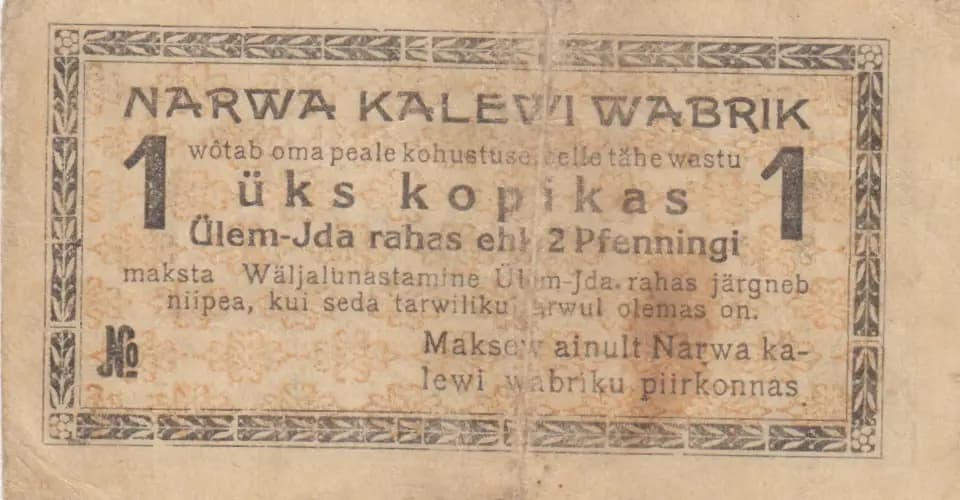
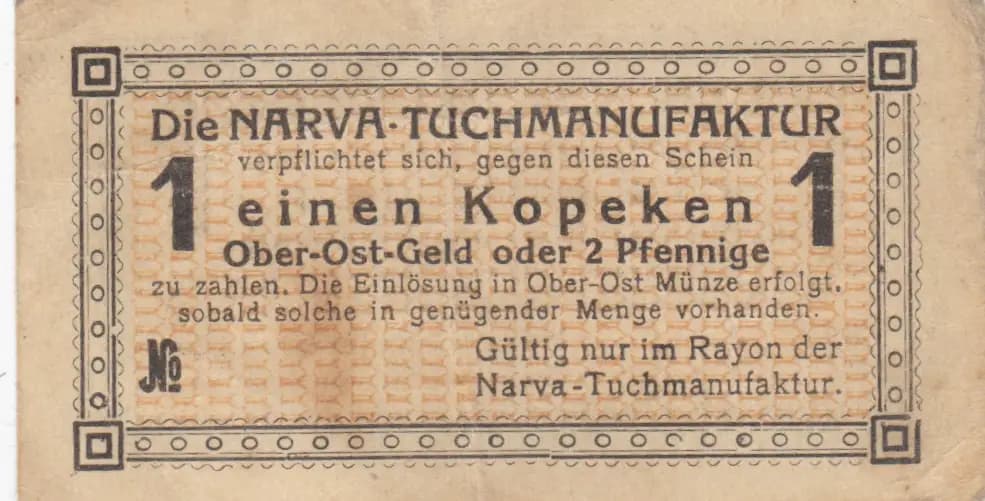
This 1918 Estonian 1 kopika emergency currency note issued by the Narva Kalevivabrik (Calendar Factory) represents a fascinating transitional monetary artifact from the tumultuous period of Estonian independence. The bilingual note—featuring Estonian on the obverse and German on the reverse—reflects the complex linguistic and political landscape of post-WWI Estonia, with tan/beige paper showing age-appropriate patina and foxing consistent with early 20th-century production. The decorative borders and corner numerals are clearly rendered in this Fine condition example, which remains unrecorded in the Pick catalog, making it a historically significant but likely understudied piece.
Scarce. This note is unlisted in the Pick catalog, indicating it either escaped earlier comprehensive cataloging of Estonian emergency issues or represents a genuinely low-circulation private note. The conflicting issuer names between the obverse (Kalevivabrik/Calendar Factory) and reverse (Tuchmanufaktur/Textile Manufactory) suggest either a printing error, two separate issues, or consolidation of operations. The 1918 date places it at the very beginning of the Estonian monetary chaos period. The combination of obscurity (Pick-unlisted status), limited geographic validity (factory district only), and the specialized industrial issuer context—rather than a wider commercial or civic authority—indicates this note had a restricted circulation. The Fine condition and survival rate further support a scarce classification, as such notes were typically discarded once monetary conditions normalized.
Issued during the chaotic transition following World War I and the Russian Revolution, this note embodies Estonia's struggle to establish monetary sovereignty in 1918. The dual-language inscription reflects the region's recent liberation from German occupation (Ober-Ost administration) and the subsequent establishment of Estonian independence, with the German text and references to 'Ober-Ost-Geld' (Upper-Eastern money) acknowledging the interim currency regime. The note's limitation to validity 'only in the Narva calendar factory district' demonstrates the localized, private emergency currency issued by individual enterprises during the period of monetary chaos before the Estonian kroon's establishment.
This bilingual emergency note features minimal pictorial elements, relying instead on text and geometric ornamentation to convey authority. The obverse displays a delicate decorative leaf and vine border pattern in brown/dark gray ink on tan/beige paper, with large denomination numerals '1' positioned in the top left and right corners. The reverse maintains the color scheme with a more geometric border design incorporating circular medallions and ornamental square corner elements. No portraits, historical figures, or landmarks are depicted; instead, the design emphasizes the legal obligation and redemption terms, reflecting the practical rather than propagandistic nature of factory-issued emergency currency. The typography is period-appropriate with serif fonts rendered in the transitional style between German Gothic and modern typefaces, suitable for an enterprise emergency currency.
FRONT (Estonian): 'Narwa Kalewd Wabrik' (Narwa Calendar Factory) / 'wôtab oma peale kohustuse, et sellä tähe wastu ü k s k o p i k a s' (takes upon itself the obligation that for this note one kopika) / 'Ülem-Jda rahas eht 2 Pfenningi' (Upper-Estonian money or 2 Pfennigs) / 'maksta Wäljalunastamme Ülim-Jda. rahas järgneb niipea, kui seda tarwiliku arwul olemas on.' (to be paid in our withdrawn Upper-Estonian money as soon as such amount is available) / 'Maksov ainult Narwa ka-lewi wabrikui piirkonnas' (Valid only in Narwa calendar factory district) / 'No' (Number). BACK (German): 'Die NARVA-TUCHMANUFAKTUR' (The Narva Textile Manufactory) / 'verpflichtet sich, gegen diesen Schein einen Kopeken Ober-Ost-Geld oder 2 Pfennige zu zahlen.' (obligates itself, against this note to pay one kopek Upper-Eastern money or 2 Pfennigs) / 'Die Einlösung in Ober-Ost Münze erfolgt, sobald solche in genügender Menge vorhanden.' (Redemption in Upper-Eastern coins will take place as soon as such are available in sufficient quantity) / 'Gültig nur im Rayon der Narva-Tuchmanufaktur.' (Valid only in the district of Narva-Textile Manufactory)
The note exhibits characteristics of letterpress printing typical of early 20th-century European commercial printing. The crisp edges on the decorative borders, the consistent impression of the text, and the clear rendering of the numerals suggest a single-pass or multi-color letterpress operation. The registration appears sound despite the advanced age of the note. No security printer attribution is documented for this unlisted Pick number, suggesting the Narva Kalevivabrik (or alternatively, the Narva Tuchmanufaktur per the reverse) likely contracted with a local Estonian or regional Baltic printer capable of bilingual composition. The relatively unsophisticated security features—limited to decorative design elements only—are consistent with what private enterprises could economically justify for short-term emergency currency.
No specific variety details are determinable from the current visual analysis. The note bears a 'No.' designation (likely for a serial number field), but no legible serial number, date overprint, or signature is visible in the image resolution provided. The discrepancy between the obverse inscription (Narwa Kalevivabrik) and reverse (Narva-Tuchmanufaktur) represents either a significant variety marker or a documentation error in the note's production. Future acquisition of this note should note whether the serial number field was filled, and whether additional examples exist with consistent or variant issuer attributions. Given the Pick-unlisted status, any numbered examples of this note should be documented with full serial number and signatures (if present) for future catalog inclusion.