50 piastres 1957
Market Prices
9 salesAbout This Note
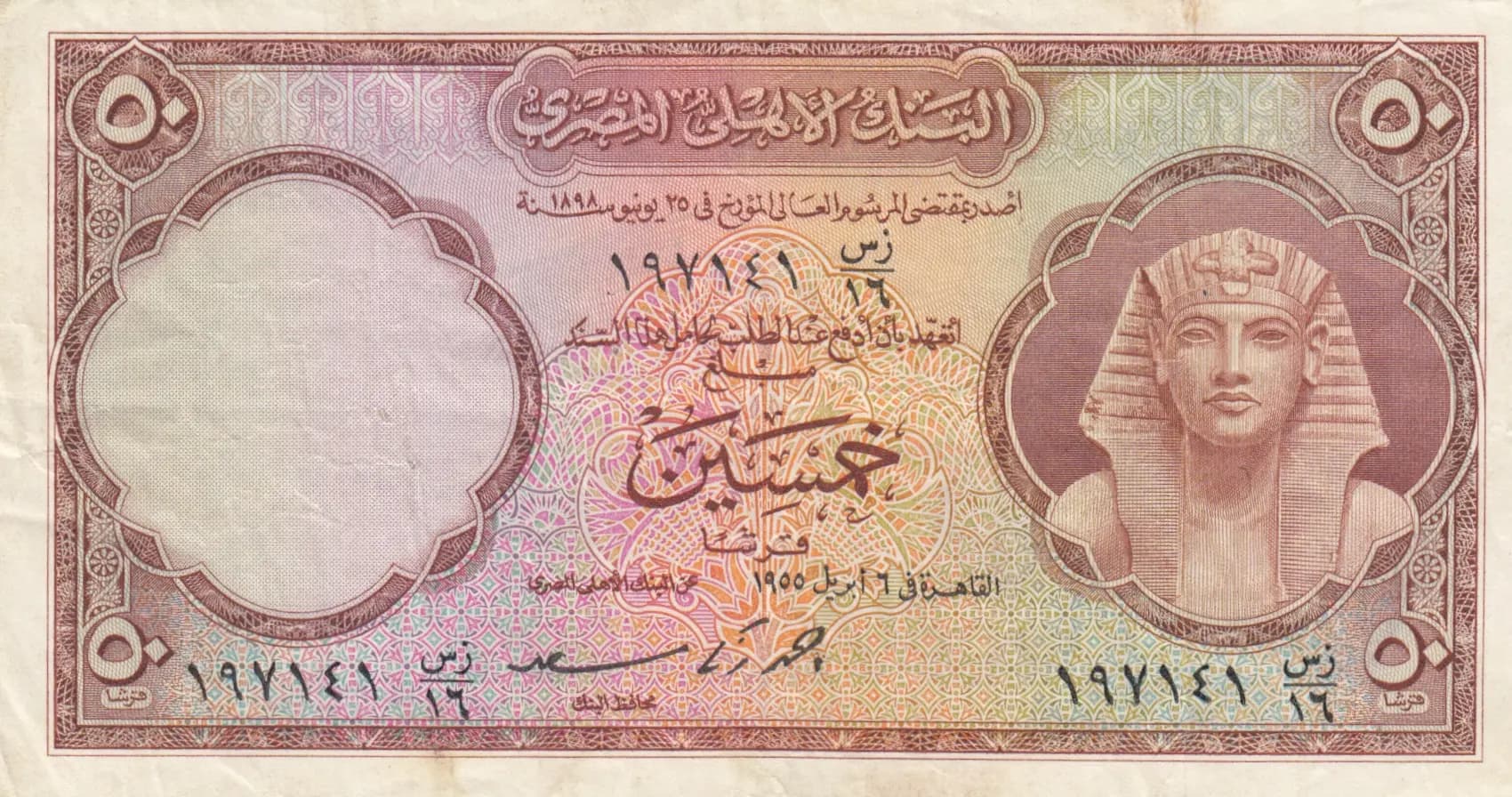
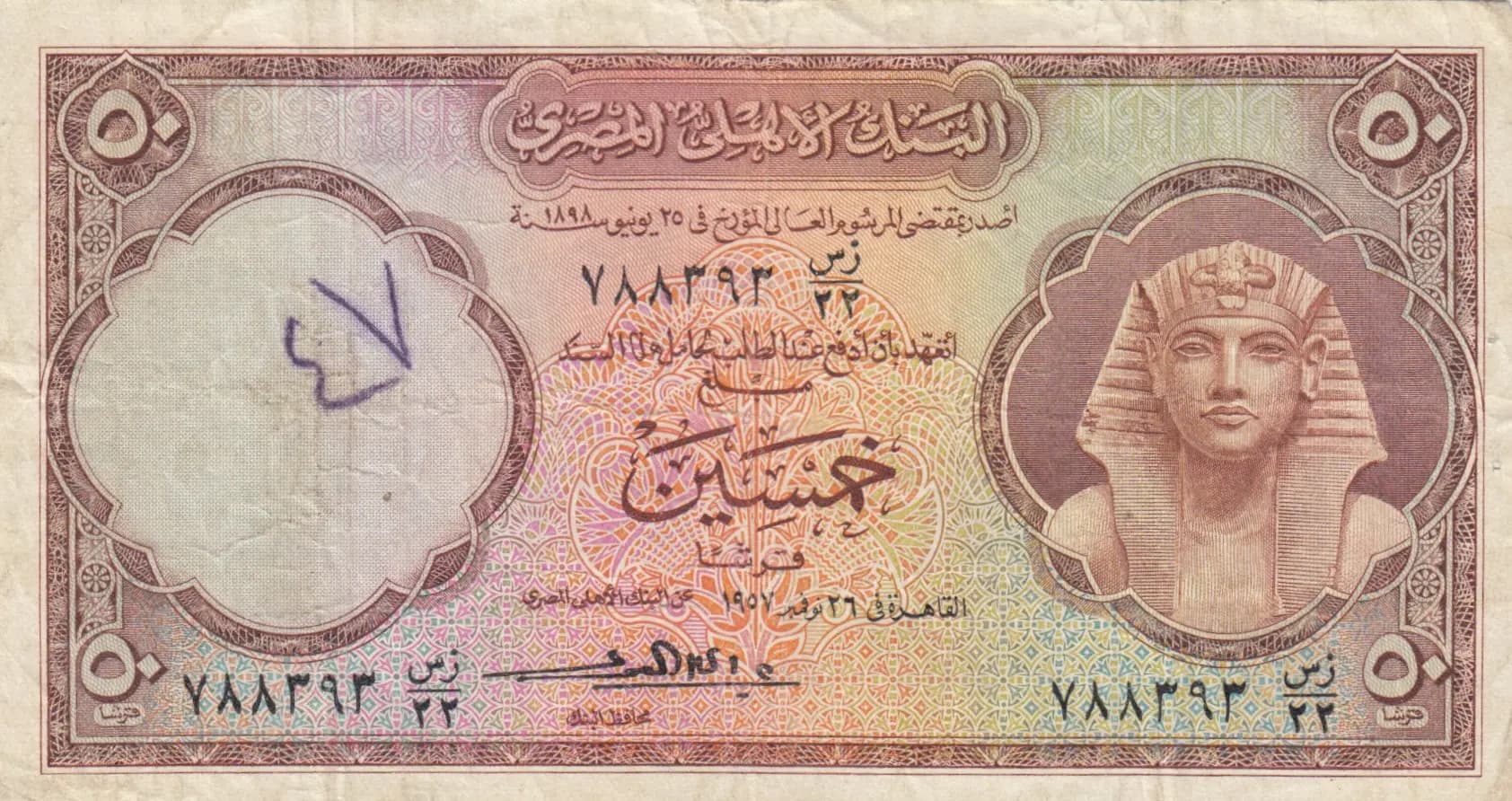
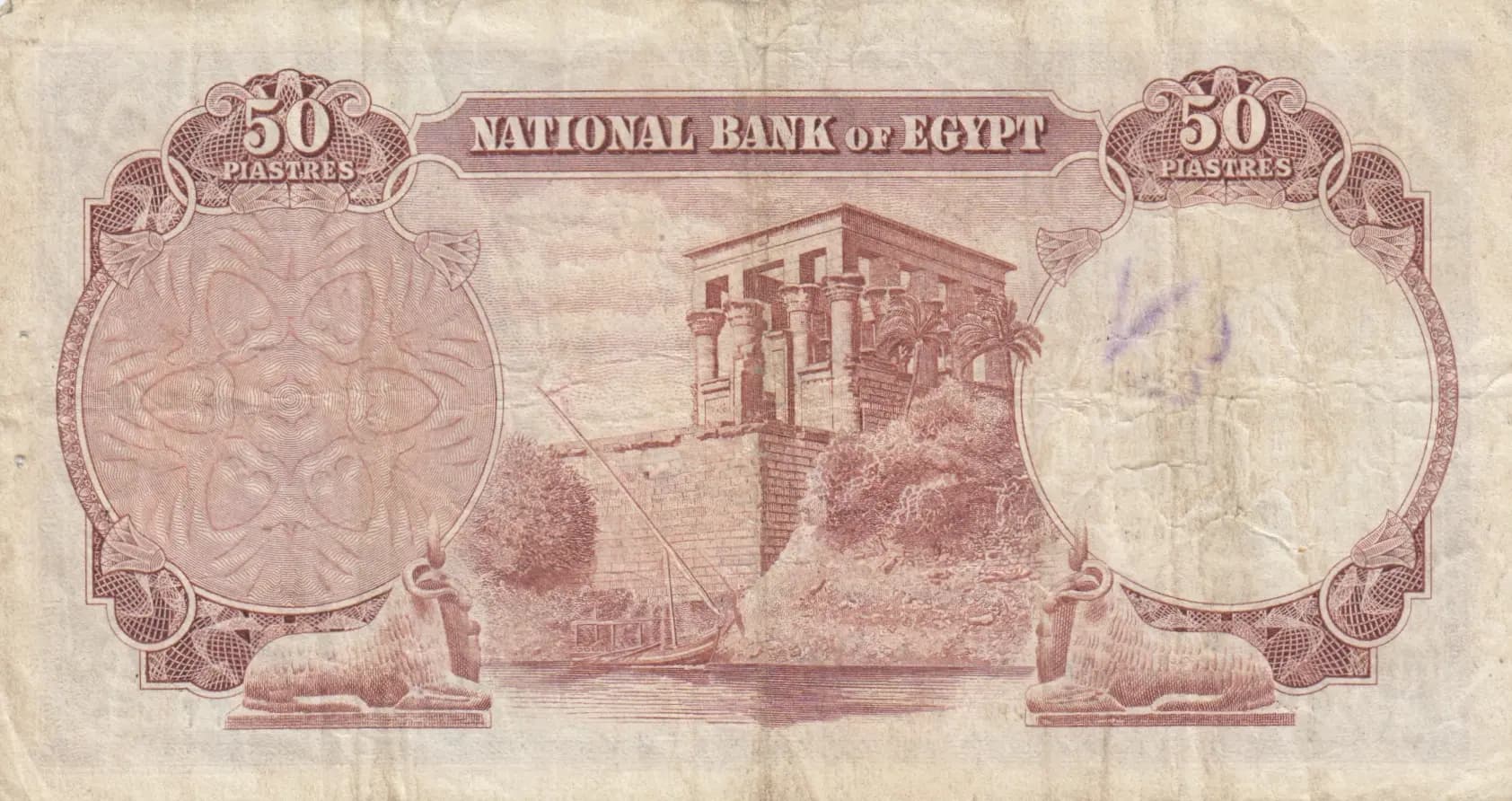
This is an Egyptian 50 Piastres banknote from 1957, issued by the National Bank of Egypt during a pivotal post-revolutionary period. The note displays the characteristic brown and multicolor design of the series, featuring Tutankhamen on the obverse and Trajan's Kiosk (temple structure) with sphinxes on the reverse. In Fair (F) condition, the note shows moderate circulation wear including creasing and fading, with some notarial markings visible, and represents a standard example of this widely circulated denomination.
Common. Despite the catalogue value range of $1–$40 (depending on condition), eBay sales data confirms this note trades frequently and affordably. Fair-condition examples consistently sold for $13–$15 in the 2015 market, with only higher-grade specimens (EF and above) commanding $35–$81. The large print runs typical of this denomination during 1952–1960 and the note's continued availability in the secondary market confirm its status as a common issue.
This 1957-dated note was issued during Egypt's early post-1952 Revolutionary period under Nasser's regime, when the National Bank of Egypt was reasserting national sovereignty over currency. The imagery—Tutankhamen representing pharaonic Egypt and Trajan's Kiosk from Philae Island representing Greco-Roman heritage—reflects the new Egypt's engagement with its rich historical identity across multiple epochs. The note's design deliberately connected Egypt's modern state to both ancient and classical antiquity, symbolizing national pride and cultural continuity.
The obverse features a classical bilateral design with two circular portrait medallions in ornate oval frames: the left medallion (now worn or obscured) and the right medallion displaying Tutankhamen wearing the traditional nemes headdress with uraeus cobra symbol. The center contains elaborate geometric and floral arabesque patterns in rose, pink, orange, yellow, and green tones. All four corners bear denomination circles marked '50'. The reverse depicts an architectural vignette of Trajan's Kiosk (the temple originally on Philae Island, later relocated to Agilkia Island) with tall columns flanked by palm trees, seated sphinx figures positioned in the lower corners, and circular ornamental medallions on the left and right sides. The English text 'NATIONAL BANK OF EGYPT' and 'PIASTRES' appears at the top in ornamental frames.
Front: 'البنك الأهلي المصري' (National Bank of Egypt); 'تم اصدار هذه الأوراق للتوقيع في 25 يونيو 1957' (This note was issued for signature on 25 June 1957); Serial number: 788493 (appearing twice). Back: 'NATIONAL BANK OF EGYPT' and '50 PIASTRES' (English denomination and issuer declaration).
This note was produced using traditional intaglio (engraved) printing techniques, evidenced by the fine line work visible throughout the border designs, portraits, and architectural details. The multicolor printing required multiple passes through the press, creating the characteristic layered appearance of rose, pink, and earth-tone underprinting beneath the brown primary design. This method was standard for Bank Note Engraving Company and similar security printers serving Middle Eastern central banks during the 1950s.
This specific example bears the 25 June 1957 signature date inscription ('تم اصدار هذه الأوراق للتوقيع في 25 يونيو 1957'), placing it within the 1957 dated variety of the 1952–1960 series. The serial number 788493 and the presence of notarial purple markings (visible on both obverse and reverse) suggest this note passed through official banking or currency exchange channels before entering circulation. No overprints or unusual printing variations are evident; this represents a standard circulation example of the established type.