25 piastres 1949
Market Prices
16 salesAbout This Note
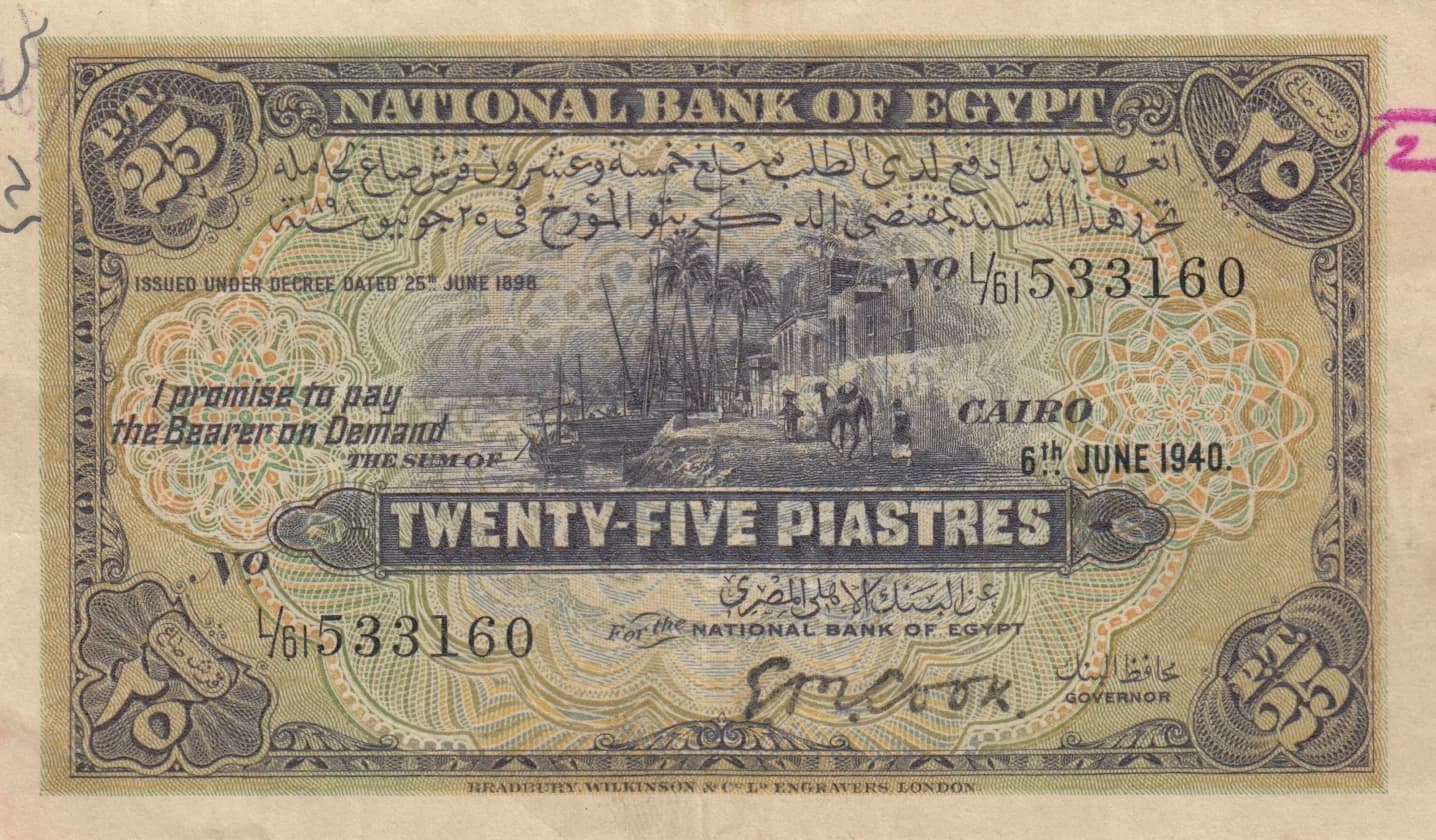
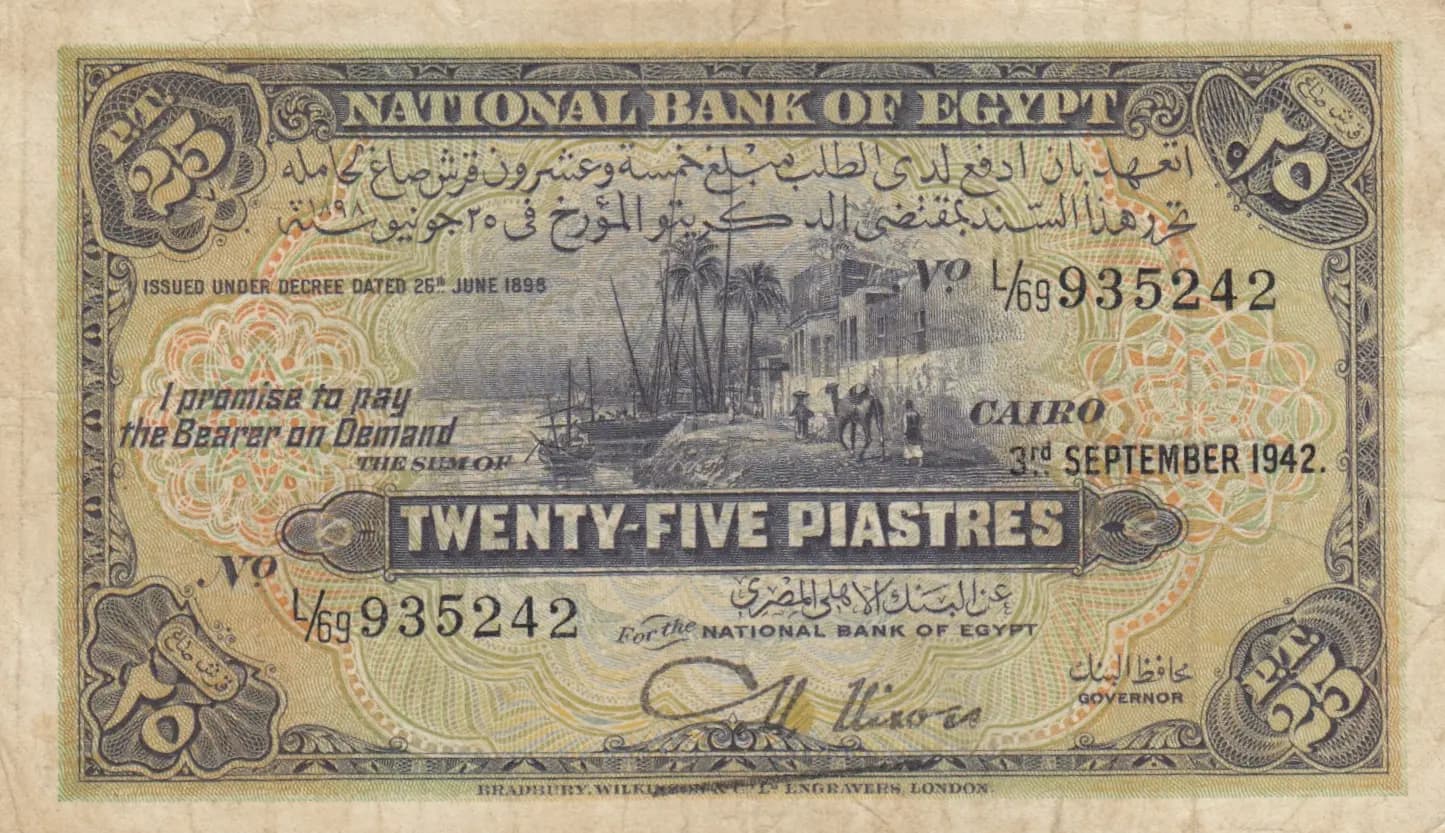
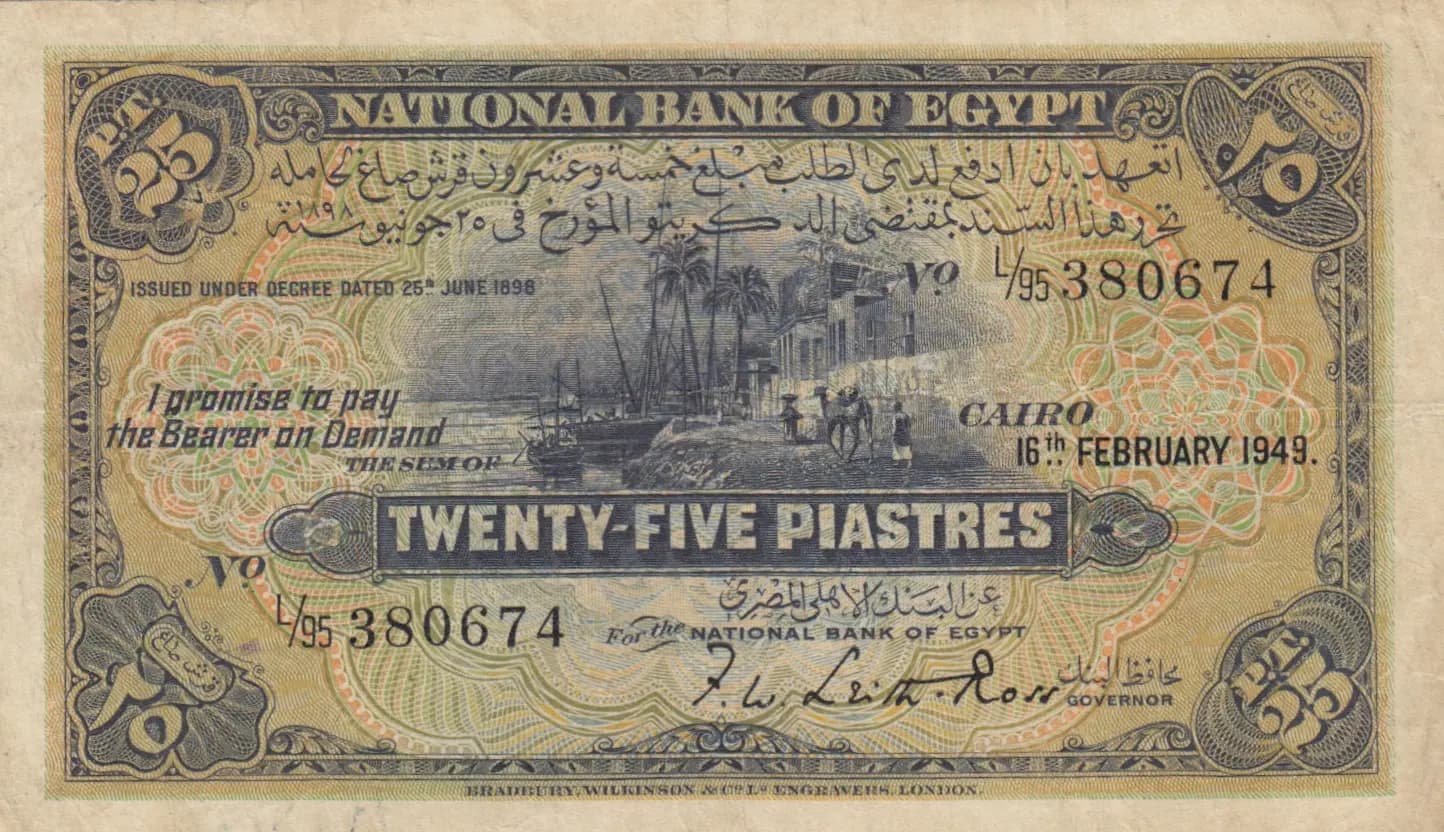
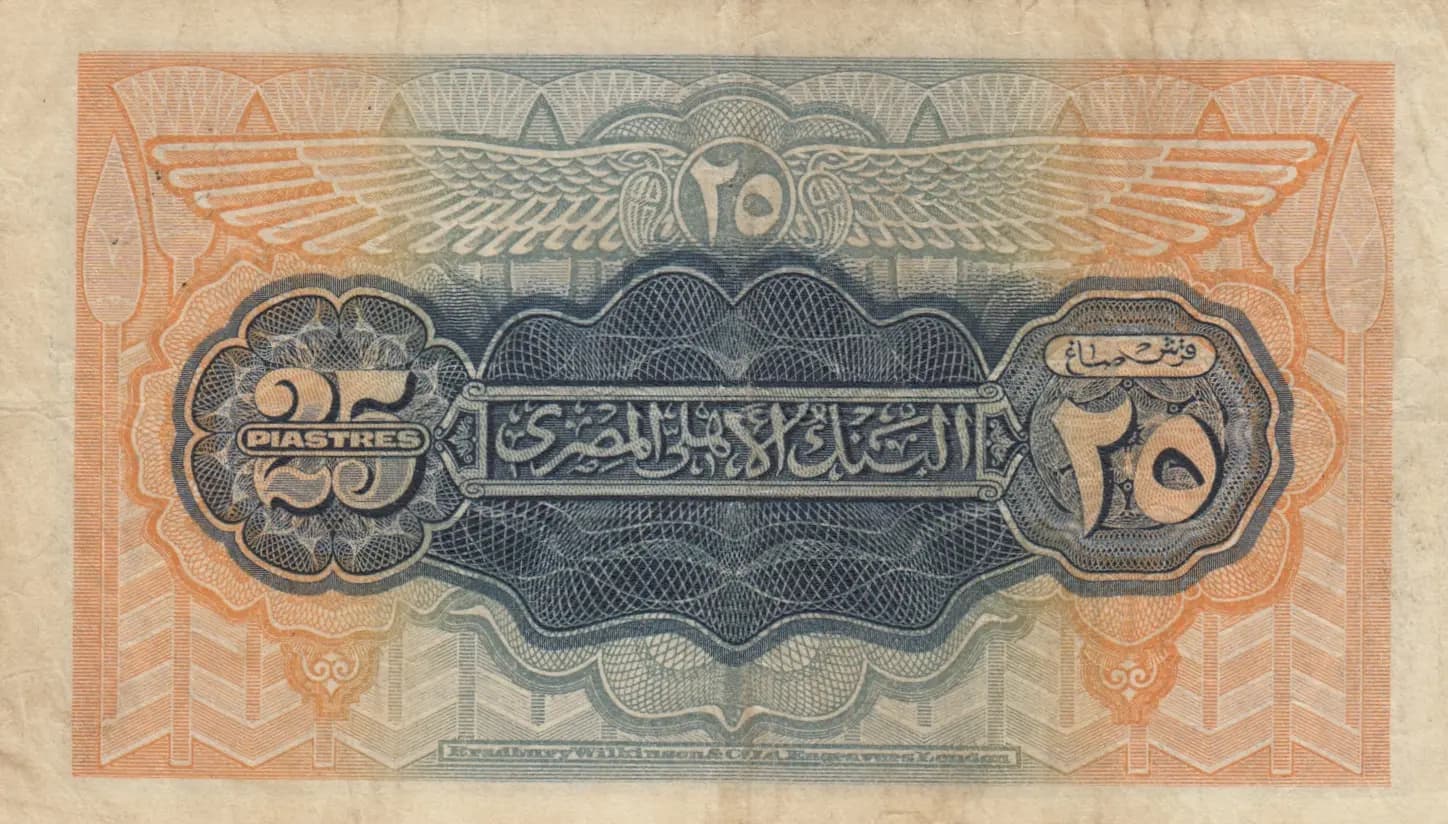
This is an Egyptian 25 Piastres banknote from the National Bank of Egypt, dated 16th February 1949, printed by Bradbury Wilkinson (Pick P-10d). The note displays the characteristic ornate design of mid-20th century Egyptian currency, featuring a harbor scene with sailing vessels and palm trees on the front, and a symmetrical design with winged Egyptian emblem on the reverse. In Fine condition, the note exhibits age-appropriate wear with a cream/tan patina throughout, clear engraving, and no major damage, making it a solid example of this circulating-issue denomination from the post-independence era.
Common. This 25 Piastres note from 1949 was part of a regular-issue denomination series (P-10d) with multiple variants and large print runs by the National Bank of Egypt. eBay market data confirms common-note pricing, with examples in Fine condition consistently selling for $20-30 historically, and VF examples typically bringing $45-75. Catalogue values place Fine condition at approximately $25-30. The wide availability of this note in the secondary market and modest pricing across all grades indicates substantial circulation and survival rates.
This note was issued during a pivotal period in Egyptian history, specifically dated to February 1949, which falls within the reign of King Farouk and before the 1952 revolution that would transform the nation. The harbor and waterfront imagery on the obverse reflects Egypt's economic importance as a maritime trading nation, with the Nile delta serving as a gateway to international commerce. The inclusion of Arabic text alongside English reflects Egypt's position in the mid-20th century, as it remained technically under British influence while asserting its national identity and sovereignty.
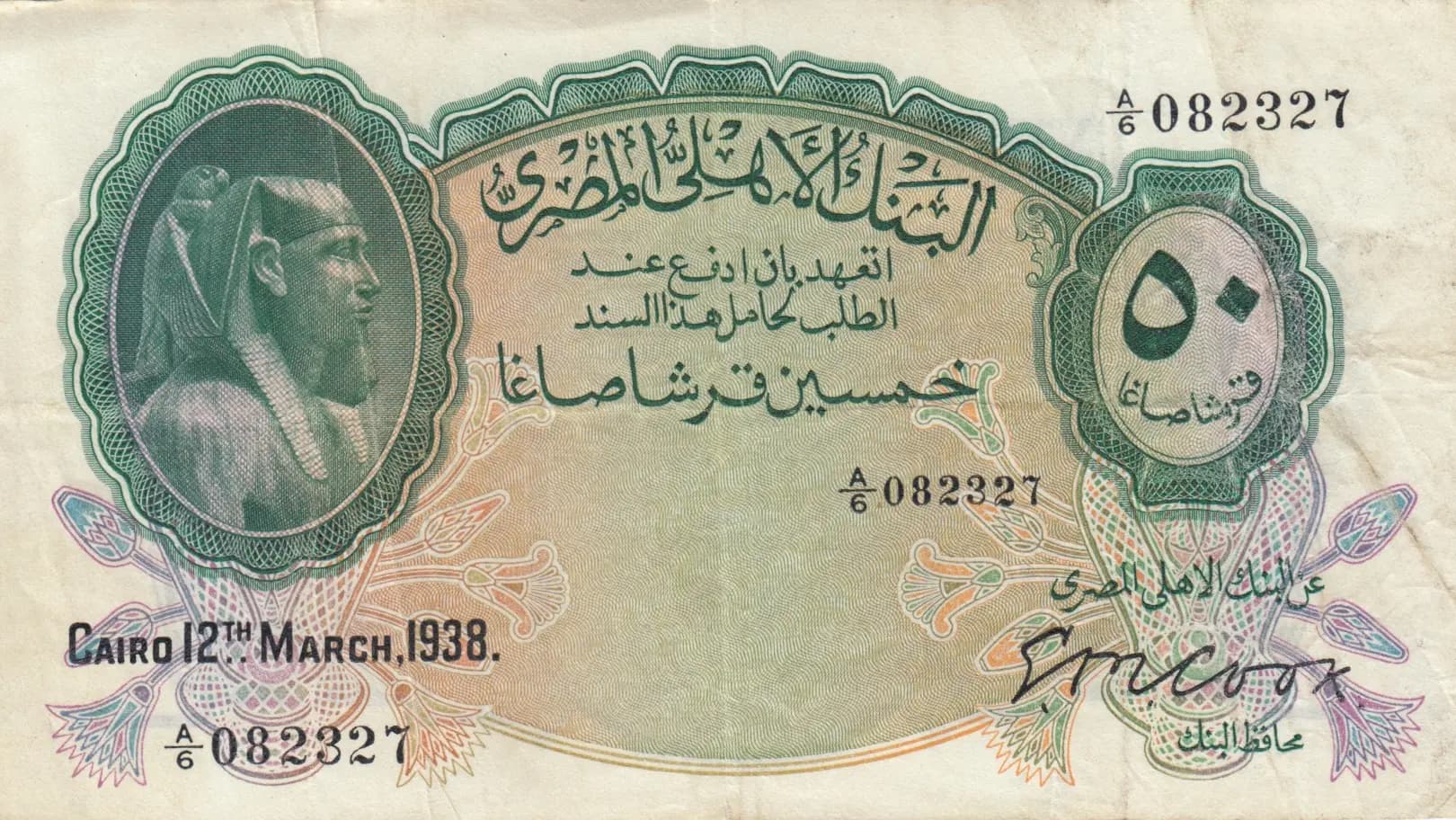
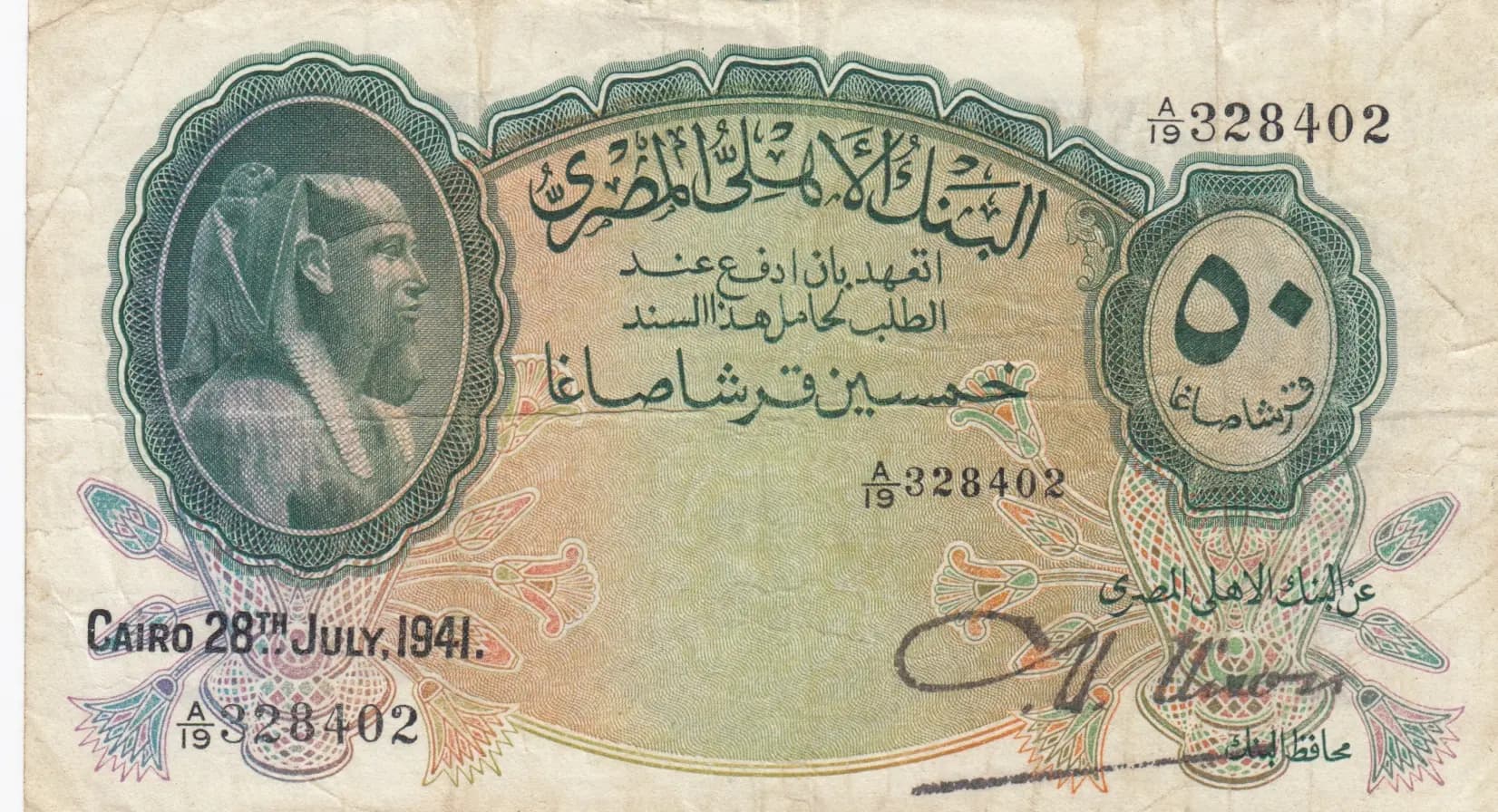
The front features an elegant vignette depicting the Nile waterfront at Cairo, showing a harbor scene with a traditional sailing vessel (felucca), palm trees, and colonial-era waterfront buildings with people visible along the shore. This maritime commerce imagery was central to Egyptian national identity and economic representation. Ornate geometric and floral decorative borders frame all four corners of the note. The reverse displays a more abstract, symmetrical design centered on an ornamental cartouche containing Arabic calligraphy, topped by a winged emblem representing Egyptian national authority (likely the royal or national seal of the era). Radiating fan and shell-like patterns in the corners create a formal, classical aesthetic. The color scheme employs deep purple on the front with multicolor underprints, and dark blue on pale orange with light gray underprints on the reverse, typical of Bradbury Wilkinson's sophisticated printing palette.
Front side: 'NATIONAL BANK OF EGYPT' (English); 'ISSUED UNDER DECREE DATED 25th JUNE 1898' (English - referring to the bank's founding decree); 'I promise to pay the Bearer on Demand THE SUM OF TWENTY-FIVE PIASTRES' (English - standard promise clause); 'CAIRO' and '16th FEBRUARY 1949' (English - place and date of issue); 'For the NATIONAL BANK OF EGYPT' and 'GOVERNOR' (English - issuing authority); Serial number '1/95 3806674' (English). Back side: '25 PIASTRES' (English); 'وخمسة وعشرون' (Arabic - 'Twenty-five'); 'الجمهورية المصرية' (Arabic - 'Egyptian Republic', though note predates 1952 revolution when this became official designation).
Intaglio engraving, executed by Bradbury Wilkinson & Co., Ltd. of London, a premier security printer. The intricate fine-line engraving throughout, complex mesh and crosshatch background patterns, detailed decorative borders, and multi-color separation printing all indicate classical intaglio security printing methods. The fine line patterns visible in the visual analysis are characteristic of anti-counterfeiting measures employed by this printer during the mid-20th century.
This note is identified as Pick P-10d variant, specifically the Bradbury Wilkinson printing (BWC printer mark). The PMG population report indicates five catalogued variants for this base Pick number (P-10c, P-10cts, P-10d, P-10e, P-10f), with P-10d, P-10e, and P-10f all attributed to Bradbury Wilkinson. Variants likely differ in signature combinations, serial number prefixes, or minor printing changes across the 1946-1950 issuance period. The dated signature line of '16th FEBRUARY 1949' places this within the middle of the stated issue date range (1.12.1947-7.7.1950 per reference). Serial number 1/95 3806674 suggests first series printing.