25 piastres 1942
Market Prices
32 salesAbout This Note
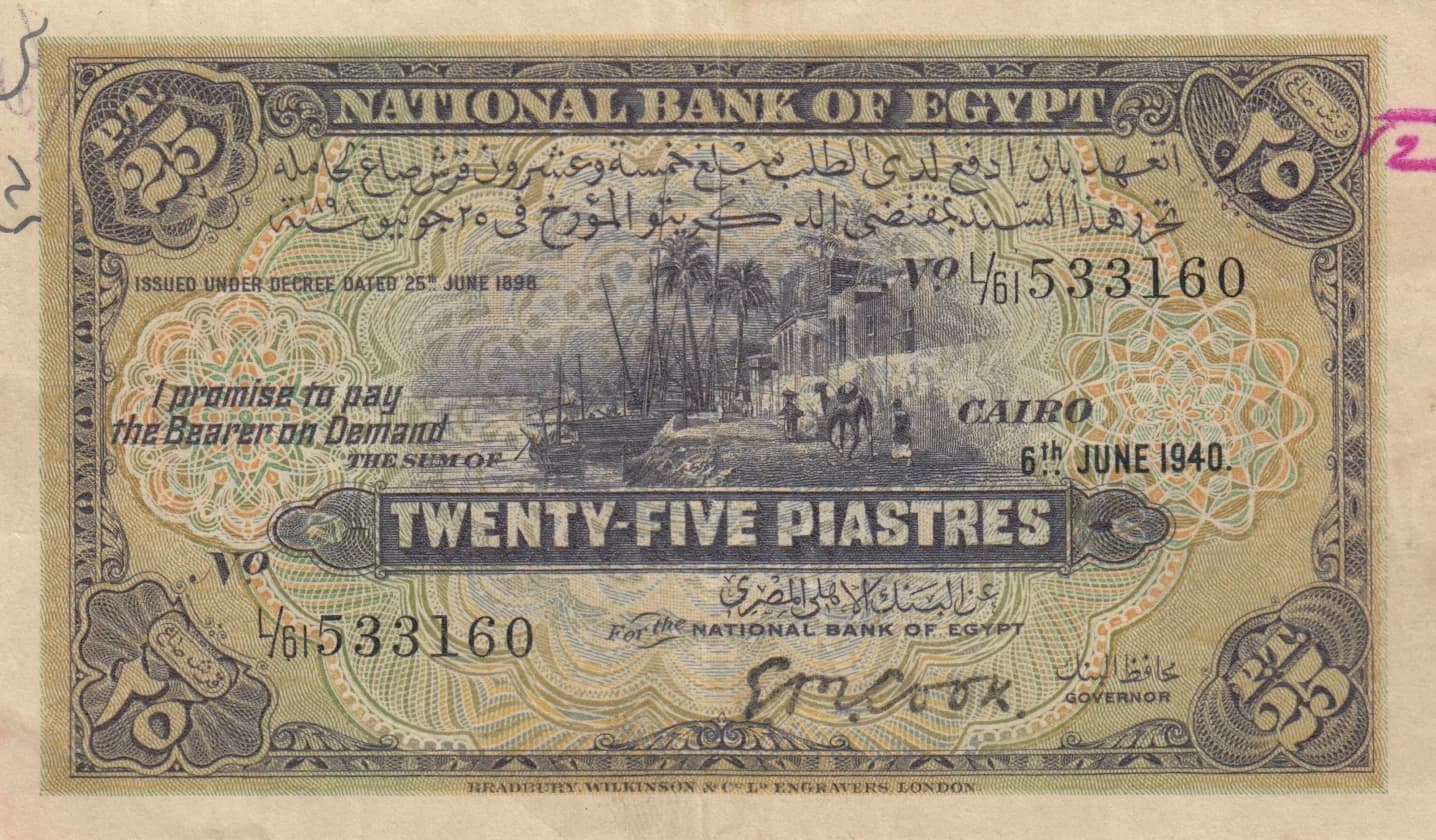
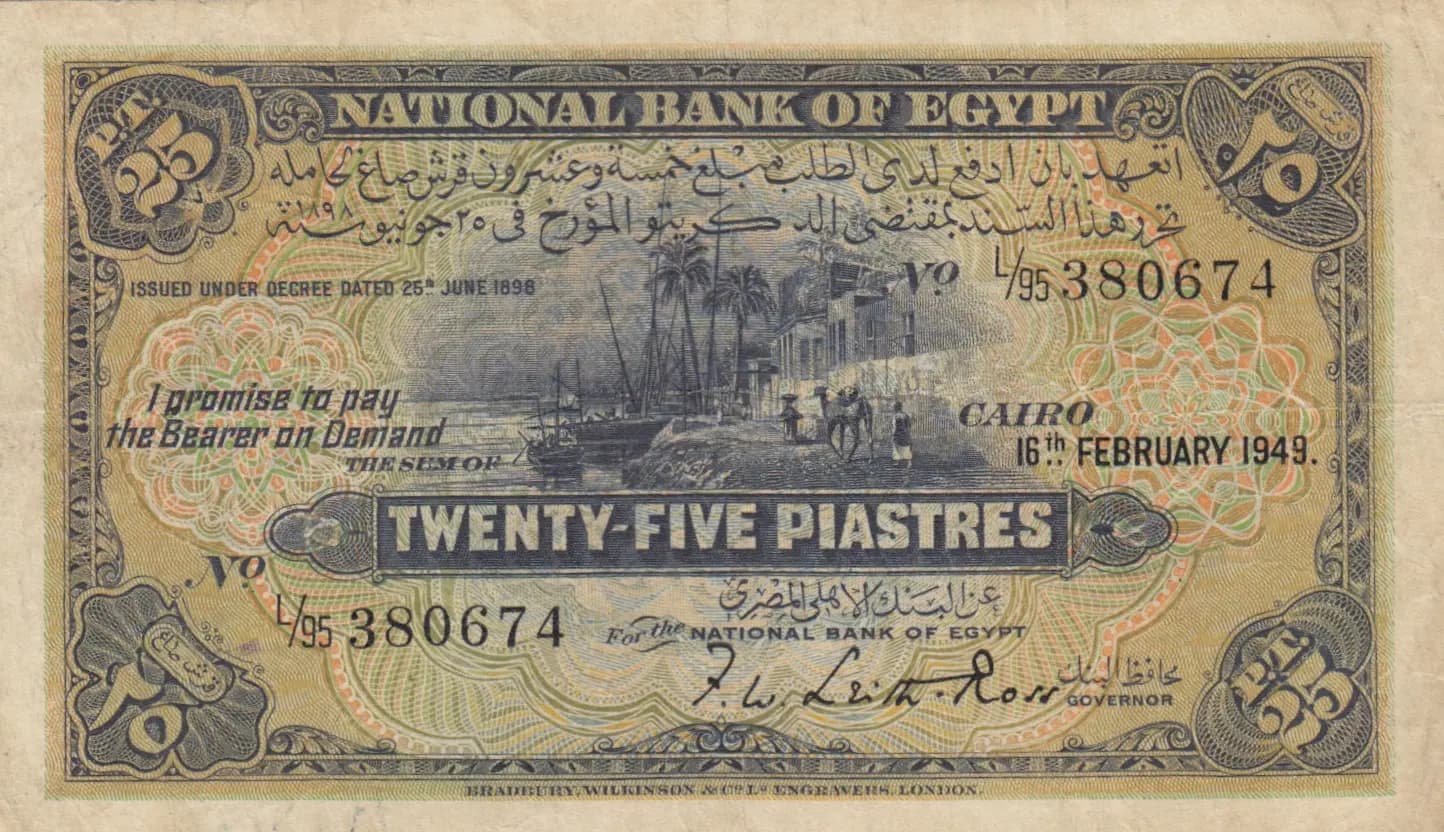
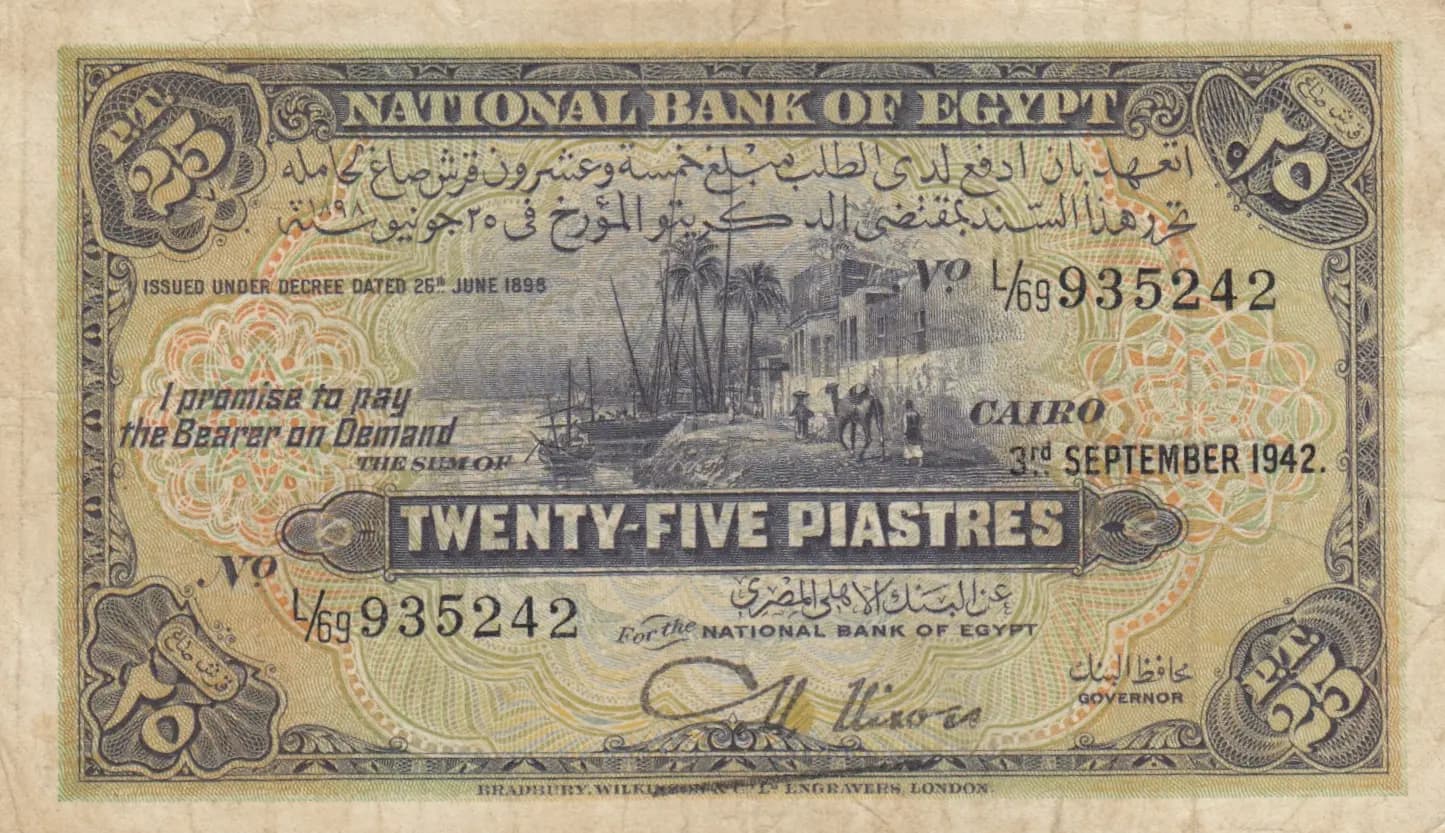
This is a 1942 Egyptian 25 Piastres note (P-10c) issued by the National Bank of Egypt, printed by Bradbury Wilkinson & Co. of London. The note features a beautifully engraved Nile River landscape vignette with palm trees, sailing vessels, and architectural elements framed by ornate Islamic geometric patterns in the corners. In Fine condition, the note shows expected aging with creasing, foxing, and discoloration consistent with a well-circulated note from the 1940s, making it a desirable example of Egypt's interwar currency design.
Common. eBay market data shows consistent sales activity for this note type across multiple condition grades spanning over a decade (2009-2025), with Fine-graded examples regularly selling in the $12-$28 range. The note was issued in substantial quantities during a 7-year period (1940-1946) for a major national currency, and examples remain widely available in the secondary market. The price points and bidding activity indicate steady collector interest without scarcity premiums. This particular note's condition grade (F) places it in the normal circulation-grade category where examples are most common.
This note was issued during the final years of the National Bank of Egypt's tenure as the primary currency issuer under British protectorate influence—a period when Egypt was asserting greater financial independence. The depicted Nile River landscape reflects the romantic Orientalist aesthetic favored in early 20th-century banknote design, romanticizing Egypt's agricultural wealth and iconic geography with sailing vessels and riverside architecture. The 1942 issue date places this note during World War II, when Egypt served as a critical strategic location and the note remained a standard circulation piece despite wartime economic pressures.
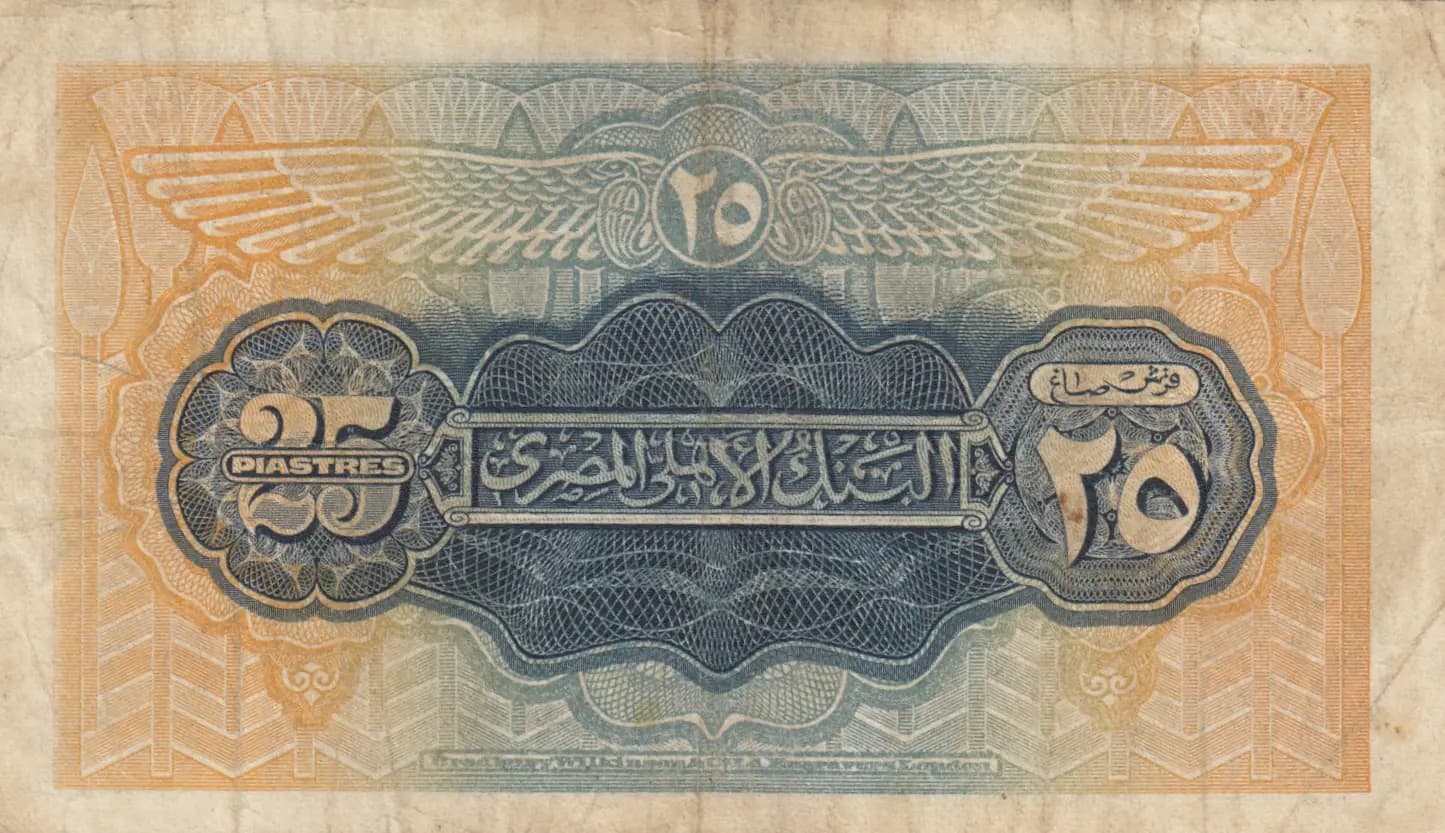
The obverse features a striking central vignette depicting the Nile River delta landscape, a quintessential symbol of Egyptian geography and prosperity. The scene includes felucca sailing vessels characteristic of traditional Nile commerce, palm trees representing Egypt's tropical resources, and riverside architectural elements suggesting Cairo's waterfront development. The composition is framed by elaborate corner ornaments featuring Islamic geometric patterns and wing motifs at cardinal points—design elements reflecting both British engraving tradition and respect for Islamic artistic conventions. The reverse employs a more abstract design, dominated by an ornate central cartouche with Arabic calligraphy surrounded by symmetrical decorative elements and fine guilloche patterns. The color scheme of deep purple on multicolor (obverse) and dark blue on pale orange with light gray (reverse) creates strong visual distinction between sides while maintaining the note's cohesive aesthetic.
FRONT: 'National Bank of Egypt' (English and Arabic البنك الأهلي المصري); 'Issued under Decree dated 25th June 1898'; 'I promise to pay the Bearer on Demand the Sum of Twenty-Five Piastres'; 'Cairo, 3rd September 1942'; 'For the National Bank of Egypt' with Governor signature line; 'Bradbury, Wilkinson & Co., Engravers, London' (printer attribution); Serial number: 469935242. BACK: '25 Piastres' (English); Central cartouche contains Arabic text (specific content not fully legible in image); Denomination '25' repeated in side cartouches.
This note was produced using intaglio engraving (letterpress/line engraving) by Bradbury Wilkinson & Co., a premier British security printer. The visual evidence of intricate line work, fine guilloche patterns, multiple decorative borders, and complex geometric designs throughout both sides confirms traditional engraved banknote production. The precision of the landscape vignette, the delicate rendering of the Nile scene with figures and vessels, and the elaborate corner cartouches are characteristic of high-quality security printing from the 1940s period. No evidence of modern offset or lithographic techniques is present.
This note is cataloged as P-10c in the Pick Standard, representing a specific variety within the 1940-1946 series of 25 Piastres notes. The visual analysis confirms the key distinguishing feature: deep purple on multicolor underprint (obverse) with dark blue on pale orange and light gray underprint (reverse), matching the P-10c specification. The printer attribution 'Bradbury, Wilkinson & Co.' is clearly visible on the obverse. The dated issue of 3rd September 1942 places this within the documented issuance period. The serial number 469935242 is a standard sequential number with no visible overprints or special markings indicating a different variety (such as P-10cts, P-10d, P-10e, or P-10f variants noted in PMG population reports). This appears to be a typical example of the standard P-10c variety.