50 piastres 1938
Market Prices
9 salesAbout This Note
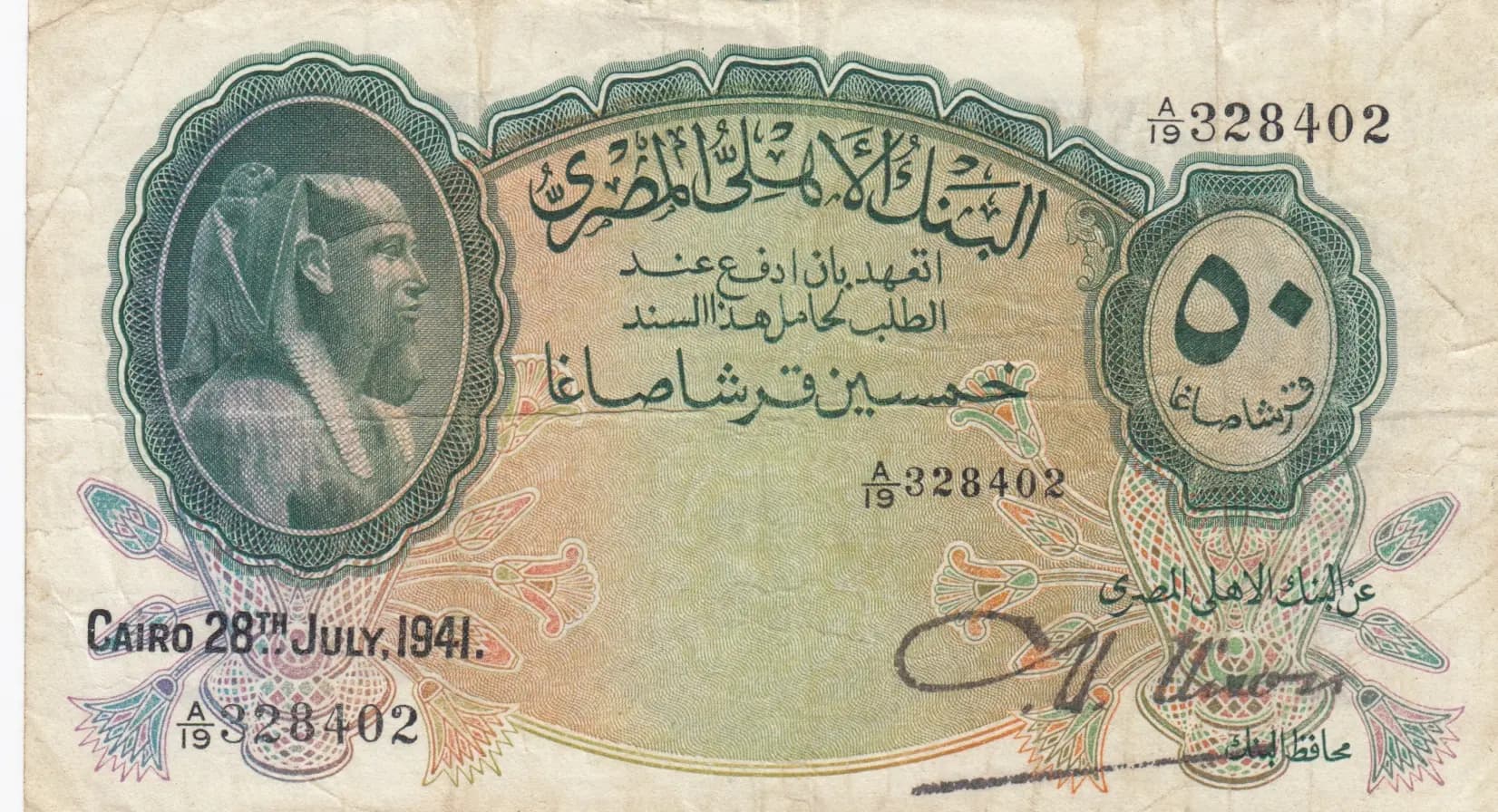
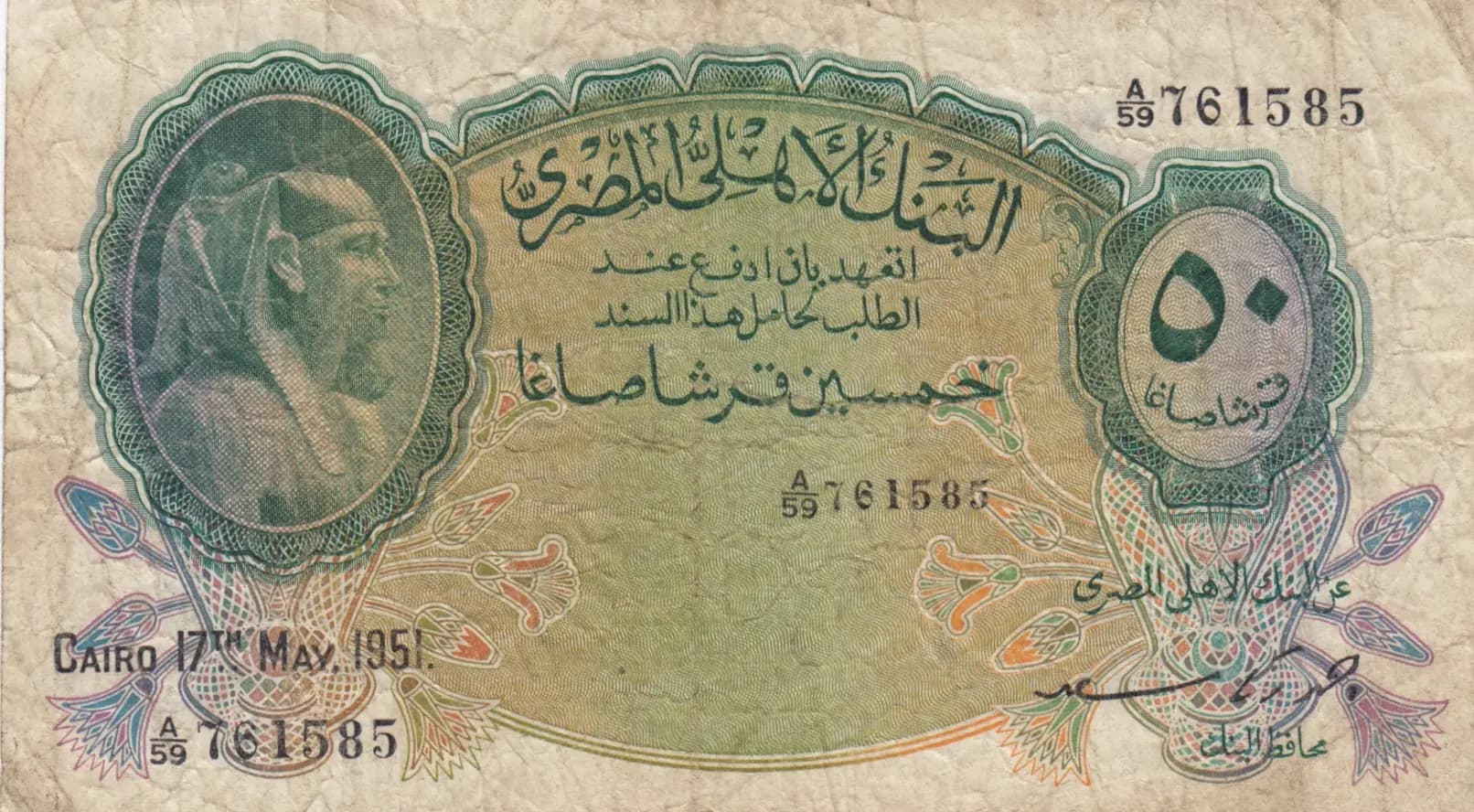
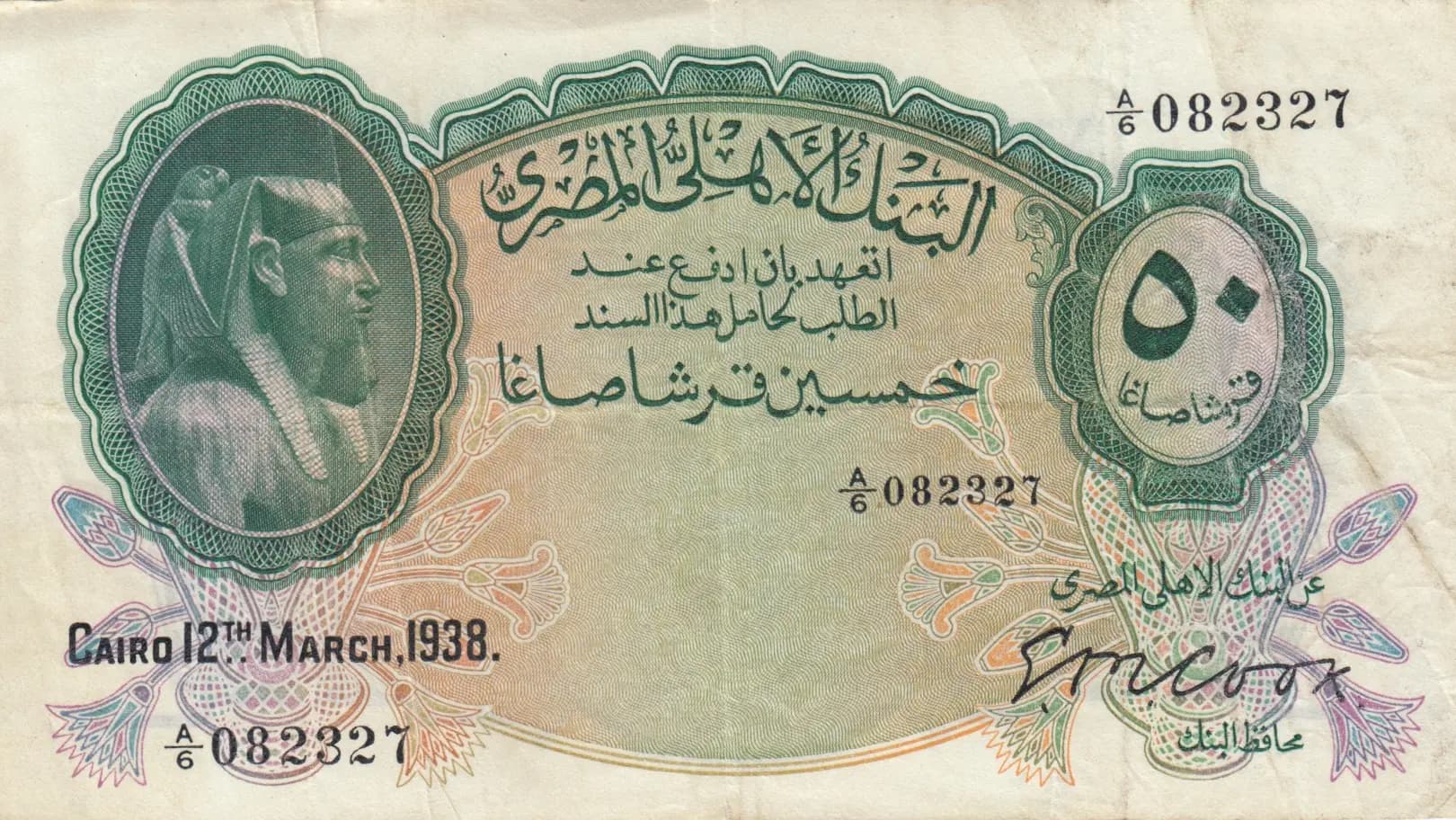
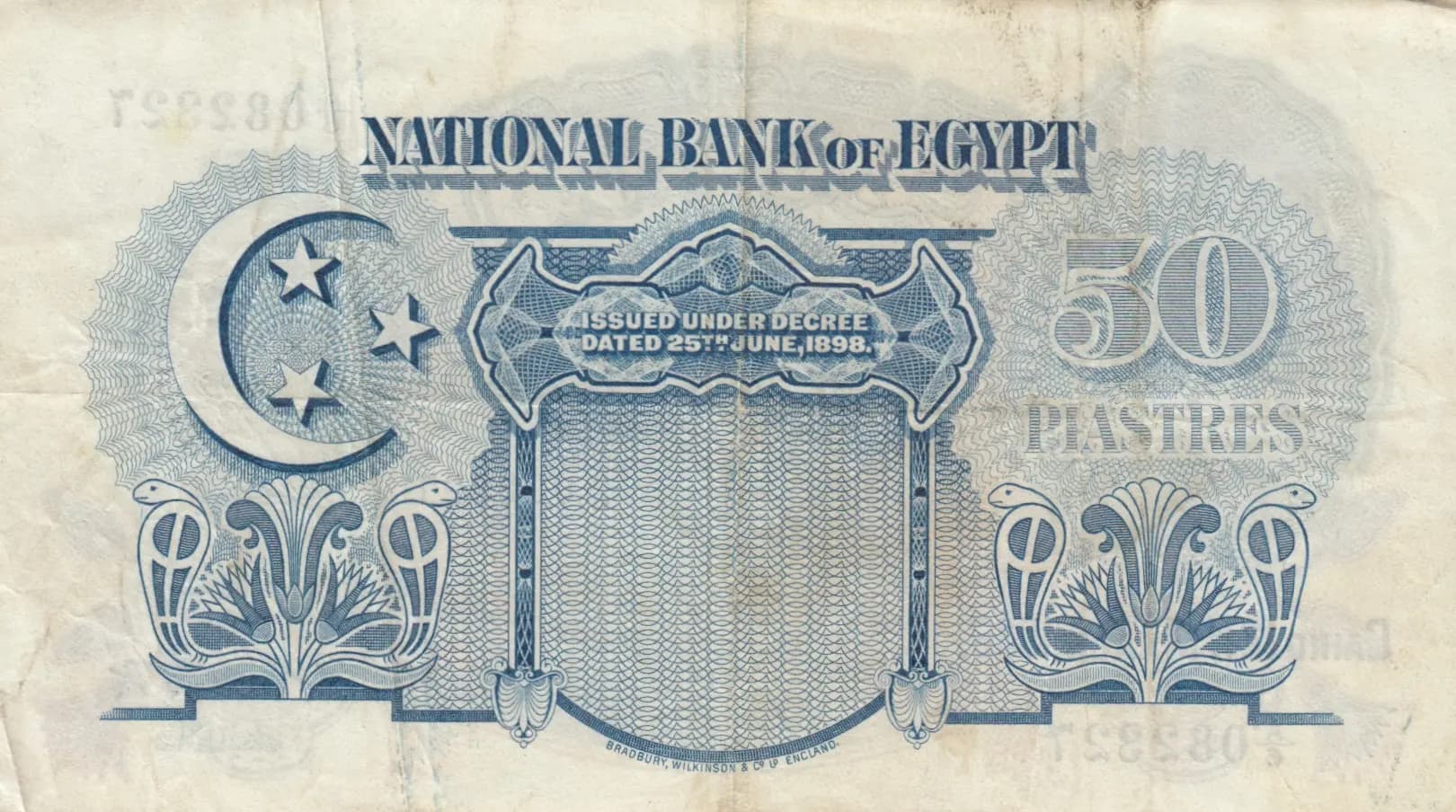
This is an Egyptian 50 Piastres banknote from 1938, issued by the National Bank of Egypt and printed by Bradbury Wilkinson. The note features a portrait of Tutankhamen on the obverse in green and multicolor with ornate scalloped framing, while the reverse displays the Egyptian national symbols (crescent moon with three stars) in dark blue. The note exhibits honest, attractive wear consistent with age, with visible creasing, foxing, and yellowing throughout—typical patina for an 86-year-old banknote in VF condition.
Common. This is a regular-issue banknote from a major 17-year printing run (1935–1951) by a well-known security printer with significant circulation. The eBay market data provided shows recent VF examples selling in the $19.55–$24.97 range (2024–2025), with historical catalog values listing VF at $250 but market realizations consistently far below that. The multiple documented PMG population variants (P-21a through P-21e) indicate substantial surviving quantities. The large print runs typical of National Bank of Egypt notes from this period support a common classification.
This note was issued during the period of the National Bank of Egypt's 50 Piastres series (1935–1951), following Egypt's 1936 independence treaty with Britain. The choice to feature Tutankhamen reflects Egypt's deep historical pride in its pharaonic legacy during a period of reasserting national identity. The Islamic symbols (crescent moon with three stars) on the reverse represent Egypt's cultural and religious identity, while the English-language decree reference to 1898 acknowledges the note's legal foundation under the earlier Bank of Egypt establishment.
The obverse features a right-facing profile portrait of Tutankhamen (the young pharaoh of Egypt's 18th Dynasty, whose tomb discovery in 1922 had captivated the world) positioned at left within an ornate scalloped circular frame. The center contains an elaborate cartouche with Arabic text. The denomination '50' appears in a circular ornate frame on the right. The color scheme employs green, tan/beige, purple/pink, and dark green with floral/botanical motifs at the bottom corners, characteristic of the art deco-influenced design language of 1930s banknote engraving. The reverse displays the Egyptian national coat of arms represented by a crescent moon with three stars positioned at left, with ornamental lotus or papyrus flower designs at the corners. The denomination '50 PIASTRES' is prominently displayed on the right, with extensive decorative cartouches and fine geometric wave patterns filling the background.
OBVERSE: 'البنك الاهلى المصرى' (National Bank of Egypt); 'CAIRO 12TH MARCH, 1938' (date of issue); 'A/6 0823227' (serial number); '50' (denomination in numerals). Additional Arabic inscriptions relating to administrative or ceremonial attributions are present but require specialized Egyptological verification for precise translation. REVERSE: 'NATIONAL BANK OF EGYPT'; 'ISSUED UNDER DECREE DATED 25TH JUNE, 1898'; '50 PIASTRES' (denomination); 'BRADBURY, WILKINSON & CO. LTD. ENGRAVERS' (printer/engraver attribution).
Intaglio engraving (copperplate/steel plate engraving), as indicated by the fine line work, intricate mesh patterns, and detailed geometric designs visible throughout both sides. The Bradbury, Wilkinson & Co. Ltd. attribution confirms use of this renowned British security printing house's proprietary engraving techniques. The complexity of the ornamental frames, fine-line palmette motifs, and background patterns are characteristic of high-security intaglio production of the 1930s era.
This note is cataloged as Pick P-21a, with the date '12TH MARCH, 1938' on the obverse and serial number format 'A/6 0823227' consistent with the 1938 issue variant. The Pick catalog identifies at least four variants (P-21a, P-21b, P-21d, P-21e) for this denomination, likely reflecting date variations or different signature combinations across the 1935–1951 production period. The current specimen's March 1938 date places it within the earlier portion of the series. No unusual overprints, perforation marks, or anomalies are visible on the observed images.