25 piastres 1940
Market Prices
1 saleAbout This Note
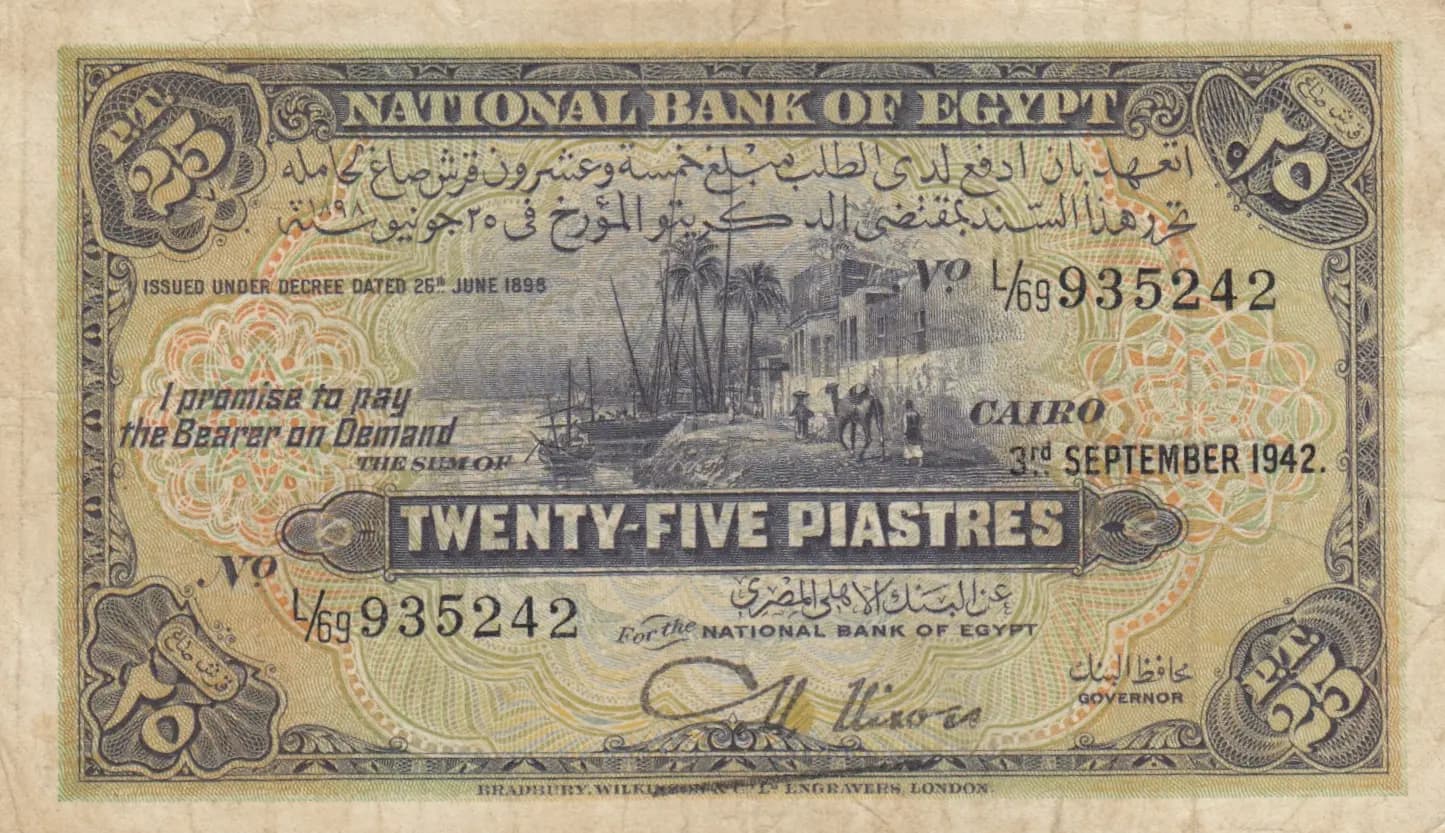
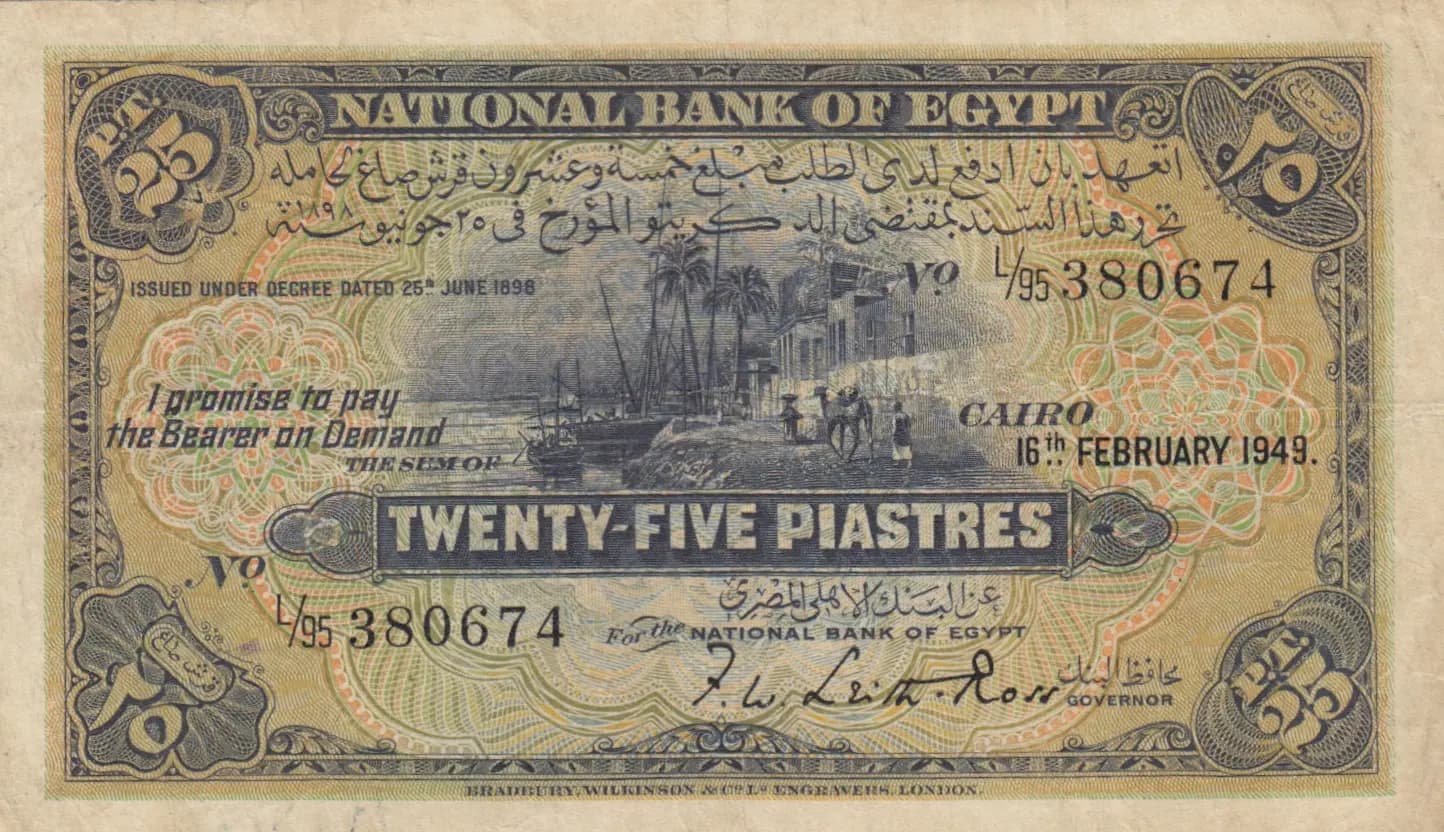
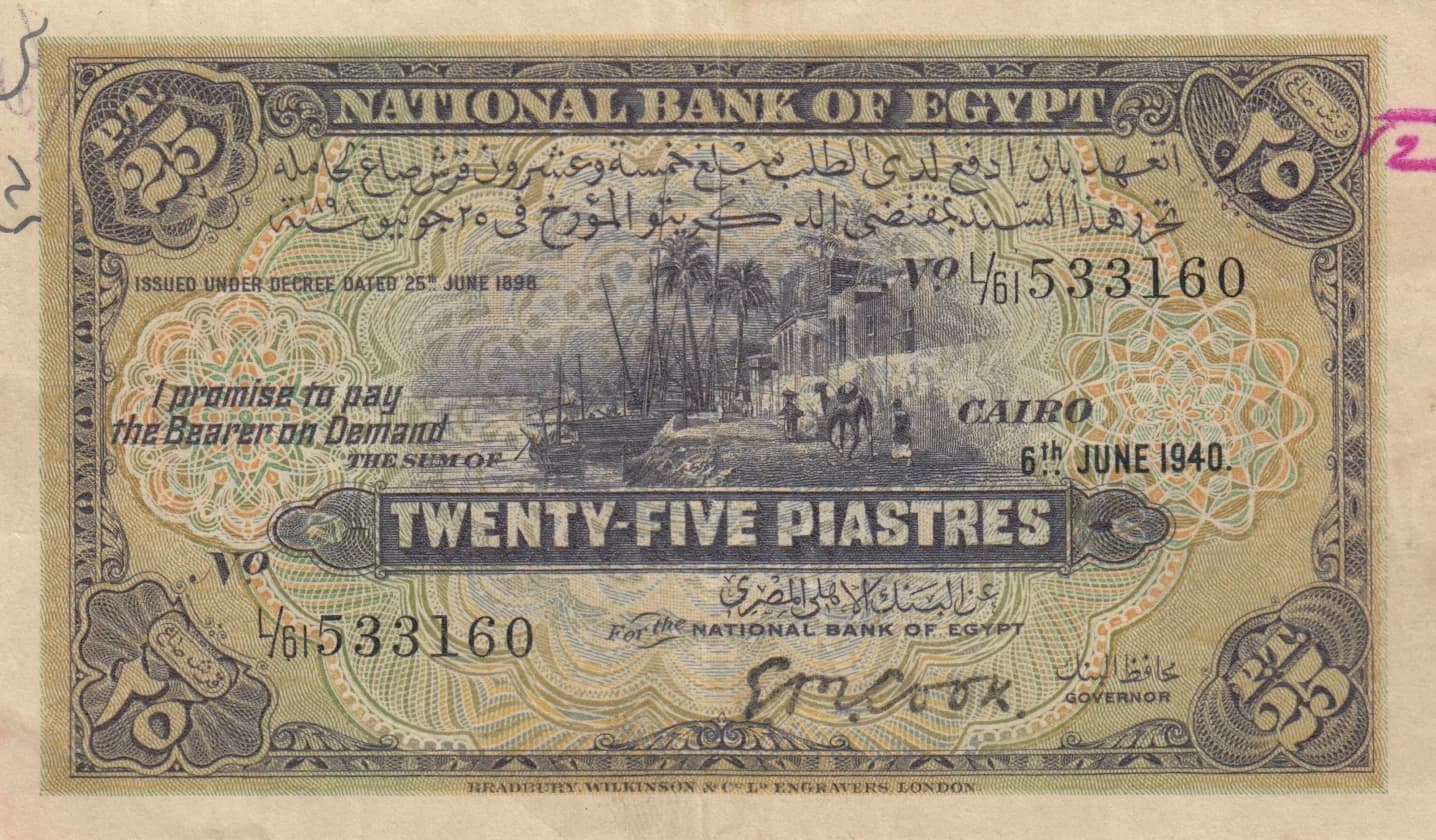
A handsome example of Egypt's 1940 National Bank of Egypt 25 piastres note (Pick-10b), featuring the characteristic ornate Bradbury Wilkinson engraving with a central vignette of a dhow sailing vessel on the Nile against a Cairo waterfront backdrop. The note exhibits honest Very Fine condition with expected aging, foxing, and institutional markings consistent with a historical document now over 80 years old; the intricate blue and orange decorative borders and dual-language inscriptions showcase the high quality security printing standards of this interwar Egyptian currency issue.
Common. While catalog values for VF specimens reach $800 (2016 pricing), this reflects general numismatic interest in interwar Egyptian currency rather than scarcity. The Pick-10b variety was issued in substantial quantities between 1917-1951, and the National Bank of Egypt's regular issues of this denomination were widely circulated. The eBay record cited (F grade, $171.50 in 2019) further confirms these notes trade at modest levels typical of common banknotes. No evidence of small print runs, recalls, or short-lived issuing authority applies to this series.
This note was issued on 5th June 1940 during a critical period in Egyptian history—months before the Western Desert Campaign and amid Egypt's complex relationship with Britain during World War II. The central imagery of the sailing dhow and Cairo cityscape reflects the romantic, historically-grounded design aesthetic favored by the National Bank of Egypt in the early 20th century, emphasizing the nation's Nile River heritage and architectural grandeur. The banknote's promise clause and regulatory language (referencing the 1898 decree) underscore Egypt's formal financial modernization under the constitutional monarchy of King Faruk I.
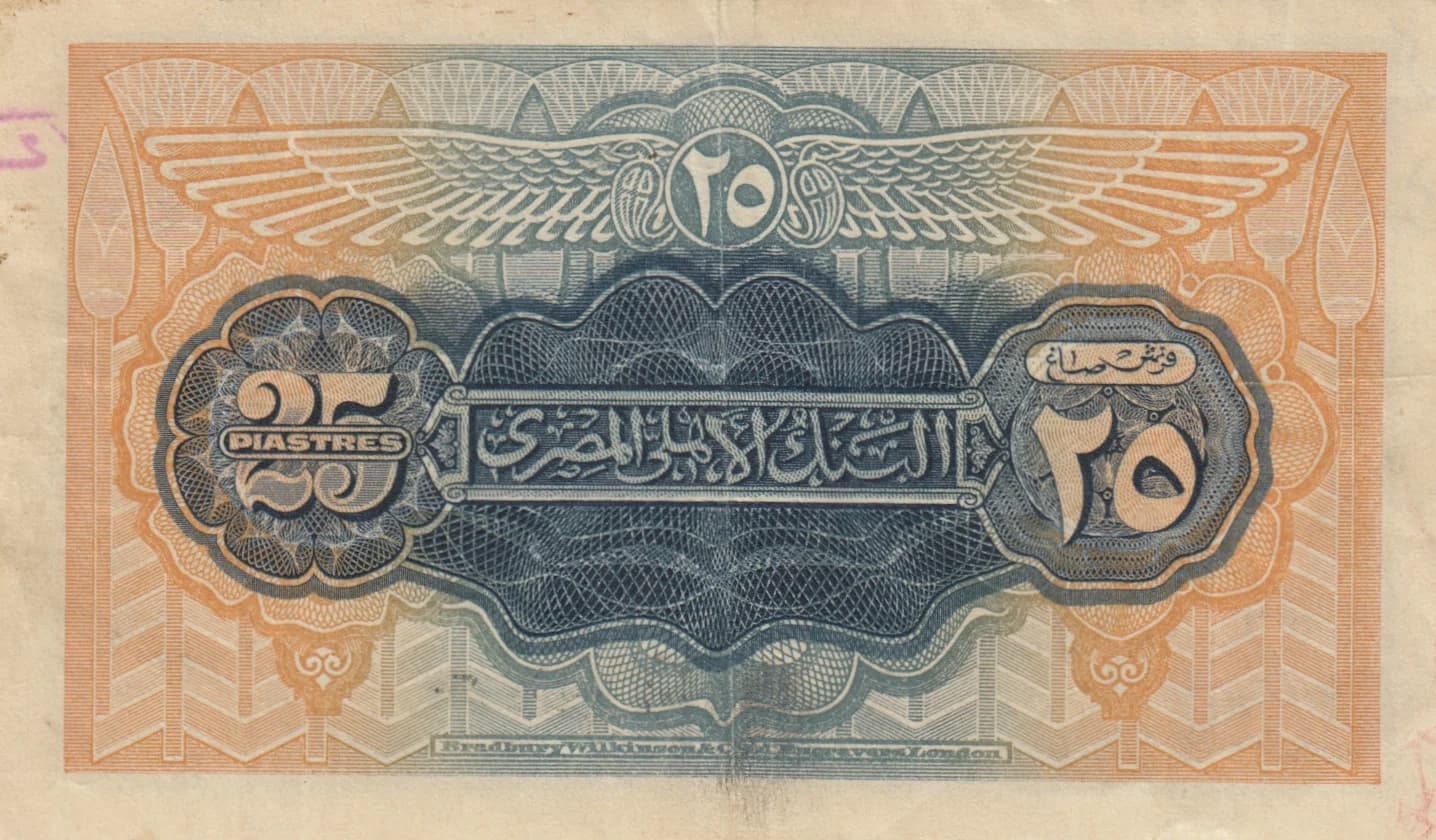
The obverse features a masterfully engraved landscape vignette depicting a traditional Egyptian felucca (dhow) under sail on the River Nile, with palm trees and the Cairo cityline featuring domed and minaret-topped Islamic architecture in the background—a romantic representation of Egypt's cultural and geographical identity. The design is anchored by ornate corner medallions and a full perimeter border of fine geometric and floral patterns in blue-gray and orange/gold tones. The reverse displays a purely ornamental composition centered on a teal-blue medallion containing the Arabic numeral '25' surrounded by elaborate rococo-style floral borders in coral and cream. Flanking the top center is the winged eagle emblem of Egypt (incorporating the royal insignia), a symbol of sovereignty and nationalist identity. The denomination appears in multiple forms—Arabic numerals and English text—on both sides, a security practice of the era.
Front Side — English inscriptions: 'NATIONAL BANK OF EGYPT' (header); 'ISSUED UNDER DECREE DATED 25th JUNE 1898' (legal authority); 'I promise to pay the Bearer on Demand THE SUM OF' (promise clause); 'TWENTY-FIVE PIASTRES' (denomination); 'CAIRO' (place of issue); '5th JUNE 1940' (date of issue); 'For the NATIONAL BANK OF EGYPT' and 'GOVERNOR' (authentication); 'BRADBURY WILKINSON & CO. LTD. ENGRAVERS, LONDON' (printer). Serial number: 6/15333160. Arabic inscriptions include Islamic/Quranic religious text. Back Side — English: 'PIASTRES' and '25' (denomination indicators repeated); 'BRADBURY WILKINSON & CO. LTD. LONDON' (printer attribution). Arabic: وعشرون (wa-ishrun, 'twenty', relating to the denomination).
Intaglio (steel/copper plate engraving), the signature technique of Bradbury Wilkinson & Co. Ltd., a London-based security printer specializing in banknotes and currency. The fine line work, intricate border patterns, and dimensional quality visible in the vignette are hallmarks of hand-engraved intaglio production. The multicolor printing evident in the obverse (tan/beige base with blue-gray and orange overprints) and reverse (orange with teal accents) indicates multiple plate passes, a standard security printing practice for Egyptian currency of this period.
Pick-10b (1940 issue with date 5th JUNE 1940). The PMG population data indicates multiple variants exist within the broader Pick-10 number: P-10c, P-10cts, P-10d, P-10e, and P-10f, with at least P-10d, P-10e, and P-10f printed by BWC (Bradbury Wilkinson). The specific serial number prefix '6' and issue date of 5th June 1940 confirm this as the 1940 dated variety (10b). Future identification would benefit from comparison of signature blocks and any date variations among the five catalogued variants.