5 piastres 1962
Market Prices
3 salesAbout This Note
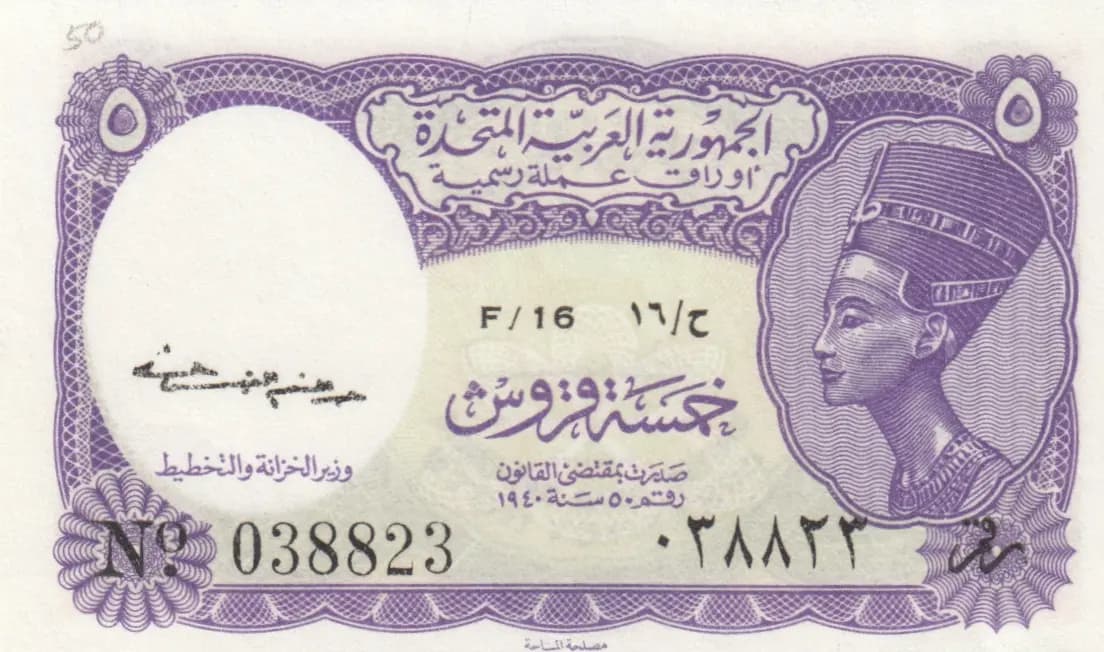
This is a 1962 Egyptian 5 Piastres banknote (P-180b) issued by the United Arab Republic, featuring a striking purple color scheme with an elegant portrait of Queen Nefertiti in profile wearing her iconic nemes crown. The note displays the characteristic fine engraving and decorative arabesque patterns typical of mid-20th century currency production. While the visual analysis notes some foxing, discoloration, and age-related patina, the cataloged condition grade is UNC (Uncirculated), suggesting this assessment may reflect the note's technical grade rather than its visual appearance—a common occurrence with vintage currency.
Common. This note was issued during a 10-year period (1961-1970) by the United Arab Republic and represents a standard circulation issue. eBay market data confirms common status: UNC examples have sold for as low as $0.99-$5.50, with 2019 catalog values of $15 for UNC reflecting moderate collector interest but widespread availability. The note is not from a short-lived authority, was not recalled, and large quantities remain in the numismatic market.
Issued under Law No. 50 of 1940 during the United Arab Republic period (1961-1970), this note represents a significant moment in Egyptian monetary history following the union of Egypt and Syria. The prominent imagery of Queen Nefertiti, ancient Egypt's most recognizable queen consort, deliberately invokes pharaonic heritage to connect the modern Arab state with Egypt's classical past. The bilingual inscriptions in Arabic and English, along with the Ministry of Finance and Planning designation, reflect the administrative structure of Gamal Abdel Nasser's nationalist government.
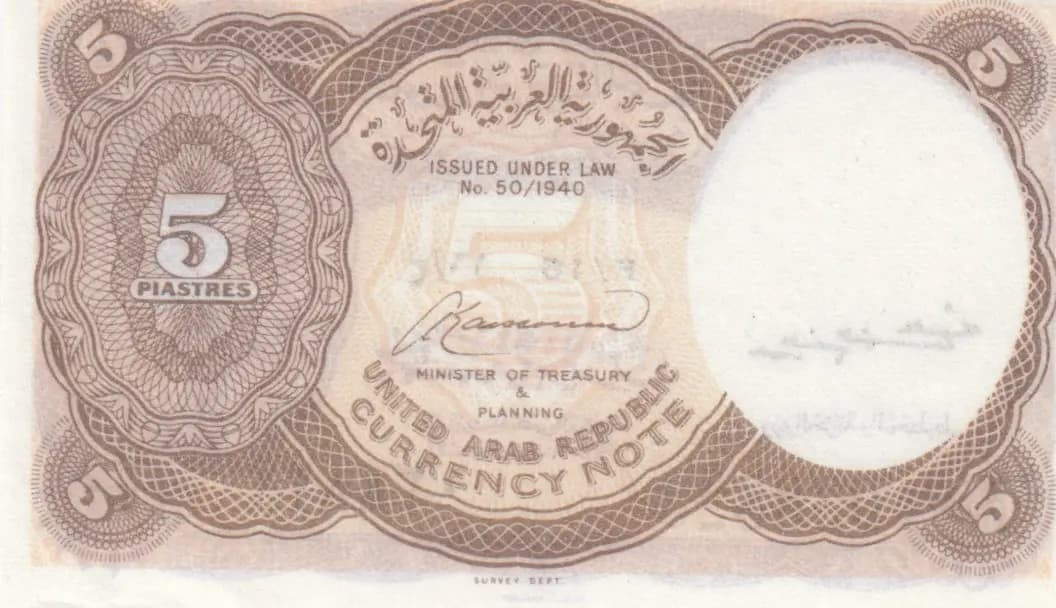
The obverse features a right-facing profile portrait of Queen Nefertiti wearing the distinctive tall nemes crown with its characteristic uraeus serpent, rendered in fine engraving detail. The portrait is positioned on the right side of the note, with an ornamental blank oval space (watermark area) dominating the left side. The purple color scheme is complemented by cream/white backgrounds and intricate decorative elements including floral rosette patterns in the corners and elaborate arabesque designs throughout the border. Denomination numerals '5' appear in decorative circular frames on both left and right margins. The reverse maintains the design vocabulary with a brown/tan color scheme, featuring similar geometric and arabesque ornamentation, watermark space, and bilingual text emphasizing the legal authority (Law 50/1940) and the issuing authority of the United Arab Republic.
FRONT SIDE: جمهورية العربية المتحدة (United Arab Republic) | وزارة المالية والتخطيط (Ministry of Finance and Planning) | خمسة قروش (Five piastres) | F/16 and 16/ج (Series designation) | ج خمسة وعشرين سنة 1940 (Twenty-five year [law] 1940) | Serial numbers: NB 038823 and 288622. BACK SIDE: ISSUED UNDER LAW No 50/1940 | 5 PIASTRES | جمهورية العربية المتحدة (United Arab Republic) | MINISTER OF TREASURY & PLANNING | UNITED ARAB REPUBLIC CURRENCY NOTE | SURVEY DEPT (printer attribution).
Intaglio engraving, printed by the Survey Department (as noted on the reverse). The fine line work, detailed decorative borders, and geometric patterns visible throughout the note are characteristic of traditional intaglio/recess printing, which was the standard security printing method for banknotes of this era. The crisp definition of the Nefertiti portrait and the intricate arabesque patterns demonstrate the high-quality engraving capabilities of the Survey Department.
This note is specifically P-180b, which is distinguished from P-180a by the absence of a text line above the Block/Series number. The visual analysis confirms this characteristic—the series designation 'F/16' and '16/ج' appears without additional text above it. The signature shown is Kaissouni with the title 'MINISTER OF TREASURY AND PLANNING.' Series numbers 16-18 are documented for this variety. The printer attribution 'SURVEY DEPT' appears on the reverse, distinguishing it from earlier issues. No Survey of Egypt imprint line appears on this variety.