25 piastres 1979
Market Prices
13 salesAbout This Note
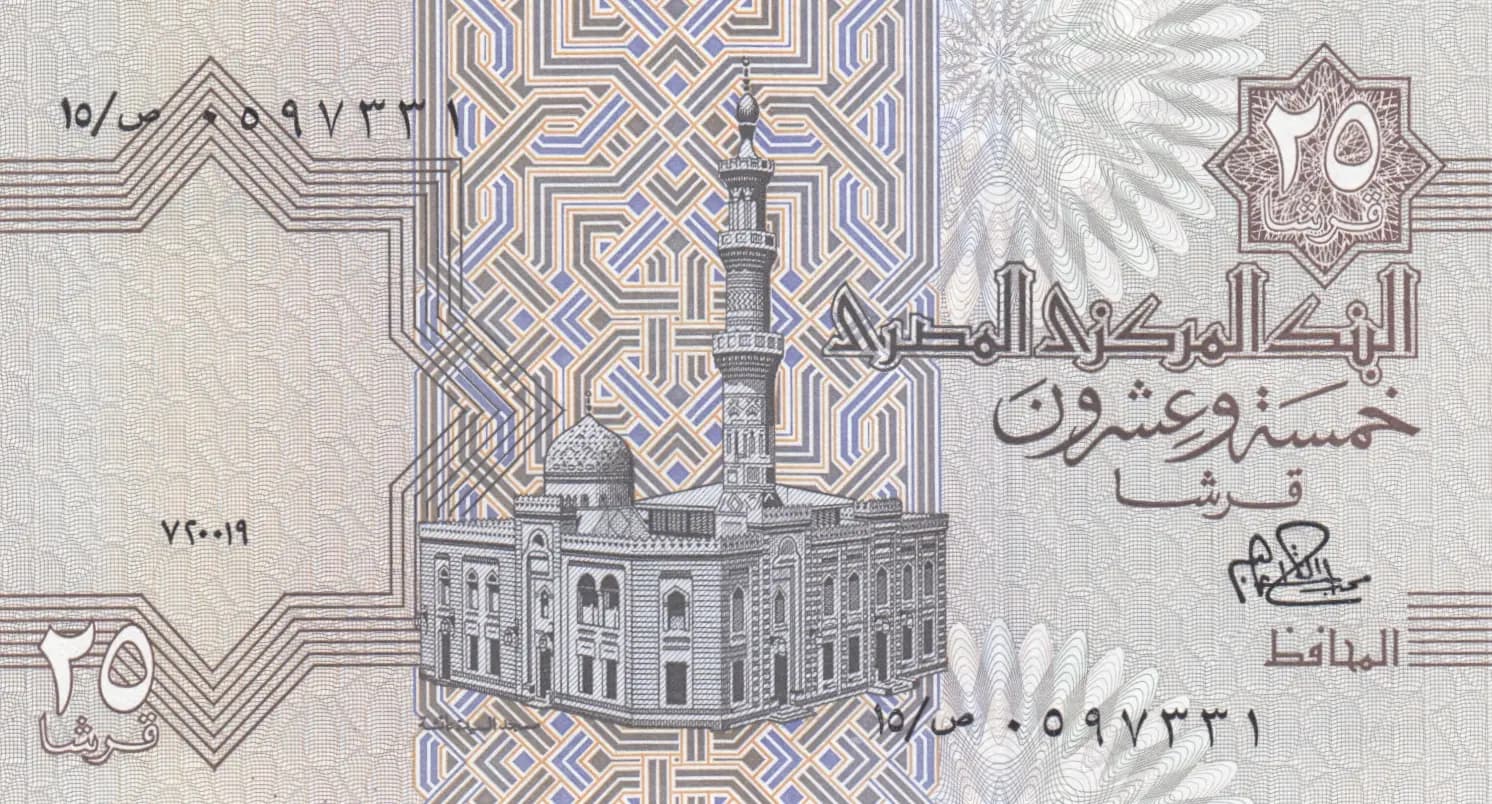
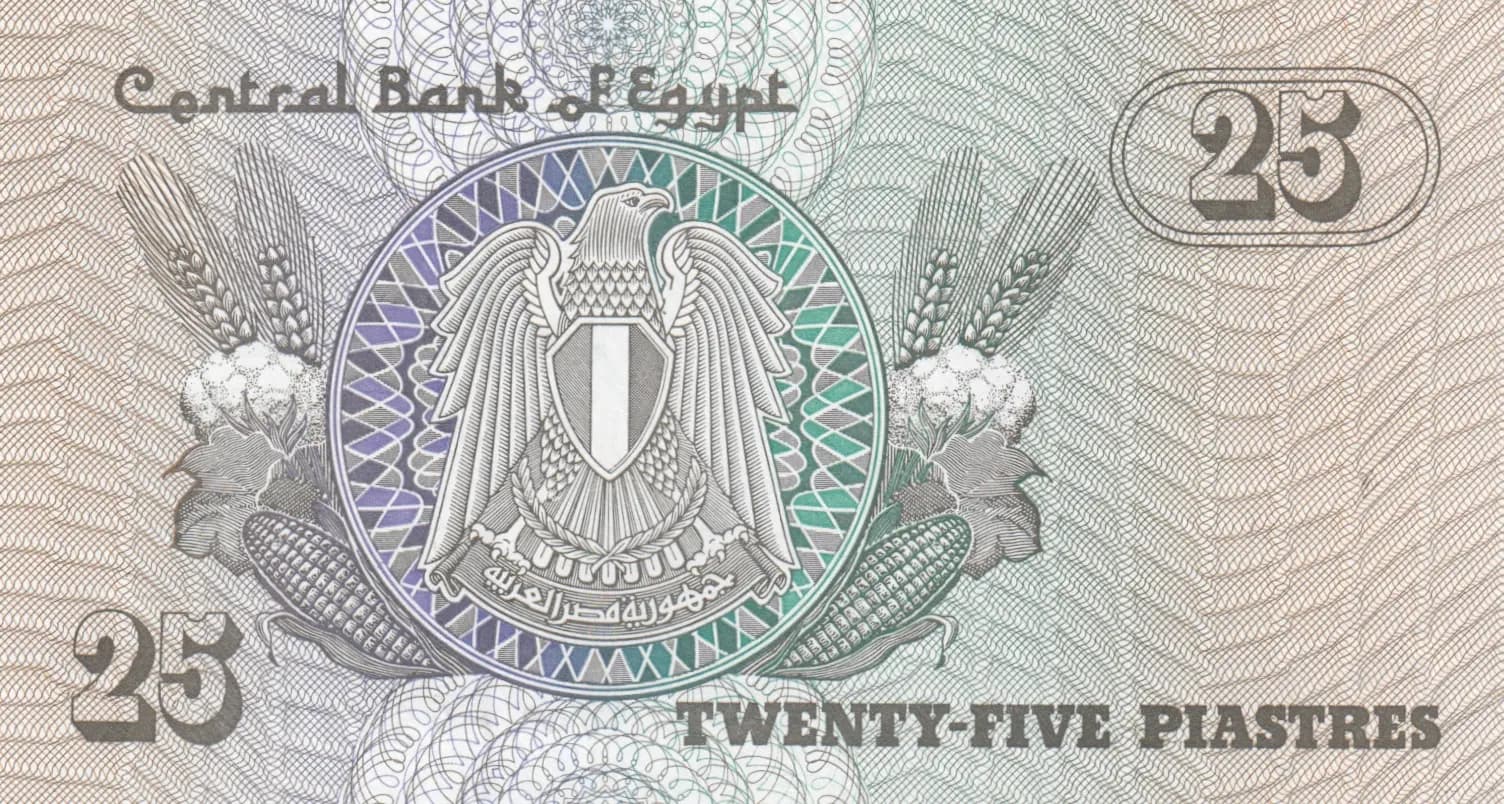
This is a crisp, uncirculated example of Egypt's 1979 25 piastres note (Pick P-49), featuring the architecturally significant Al-Sayida Aisha mosque prominently displayed on the obverse. The reverse showcases the stylized Egyptian national arms with an eagle emblem flanked by wheat stalks, all rendered in fine detail with sophisticated security printing. The note exhibits the characteristic color palette of brown, blue, and gold on the obverse with green and purple accents on the reverse, displaying no signs of wear or circulation.
Common. The eBay price tracking data shows this denomination in UNC condition selling consistently in the $6.84–$15.50 range across multiple sales from 2015–2023, with catalog 2019 valuations at $2 for UNC. These low price points and regular market availability indicate robust print runs with no scarcity premium. The note was part of regular circulation issue (1979) and remains widely available to collectors.
Issued in 1979 by the Central Bank of Egypt during a period of significant modernization in Egyptian banking and currency design, this note reflects the nation's pride in its Islamic architectural heritage through the prominent depiction of the Al-Sayida Aisha mosque in Cairo's Nasr City. The reverse's agricultural imagery—wheat, corn, and cotton plants—alongside the national eagle emblem emphasizes Egypt's economic foundation during the post-Sadat era, symbolizing both national identity and economic resources. The use of Tutankhamen's mask as the watermark connects modern Egypt to its ancient pharaonic legacy.
The obverse features the Al-Sayida Aisha mosque as the central focal point—an important Fatimid-era religious structure located in Nasr City, Cairo, depicted with its characteristic minaret tower and domed structures rendered in fine intaglio engraving. The composition is framed by ornate Islamic geometric patterns in blue and gold, creating a decorative border typical of Egyptian currency design. The denomination '25' appears within a star-shaped cartouche bearing the crescent moon and star national symbols. The reverse displays the Egyptian national coat of arms featuring a stylized eagle (Qanun al-Nisr) with an intricate shield, flanked by wheat and grain stalks representing agricultural wealth. Both sides employ fine guilloche patterns and microprint security elements throughout, with a clean, balanced layout emphasizing national pride and cultural heritage.
OBVERSE: 'البنك المركزي' (Central Bank), 'جمهورية مصر' (Republic of Egypt), 'خمسة وعشرون' (Twenty-five), 'قرش' (Piaster), '25' (numeral), with serial numbers '10/0973/2' and '750019'. REVERSE: 'Central Bank of Egypt' (English), 'جمهورية مصر العربية' (Arab Republic of Egypt), 'TWENTY-FIVE PIASTRES' (English), '25' (numeral denomination).
Intaglio printing (engraved), characteristic of high-security banknote production from this era. The note demonstrates sophisticated security printing with complex guilloche patterns, fine-line engraving detail, and background microprint security features typical of Central Bank of Egypt currency produced in the late 1970s. The precision and depth of the architectural details, particularly on the mosque minaret and national emblem, indicate master engraving craftsmanship. The printer for this series is consistent with CBE security standards of the period, likely produced at the National Printing House or under CBE supervision.
Pick P-49 covers the 1979 issue date range of 02.01.1979–10.05.1979. Varieties exist within this series based on date of issue and serial number prefixes. The observed specimen with serial numbers visible can be cross-referenced against known variety catalogs, though the standard design elements (Al-Sayida Aisha mosque obverse, national arms reverse, Tutankhamen watermark) remain consistent across the 1979 issue. Related contemporary varieties are cataloged as P-54 and P-57 with different dates and color schemes.