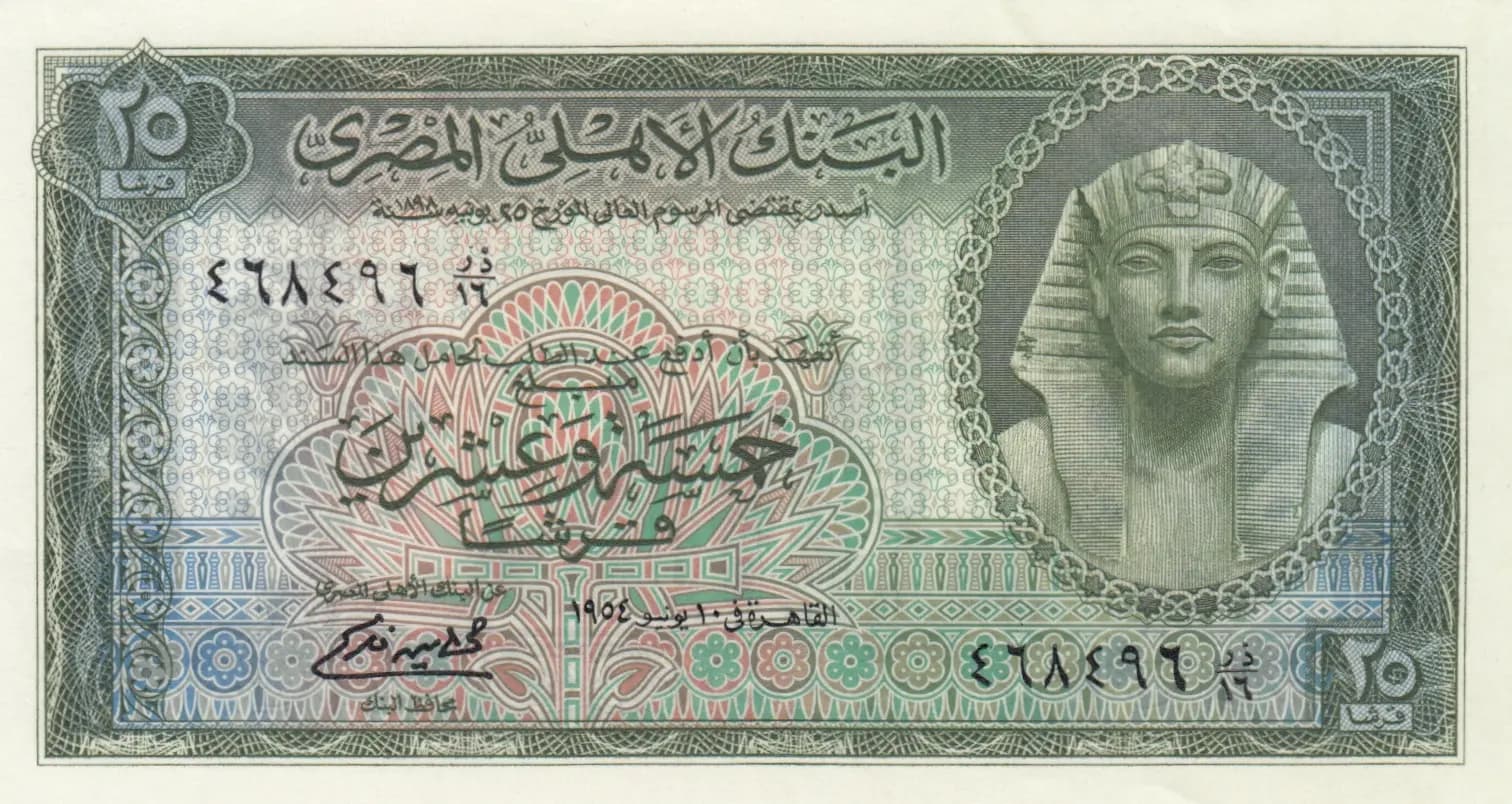
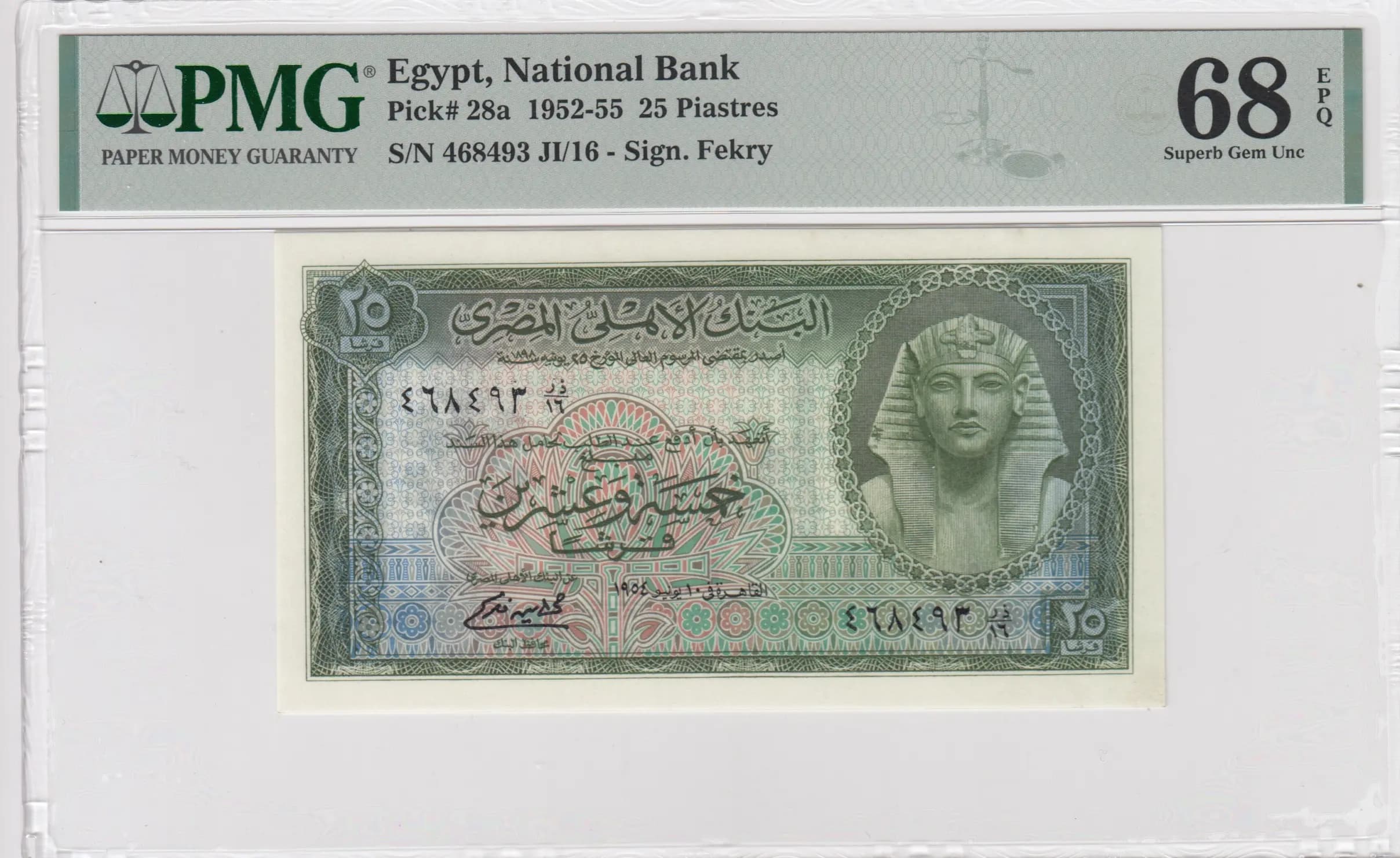
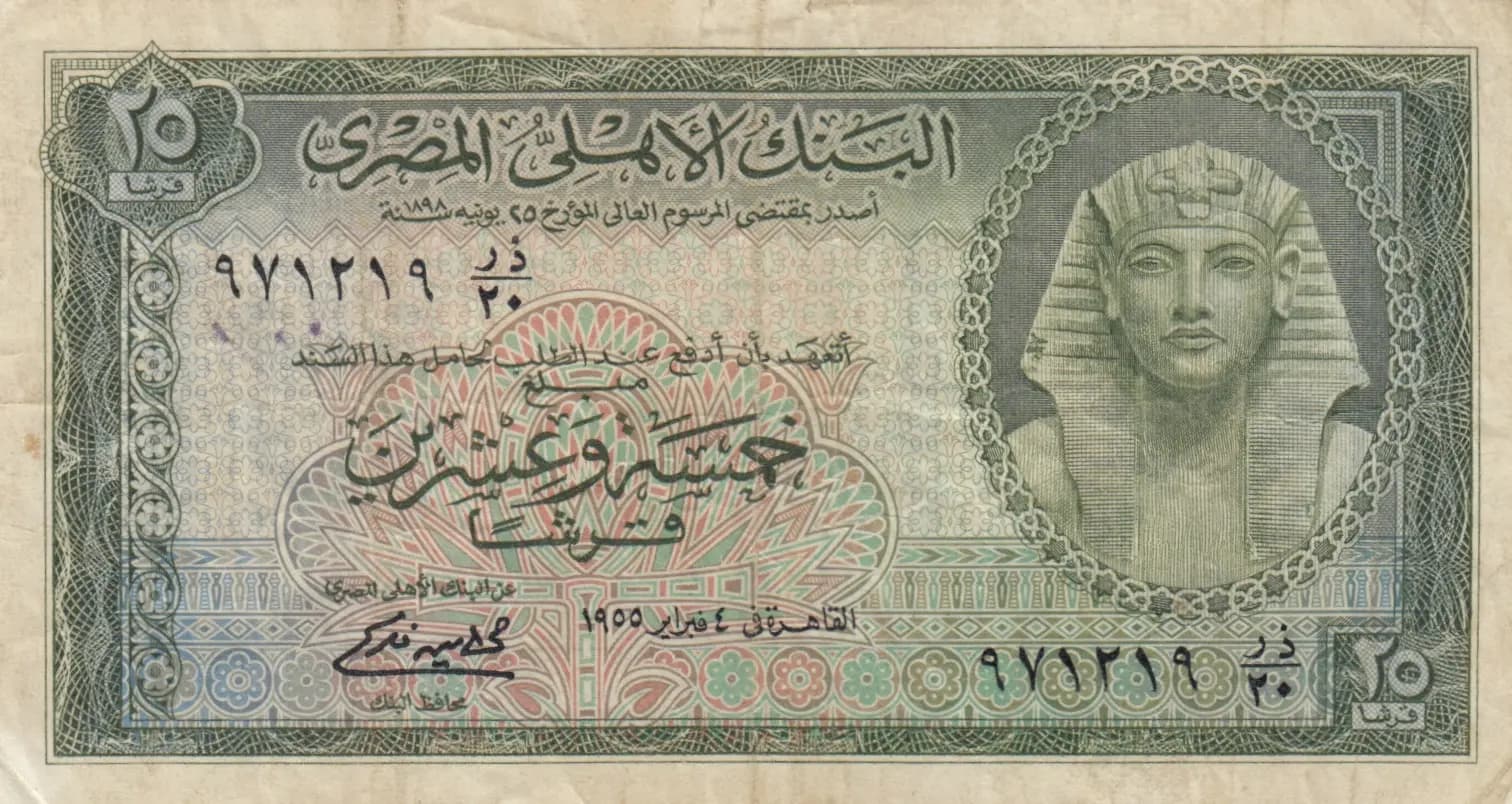
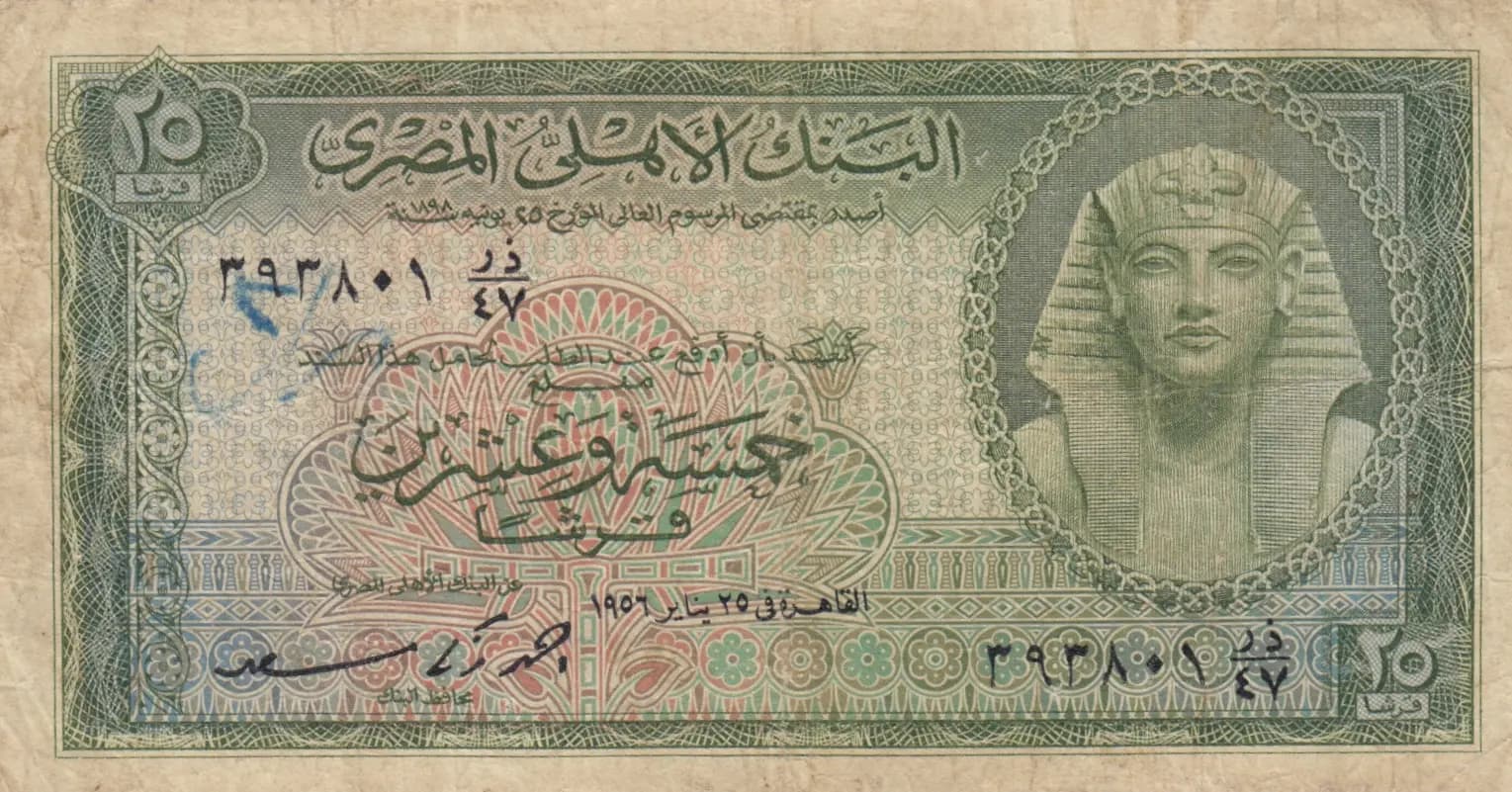
25 piastres 1952
Market Prices
21 salesAbout This Note
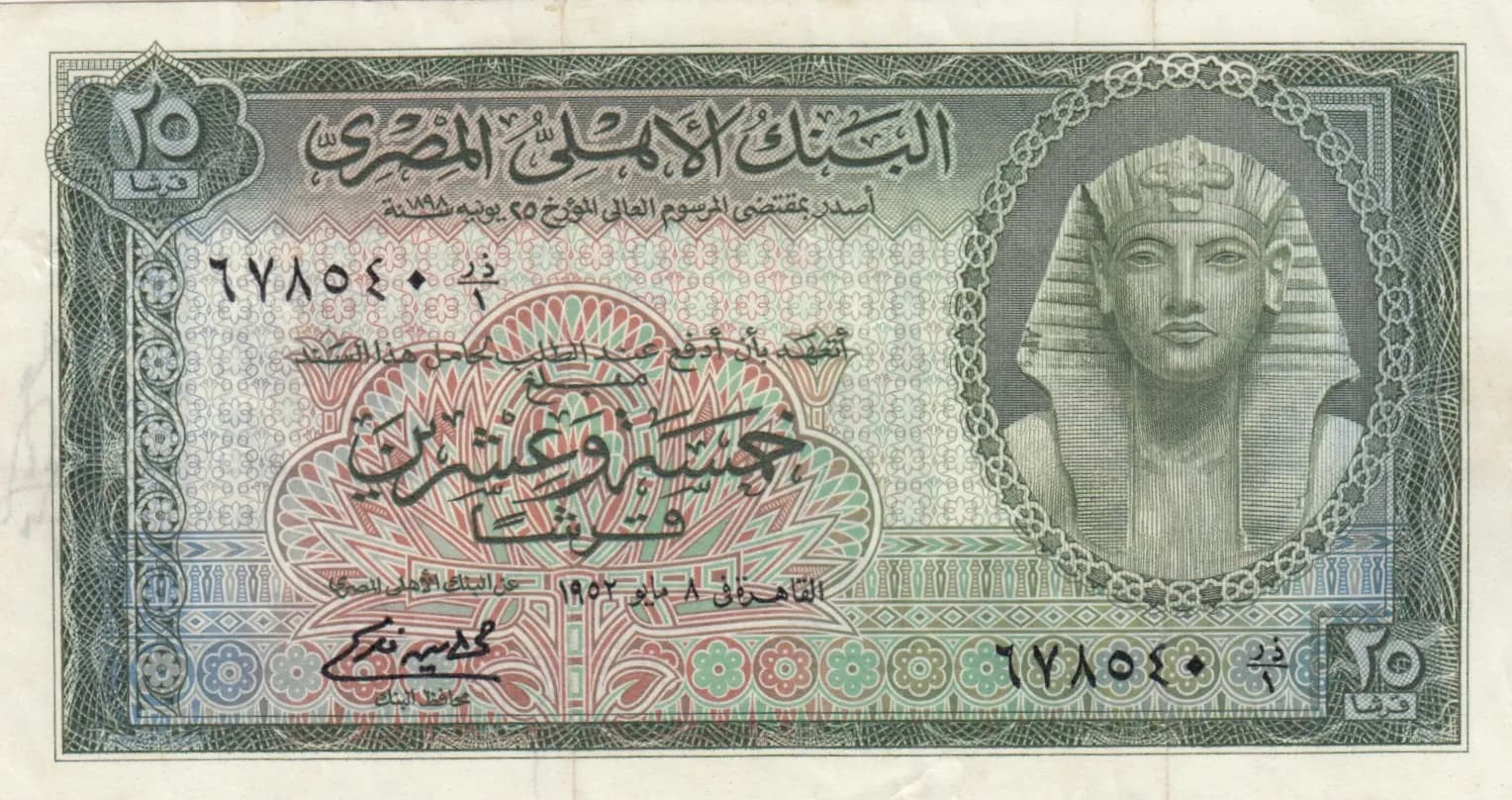
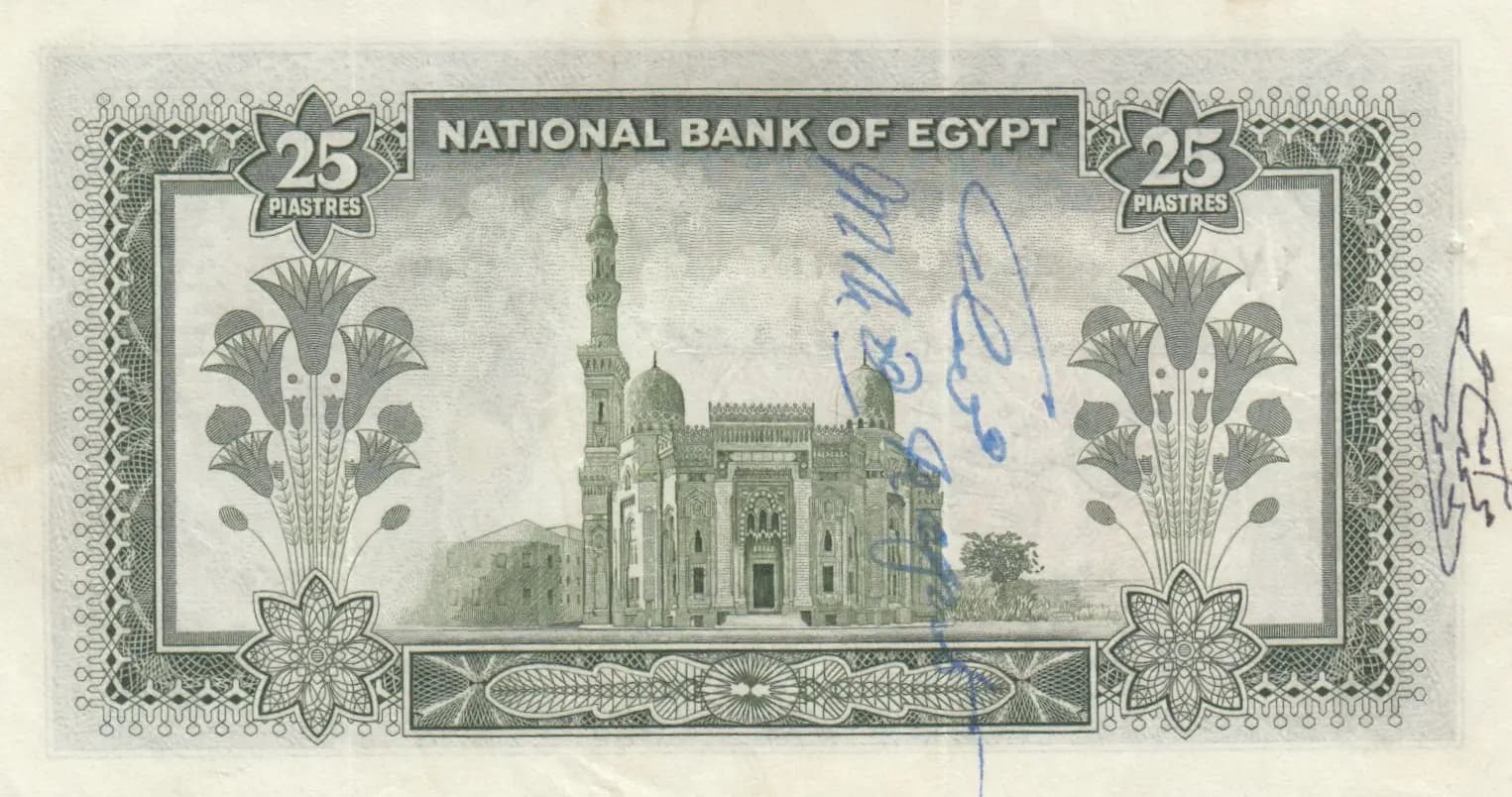
This is an Egyptian 25 Piastres note from 1952, issued by the National Bank of Egypt and graded VF (Very Fine). The note features a striking profile portrait of Tutankhamen in traditional nemes headdress on the obverse, surrounded by intricate ornamental borders with geometric and floral patterns, and a central radiating medallion in red, pink, and green. The reverse displays an architectural scene of the El-Morsi Abdoul Abbas mosque in Alexandria flanked by stylized lotus blossoms. Despite its age, the note shows typical handling wear with creases, folds, and ink marks consistent with circulation use, yet retains good visual clarity and color definition.
Common. The eBay market data shows consistent sales activity at modest prices ($20-$40 for EF condition, $30-$50 for AUNC, $60-$90 for PMG 66), with catalog values of $5 for VF condition as of 2016. The 1952-1957 issue series had substantial print runs, and this denomination remains readily available in the secondary market. The presence of multiple sales transactions over more than a decade with stable pricing indicates healthy supply. The VF condition grade observed here represents a typical circulated specimen, not a premium or scarce variant.
This note was issued during Egypt's transitional period following the 1952 Revolution that toppled the monarchy and established the Egyptian Republic. The obverse portrait of Tutankhamen references ancient Egyptian pharaonic heritage—a symbolic choice for the newly independent nation reclaiming its historical identity. The reverse's depiction of the El-Morsi Abdoul Abbas mosque in Alexandria, a significant Islamic landmark in Egypt's second-largest city, reflects the nation's religious and cultural prominence, while the lotus motif connects to both ancient Egyptian symbolism and classical artistic traditions.
The obverse features a portrait of the young pharaoh Tutankhamen shown in left-facing profile, wearing the iconic striped nemes headdress rendered in green and gray tones. The portrait is positioned on the right side of the note and is framed within a cartouche-style ornamental border. The central design element is an elaborate radiating medallion with fan-like patterns in red, pink, and green, creating a highly decorative focal point. Intricate geometric and floral border designs frame the entire composition. The reverse showcases the El-Morsi Abdoul Abbas mosque with its characteristic minaret and dome in the center, a historically significant Islamic architectural landmark. The mosque is flanked symmetrically by stylized papyrus or lotus flower motifs, symbols deeply rooted in ancient Egyptian iconography. The denomination '25 PIASTRES' appears in English in multiple locations around the ornamental border frame.
FRONT SIDE: 'البنك الأهلي المصري' (National Bank of Egypt); 'أسدر عملاً بقانون العام الثالث عشر بتاريخ مايو سنة ١٩٥٢' (Issued by law of the 13th year, dated May 1952); '٢٥' (25); Serial number '٢٧٨٥٤' (27854); Official signatures and authorization marks in Arabic script. BACK SIDE: 'NATIONAL BANK OF EGYPT' (in English); '25 PIASTRES' (denomination in English, appearing in multiple locations around the border); Handwritten marks and signatures visible on the note.
This note was produced using intaglio (recess) engraving printing, evident from the fine, intricate line work, precise geometric patterns, and multi-color separation printing visible throughout both sides. The complexity of the border designs, the detailed architectural rendering of the mosque, and the fine background pattern work are characteristic of high-security banknote production. The National Bank of Egypt likely employed Thomas De La Rue or a similar prominent security printer of the era, as was standard for Commonwealth and Middle Eastern central banks during the 1950s. The multi-tone color application and precise registration demonstrate professional banknote-grade production standards.
This specimen is from the standard P-28 issue of 1952. The PMG population report indicates two cataloged variants exist for this Pick number (P-28 and P-28s, the latter presumably being a specimen or special variety). The serial number '27854' visible on the obverse and multiple handwritten marks suggest this is a standard circulation note rather than a specimen issue. No significant overprints, special prefixes, or documented major varieties are apparent from the visual evidence. The May 1952 date of issue corresponds to the immediate post-revolutionary period and represents the standard first-year issuance of this series.