10 pounds 1947
Market Prices
22 salesAbout This Note
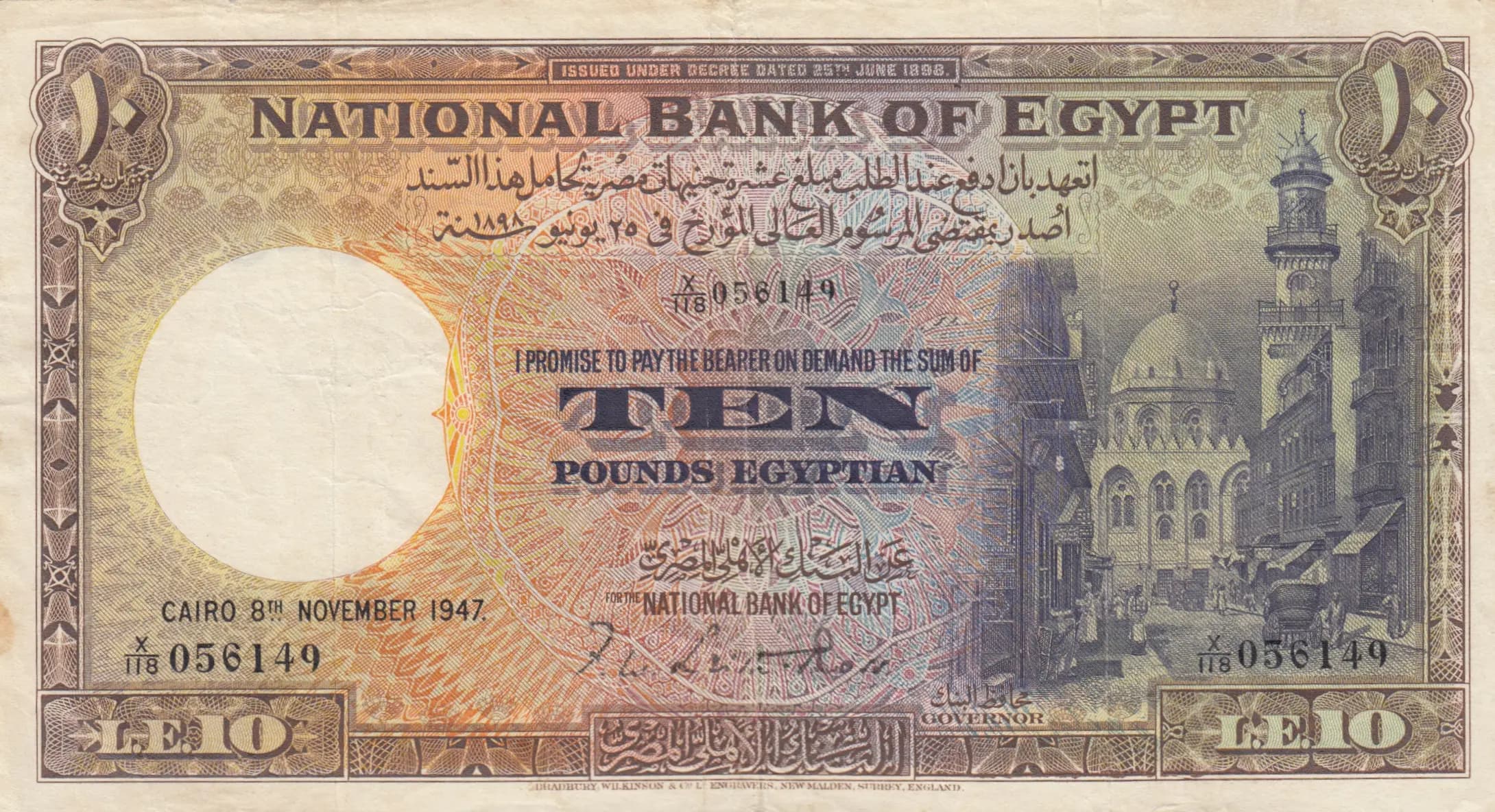
This 10 Egyptian Pounds note from 1947 represents a classic example of mid-20th century Egyptian currency featuring fine engraved Islamic architectural imagery. The front displays the ornate Sultan Qala-un mosque complex with characteristic minarets and domes rendered in muted blue and green tones against elaborate geometric borders. In VF condition, this note exhibits the expected aging patina and light circulation wear typical of notes from this era, with the detailed engraving and security features remaining well-preserved and legible.
Common. The Pick P-23c (10 Egyptian Pounds, 1947 series) was part of a substantial issue during the 1931-1951 circulation period. Secondary market data from eBay shows consistent availability with regular sales, with VF-graded examples selling in the $29-$77 range across multiple transactions from 2012-2024. The 2016 catalogue value of $150 for VF reflects a moderately popular collector note rather than a scarce issue. Print runs during this period were substantial, and these notes remain relatively available in used grades, confirming common status.
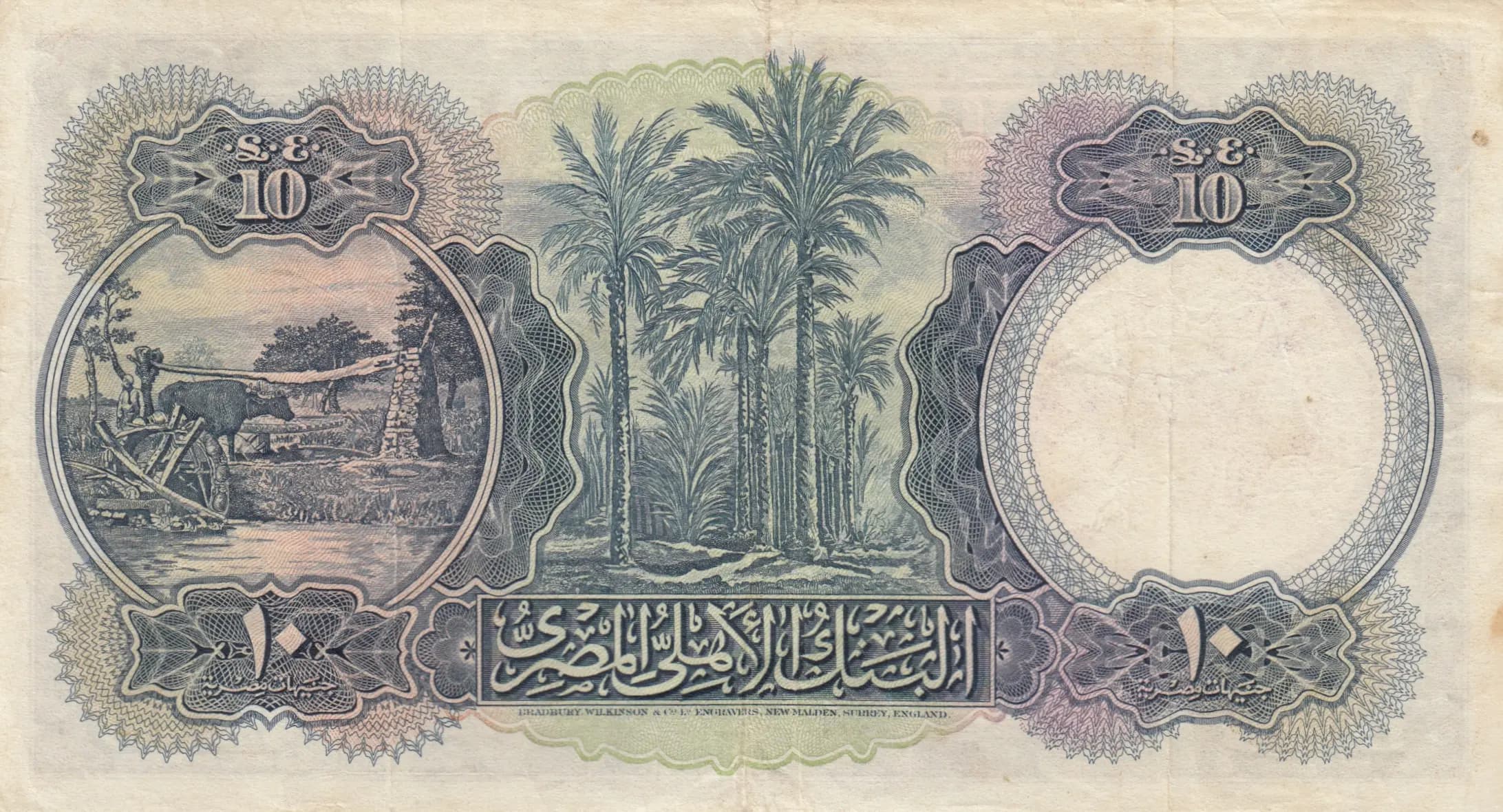
Issued under the authority of the National Bank of Egypt on November 8, 1947, this banknote reflects Egypt's pre-revolutionary currency period during the late monarchy era. The prominent depiction of the Sultan Qala-un mosque—one of Cairo's most significant Islamic architectural monuments—underscores Egypt's cultural heritage and Islamic identity. The reverse imagery of palm groves and rural agricultural scenes emphasizes the agrarian foundations of Egypt's economy during this period, while the English-language inscriptions reflect the lingering influence of British colonial administration in Egyptian institutions.
The obverse features the Sultan Qala-un Mosque complex in Cairo as the primary architectural landmark, depicted with detailed engraving showing multiple minarets and domes characteristic of Mamluk Islamic architecture. The composition is framed by ornate Islamic geometric borders in browns and golds with quatrefoil design elements in the corners. A prominent circular watermark space occupies the left side. The reverse presents a diptych composition with a rural pastoral scene in the left vignette showing figures and animals near water, flanked by an ornamental but empty right vignette. The central focus of the reverse is a tall palm grove or date palm forest, evoking Egypt's agricultural wealth. Both sides are bordered with intricate geometric and floral patterns reflecting Islamic design traditions. Denomination numerals appear in decorative frames in corner cartouches on both sides.
FRONT: 'NATIONAL BANK OF EGYPT' (issuer); 'I PROMISE TO PAY THE BEARER ON DEMAND THE SUM OF TEN POUNDS EGYPTIAN' (promise to pay clause); 'CAIRO 8TH NOVEMBER 1947' (issue date); 'ISSUED UNDER DECREE DATED 23TH JUNE 1898' (legal authority); Serial number 'ITS 056149'; Denomination 'L.E 10' (Egyptian pounds). Arabic text in upper portion and center provides institutional information in Arabic script. BACK: Denomination '10' appears in corner cartouches; 'BRADBURY WILKINSON & Co LTD, ENGRAVERS, NEW MALDEN, SURREY, ENGLAND' (printer attribution); Arabic text at bottom center with institutional information; Reference mark 'S.&8'.
This note was produced using intaglio engraving (line engraving) by Bradbury Wilkinson & Co Ltd, a renowned British security printer located in New Malden, Surrey. The visual analysis reveals characteristic fine line work, intricate parallel line patterns creating security texture, and detailed engraved landscape and architectural imagery typical of high-security banknote production of this era. The multiple layers of fine parallel lines and ornamental patterns demonstrate sophisticated anti-counterfeiting techniques employed through engraved intaglio printing.
This note is catalogued as Pick P-23c, one of four identified variants (P-23a through P-23d) for the 10 Egyptian Pounds denomination in this series. The specific variety appears to be differentiated by signature combinations or minor design variations typical of the 1931-1951 issue period. The November 8, 1947 date on this example confirms it falls within the established issue range. Serial number ITS 056149 suggests it is from a standard production run without special overprints or variations.