1 pound 1950
Market Prices
12 salesAbout This Note
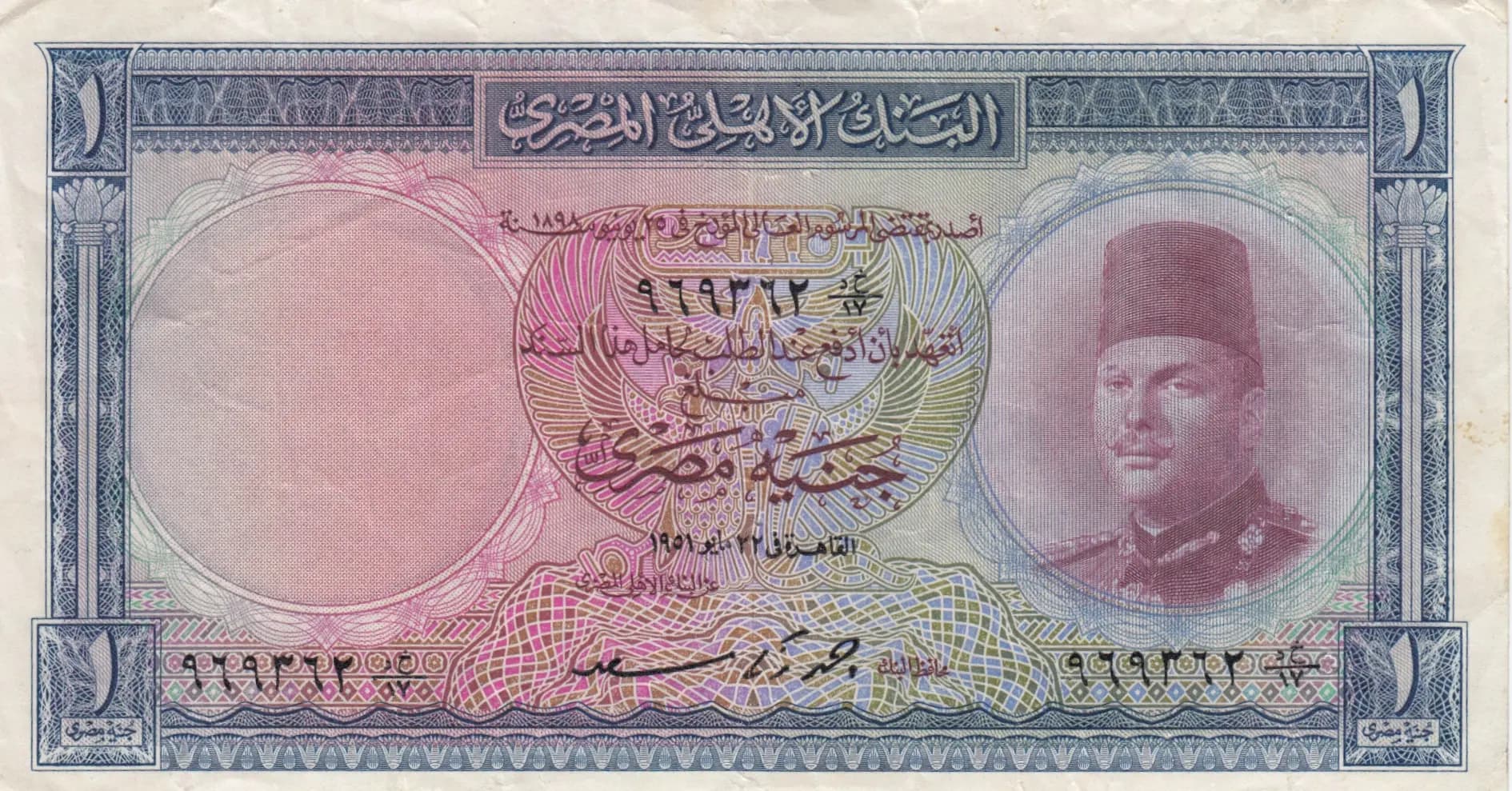
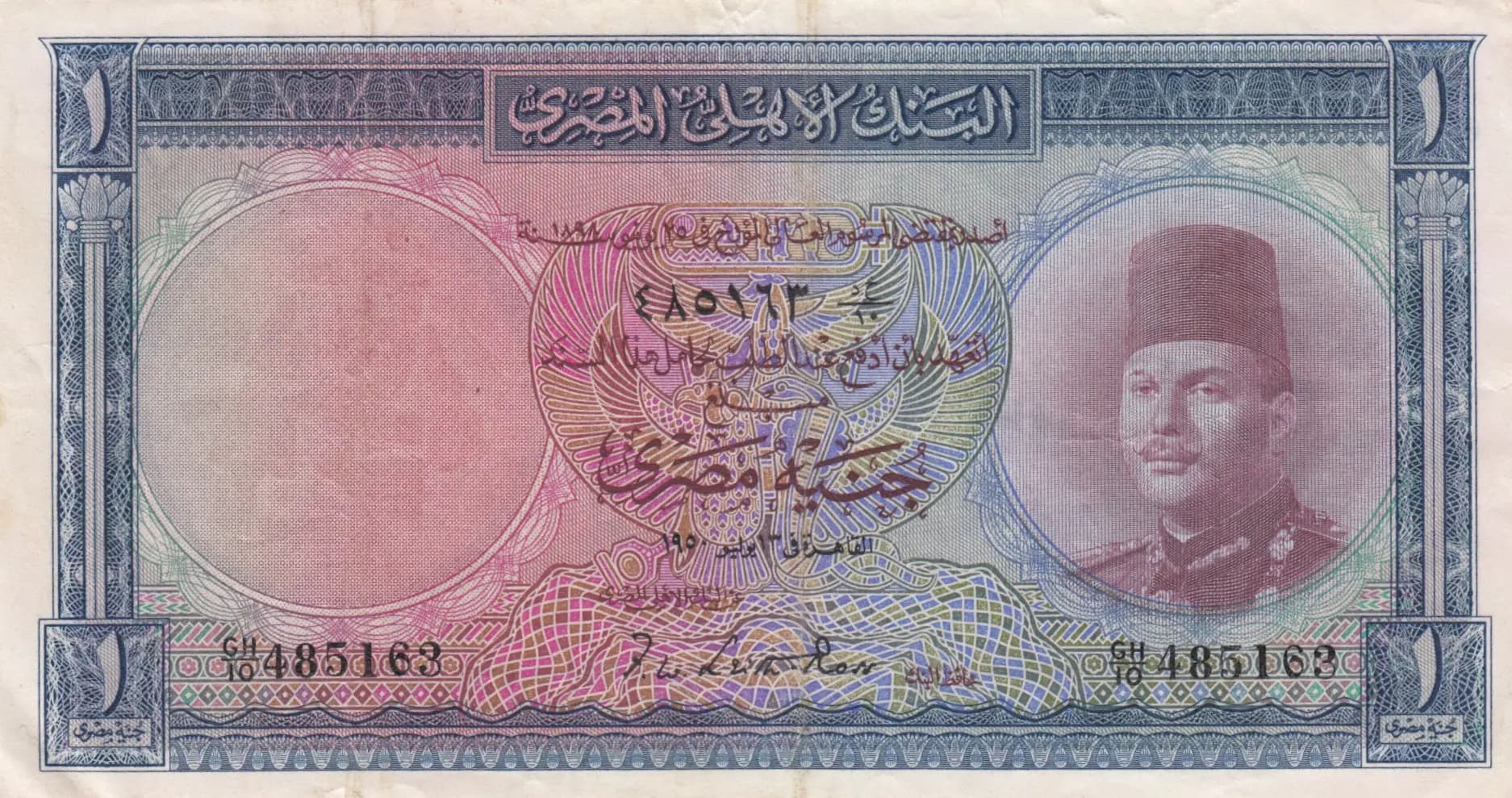
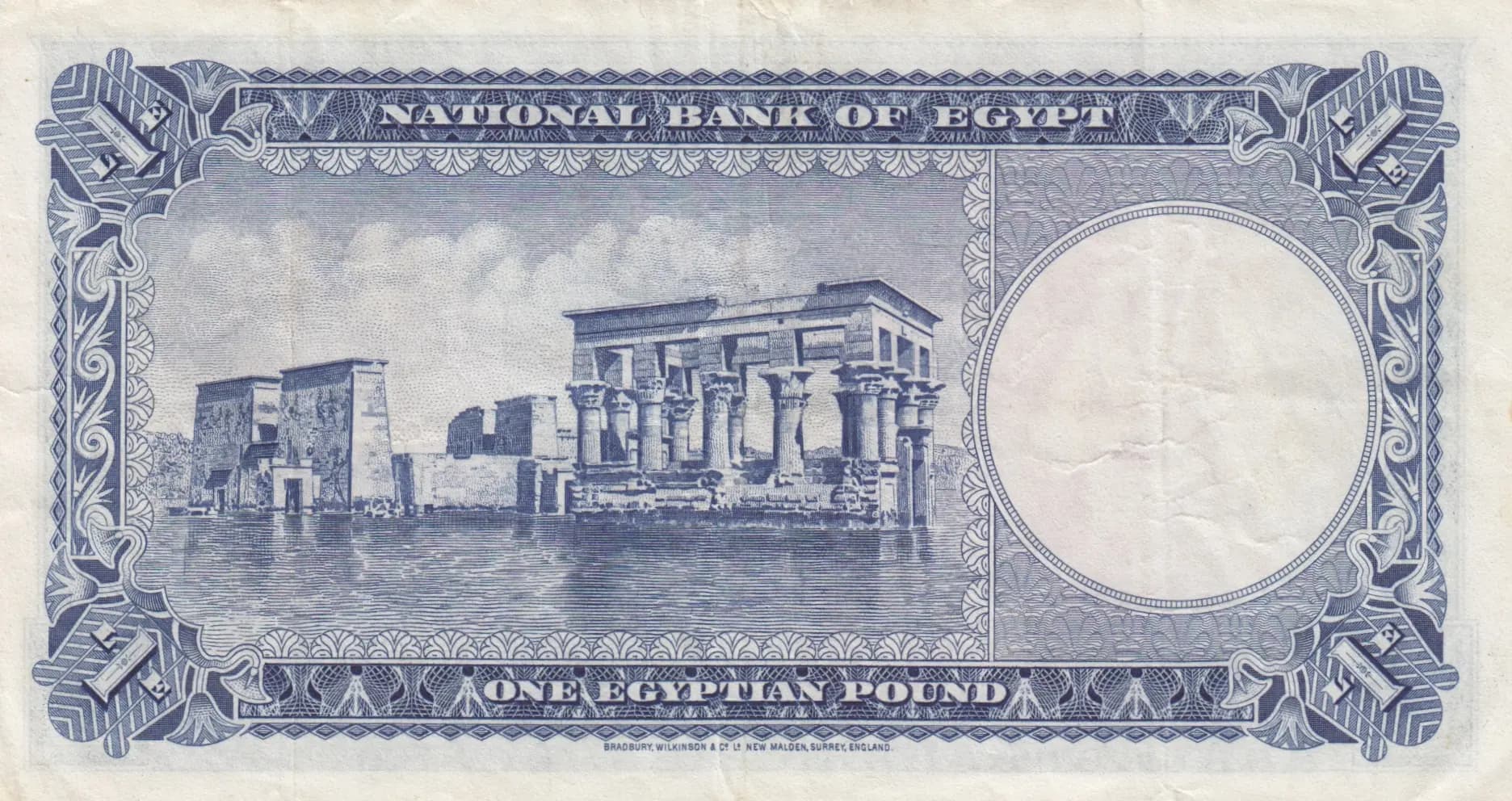
This 1950 Egyptian 1 pound note presents an excellent example of post-war Egyptian currency from the reign of King Farouk I. The VF condition specimen displays crisp, well-preserved imagery featuring the king's portrait on the obverse and the iconic Philae temple on the reverse, with vibrant multi-colored security printing in pink, blue, green, and gold tones. The note exemplifies the craftsmanship of Bradbury Wilkinson's security printing and represents an important transitional period in Egyptian monetary design before the 1952 revolution.
Common. The 1950-1952 issue of the Egyptian 1 pound note was produced in substantial quantities for regular circulation. eBay sales data shows consistent trading at modest valuations, with VF specimens selling for $20-$100 in recent years and lower grades realizing $9-$40. The 2016 catalogue valuation of $100 for VF condition reflects a common circulating issue rather than a scarce variety. Print runs from the National Bank of Egypt for this standard denominational issue were substantial, and specimens remain readily available in the collector market.
Issued in 1950 during King Farouk I's reign, this banknote represents Egypt's monetary system in the final years before the Free Officers' Revolution of 1952. The obverse inscription 'Independence and Republic' reflects Egypt's post-independence identity following the 1952 revolution, though this specific note was issued during the constitutional monarchy period. The reverse features the Philae temple, an ancient Pharaonic monument symbolizing Egypt's continuity and heritage, reinforcing nationalist sentiment during this pivotal historical moment.
The obverse features a formal portrait of King Farouk I in three-quarter view, wearing a distinctive red/maroon fez and formal attire, positioned on the right side of the note. The center of the design showcases an ornate winged coat of arms or state emblem rendered in multi-color security printing with intricate detailing. The design incorporates elaborate decorative borders with geometric patterns and stylized lotus or floral motifs in the corners, characteristic of Egyptian design aesthetics. The reverse depicts the Temple of Philae, an ancient Egyptian temple with multiple Pharaonic columns, shown partially reflected or set within water, evoking the historical flooding patterns of the Nile. Large circular frames/cartouches are present on both sides, and the entire design is framed by an intricate ornamental border with fine geometric and scrollwork elements.
Front side: Arabic inscription 'الاستقلال والجمهورية' translating to 'Independence and Republic'. Back side: English inscriptions reading 'NATIONAL BANK OF EGYPT', 'ONE POUND NOTE', and 'BRADBURY, WILKINSON & CO LTD NEW MALDEN, SURREY, ENGLAND' (printer attribution).
Intaglio/engraved printing executed by Bradbury Wilkinson & Co Ltd of New Malden, Surrey, England—one of the world's premier security printers of the era. The visual analysis reveals fine line work, intricate geometric patterns, multi-color security printing elements, and the detailed architectural rendering characteristic of high-security intaglio production. The fine engraving visible in both the border work and the central emblematic designs demonstrates professional security printing methodology.
This note is identified as Pick P-24a, characterized by the Sphinx watermark. The Pick catalog recognizes three distinct varieties for the 1 Egyptian Pound 1950-1952 issue (P-24a, P-24b, P-24c). The specific variety P-24a is distinguished by its Sphinx watermark, differentiating it from the subsequent varieties. Serial numbers appear in both European and Arabic notation. Specific date verification would require examination of the date field (noted as '1950-13.7.1950' in reference data), and signature varieties may exist within this Pick number, though the visual analysis does not provide sufficient clarity to definitively identify signature variations.