5 sucres 1970
Market Prices
9 salesAbout This Note
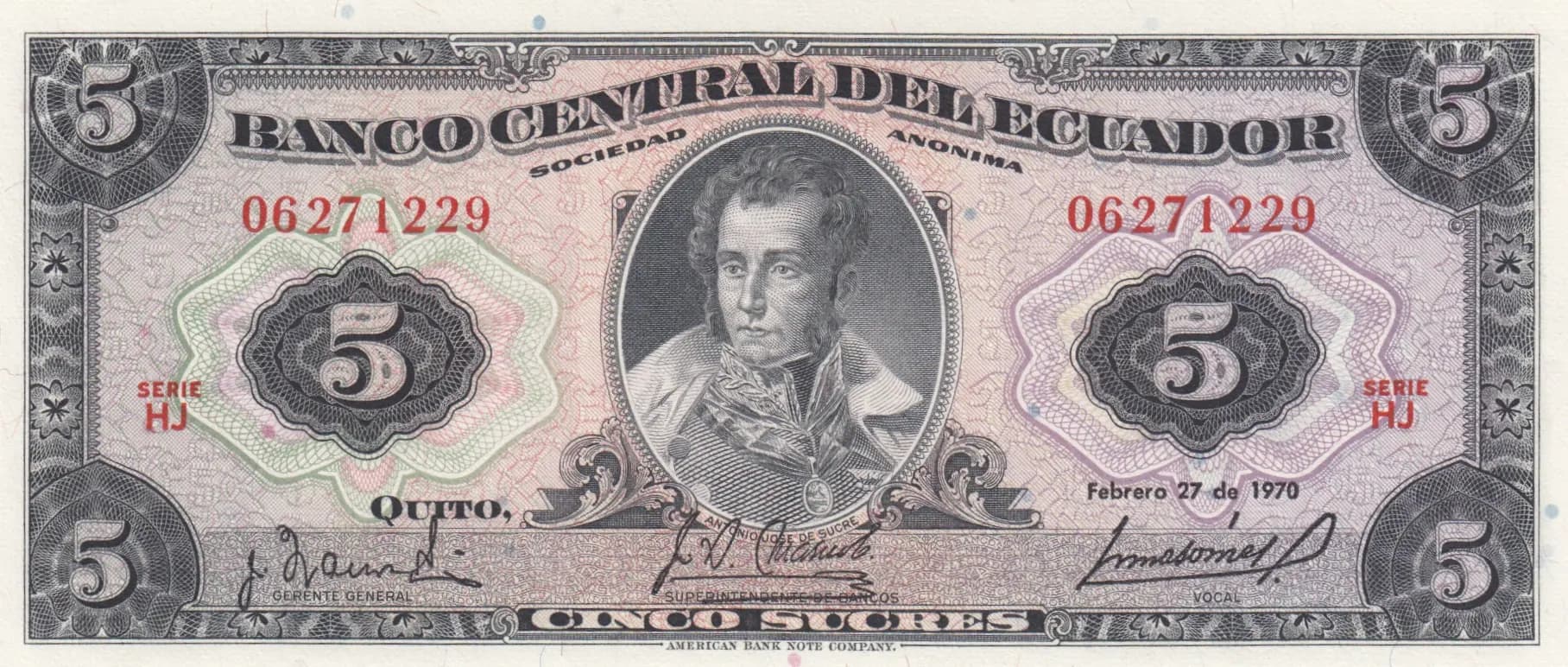
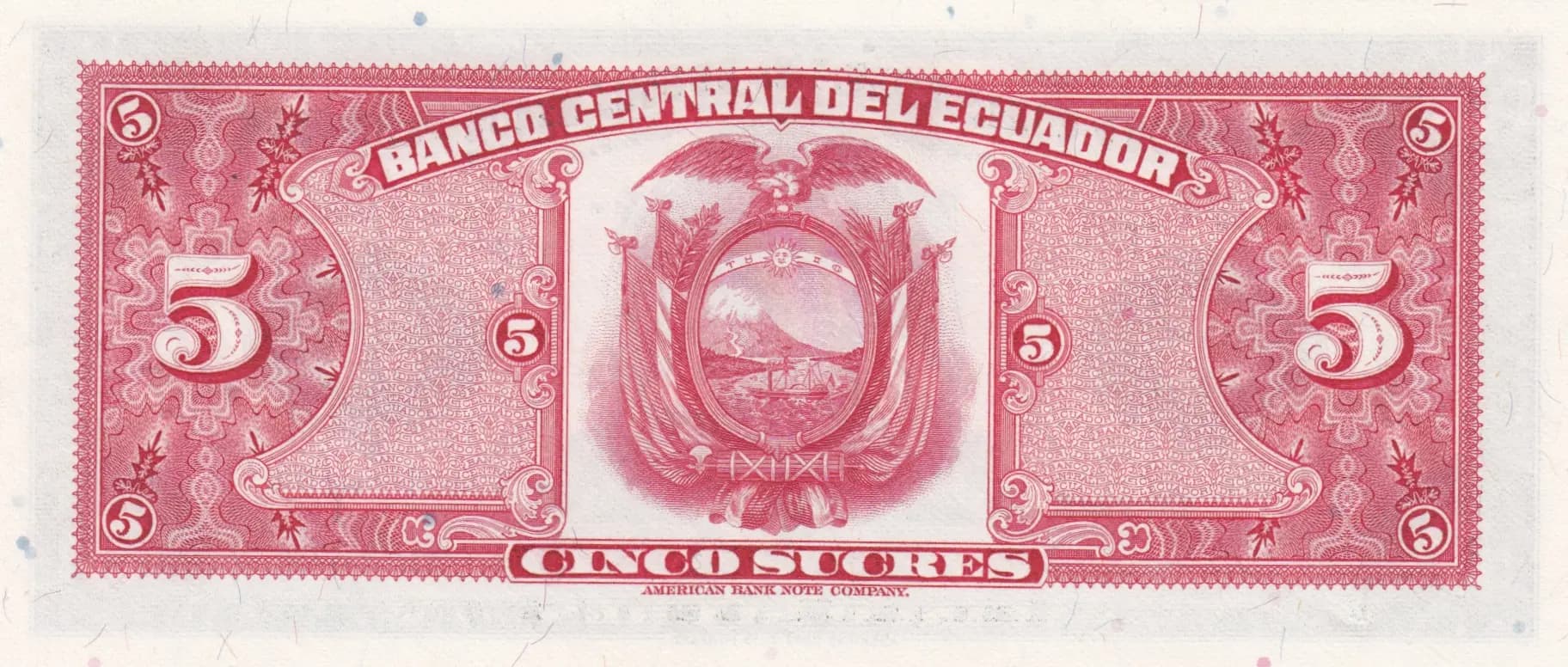
This is an exceptional example of Ecuador's 5 Sucres note from 1970 (Pick P-100d), graded UNC and printed by the American Bank Note Company. The note features a striking portrait of Antonio José de Sucre in formal 18th-century attire on the obverse, with a multicolored design dominated by pink/rose tones and intricate black engraving work. The reverse displays Ecuador's national arms within a landscape scene featuring mountains and a ship, demonstrating the high-quality security printing characteristic of ABNC work from this era.
Common. This note shows consistent market activity on eBay with regular sales in the $2-$15 range depending on grade, with UNC examples historically selling for approximately $3.50-$4.26 according to the provided market data. The issue had a production period spanning 1956-1973, indicating substantial print runs. The PMG population report shows this Pick number has limited professional grading submissions, but this reflects typical collector behavior for lower-denomination, common twentieth-century Latin American notes rather than actual rarity. The consistent availability and modest pricing confirms this as a common, readily obtainable note for collectors.
This 1970 issue represents the Banco Central del Ecuador's mid-period sucre currency, issued during a time of economic reform in Ecuador. The portrait of Antonio José de Sucre, Ecuador's founding father and national hero, honored the nation's independence legacy and was a consistent motif on Ecuadorian currency throughout the 20th century. The landscape scene with maritime elements on the reverse reflects Ecuador's geographical significance as a Pacific coastal nation with mountainous terrain.
The obverse features a centered oval portrait medallion of Antonio José de Sucre (1795-1830), Ecuador's founding father, depicted in formal 18th-century diplomatic attire with period-appropriate clothing. The portrait is surrounded by ornate scrollwork, geometric patterns, and decorative flourishes in a classical banknote style. Denomination circles in each corner contain the numeral '5' with surrounding geometric patterns in green and purple tints. The predominant pink/rose background with black engraved details creates strong visual contrast. The reverse displays Ecuador's national coat of arms (represented as a shield landscape scene) featuring mountainous terrain, water features, and a maritime vessel, surmounted by a double-headed eagle or heraldic wings. The landscape is contained within an oval shield formation, reflecting traditional heraldic presentation. Both sides feature fine-line guilloche patterns and ornamental borders typical of ABNC security printing standards.
FRONT SIDE: 'BANCO CENTRAL DEL ECUADOR' (Central Bank of Ecuador) / 'SOCIEDAD ANONIMA' (Anonymous Society/Joint Stock Company) / 'CINCO SUCRES' (Five Sucres) / 'Febrero 27 de 1970' (February 27, 1970) / 'QUITO' (Quito) / 'GERENTE GENERAL' (General Manager) / 'SUPERINTENDENTE DE BANCOS' (Superintendent of Banks) / 'VOCAL' (Vocal Member/Board Member) / 'AMERICAN BANK NOTE COMPANY' (printer attribution) / Serial number: '06271229' / Series: 'SERIE HJ'. BACK SIDE: 'BANCO CENTRAL DEL ECUADOR' (Central Bank of Ecuador) / 'CINCO SUCRES' (Five Sucres) / 'AMERICAN BANK NOTE COMPANY' (printer attribution) / Denomination '5' appears in multiple corners.
Intaglio engraving (line engraving) by the American Bank Note Company, characterized by the fine detailed line work visible throughout the design, intricate background patterns, and the crisp, raised printing quality evident in the sharp registration of colors. The multicolor printing on the obverse (black, pink, green, purple, and gray) demonstrates sophisticated color separation and registration typical of ABNC's advanced printing capabilities. Security features include fine guilloche patterns, geometric border designs, and the complex background ornamentation that would be difficult to counterfeit with period printing technology.
This specific variety is Pick P-100d from the series HJ with date February 27, 1970, serial number 06271229. The note is part of the 1956-1973 issue period with ABNC printing. The catalog reference notes that similar designs exist for Pick P-108 and P-113, suggesting this is one of multiple denominations sharing the Antonio José de Sucre portrait design from this issuing era. No overprints, watermark variations, or exceptional printing varieties are apparent in the visual analysis of this particular specimen.