1000 sucres 1988 specimen
Market Prices
24 salesAbout This Note
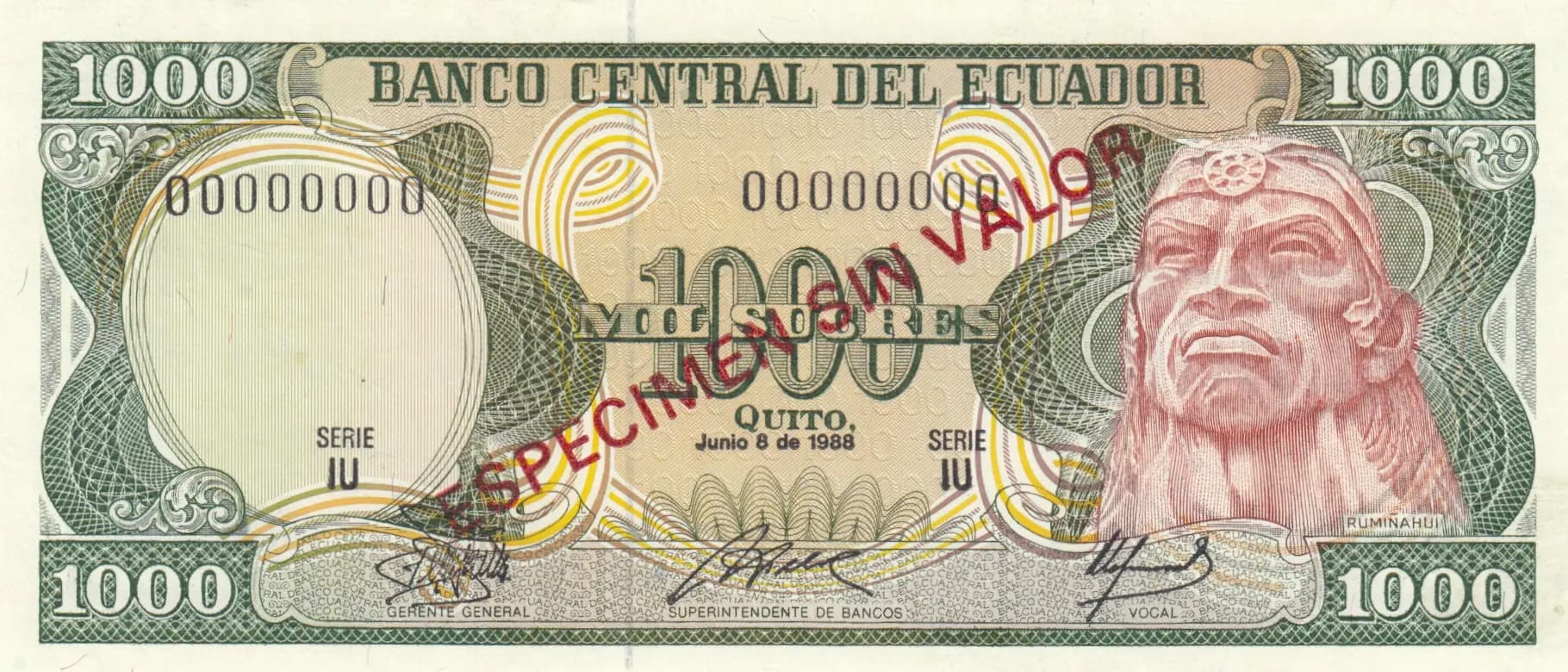
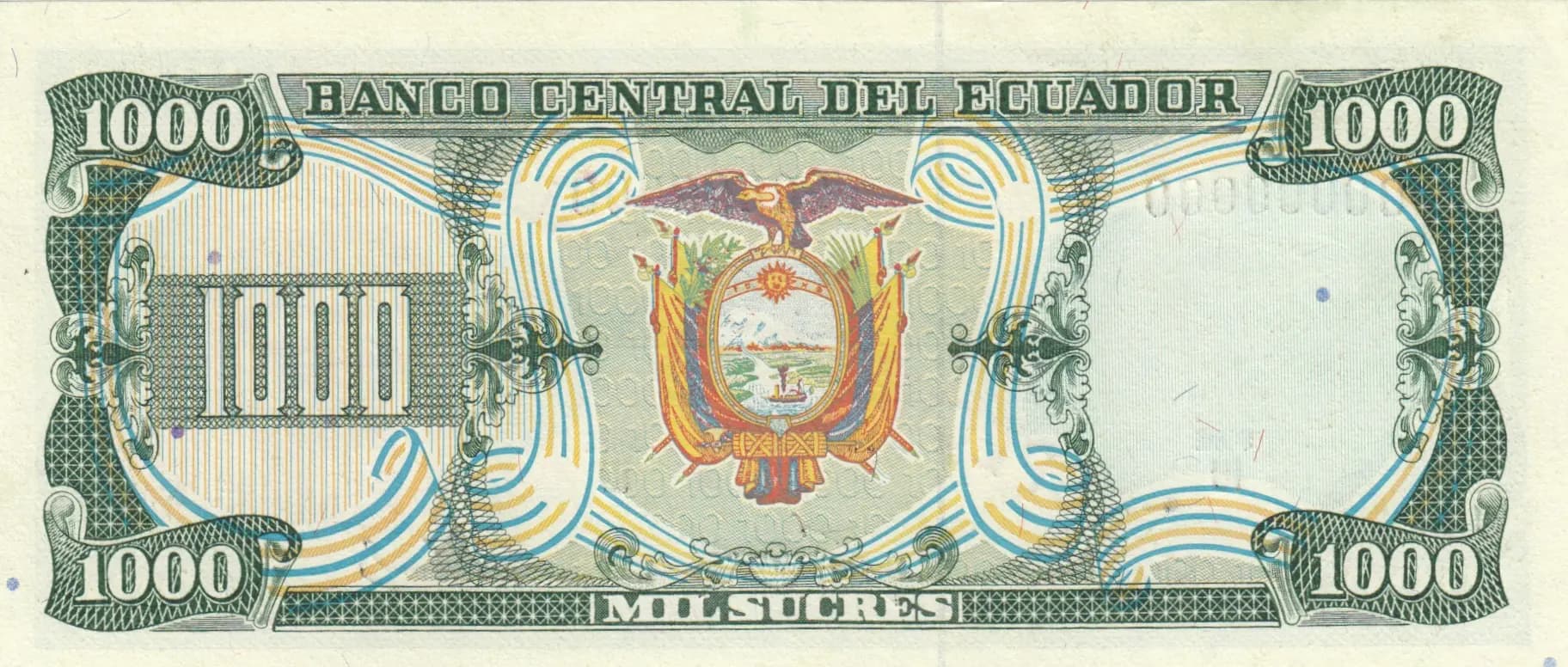
This is a 1988 specimen 1000 sucres banknote from Ecuador's Banco Central, graded UNC. The note features a portrait of Ruminahui on the obverse and Ecuador's national coat of arms on the reverse, rendered in a multicolored palette dominated by greens, pinks, and blues. As a specimen note marked with a red diagonal 'ESPECIMEN' overprint and bearing serial numbers of all zeros, this represents an official bank specimen issued for distribution, archival, or security printing reference purposes—a category of note highly valued by collectors of world banknotes and central banking artifacts.
Common. This is a specimen note from a large-scale official issue (1984-1988 date range with multiple series). eBay market data from realbanknotes.com shows consistent sales of UNC examples at $2.50–$8.00 (with professionally graded PMG examples commanding $12–$20), indicating healthy collector demand but abundant supply. Specimen notes of this denomination and period were produced in substantial quantities for banking distribution and reference purposes. While specimens are somewhat more desirable than regular-circulation notes, this particular Pick number remains widely available in the numismatic market.
The 1000 sucres denomination was issued during a period of significant inflation in Ecuador's economy during the late 1980s, necessitating higher denomination notes. The obverse features Ruminahui, an important 16th-century Quito indigenous leader who resisted Spanish colonial conquest, reflecting Ecuador's cultural heritage and nationalist identity. The reverse displays the national coat of arms with its iconic condor, shield landscape, and flags—symbols of the nation's sovereignty and territorial pride under the Banco Central del Ecuador's stewardship.
The obverse features a three-quarter portrait of Ruminahui, the 16th-century indigenous leader of Quito, rendered in pink and reddish tones on the right side of the note. The portrait is framed by ornate scrollwork and decorative flourishes in yellow, blue, and black. The left side contains a prominent circular watermark area with concentric lines, a security feature typical of the era. Denomination numerals and text identifying the issuing authority occupy the center. The reverse displays Ecuador's national coat of arms as the focal point—featuring a crowned condor at the top, a shield containing a landscape vignette with water and terrain elements, flanked by the national flags of Ecuador on either side. This is surrounded by elaborate guilloche patterns and ornamental scrollwork in greens, blues, yellows, and red-browns, creating an intricate and difficult-to-counterfeit design.
FRONT SIDE: 'BANCO CENTRAL DEL ECUADOR' (Central Bank of Ecuador), 'SERIE III' (Series 3), '1000' (denomination, appears multiple times), 'Quito' (issuing city), 'Junio 8 de 1988' (June 8, 1988), 'GERENTE GENERAL' (General Manager), 'SUPERINTENDENTE DE BANCOS' (Superintendent of Banks), 'VOCAL' (Member/Spokesman), 'ESPECIMEN' (Specimen), serial numbers shown as '00000000' (twice). BACK SIDE: 'BANCO CENTRAL DEL ECUADOR' (Central Bank of Ecuador), '1000' (denomination, appears multiple times), 'MIL SUCRES' (One Thousand Sucres).
This note was produced using intaglio engraving combined with multicolor letterpress or lithographic printing techniques, as evidenced by the crisp, fine-detail ornamental patterns, the dimensional quality of the portraits and coat of arms, and the complex guilloche security designs throughout. The printer is identified in catalog records as TDLR (Taller de Dólares, likely a reference to the security printer responsible for Ecuadorian currency production during this period). The specimen overprint in red diagonal text was applied as a secondary security measure to distinguish this note from regular-issue circulation pieces.
This is cataloged as P-125bs, the specimen variant of Pick 125. According to PMG population data, two variants exist within the broader P-125 designation: P-125a and P-125b (both printed by TDLR). This specimen note bears the 'ESPECIMEN' overprint in red diagonal text and exhibits specimen serial numbers (all zeros: 00000000). The date 'Junio 8 de 1988' and 'SERIE III' designation indicate this belongs to the later issuance within the 1984–1988 production window. Notes without 'EL' in the bank title are distinguished from the similar P-120 series (which included 'Sociedad Anónima' in the bank designation), confirming this as a P-125 variant.