100 sucres 1988 specimen
Market Prices
46 salesAbout This Note
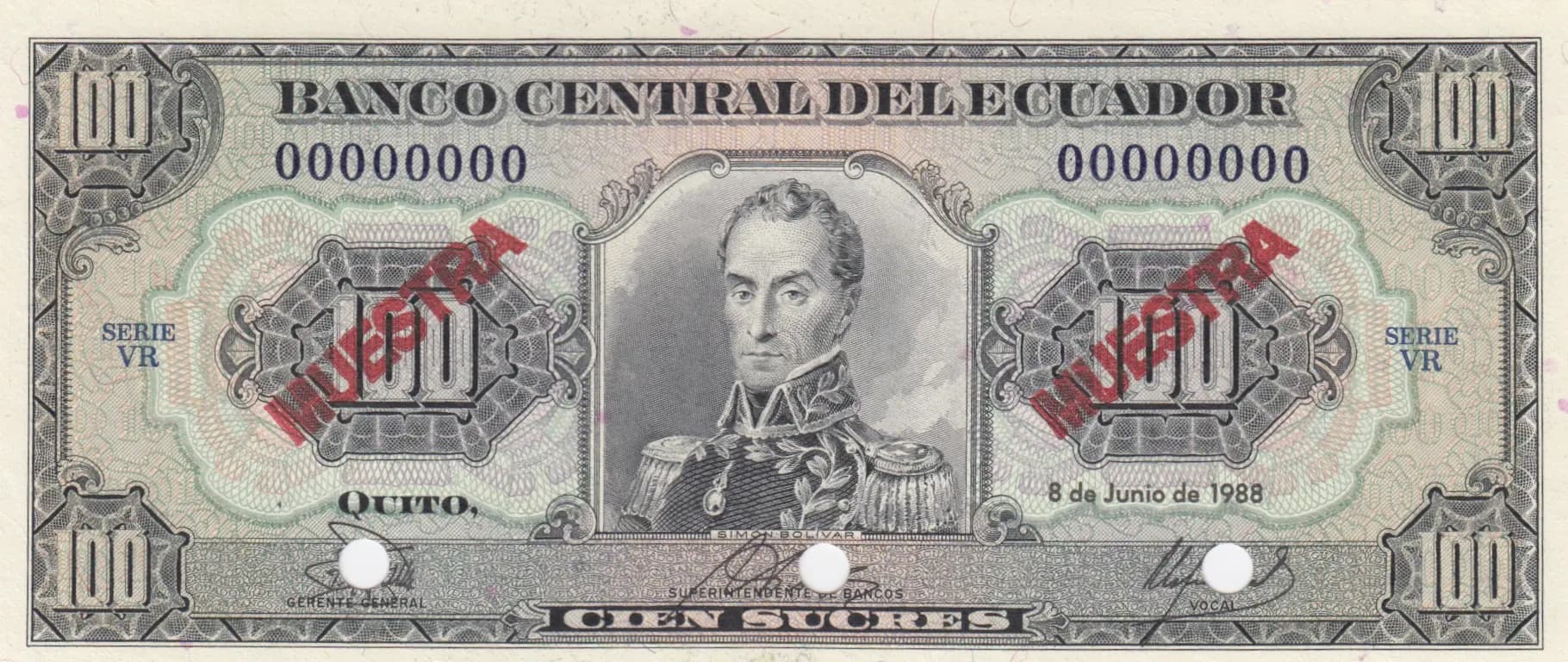
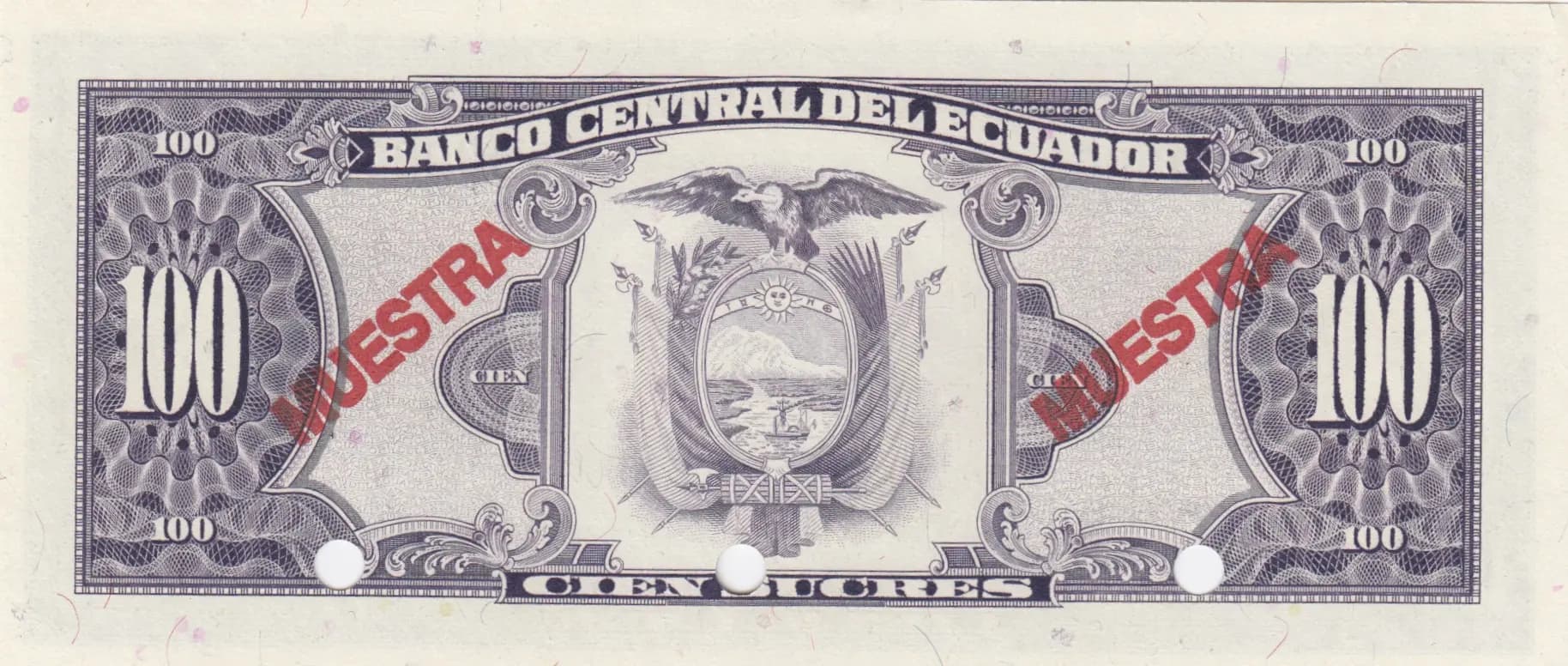
A 1988 Ecuadorian 100 Sucres specimen note issued by the Banco Central del Ecuador, featuring the striking portrait of Simón Bolívar in military dress uniform on the obverse. This specimen example displays the characteristic red 'MUESTRA' diagonal overprint and three circular punch holes typical of specimen notes distributed to banks and collectors. Despite these specimen markings, the note exhibits pristine uncirculated condition with crisp paper and excellent visual clarity, making it an attractive example of Ecuador's pre-dollarization currency.
Common. While this is a specimen note (which are generally less common than circulating examples), the 1988 100 Sucres is a standard denomination from a major print run by the Banco Central del Ecuador. eBay market data indicates consistent sales of UNC specimens in the $1.25–$5.50 range, with even graded examples (PMG 66-67) typically selling between $13–$26. The 2019 catalog valuation of $15 UNC supports common classification. Specimen notes from this era and denomination are readily available to collectors.
This 1988 specimen was issued during a transitional period in Ecuador's monetary history, when the sucre remained the national currency before the country's eventual adoption of the U.S. dollar in 2000. The note prominently features Simón Bolívar, the Liberator of South America, whose portrait graces the obverse alongside the national coat of arms on the reverse, reflecting Ecuador's cultural veneration of its independence hero. The issuing date of June 8, 1988 places this specimen within the later years of the sucre's circulation, during a period of economic challenges that would eventually lead to currency reform.
The obverse features a formal portrait of Simón Bolívar positioned centrally within an ornate oval frame, depicted in military dress uniform complete with medals and shoulder insignia, flanked by two heraldic shields containing Ecuador's national coat of arms. The reverse displays Ecuador's full national coat of arms within a central oval medallion, featuring an eagle perched above a shield containing a landscape vignette of the Andes mountains, a river (representing the Pacific watershed), and a rising sun, all enclosed within ornamental scrollwork and decorative borders. The denomination '100' appears in all four corners of the obverse and reverse. The entire design demonstrates fine line engraving techniques typical of high-security currency production.
FRONT: 'BANCO CENTRAL DEL ECUADOR' (Central Bank of Ecuador) / 'CIEN SUCRES' (One Hundred Sucres) / 'MUESTRA' (Specimen) / 'SERIE VR' (Series VR) / '00000000' (Serial number - specimen zeros) / 'QUITO.' (Quito - city of issue) / '8 de Junio de 1988' (June 8, 1988) / 'GERENTE GENERAL' (General Manager) / 'SUPERINTENDENTE DE BANCOS' (Superintendent of Banks) / 'VOCAL' (Board Member). BACK: 'BANCO CENTRAL DEL ECUADOR' (Central Bank of Ecuador) / '100' (Denomination numeral) / 'CIEN SUCRES' (One Hundred Sucres) / 'MUESTRA' (Specimen).
Intaglio (engraved) printing with multicolored offset elements, executed by the security printer TDLR (Thomas De La Rue). The note exhibits characteristic fine line engraving throughout the border work, portrait details, and coat of arms representation, combined with multicolored underprinting to create the noted green tints on the obverse and blue-purple tones on the reverse. The specimen overprint and punch holes were applied post-production to identify this as a specimen distribution example not intended for circulation.
This is a P-123Aas specimen variety, where the 'as' suffix denotes specimen status. The note exhibits 'SERIE VR' designation and features serial number 00000000, typical of specimen examples. The visual analysis indicates a dark or light blue serial number; this note would be cataloged within the P-123A group referenced alongside P-104A, P-105, P-112, P-117, and P-118. The June 8, 1988 issue date confirms this as from the 1988 specimen printing, distinct from the regular-issue circulating varieties dated 1986 and 1990 noted in external references.