10 sucres 1980 specimen
Market Prices
8 salesAbout This Note
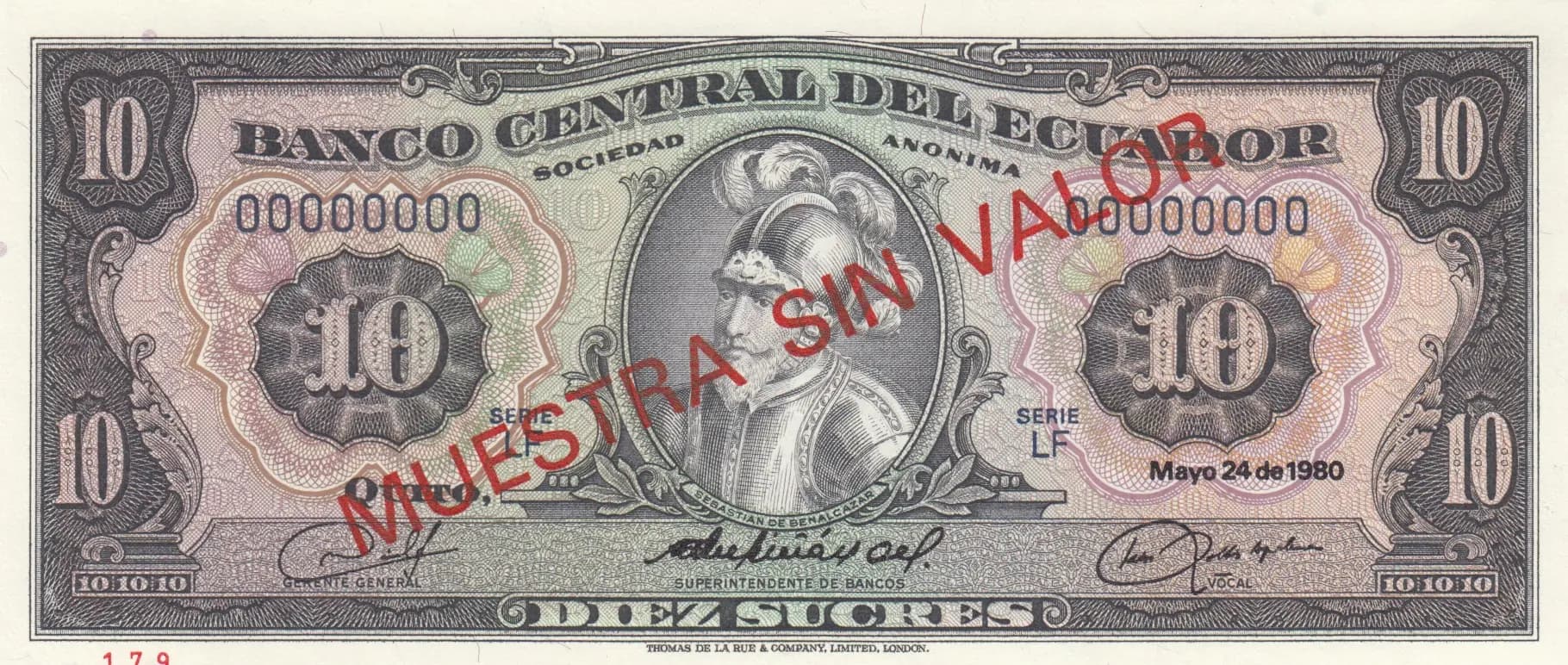
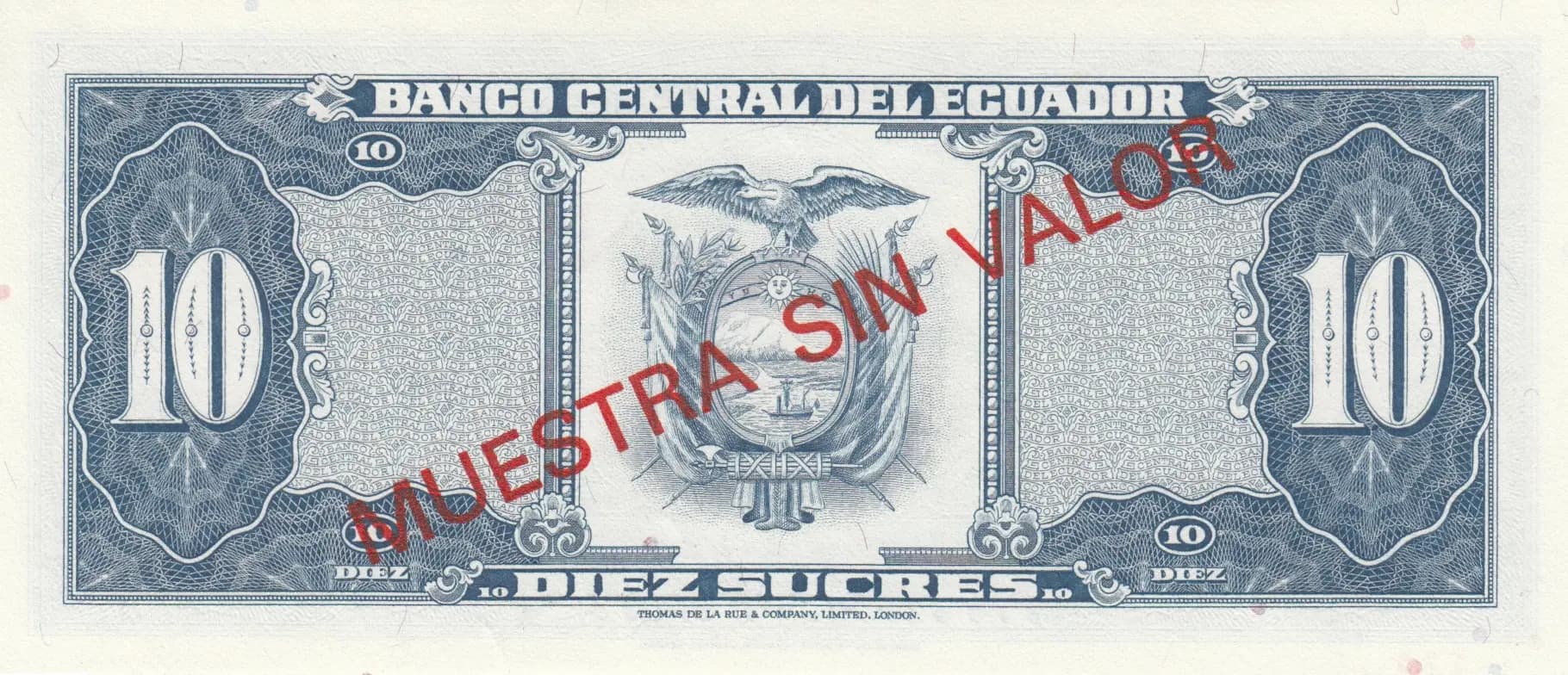
This is a specimen example of Ecuador's 10 sucres banknote from 1980, issued by the Banco Central del Ecuador and printed by Thomas de la Rue. The note exhibits pristine uncirculated condition with no wear, creases, or tears, and features a striking pink/mauve obverse with a portrait of Sebastián de Benalcazar and an ornate blue reverse depicting Ecuador's national coat of arms with an eagle. The diagonal red 'SPECIMEN' overprint and 'MUESTRA SIN VALOR' markings identify this as a non-circulating sample, which is particularly notable as specimen notes are typically distributed for educational and archival purposes rather than currency circulation.
Common. Specimen notes from the 1968–1983 series of this denomination are regularly encountered in the collector market. The 2019 catalog value for circulated UNC examples is listed at $20, and eBay historical data shows specimen examples and similar grade notes selling for modest prices ($3–$61 depending on condition and grading service). The broad print run of this series across the 15-year production window and the absence of any indication of restricted or limited specimen distribution suggest this is a typical example with no particular rarity premium.
Issued on May 24, 1980, this banknote reflects Ecuador's monetary system during the latter period of sucre currency, which remained in circulation until 2000. The obverse features Sebastián de Benalcázar, the Spanish conquistador who founded Quito and played a central role in Ecuador's colonial history. The reverse displays the national arms with a condor eagle, symbolizing Ecuador's sovereignty and Andean heritage, imagery consistent with mid-20th century Latin American currency design emphasizing historical figures and national symbols.
The obverse features a right-facing profile portrait of Sebastián de Benalcázar, the Spanish conquistador and founder of Quito, rendered in classical engraving style and positioned centrally within ornate baroque-style scroll work and oval medallion frames. The denomination '10' appears in decorative frames in the corners. The color scheme comprises pink and mauve backgrounds with purple accents. The reverse displays Ecuador's national coat of arms prominently centered within an oval vignette: a condor with spread wings positioned above a shield bearing the nation's heraldic design, with landscape elements (mountains) visible in the background. Large denomination numerals '10' in decorative frames flank the central vignette on left and right. The reverse features a predominantly dark blue background with lighter blue tones and intricate geometric patterning. Both sides incorporate fine-line guilloche patterns and multiple security denomination markers.
FRONT: 'BANCO CENTRAL DEL ECUADOR' (Central Bank of Ecuador), 'SOCIEDAD ANONIMA' (Anonymous Society/Limited Company), 'DIEZ SUCRES' (Ten Sucres), 'Mayo 24 de 1980' (May 24, 1980), 'SERIE LP' (Series LP), serial number placeholder '00000000', 'SPECIMEN' (Specimen), 'MUESTRA SIN VALOR' (Sample Without Value), 'THOMAS DE LA RUE & COMPANY, LIMITED, LONDON' (printer attribution), denomination markers '10'. BACK: 'BANCO CENTRAL DEL ECUADOR' (Central Bank of Ecuador), 'DIEZ SUCRES' (Ten Sucres), 'SPECIMEN' (Specimen), 'MUESTRA SIN VALOR' (Sample Without Value), 'THOMAS DE LA RUE & COMPANY, LIMITED, LONDON' (printer attribution), denomination numerals '10' in corners.
This note was produced using intaglio/engraved printing by Thomas de la Rue & Company, Limited, London, as indicated in the printer attribution. The visual evidence of fine-line engraving throughout, intricate guilloche patterns, multiple layers of security printing, and the characteristic sharp detail and crisp lines visible in the decorative elements confirm high-security intaglio production. The specimen overprint in red was applied as an additional marking after the primary printing.
This note is identified as series LP based on the visible 'SERIE LP' inscription on the obverse. It is marked as a specimen with red overprint and 'MUESTRA SIN VALOR' (sample without value) text, features the May 24, 1980 date, and displays placeholder serial number '00000000' consistent with specimen production practices. The Pick catalog designation P-114bs confirms this is the specimen variety of Pick 114b. Related varieties within the series are noted in the reference data as P-101, P-101A, P-109, and P-121.