5 shillings 1958
Market Prices
17 salesAbout This Note
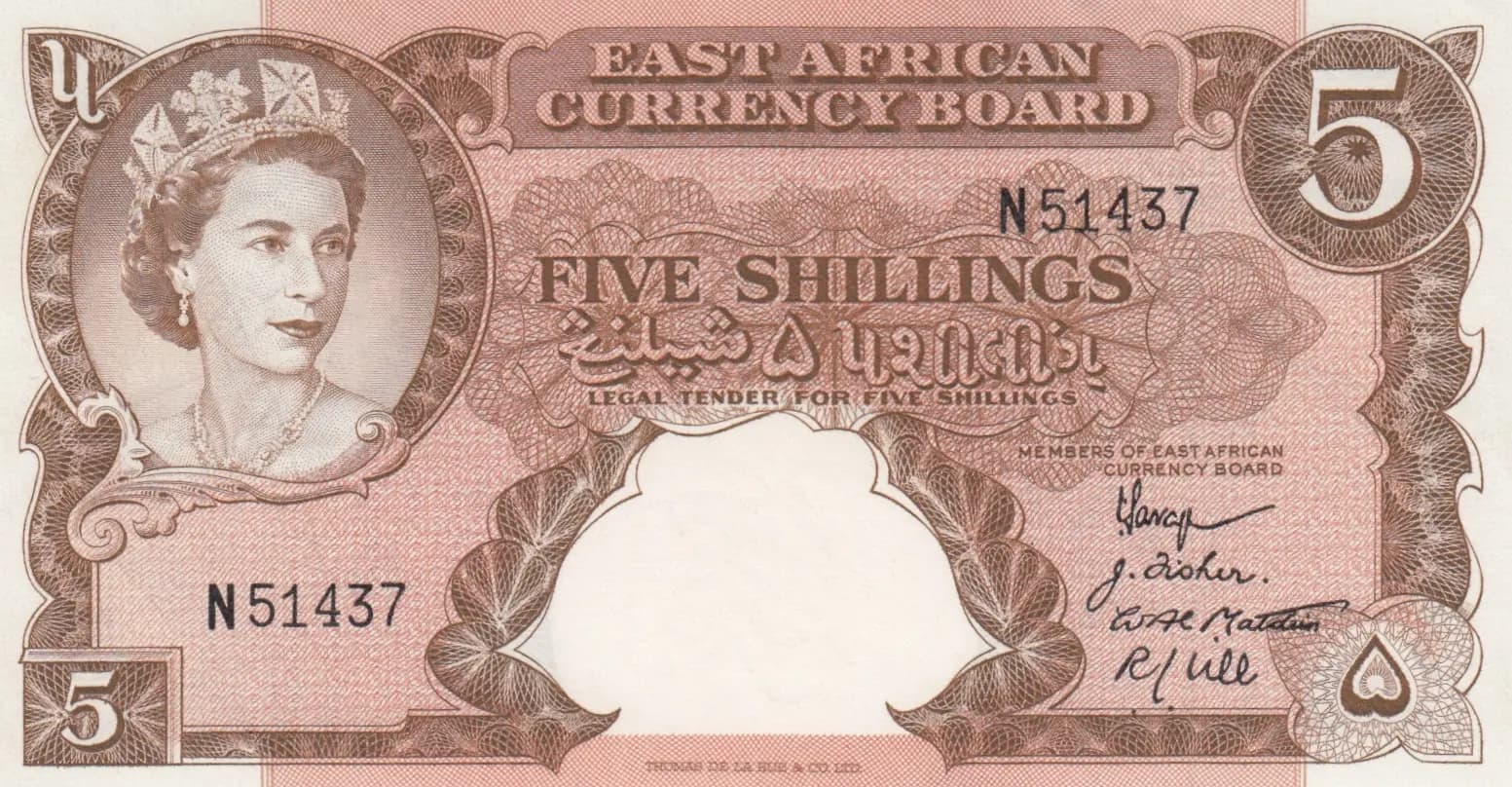
This is an exceptional uncirculated example of the East African Currency Board's 1958 5 Shillings note (Pick P-37), featuring a striking portrait of Queen Elizabeth II in profile wearing a crown and pearl earrings. The note exhibits pristine condition with no signs of wear, creases, or damage, displaying crisp brown and tan multicolor printing with intricate ornamental borders and fine-line engraving throughout. As a colonial-era note from the short-lived East African Currency Board, this piece represents an important transitional period in East African monetary history and remains highly collectible, particularly in uncirculated condition.
Common. While the East African Currency Board operated for only a brief period (1958-1960) and these notes have historical significance, auction price data shows recent VF examples selling consistently in the $56-$99 range, with UNC catalogue value at $175 (2016). The regular circulation of this denomination and the relatively high print runs characteristic of colonial currency boards indicate widespread availability. UNC examples command premiums relative to circulated grades, but the note itself is not scarce in the collector market.
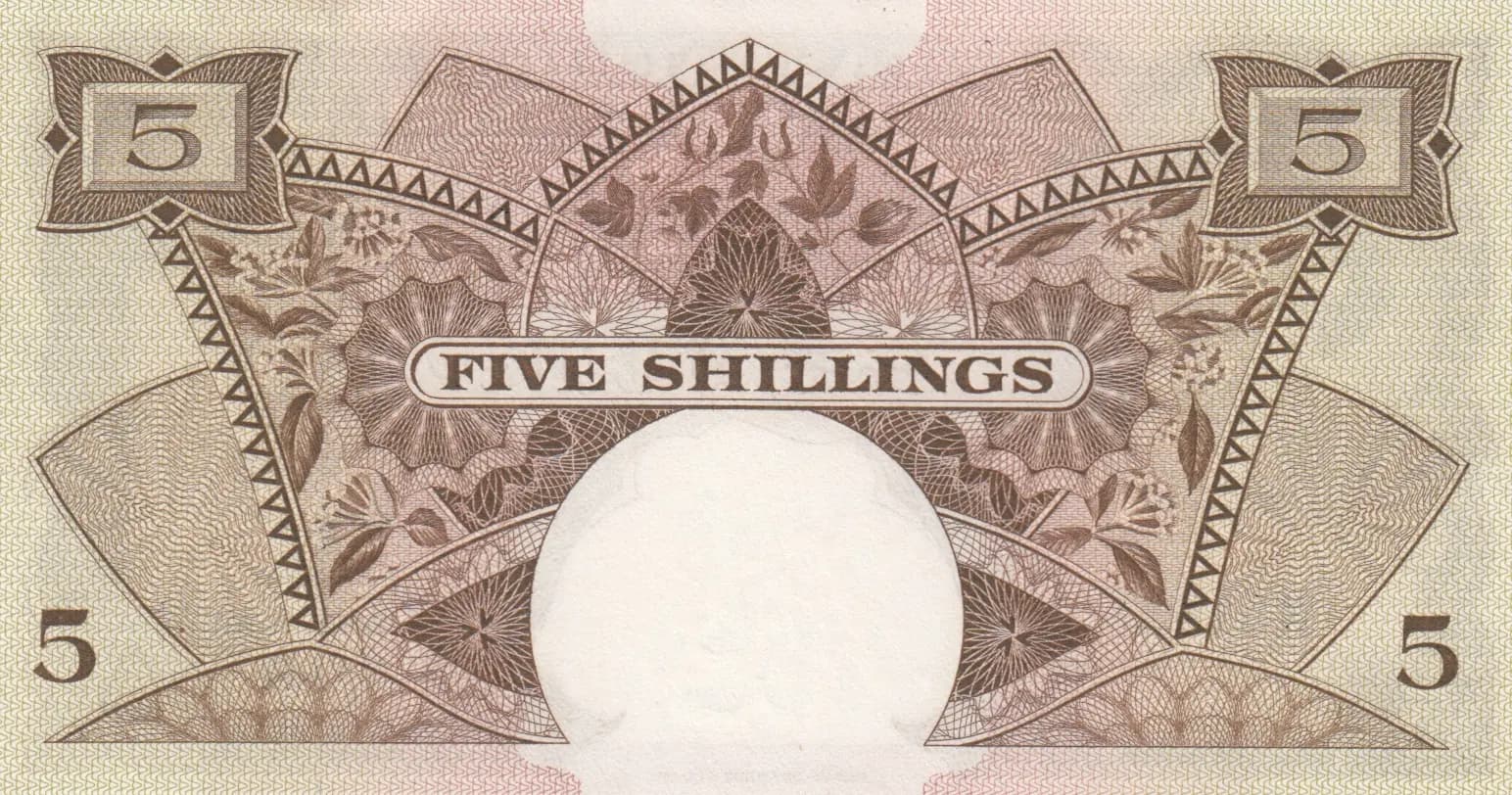
Issued by the East African Currency Board between 1958-1960, this note represents the final years of unified currency across East Africa before the region's political fragmentation. The portrait of Queen Elizabeth II reflects the period's continued British colonial oversight, while the inclusion of Arabic script ('شلنج خمسة' - Five Shillings) acknowledges the region's diverse linguistic and cultural makeup. The ornamental botanical design on the reverse, featuring native flora in a diamond-shaped frame, emphasizes East Africa's natural resources and cultural identity during this pivotal moment of transition toward independence.
The obverse features a formal profile portrait of Queen Elizabeth II positioned at the upper left, depicted wearing a crown and pearl earrings in classical numismatic style. The note employs a brown multicolor underprint with tan and white dominants, creating a sophisticated colonial aesthetic. Ornate scrollwork and floral patterns form elaborate decorative borders throughout, with shield-shaped denomination markers containing the numeral 5. The reverse displays a symmetrical ornamental design centered on native East African botanical specimens (flowers, plants, and leaves) enclosed within a diamond-shaped decorative frame, flanked by geometric triangular border patterns. The overall design emphasizes security through complex fine-line engraving, crosshatching, and intricate background patterns typical of Thomas de la Rue's high-security production standards.
FRONT: 'EAST AFRICAN CURRENCY BOARD' (issuing authority); 'FIVE SHILLINGS' (denomination in English); 'LEGAL TENDER FOR FIVE SHILLINGS' (legal tender declaration); 'MEMBERS OF EAST AFRICAN CURRENCY BOARD' (institutional identifier); 'شلنج خمسة' (Arabic for 'Five Shillings'); Serial number 'N51437'; Signature line with names 'Harry J. Soker, Louis Marston, R. Wills' (official signatories); Multiple instances of '5' (denomination marker). BACK: 'FIVE SHILLINGS' (denomination); Multiple instances of '5' (denomination markers).
Intaglio engraving (line engraving) printed by Thomas de la Rue, London, the renowned British security printer. The visual analysis confirms the characteristic fine-line engraving throughout, complex crosshatching in background patterns, detailed portrait engraving of Queen Elizabeth II, and ornamental borders with integrated security patterns. The multicolor printing with brown, tan, white, and pink-beige tones reflects TDLR's advanced multicolor intaglio capabilities of the period.
This specimen exhibits the standard P-37 variety (5 Shillings, Nairobi) with four signatures at the lower right (Harry J. Soker, Louis Marston, R. Wills, and one additional signature). PMG records indicate a P-37s specimen variety also exists. The serial number prefix 'N' and the specific signature combination should be noted for variety identification. The note falls within the broader 1958-1960 date range of issuance, representing the early production run of this series.