100 shillings= 5 pounds 1933
Market Prices
About This Note
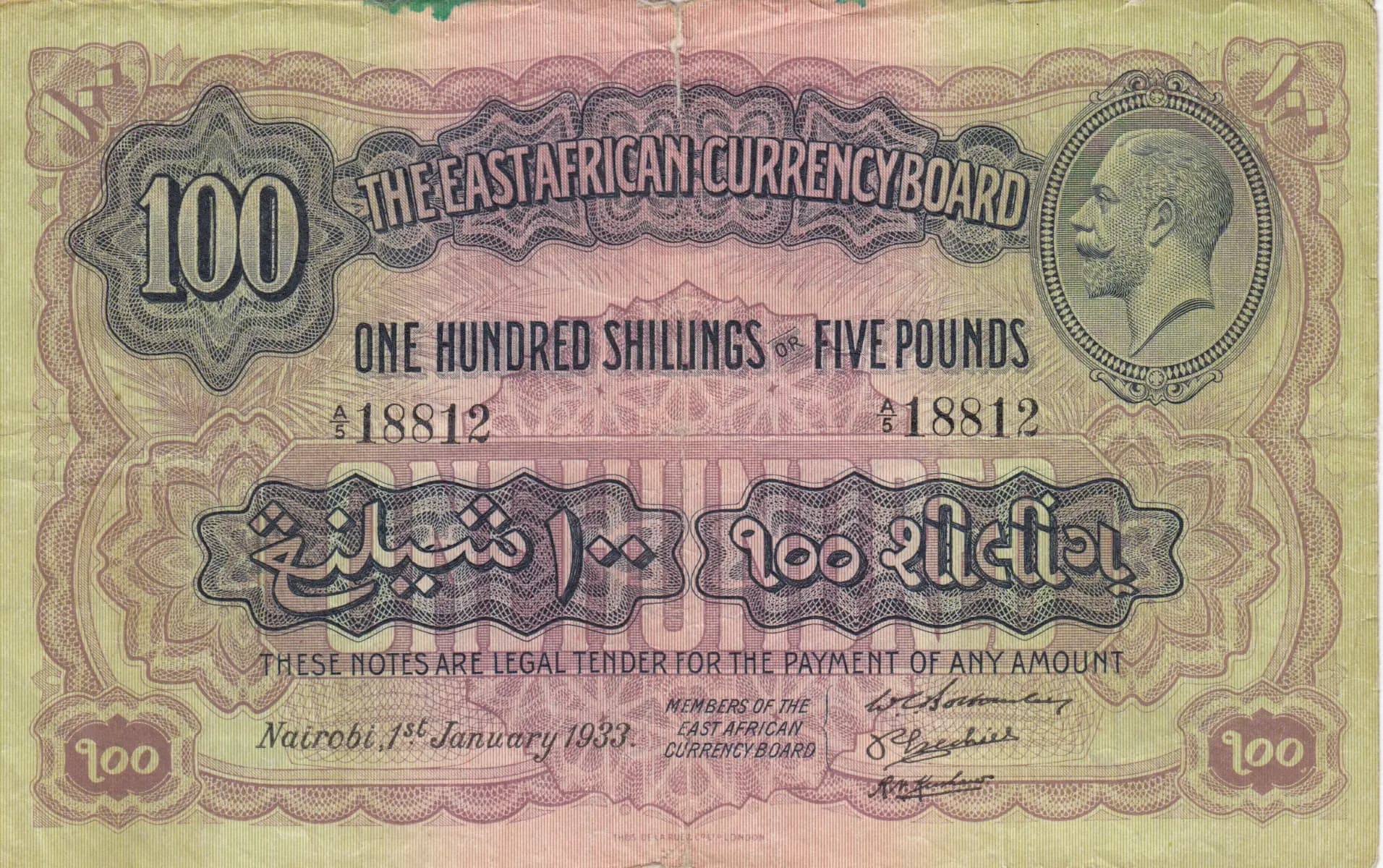
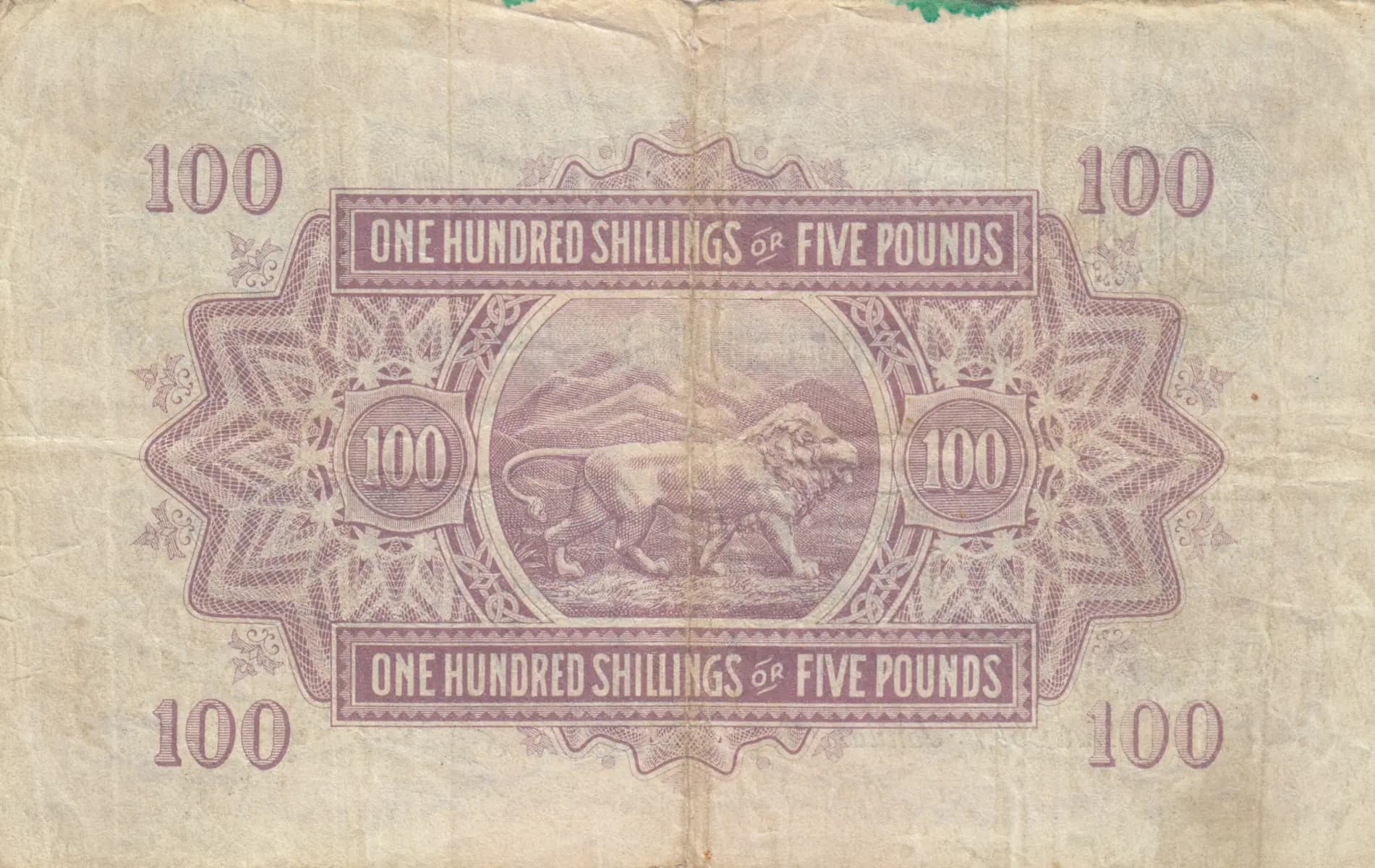
This is a 1933 East African Currency Board 100 Shillings (5 Pounds) note, Pick-23, featuring a portrait of King George V on the obverse and an elephant vignette on the reverse. The note displays the characteristic blue-black on green and lilac underprint noted in catalogs, with ornate scalloped borders and fine engraving throughout. In Fair condition as graded, it exhibits age-appropriate wear including a prominent center fold, foxing, yellowing, and edge damage consistent with extended circulation, making it a representative example of this early East African currency issue.
Common. The eBay market data shows consistent sales activity with VF specimens trading in the $125–$532 range and catalog values for F-grade notes at $475 (2016). These price points and the regular market availability indicated by multiple eBay listings suggest this is a widely circulated note with no scarcity premium. The East African Currency Board issued these notes in substantial quantities for regular circulation across the region, and many examples have survived. The Fair condition grade observed here places it in the lower-to-middle range of the typical survival spectrum for this well-produced colonial note.
Issued on January 1, 1933, from Nairobi, this note represents the East African Currency Board's early efforts to establish a unified currency across British East Africa during the height of colonial administration. The portrait of King George V on the obverse reflects the monetary sovereignty of the British Crown in the region, while the elephant vignette on the reverse symbolizes the natural wealth and wildlife heritage of East Africa—a common iconographic choice in colonial-era currency design that emphasized imperial connection to exotic colonial territories.
The obverse features a right-facing profile portrait of King George V within an ornate circular decorative frame, positioned on the right side of the note. The portrait is rendered in fine engraving with subtle cross-hatching. The reverse displays a naturalistic vignette of an African elephant depicted in profile within a savanna landscape, serving as the central focal point. Both sides are framed by distinctive scalloped border patterns with geometric and floral ornamental elements. The denomination appears prominently in multiple locations on both sides—in numerical and written form. The note incorporates bilingual text in English and Arabic, reflecting the multi-ethnic composition of East Africa. The color scheme on the obverse consists of tan, light brown, pink, and green tones with black printing; the reverse employs mauve and purple tones with cream backgrounds.
FRONT: 'THE EAST AFRICAN CURRENCY BOARD' (issuing authority); 'ONE HUNDRED SHILLINGS OR FIVE POUNDS' (denomination); 'THESE NOTES ARE LEGAL TENDER FOR THE PAYMENT OF ANY AMOUNT' (legal tender declaration); 'MEMBERS OF THE EAST AFRICAN CURRENCY BOARD' (institutional note); 'Nairobi, 1st January 1933' (place and date of issue); Serial number 'A 18812' (appears twice); Arabic text 'شيلنج مائة' (One hundred shillings) and 'مائة' (One hundred). BACK: 'ONE HUNDRED SHILLINGS OR FIVE POUNDS' (denomination text at top and bottom); '100' (denomination numerals in all four corners, within circular frames).
Engraved and printed by Thomas de la Rue (TDLR), London, utilizing intaglio (engraving) printing methods. The visual analysis confirms the presence of intricate fine-line engraving, complex cross-hatching, and stippling techniques throughout both sides, creating tonal depth and security against counterfeiting. The multi-color printing on the obverse (blue-black on green and lilac underprint) and the mauve/purple coloring of the reverse are characteristic of de la Rue's high-security banknote production standards of the early 1930s.
This example is identified as P-23 (not P-23s variant) based on visual characteristics. The serial number prefix 'A 18812' and the Nairobi issue location with date '1st January 1933' are consistent with the standard 1933 issue. PMG records indicate two cataloged variants exist for this Pick number (P-23 and P-23s, both from Nairobi), suggesting possible differences in signatures or minor design elements, though the visual analysis does not reveal distinguishing features that would definitively classify this as a specimen (s) note. The bilingual English/Arabic inscriptions are standard for this issue reflecting the cosmopolitan nature of East African trade and administration during this period.