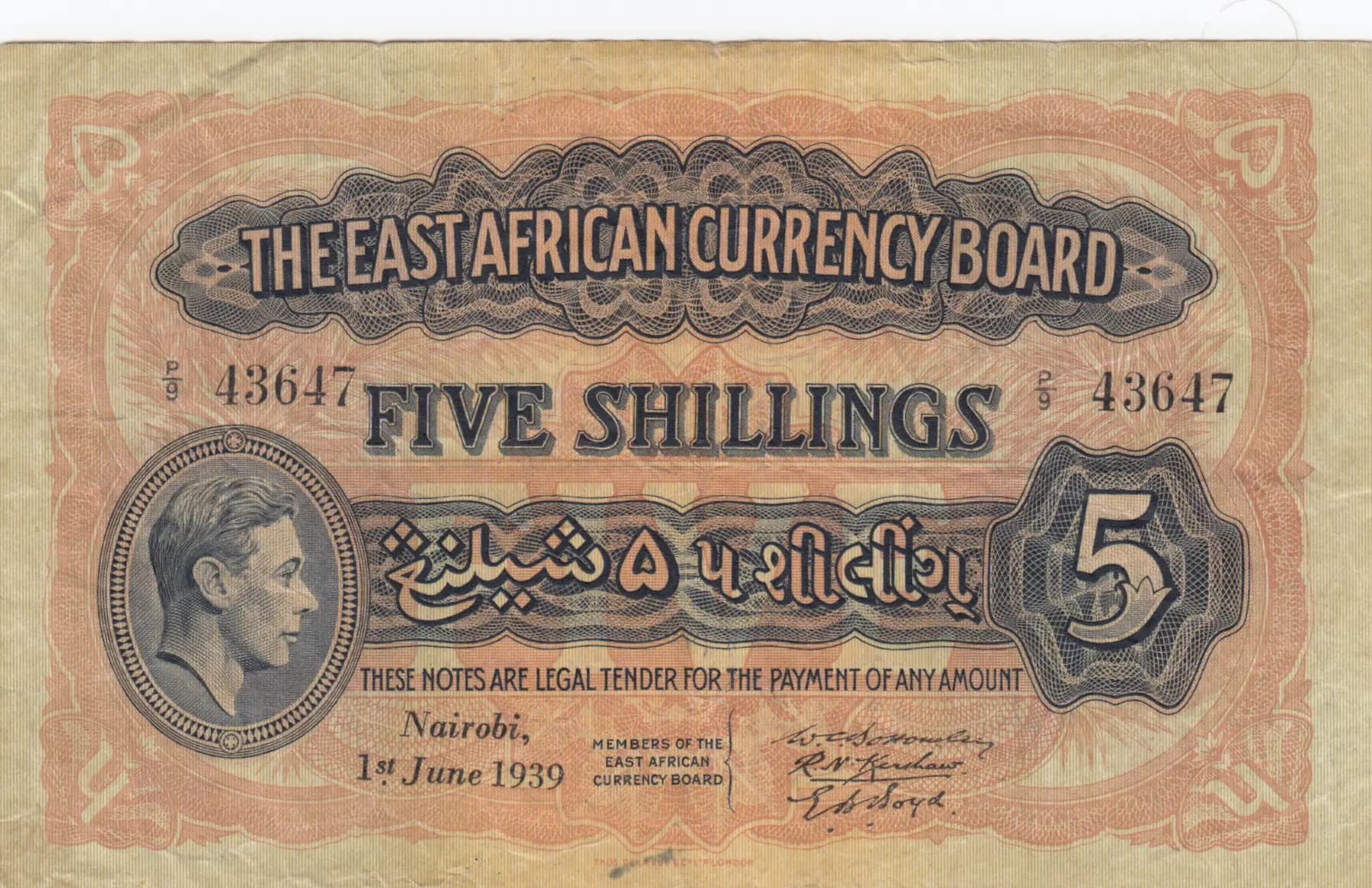
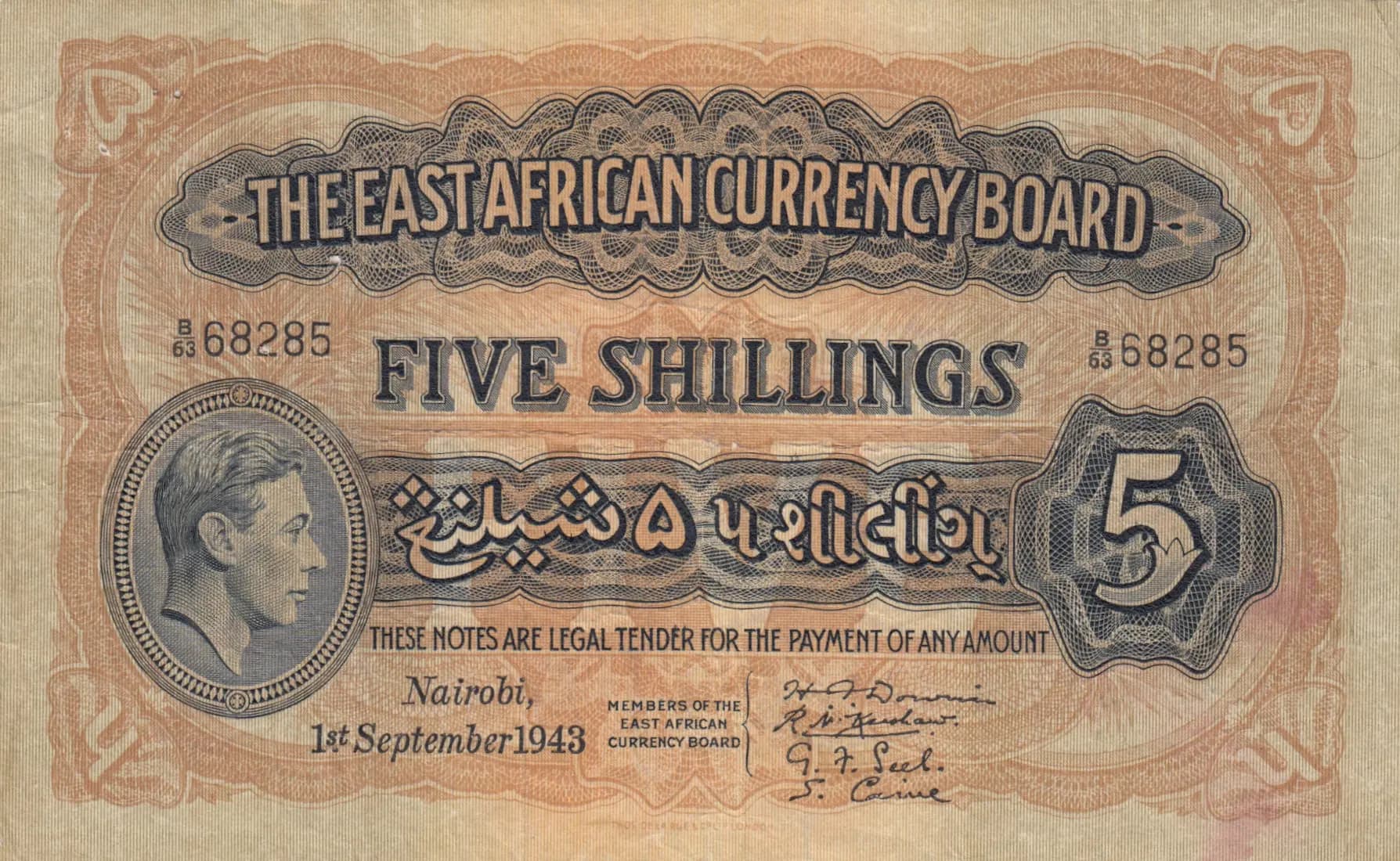
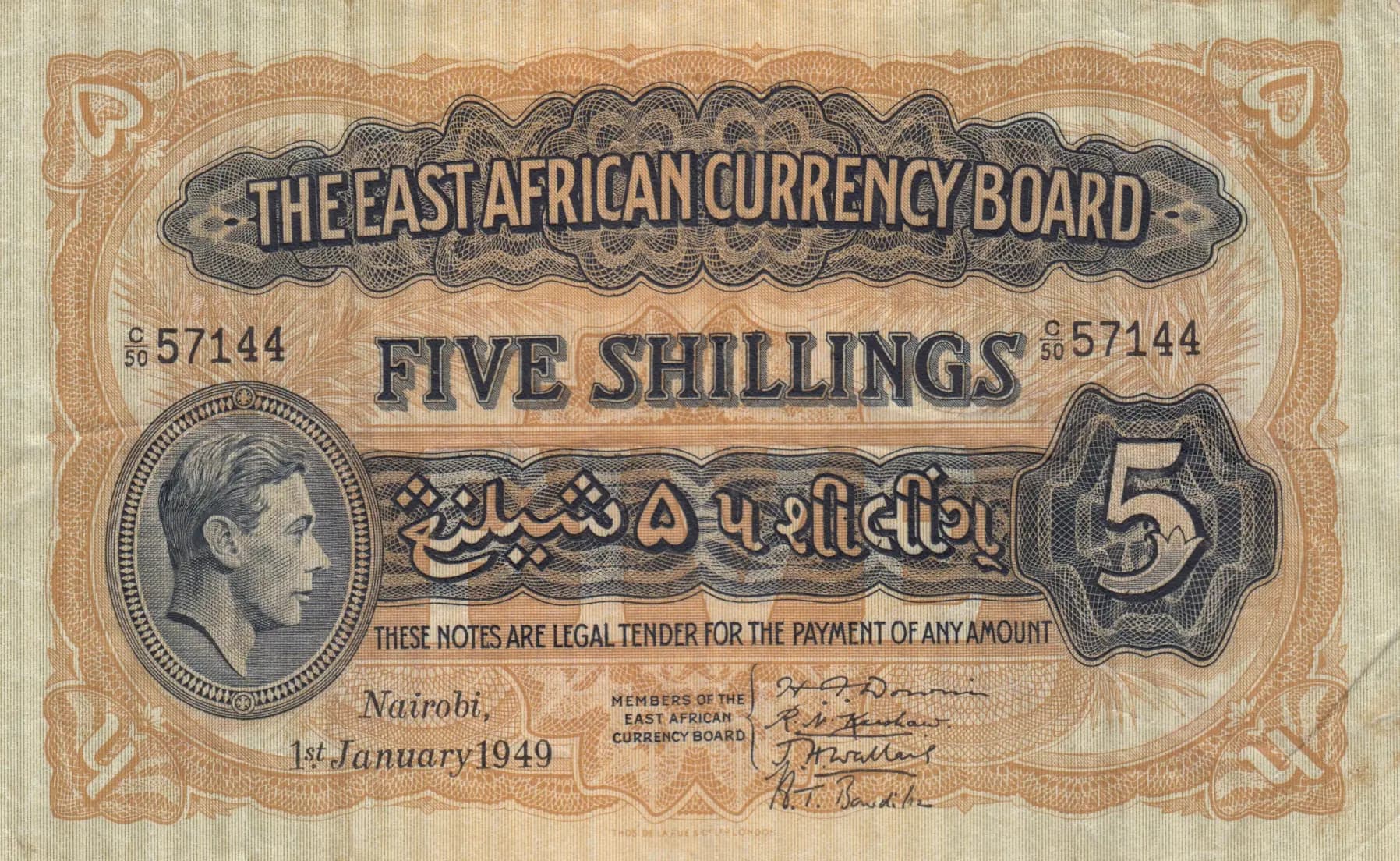
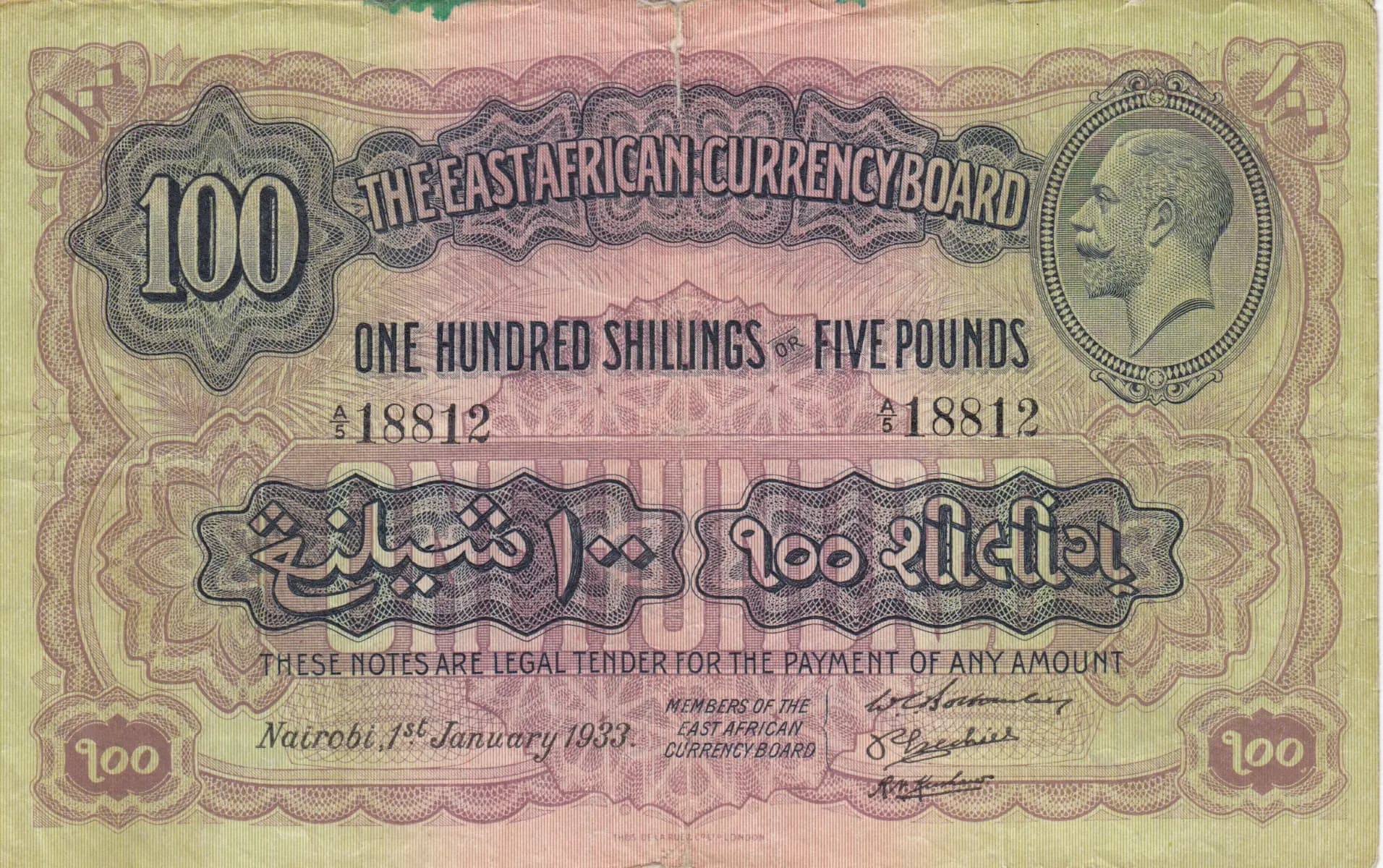
5 shillings 1941
Market Prices
6 salesAbout This Note
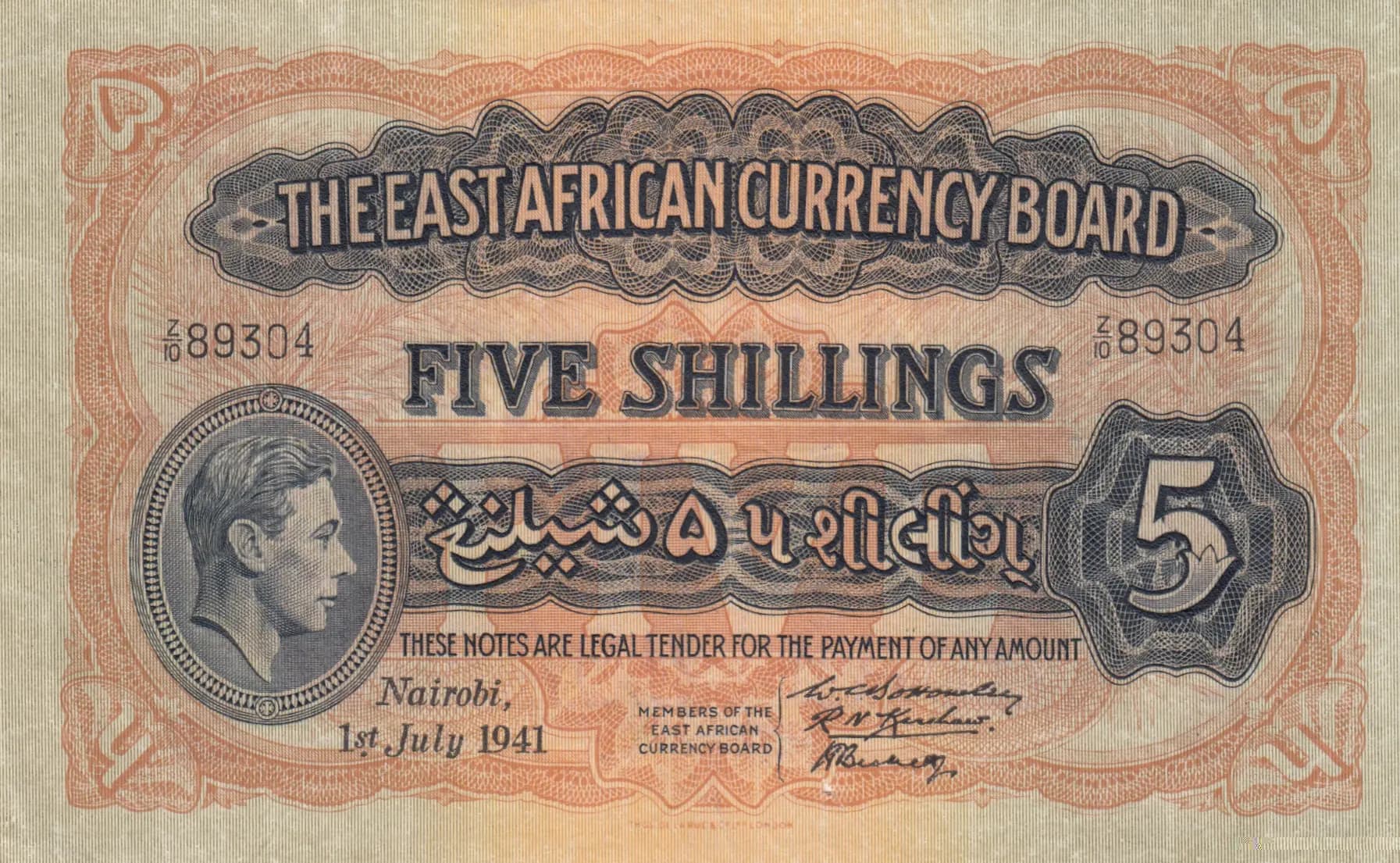
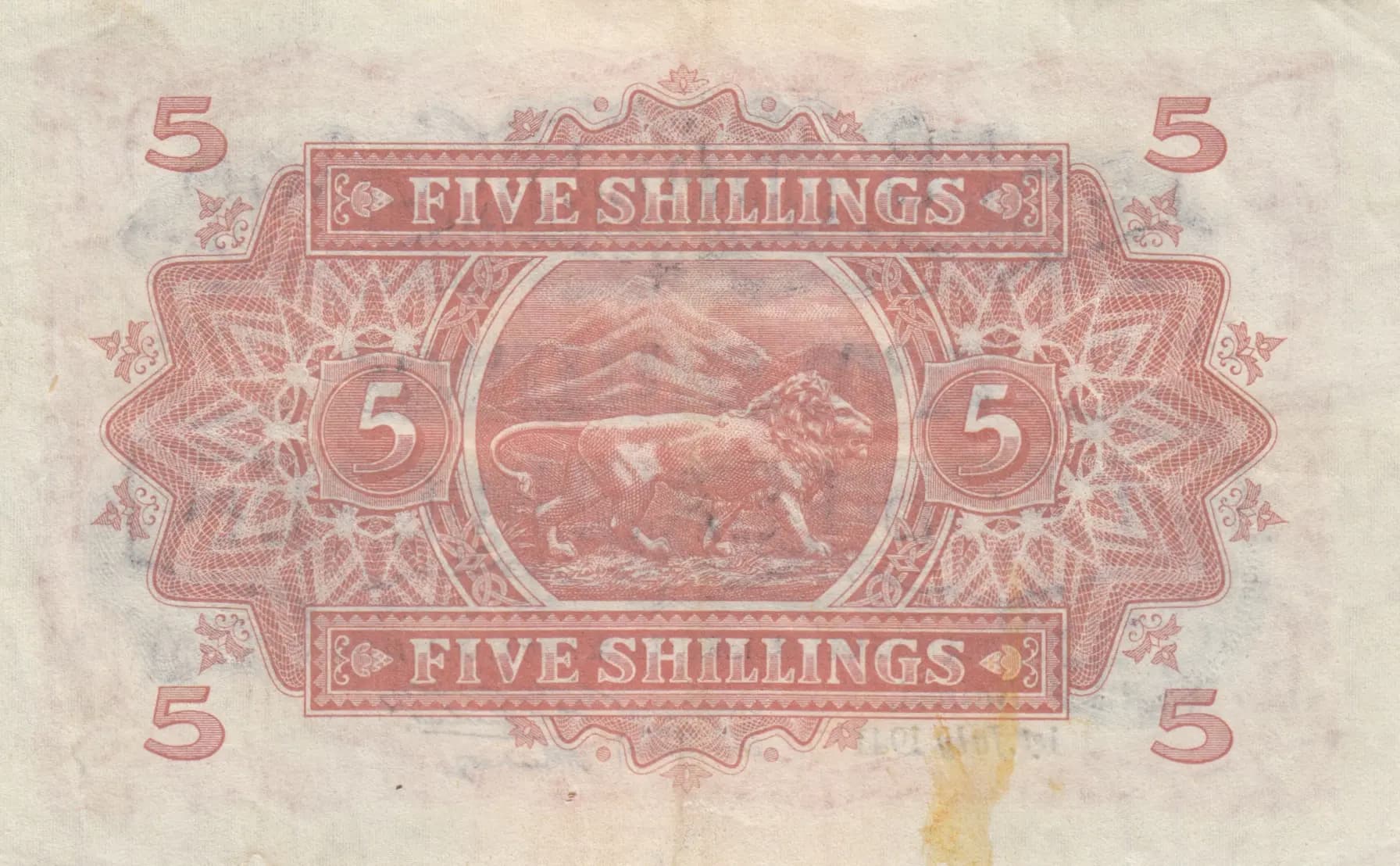
This is a 5 Shillings banknote issued by the East African Currency Board on 1st July 1941, Pick P-28a, graded VF (Very Fine). The note features a striking portrait of King George VI in profile on the obverse and a detailed central lion vignette on the reverse, both rendered in fine engraving with ornate decorative borders. While the visual analysis suggests excellent preservation, the assigned VF grade and observed light yellowing in corners indicate this is a circulated specimen with minor aging consistent with near-80-year-old paper currency.
Common. The East African Currency Board issued these notes across an extended period (1938-1952) and in substantial quantities to serve multiple territories. eBay transaction data shows VF specimens selling in the $20-50 range with regular market activity, and catalog values place VF examples at $50 (2016), well within the range expected for commonly circulated colonial currency. No print-run restrictions or recall status applies to this note. The P-28a variety is a standard variant within the base Pick number P-28, and no evidence suggests limited production for this specific date (1st July 1941) or serial number prefix 'Z00'.
This note was issued during World War II, when the East African Currency Board maintained monetary stability across British East African territories. The prominent portrait of King George VI on the obverse reflects the territories' status within the British Commonwealth during the war years, while the lion on the reverse symbolizes the wildlife and natural authority of East Africa itself. The bilingual English and Arabic inscriptions underscore the diverse populations served by the currency board across East Africa's cosmopolitan trading regions.
The obverse features a formal right-facing profile portrait of King George VI enclosed within an ornamental circular medallion with decorative border work. The portrait is positioned left of center, balanced by a large decorative shield containing the numeral '5' to the right. The entire design is framed by an ornate border with Celtic-style corner ornaments (triangular designs) and repeating patterns in peachy-pink and gray tones. The reverse depicts a naturalistic lion walking rightward within a circular frame, set against a rocky mountainous landscape background. This central vignette is flanked by ornamental cartouches containing denomination text and corner numerals '5'. The consistent fine-line engraving technique and intricate cross-hatching throughout both sides create a cohesive, highly detailed design typical of Thomas de la Rue's premium banknote work.
FRONT SIDE: 'THE EAST AFRICAN CURRENCY BOARD' (ornamental cartouche, upper center); 'FIVE SHILLINGS' (large denomination text, center-right); 'شلنجي ٥' (Arabic: Five Shillings); 'THESE NOTES ARE LEGAL TENDER FOR THE PAYMENT OF ANY AMOUNT' (legal text); 'Nairobi,' (place of issue); '1st July 1941' (date of issue); 'MEMBERS OF THE EAST AFRICAN CURRENCY BOARD' (signature line); 'Z00 89304' (serial number). BACK SIDE: 'FIVE SHILLINGS' (denomination, appears twice in ornamental cartouches above and below central vignette); '5' (corner numerals in all four corners).
This note was printed by Thomas de la Rue, London (TDLR), using intaglio (letterpress/engraving) printing on both obverse and reverse. The security features rely entirely on the complexity of fine-line engraving, with multiple layers of cross-hatching, ornamental border patterns, and intricate vignette work creating visual and tactile security. No modern security features such as watermarks, security threads, or color-shifting elements are evident, consistent with 1941 printing standards. The crisp registration between colors (blue-black on brown underprint on obverse, pink/rose on cream on reverse) demonstrates the precision of the era's multi-plate printing process.
This note is identified as Pick P-28a based on the date (1st July 1941), serial number format (Z00 89304), and signature configuration. The PMG population report indicates four cataloged variants for this base Pick number: P-28A, P-28a, P-28b, and P-28s, suggesting variations in signature placement, date ranges, or serial number styles across the 1938-1952 issue period. The 'Z' serial prefix observed here (Z00 89304) may represent a specific print batch or geographical series. Without access to a detailed variety guide, the lowercase designation 'P-28a' likely indicates this is a standard mid-period variant (1941 date) as opposed to earlier (P-28A) or later (P-28b) printing runs.