20 shillings 1961
Market Prices
4 salesAbout This Note
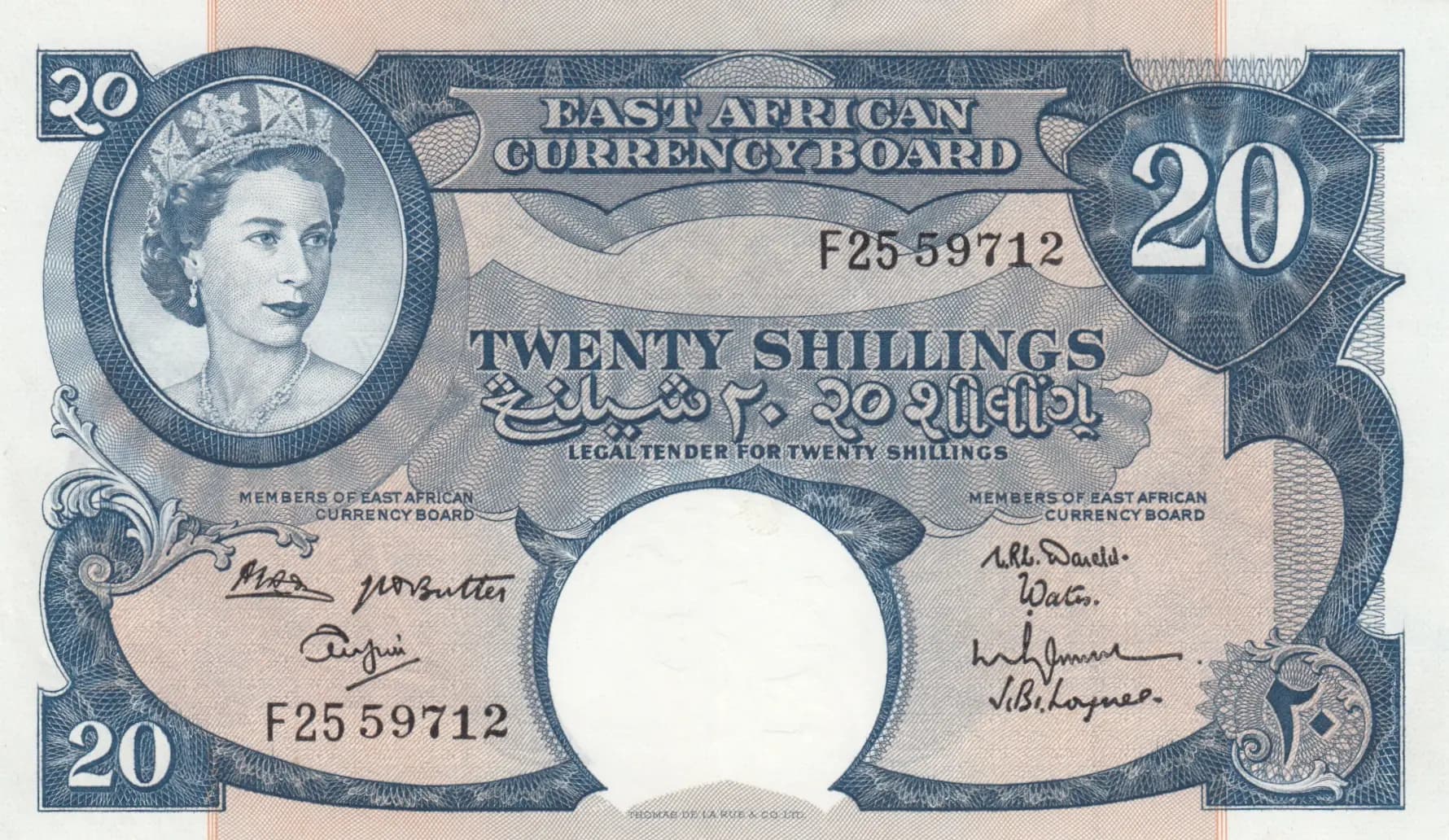
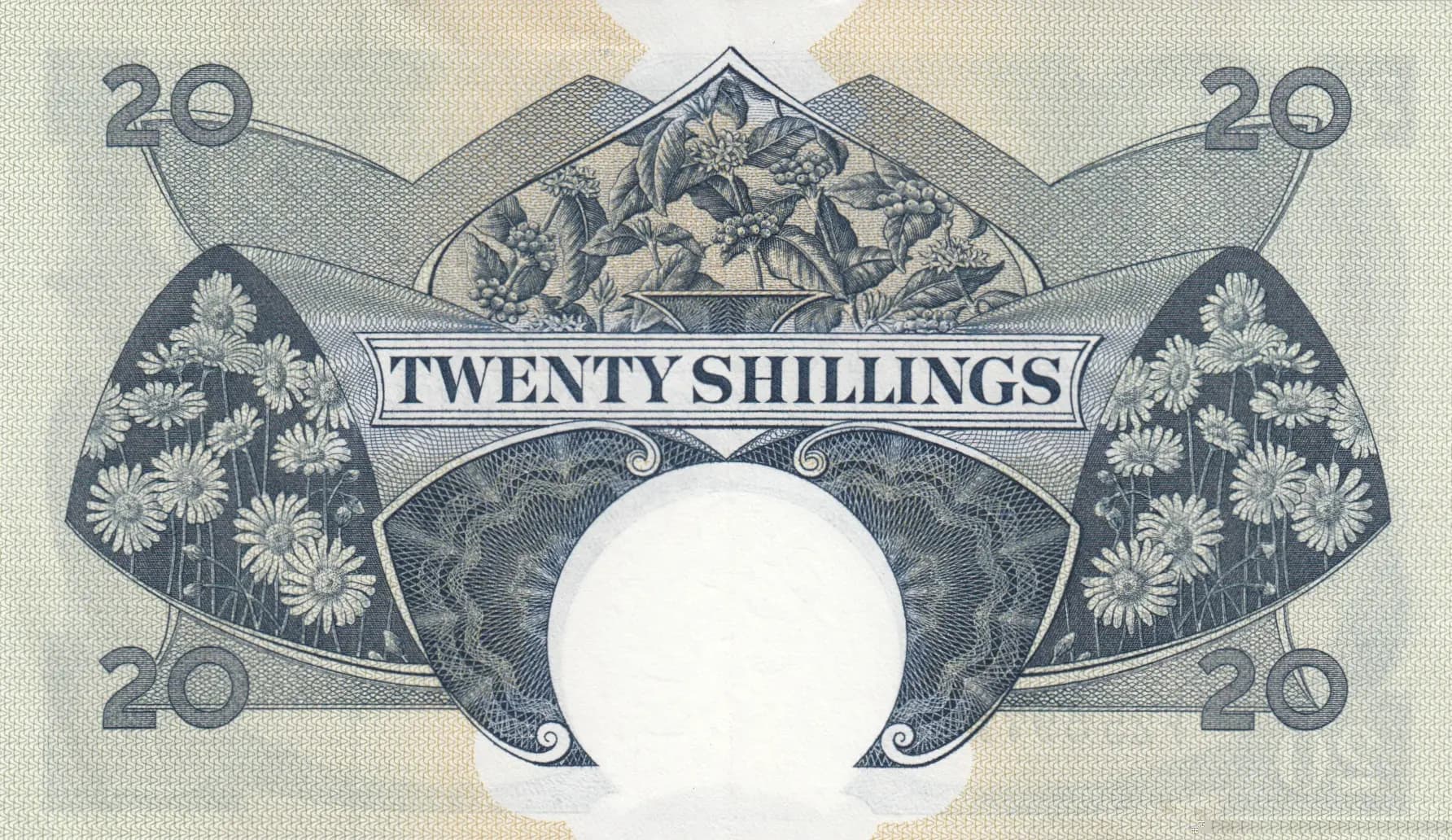
This is an exceptional East African Currency Board 20 Shillings note from 1961, graded EF (Extremely Fine), featuring a formal portrait of Queen Elizabeth II in a circular ornamental frame on the obverse and elegant botanical illustrations on the reverse. The note exhibits crisp paper, clear impressions of all engraved elements, and no visible wear, creasing, or stains, making it a desirable example for collectors. Its bilingual inscriptions (English and Arabic), multiple official signatures, and fine line engraving exemplify the sophisticated security features of early East African currency.
Common. While this is an early East African Currency Board issue and historically significant, eBay market data shows VF examples selling for $86–$153.50, with PMG 58 (Choice About Uncirculated) achieving $299.99. Catalogue values from 2019 list VF at $50 and UNC at $350, indicating consistent, moderate collector interest without extreme scarcity. The note was produced in reasonable quantities during the 1961–1963 issuance window, and EF examples remain accessible to collectors. The denomination (20 shillings) was a standard circulating note, not a limited commemorative issue.
Issued during the nascent period of East African independence (1961-1963), this note represents the transitional currency of the East African Currency Board, which served Kenya, Uganda, and Tanganyika before the establishment of individual national banks. The prominent portrait of Queen Elizabeth II reflects the Commonwealth connection of these newly independent nations, while the inclusion of Arabic alongside English inscriptions acknowledges the diverse populations and Islamic heritage of the region. The note's design emphasizes stability and legitimacy through formal portraiture and intricate botanical symbolism, establishing confidence in the new monetary authority.
The obverse features a formal portrait of Queen Elizabeth II positioned in a circular ornamental frame at the left side, rendered in profile facing left with styled hair and formal dress, reflecting the royal authority behind the currency. The reverse displays intricate botanical illustrations of flowering plants—identified as daisies or similar flora—with detailed leaves and stems, arranged symmetrically with decorative winglike shield-like elements flanking a central ornamental cartouche. The dominant color palette of blue and grayish-blue on a beige/cream background creates visual distinction, while multiple ornamental scrollwork flourishes, corner numerals, and a shield-like denomination cartouche provide additional decorative security elements. The bilateral English-Arabic inscription scheme reflects the cosmopolitan nature of East African commerce and the region's Islamic populations.
Front side: 'EAST AFRICAN CURRENCY BOARD' (issuing authority), 'TWENTY SHILLINGS' / 'شيلنج عشرون' (denomination in English and Arabic), 'LEGAL TENDER FOR TWENTY SHILLINGS' (legal tender declaration), 'MEMBERS OF EAST AFRICAN CURRENCY BOARD' (authority designation), signatures of A.R.L. Dauldi Watu, W.T. Lamont, and J.B. Loyne, serial number 'F25-59712'. Back side: 'TWENTY SHILLINGS' (denomination text). All numerals '20' appear in corners and central cartouche.
Intaglio/engraving, produced by Thomas de la Rue (TDLR), London. The note exhibits fine line engraving throughout with detailed ornamental patterns, circular portrait framing, and intricate botanical motifs—all characteristic of high-security currency production. The crisp impressions and sharp detail visible in both obverse and reverse designs confirm professional security printing of the highest standard typical of TDLR's East African work during this period.
This note is catalogued as Pick P-43b, representing the variant with three signatures at left and four signatures at right. The visual analysis confirms the presence of multiple official signatures (A.R.L. Dauldi Watu, W.T. Lamont, J.B. Loyne identified), consistent with this signature variety. The serial number F25-59712 is specific to this individual specimen. Per catalog reference, P-43a represents an alternate variant; PMG population data indicates limited professionally graded examples of the base Pick number, suggesting careful condition assessment in grading circles. The 1961 date (catalogued ND 1961–1963) places this among the earliest emissions of East African Currency Board notes.