20 shillings 1958
Market Prices
22 salesAbout This Note
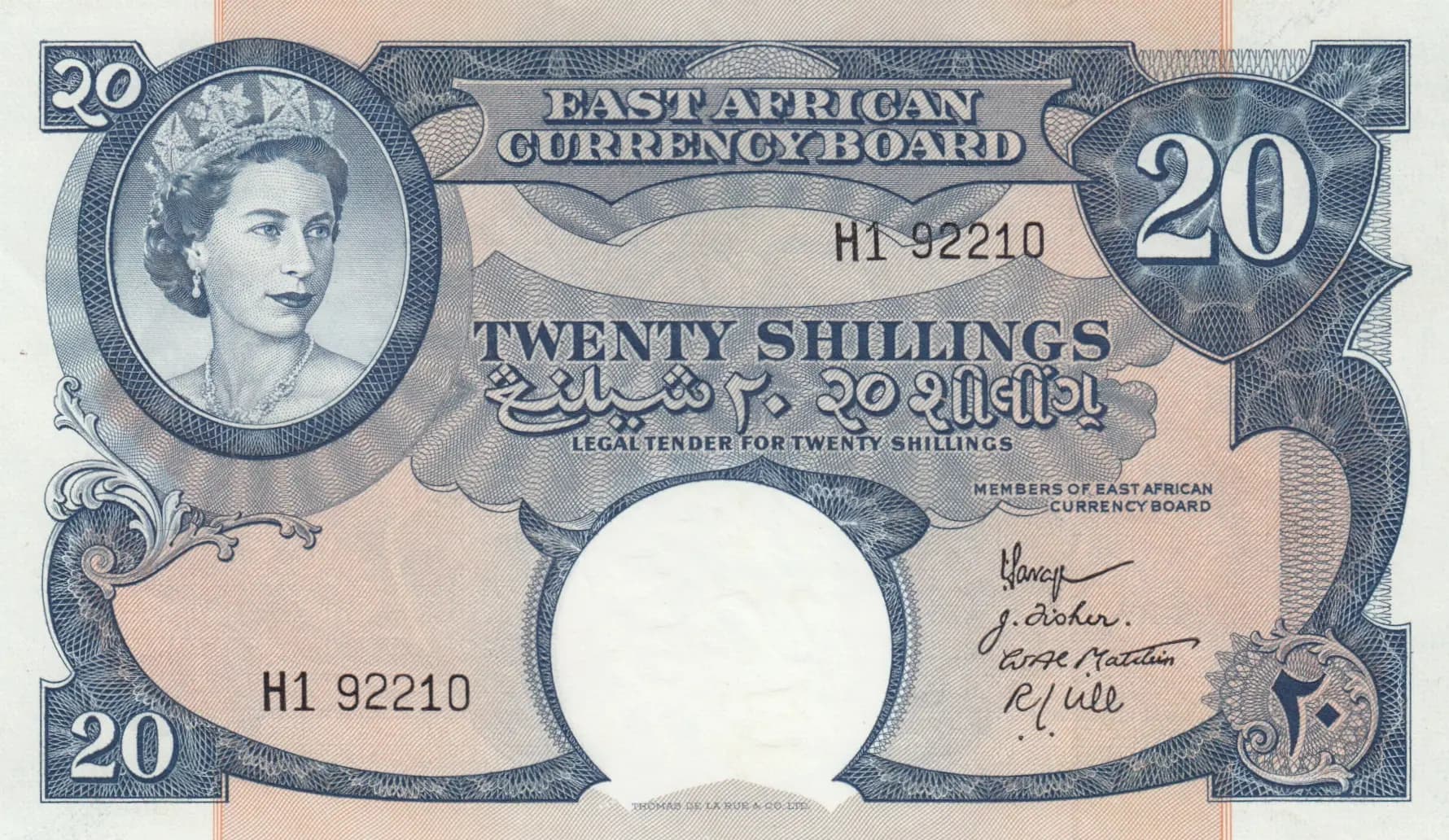
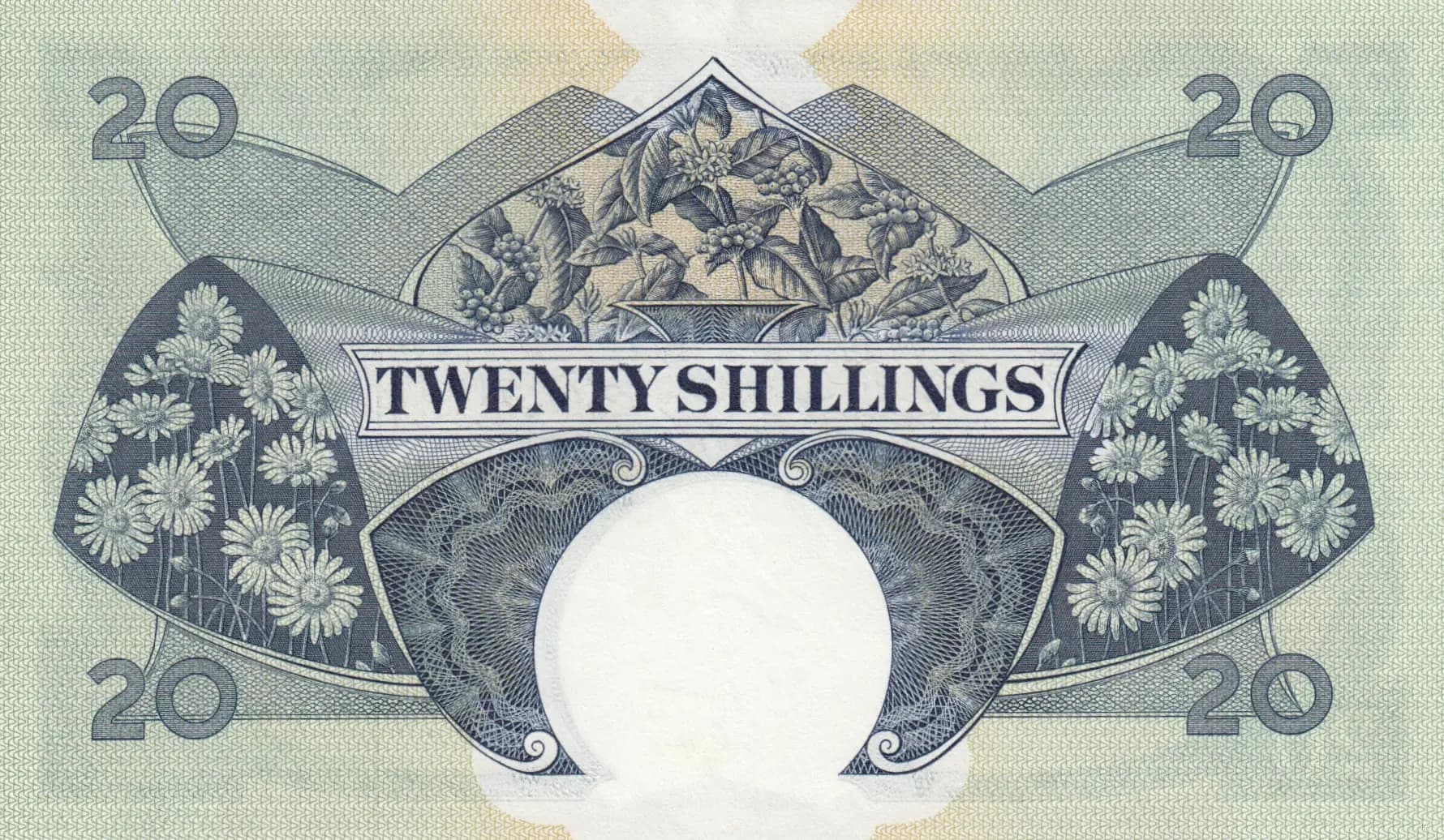
This is a pristine example of the 1958 East African Currency Board 20 Shillings note (Pick P-39), graded AU, displaying exceptional preservation with crisp engraving and no visible wear. The obverse features a formal portrait of Queen Elizabeth II in a circular frame at the left, with four signatures positioned in the lower right, while the reverse showcases fine botanical engraving of flowering plants flanking a central watermark circle. This note represents an early and significant issue from the post-colonial East African currency union, combining Commonwealth imagery with Arabic script to reflect the region's linguistic and cultural diversity.
Common. While this is an early issue from the East African Currency Board (1958), the eBay price history demonstrates consistent, modest market pricing with most sales between $25-$100 for circulated examples and UNC examples reaching approximately $300-400. The note had a substantial print run as the base currency of three territories. Recent sales data (2024) shows AU/VF examples selling in the $130-280 range, indicating stable but not exceptional demand. This is a standard cataloged issue without reported scarcity or restricted print runs.
Issued in 1958 by the African Currency Board (later renamed the East African Currency Board), this banknote was produced during the transition period of East African territories toward independence and the establishment of unified monetary systems. The prominent portrait of Queen Elizabeth II reflects the Commonwealth connection of Kenya, Uganda, and Tanganyika during this era, while the inclusion of Arabic script acknowledges the Islamic heritage and Swahili-speaking populations of the region. The note's design symbolizes the attempt to create a common currency for the three East African territories before the eventual dissolution of the currency board in 1966.
The obverse features a formal left-facing portrait of Queen Elizabeth II, positioned within a circular frame at the left side of the note, reflecting her status as Head of State for the member territories. The reverse displays an ornamental botanical design with flowering plants and agricultural motifs, emphasizing the region's agricultural heritage, particularly coffee production. Both sides incorporate fine line engraving with decorative scrollwork and flourishes in the corners. A prominent circular watermark area appears in the center-right of both sides, serving as a security feature. The color palette of blue-gray with tan/beige and cream underprinting creates a sophisticated appearance characteristic of Thomas de la Rue currency production.
FRONT: 'EAST AFRICAN CURRENCY BOARD' (English), '20' (denomination in all four corners), 'TWENTY SHILLINGS' (English), 'شيلنج ٢٠' (Arabic: Twenty Shillings), 'LEGAL TENDER FOR TWENTY SHILLINGS' (English), 'MEMBERS OF EAST AFRICAN CURRENCY BOARD' (English), Serial number 'H1 92210' (repeated upper right and lower left), Signatures of 'Harvey,' 'J. Fisher,' 'George Mathieson,' and 'E. Ule' (lower right). BACK: '20' (denomination in all four corners), 'TWENTY SHILLINGS' (English centered).
Intaglio engraving (line engraving) executed by Thomas de la Rue, London, as indicated in the catalog data. The crisp, detailed rendering of the portrait, botanical elements, and fine line work visible in the visual analysis are characteristic of high-security intaglio printing. The fine line engraving patterns, particularly evident in the reverse design, served as anti-counterfeiting measures. Multiple color printing on the note demonstrates advanced multicolor intaglio capability of this period.
This note displays four signatures (Harvey, J. Fisher, George Mathieson, and E. Ule) positioned in the lower right, consistent with the Pick P-39 listing. The catalog reference notes that similar notes exist with variant signature configurations (3 signatures at left, 4 at right; see Pick P-43), indicating this is the standard 4-signature right variety. Serial number prefix 'H1' is visible. The specific signature combination and positioning identifies this as a standard variety from the initial 1958 issue of the East African Currency Board series.