20 shillings 1956
Market Prices
19 salesAbout This Note
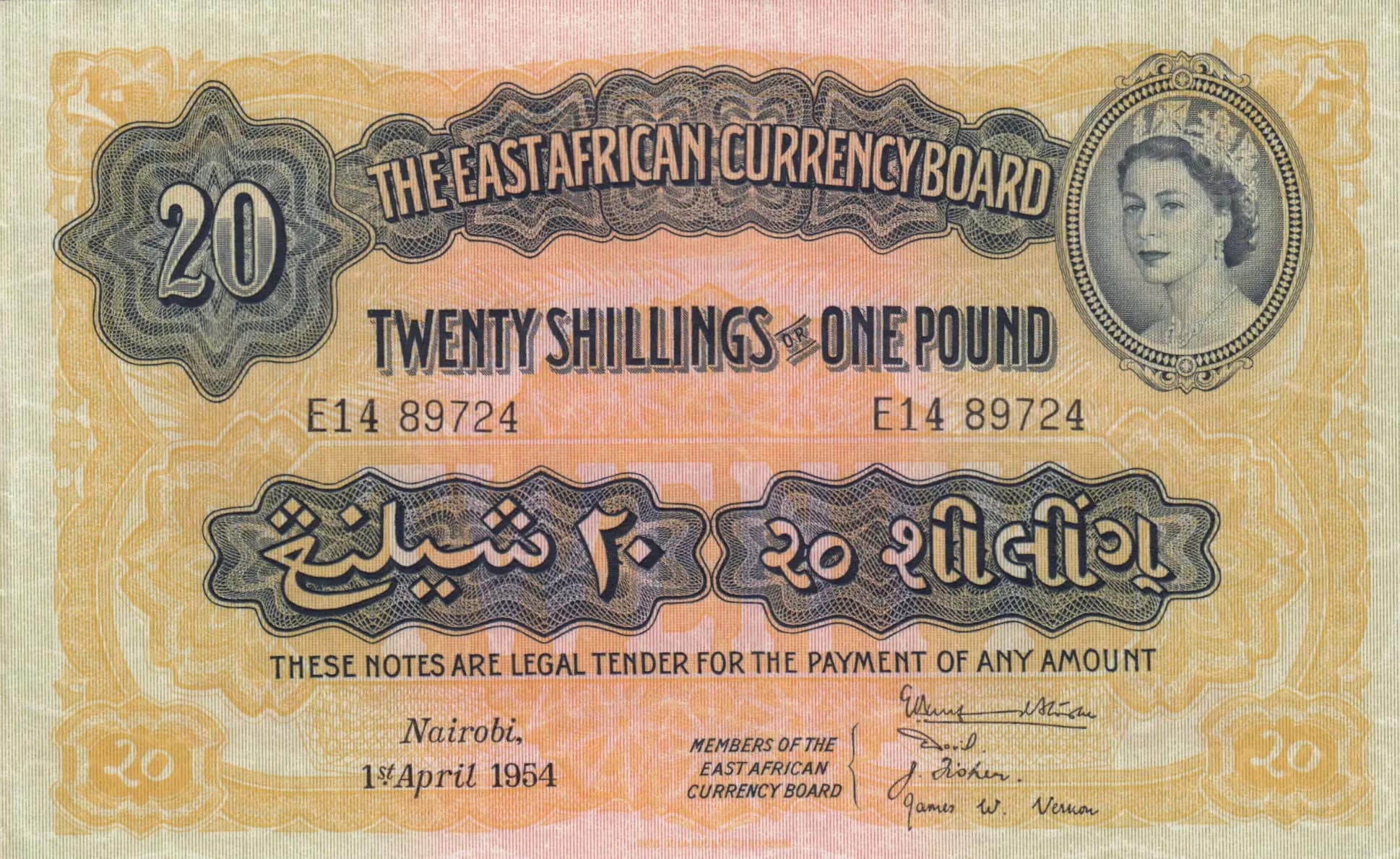
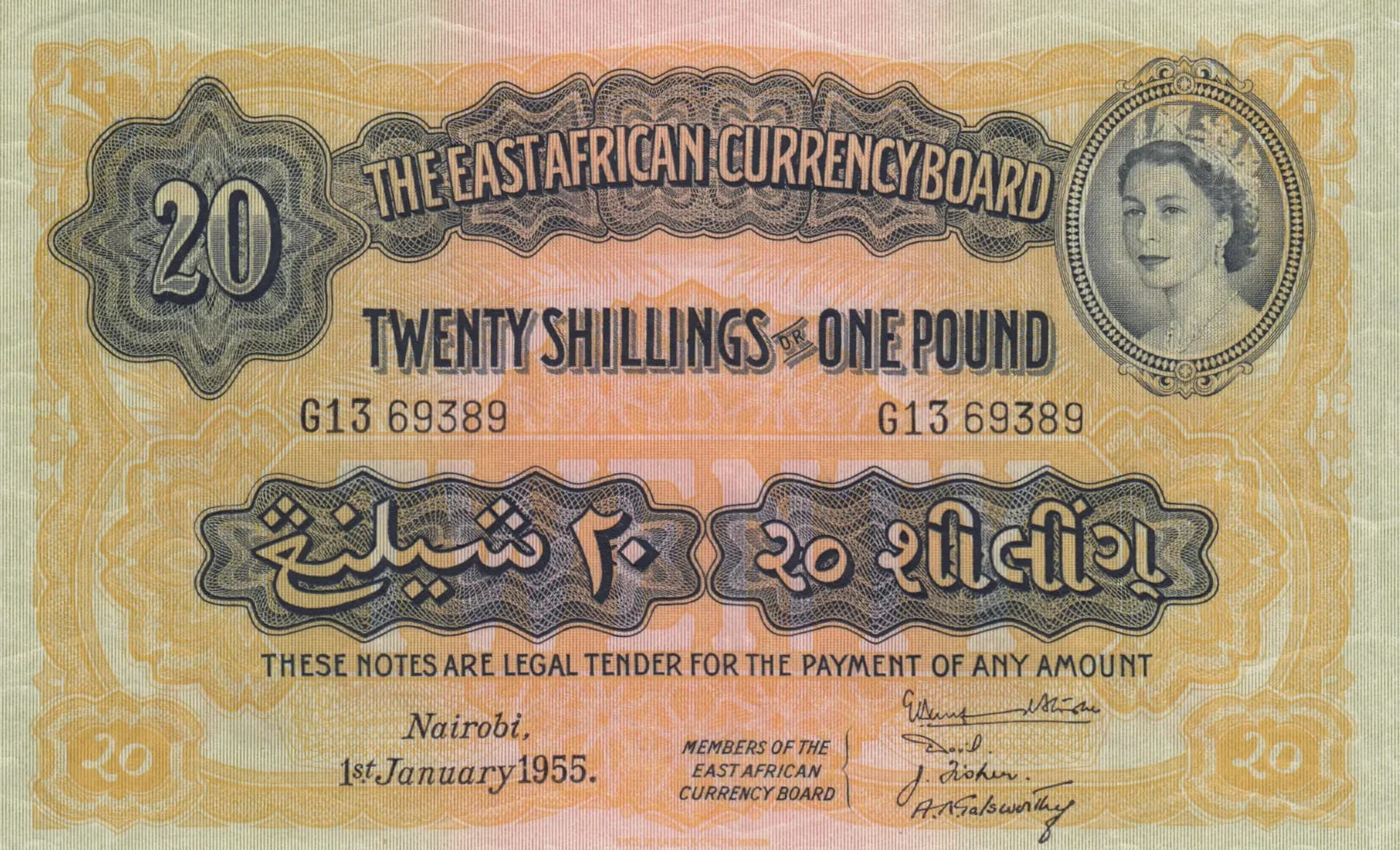
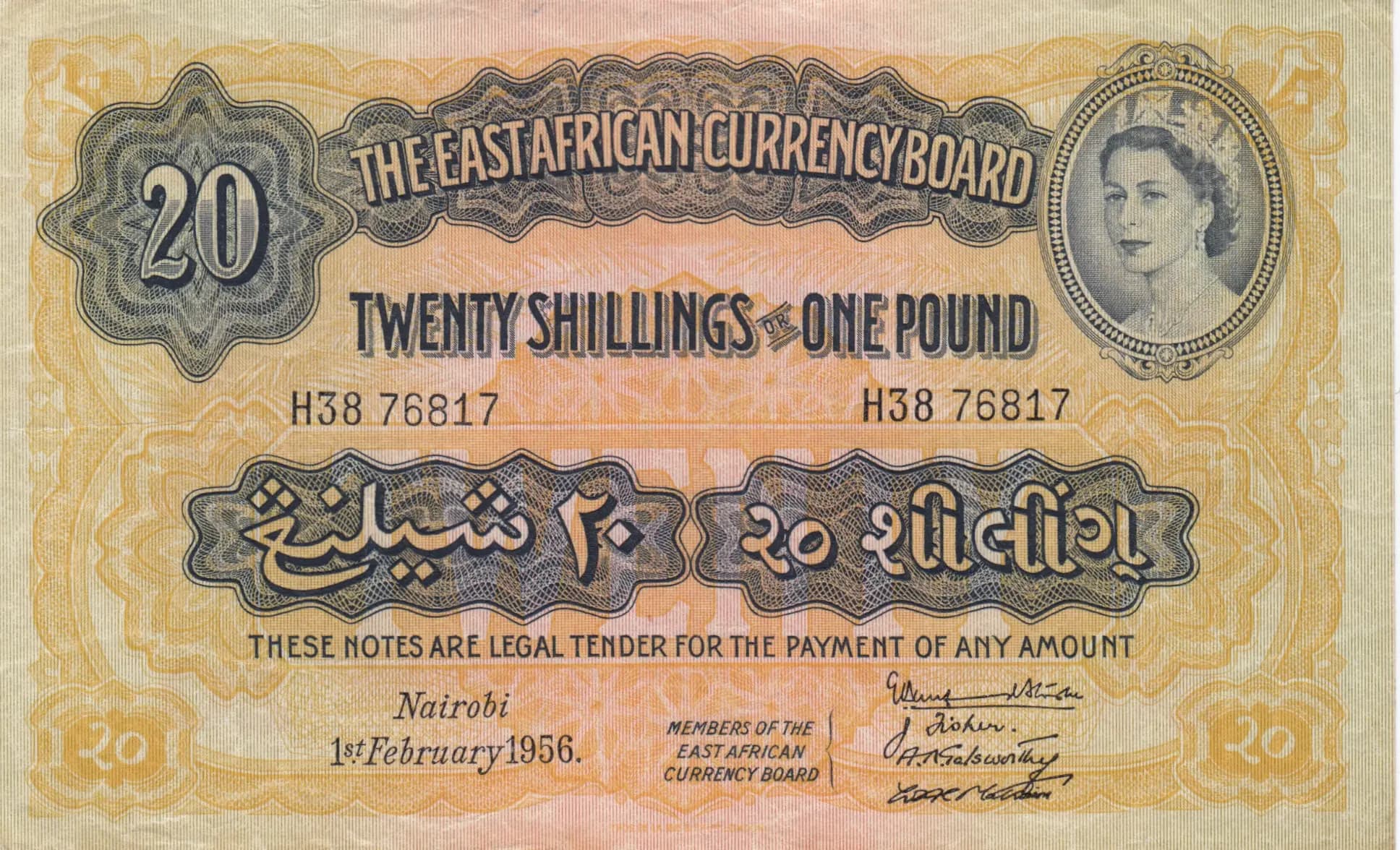
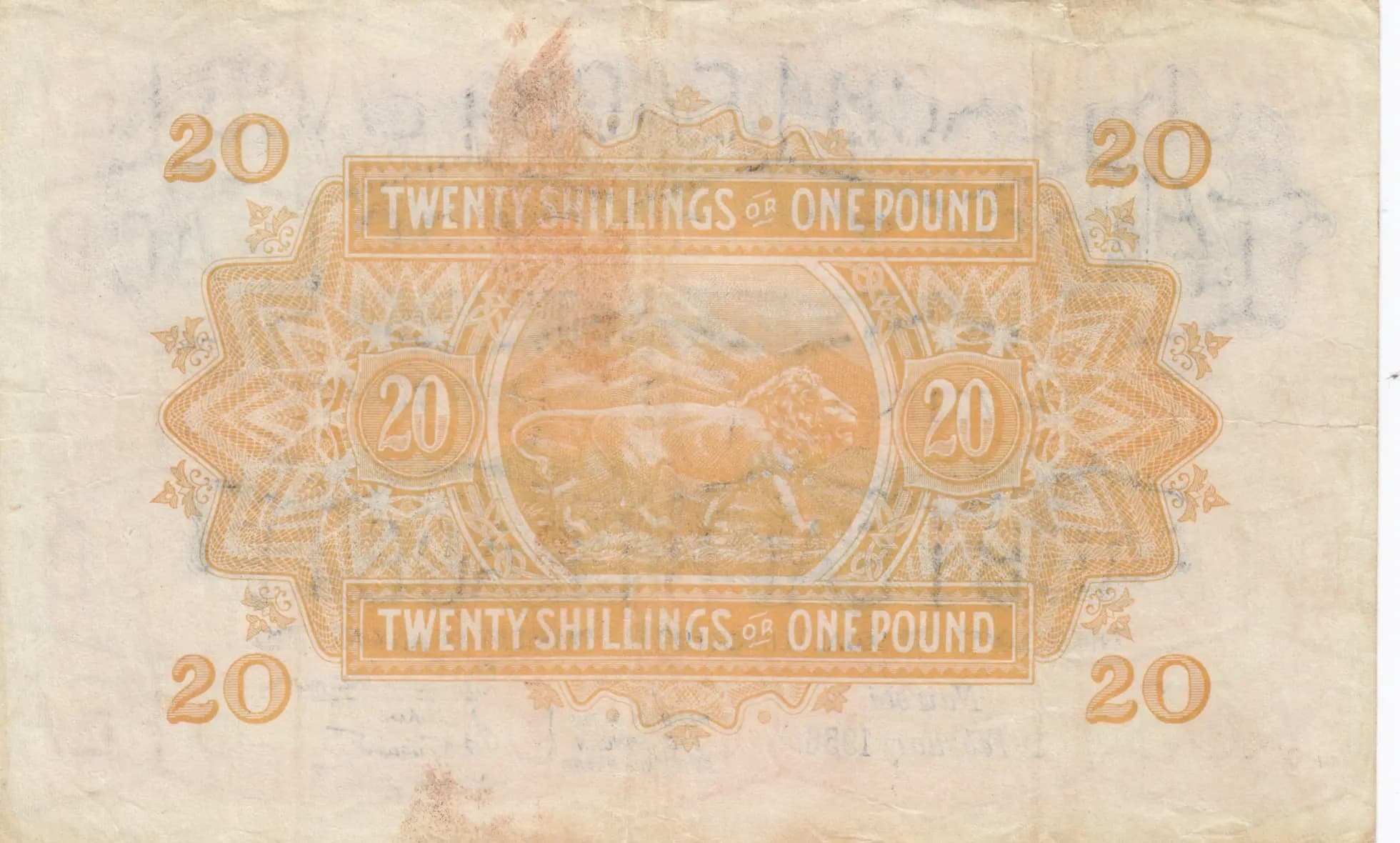
This is an East African Currency Board 20 Shillings note from 1956, issued in Nairobi and printed by Thomas de la Rue. The note features a portrait of Queen Elizabeth II in profile on the obverse, set within an ornate circular frame against a warm tan and gold background with pink undertones, while the reverse displays a detailed engraved lion vignette in a naturalistic landscape. In VF condition, the note exhibits moderate wear consistent with its age—visible creasing, light foxing, and some staining—but retains good structural integrity and readable inscriptions in English, Arabic, and Hindi, making it a desirable example of this multi-lingual Commonwealth currency issue.
Common. eBay market data provided shows consistent sales activity across multiple condition grades spanning from 2012 to 2025, with VF-grade notes selling for $68–$140.50, well within the range for commonly circulated notes. The catalogue value for VF is listed at $50. The East African Currency Board's 20 shillings issue had a substantial print run supporting multiple territories during a 4-year period (1953–1956), and no evidence of short print runs, recalls, or scarcity exists in the historical record or pricing data.
The East African Currency Board issued this note during the final years before East African monetary independence, representing a transitional period in the region's post-colonial development. The inclusion of inscriptions in English, Arabic, and Hindi reflects the diverse populations of East Africa and the board's commitment to inclusive currency design. Queen Elizabeth II's portrait symbolized the Commonwealth connection at a moment when East Africa was preparing to establish its own central banking institutions, which would occur within a decade.
The obverse features a right-facing profile portrait of Queen Elizabeth II within an ornate circular medallion positioned on the right side of the note, rendered in the classical engraved style characteristic of Commonwealth currency of the 1950s. The left side displays a decorative scalloped shield bearing the denomination '20'. The entire design is framed with elaborate ornamental border patterns incorporating floral and geometric motifs. The reverse presents a central rectangular vignette containing a detailed naturalistic depiction of an African lion, flanked by decorative scalloped frames on both left and right sides, with additional ornamental borders. The color scheme throughout employs tan, gold, black, pink, and cream tones, creating a warm, imperial aesthetic typical of de la Rue's mid-20th century Commonwealth banknote work.
FRONT SIDE: 'THE EAST AFRICAN CURRENCY BOARD' — The official issuing authority. 'TWENTY SHILLINGS OR ONE POUND' — Denomination statement emphasizing the pound sterling equivalent. 'THESE NOTES ARE LEGAL TENDER FOR THE PAYMENT OF ANY AMOUNT' — Legal tender declaration. 'Nairobi' — Place of issue. '1st February 1956' — Date of issue. 'MEMBERS OF THE EAST AFRICAN CURRENCY BOARD' — Authority attribution. Arabic inscription: 'ف ٢٠ شلنج' (20 shillings). Hindi inscription: 'एक पाउंड २०' (20 one pound). Serial number: 'H38 76817' — Appears twice on the front. BACK SIDE: 'TWENTY SHILLINGS OR ONE POUND' — Denomination repeated. '20' — Denomination indicator in all four corners.
Intaglio engraving (line engraving), the primary security printing method employed by Thomas de la Rue for this issue. The visual analysis confirms the presence of 'intricate engraved line patterns throughout,' 'fine detail work in decorative borders,' and detailed engraved vignettes—all hallmarks of traditional intaglio engraving. Multiple layers of design complexity and fine line work visible in both the portrait medallion and the lion vignette are consistent with hand-engraved plates characteristic of de la Rue's premium banknote production.
This specific example is dated 1st February 1956 and bears the serial number prefix 'H38', issued from Nairobi. The note exhibits one of the known signature varieties for Pick-35, though the signatures are not clearly legible in the visual analysis. The PMG Population Report indicates this Pick number has one catalogued variant. The 1956 date places this note in the later portion of the 1953–1956 issue window, potentially representing a later signature variety. No overprints or other distinguishing varieties are evident from the images provided.