20 shillings 1952
Market Prices
7 salesAbout This Note
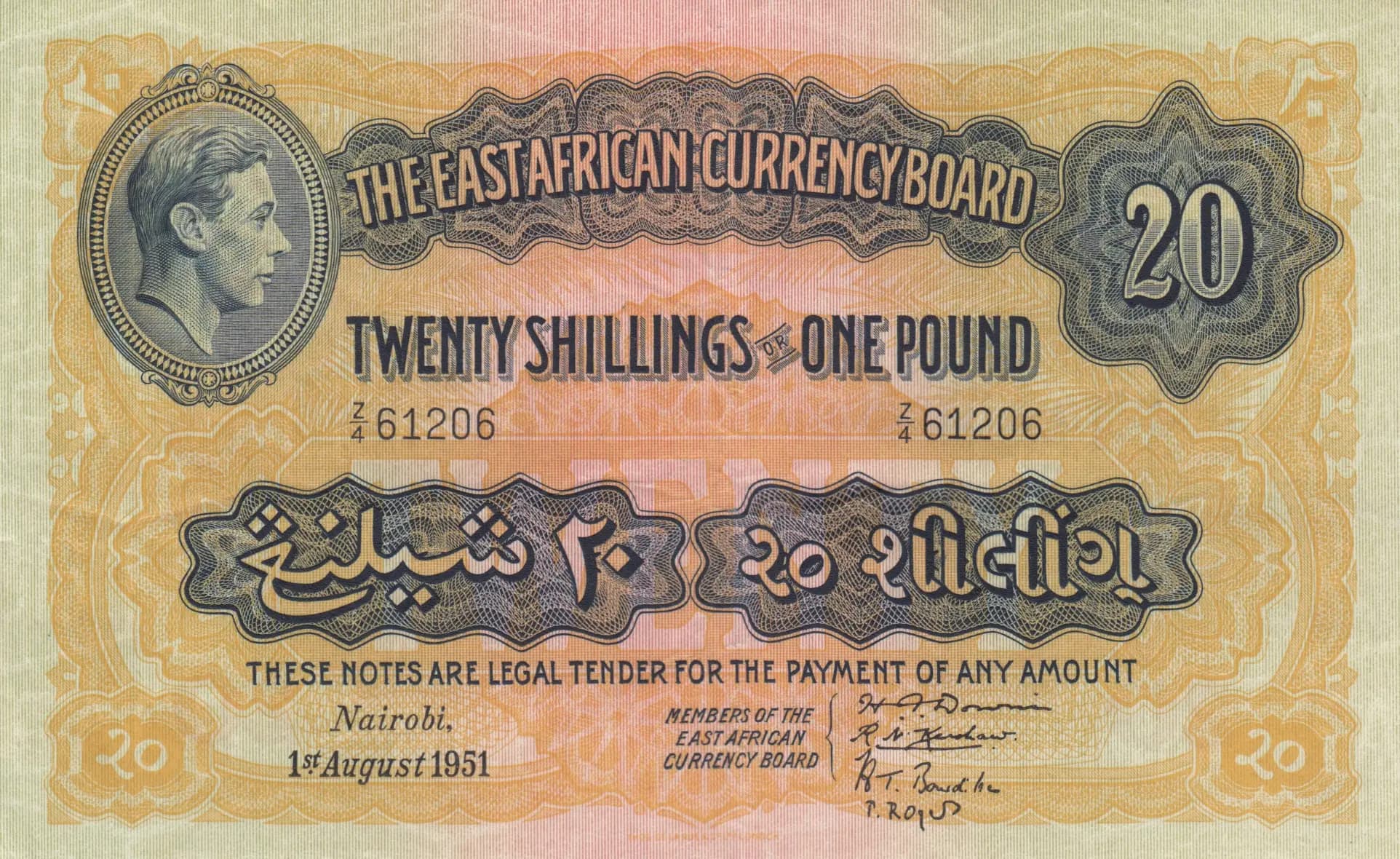
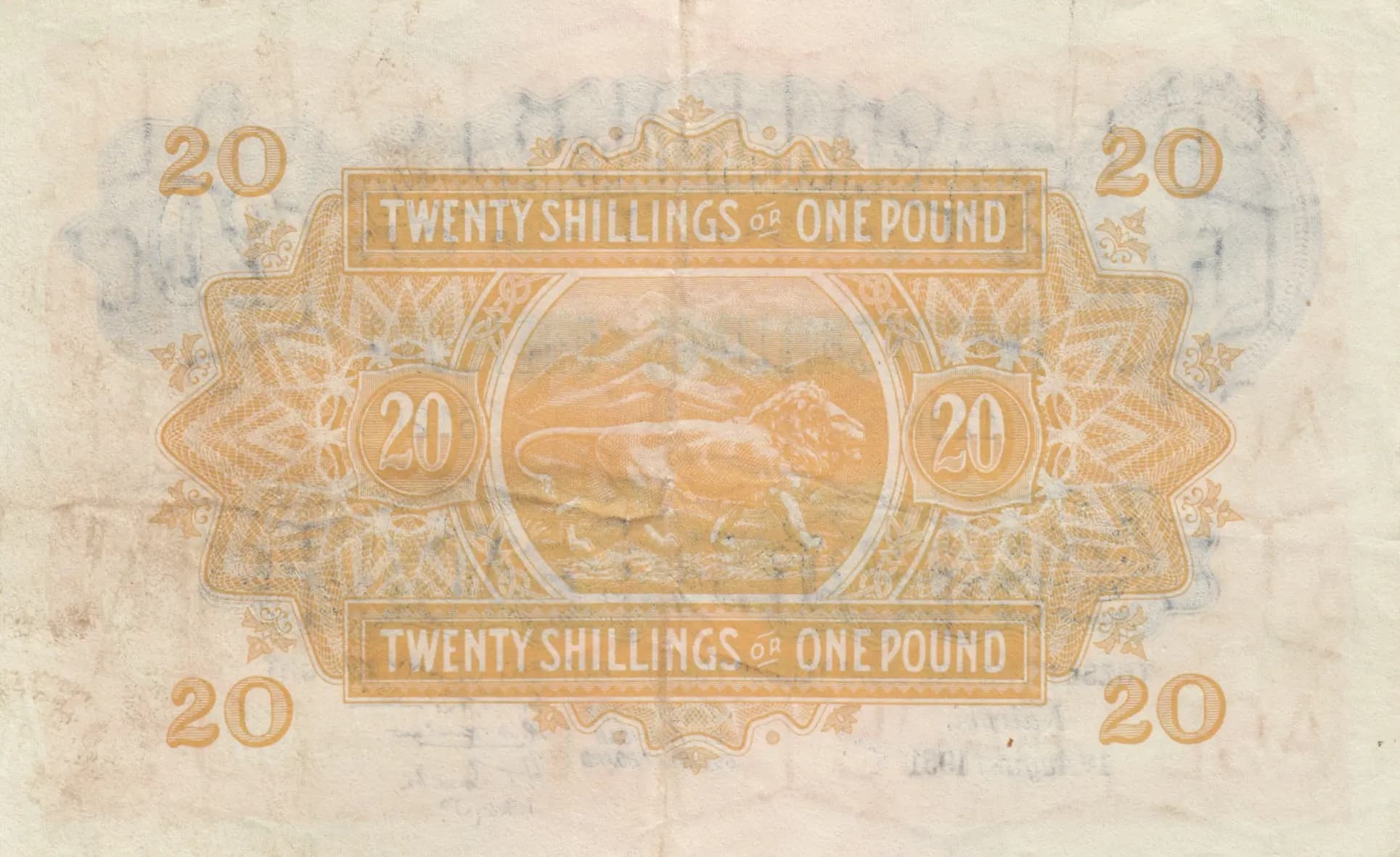
This is an East African Currency Board 20 Shillings note from 1951, featuring a portrait of King George VI in profile on the obverse and a mountainous East African landscape on the reverse. The note displays moderate circulation wear consistent with VF grade, with visible creasing, foxing, and age-related discoloration, yet the fine engraving details remain clearly visible. This Pick 30b variant from Nairobi is a significant example of the later George VI issue period, representing the final years before East African currency board operations were restructured.
Common. This note is a standard regular issue of the East African Currency Board with a documented production run spanning 1943-1952. eBay market data confirms common status, with comparable VF specimens selling between $145-$217 in recent years and lower grades readily available. The P-30b variant (Nairobi printing) is among the more frequently encountered variants of this denomination. No indicators of scarcity or rarity exist in print run records or collector demand patterns.
Issued during the final decade of the East African Currency Board's operation under British colonial administration, this 1951 note represents the transition period between World War II and East African independence movements of the 1960s. The inclusion of multilingual text in Amharic and Kannada reflects the cosmopolitan nature of East African commerce and the Board's recognition of its diverse user base across Kenya, Uganda, and Tanganyika. The mountainous landscape depicted on the reverse symbolizes the natural geography and economic significance of the East African highlands.
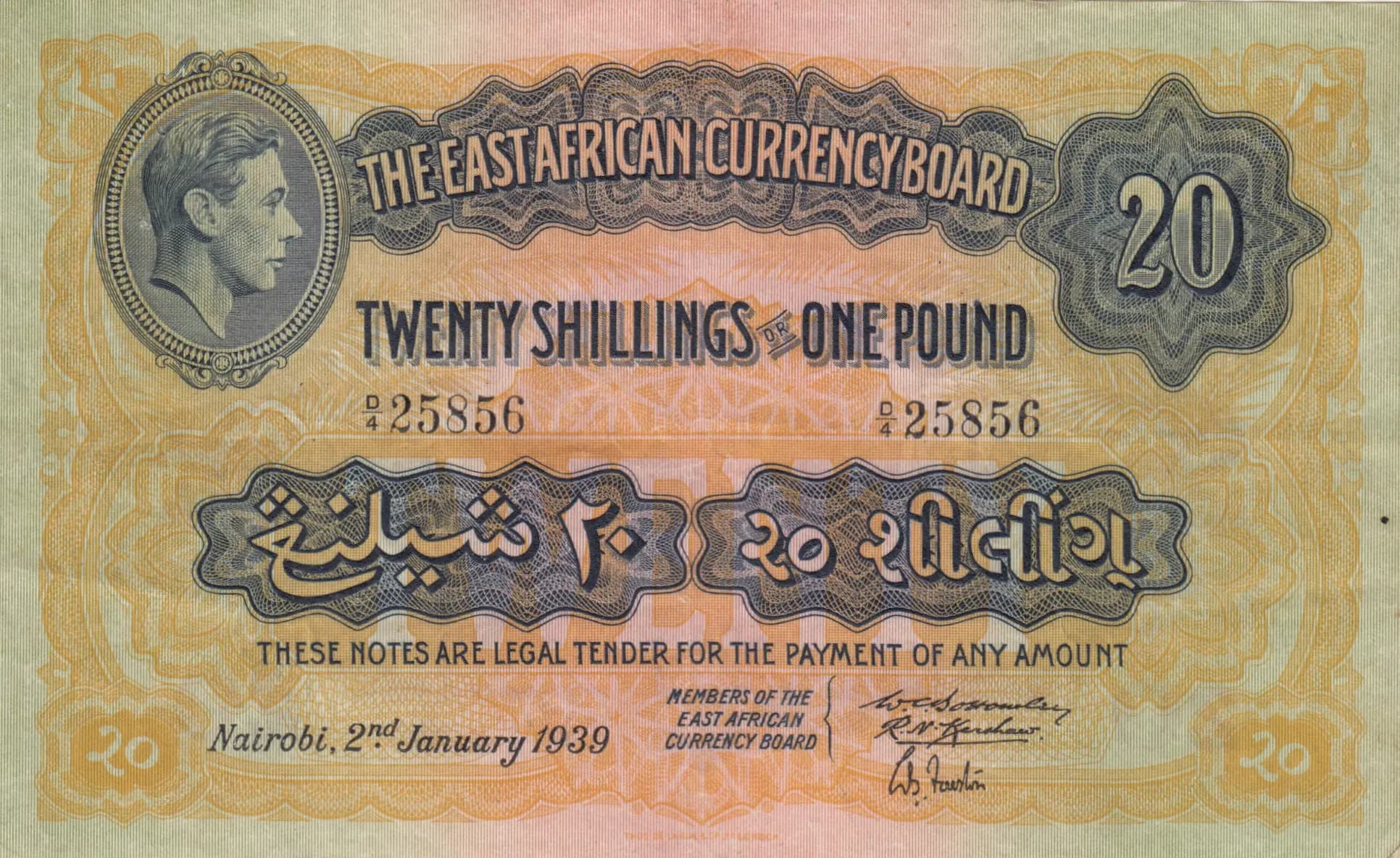
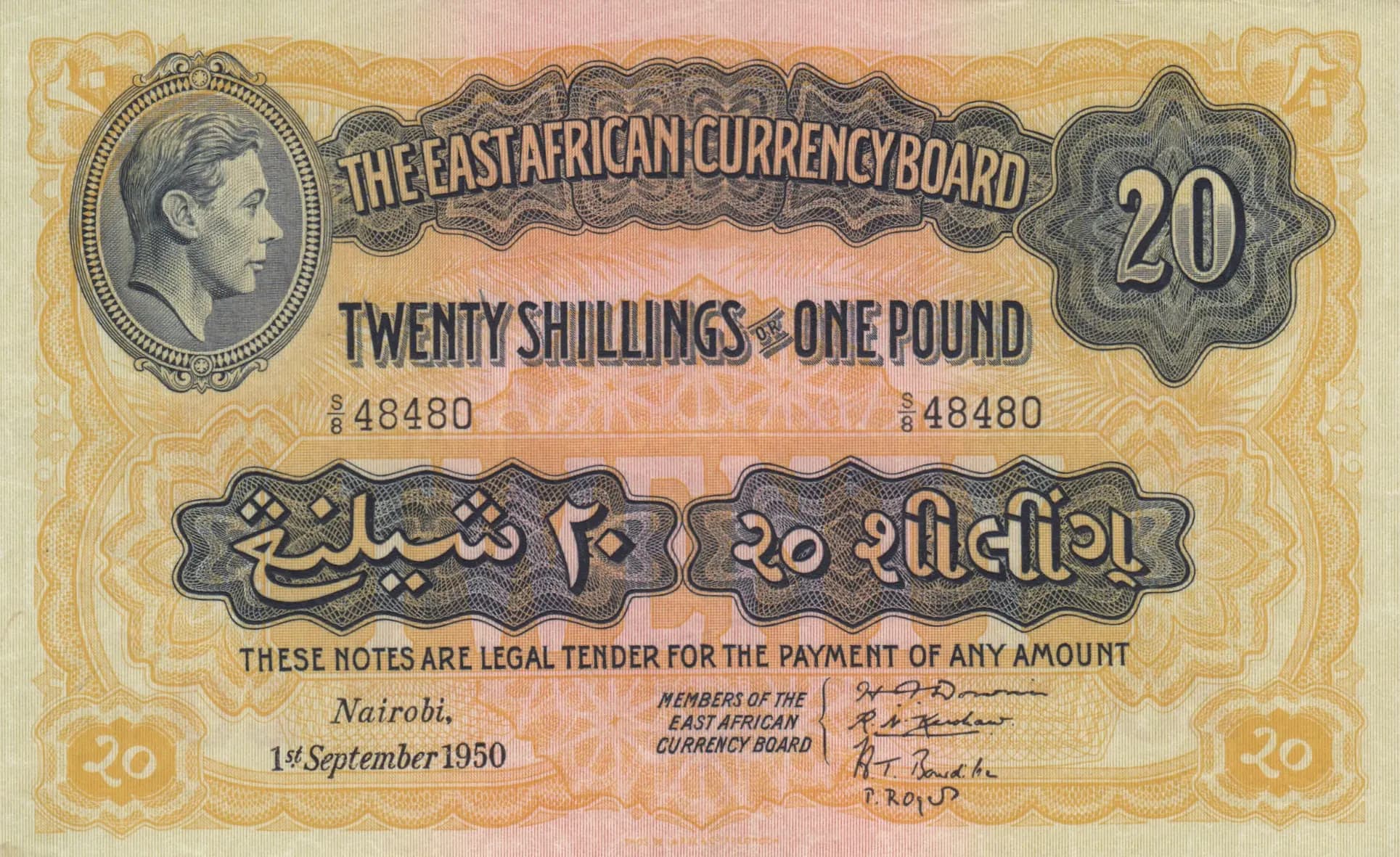
The obverse features a formal portrait of King George VI rendered in profile facing right, positioned within an ornate circular medallion with elaborate engraved borders. The design employs a cream-to-pink/salmon gradient background with decorative scalloped frames containing the denomination numerals. The reverse displays a vignette of East African mountainous terrain with sparse vegetation, rendered in fine detail and surrounded by ornamental borders in cream and tan tones. Filigree patterns and intricate engraving work frame all design elements, characteristic of Thomas de la Rue's high-security banknote production standards.
FRONT: 'THE EAST AFRICAN CURRENCY BOARD' (issuing authority); 'TWENTY SHILLINGS OF ONE POUND' (denomination statement); 'THESE NOTES ARE LEGAL TENDER FOR THE PAYMENT OF ANY AMOUNT' (legal tender declaration); 'Nairobi.' (place of issue); '1st August 1951' (issue date); 'MEMBERS OF THE EAST AFRICAN CURRENCY BOARD' (governing body reference); Serial number 'Z 61206' (appears twice); Amharic numerals for 'Twenty'; Kannada text 'ಇಪ್ಪತ್ತು ಶಿಲ್ಲಿಂಗ್' (Twenty shillings); Four handwritten authorized signatures. BACK: 'TWENTY SHILLINGS OF ONE POUND' (denomination statement, appears top and bottom); Denomination '20' in all four corners.
Line engraving on steel plates with multi-color offset lithography, printed by Thomas de la Rue, London. The note employs the security printer's signature fine-line engraving technique for portraits and ornamental borders, combined with colored underprinting in yellow and orange tones (visible in the gradient background). The blue-black primary color combined with secondary background colors was standard De la Rue practice for colonial currency during this period.
This is cataloged as P-30b, the Nairobi printing variant dated 1st August 1951. Per PMG population data, P-30 has three known variants: P-30A (with printer identification, earlier issues), P-30a (Nairobi, Indian-style serials), and P-30b (Nairobi variant noted here). The observed specimen shows the characteristic four-signature format of later Board issues and the Nairobi production marker. Serial number Z 61206 is consistent with documented Nairobi printing batches.