20 shillings 1939
Market Prices
3 salesAbout This Note
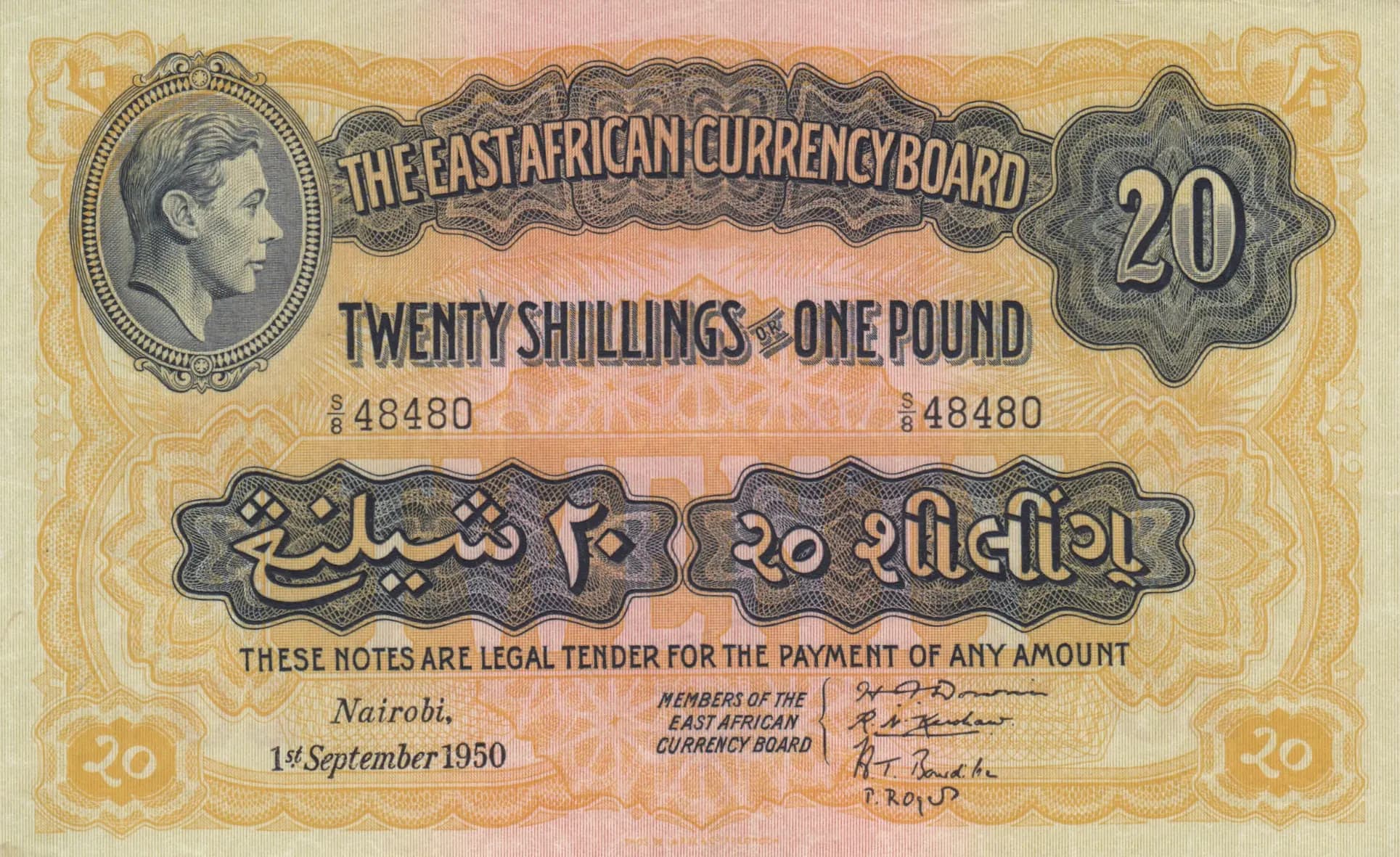
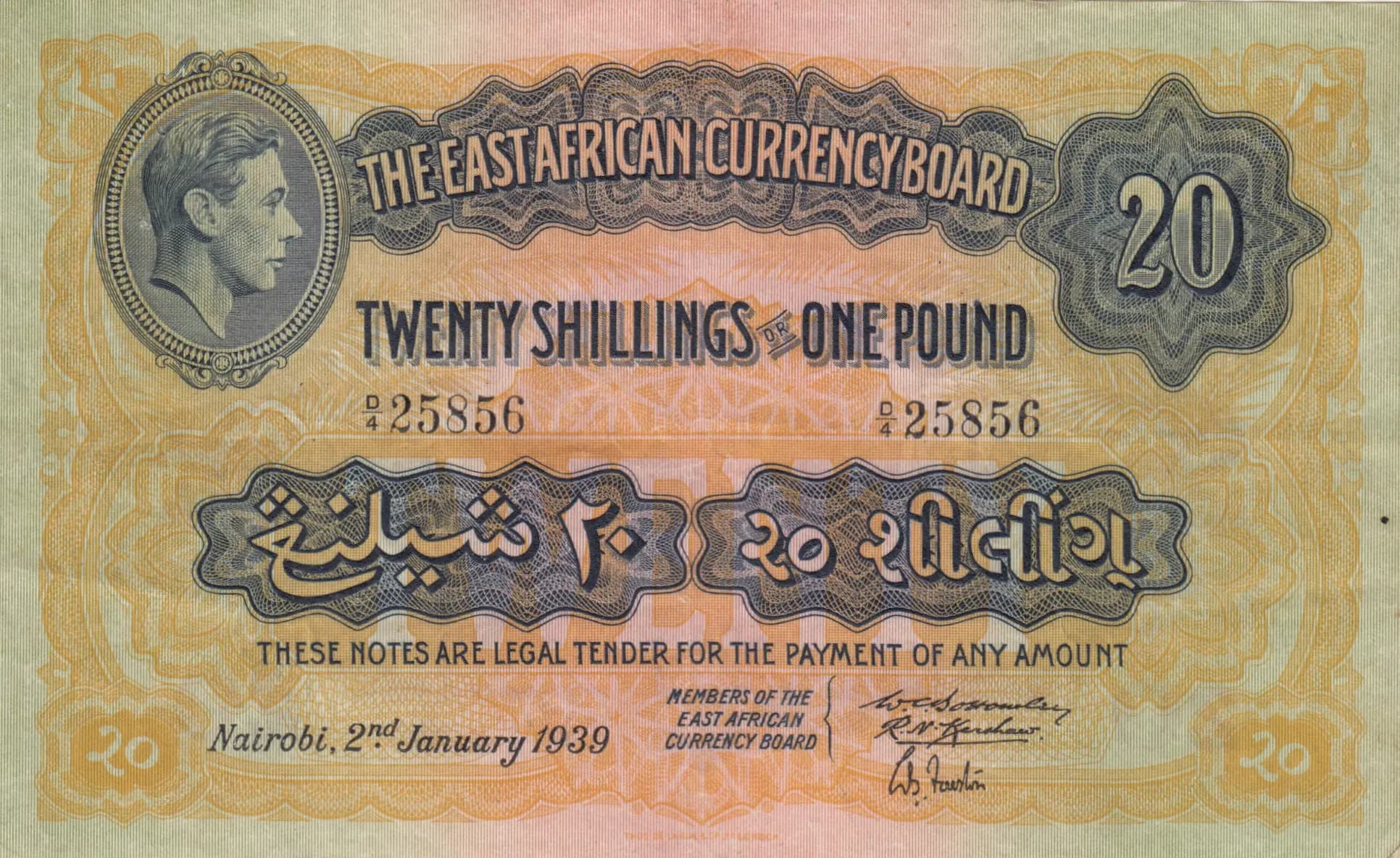
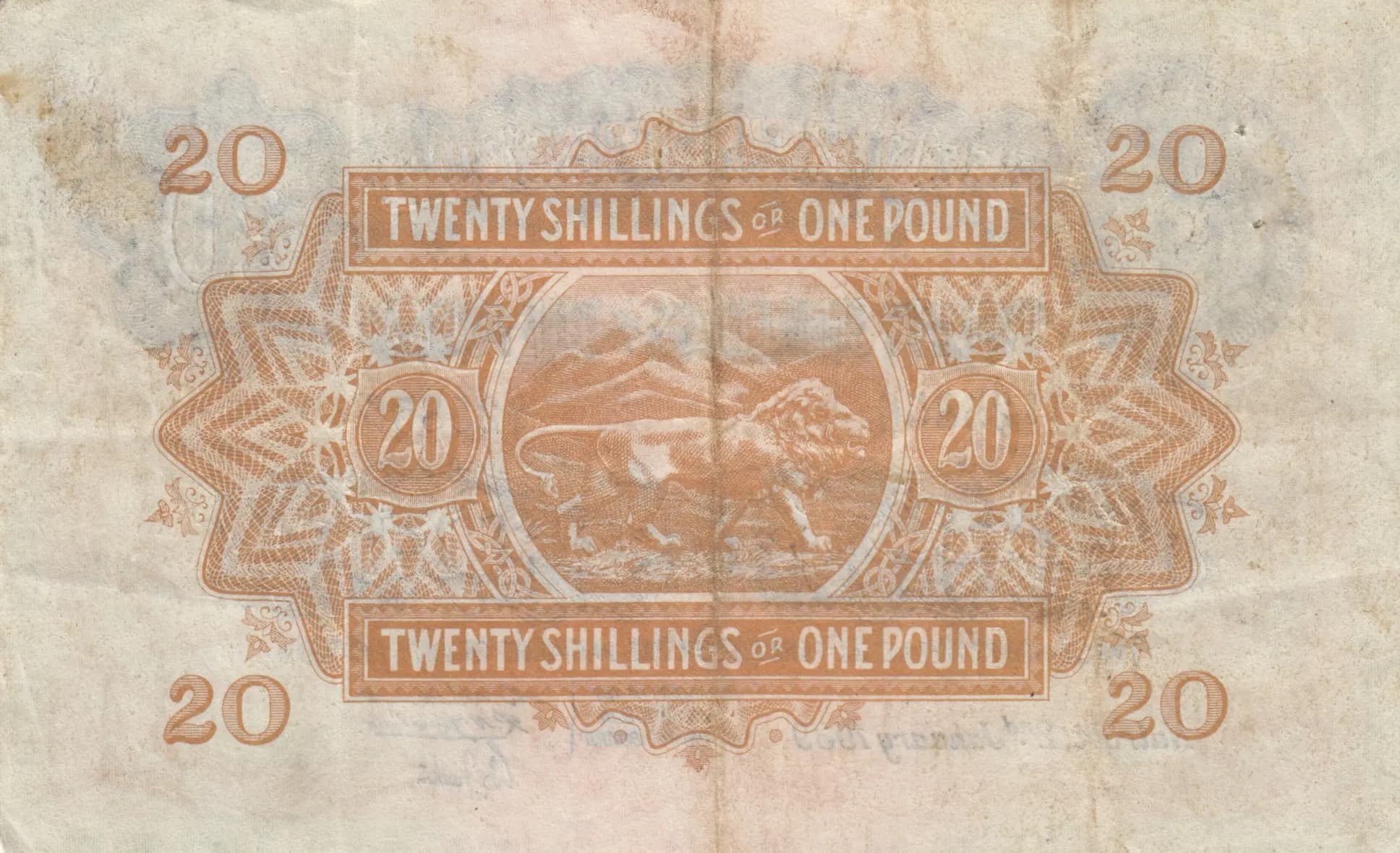
This is a VF-graded 20 Shillings banknote from the East African Currency Board, dated 2nd January 1939 and issued from Nairobi. The note features a formal portrait of King George VI in profile on the obverse and a striking lion in African landscape on the reverse, both rendered in the characteristic tan, brown, and orange palette typical of Thomas de la Rue's 1938-1942 series. The note displays honest circulation wear including creases, foxing, and discoloration consistent with its age, with a notable vertical center fold visible on the reverse.
Common. Market evidence strongly supports this assessment: eBay sales data shows VF examples selling for approximately $125-$145 (2014-2016 transactions), with even higher grades (AUNC) achieving $264. The catalog value for VF is listed at $125. The 1938-1952 date range indicates a lengthy production run, and no evidence of recall, short print runs, or special rarity factors exists. The Pick P-30a variety is well-represented in PMG population data. This note, while historically significant, is readily obtainable at modest cost in the numismatic market.
This note was issued during the reign of King George VI and represents the early currency authority of British East Africa under the African Currency Board, which operated from 1938-1952. The lion depicted on the reverse symbolizes the natural wildlife and colonial administration's connection to East Africa's identity, while the Nairobi date-line confirms this as a regional issue from the British protectorate era. The dual denomination (20 Shillings = 1 Pound) reflects the sterling-based monetary system that governed British colonial territories.
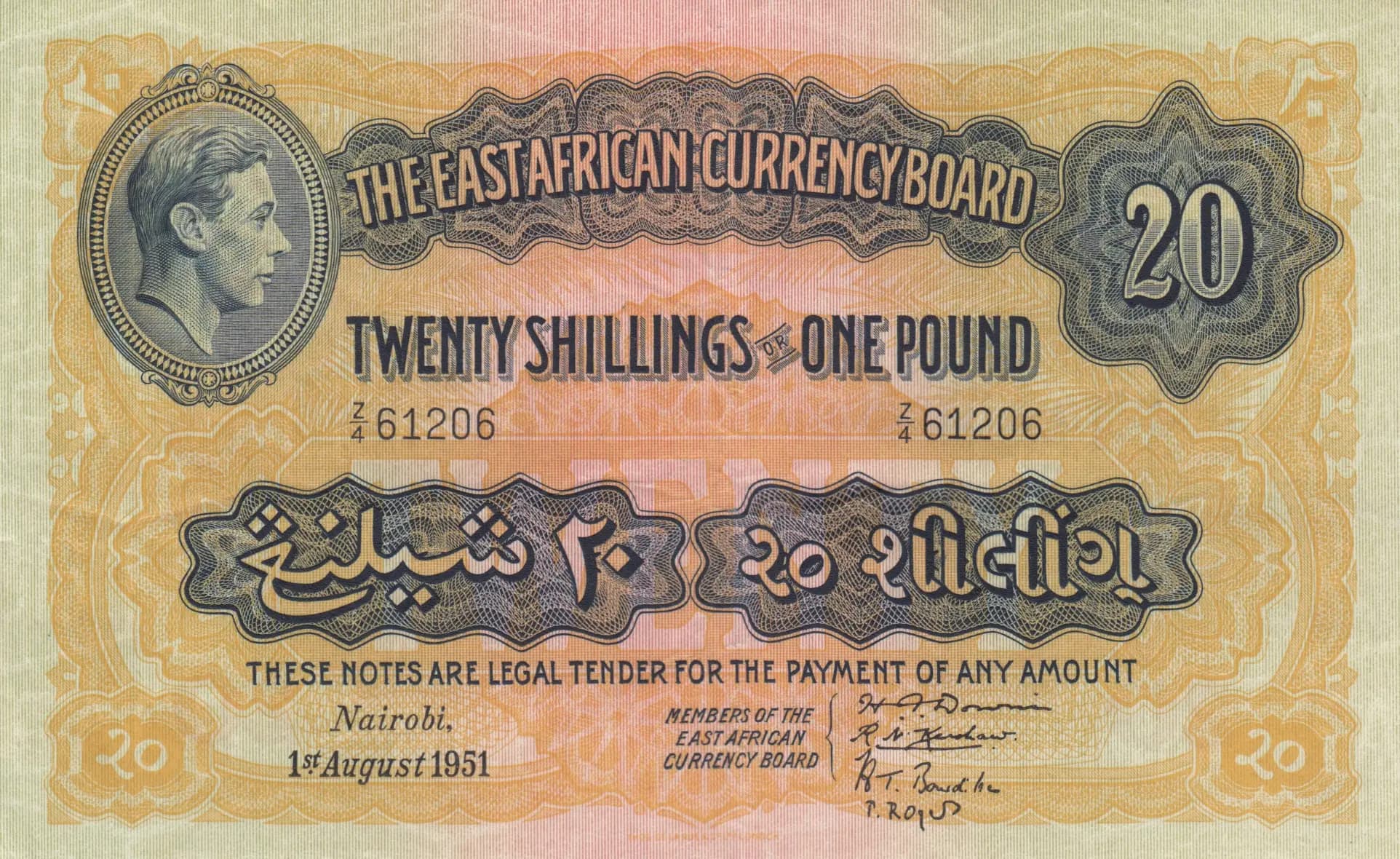
The obverse presents a formal right-facing profile portrait of King George VI, rendered in classical intaglio style within an ornate circular medallion with intricate line work and filigree. The denomination '20' appears in a decorative shield on the right side. The reverse features a detailed engraved landscape vignette showcasing an African lion in its natural habitat with mountainous terrain (likely Mount Kenya or similar East African peak) in the background. Four corner shields contain the denomination numeral. Both sides employ elaborate decorative borders, scrollwork, and geometric patterns characteristic of high-security banknote design. The color scheme throughout uses tan, brown, and orange underprinting on a cream/pale base.
OBVERSE: 'THE EAST AFRICAN CURRENCY BOARD' (issuing authority), 'TWENTY SHILLINGS OR ONE POUND' (denomination statement), 'THESE NOTES ARE LEGAL TENDER FOR THE PAYMENT OF ANY AMOUNT' (legal tender declaration), 'Nairobi, 2nd January 1939' (place and date of issue), 'MEMBERS OF THE EAST AFRICAN CURRENCY BOARD' (signature block header), Serial number 'D25856' (appears twice, indicating both halves of note), plus handwritten signatures of authorized board members. REVERSE: 'TWENTY SHILLINGS OR ONE POUND' (appears both above and below central vignette), '20' (denomination numeral, repeated in all four corner shields).
Intaglio engraving (taille-douce), executed by Thomas de la Rue, London, the principal security printer for British Commonwealth currency during this period. The fine line work, complex circular frames, intricate filigree patterns, and detailed landscape vignette are hallmarks of intaglio printing. The note exhibits the characteristic crisp detail and dimensional quality produced by this method, with no evidence of lesser printing techniques.
This note is catalogued as Pick P-30a, representing the Nairobi variant with printer's name (TDLR) visible and Indian-style serial numbering. PMG identifies three variants under the base P-30 number: P-30A (with TDLR printer mark), P-30a (Nairobi, without TDLR), and P-30b (Nairobi variant). The specimen analyzed bears the date 2nd January 1939, with serial number D25856, and displays characteristics consistent with the 1938-1942 issue period. The presence of TDLR attribution and three handwritten signatures confirms this as a standard regular-issue variant of the series.