10 shillings 1961
Market Prices
About This Note
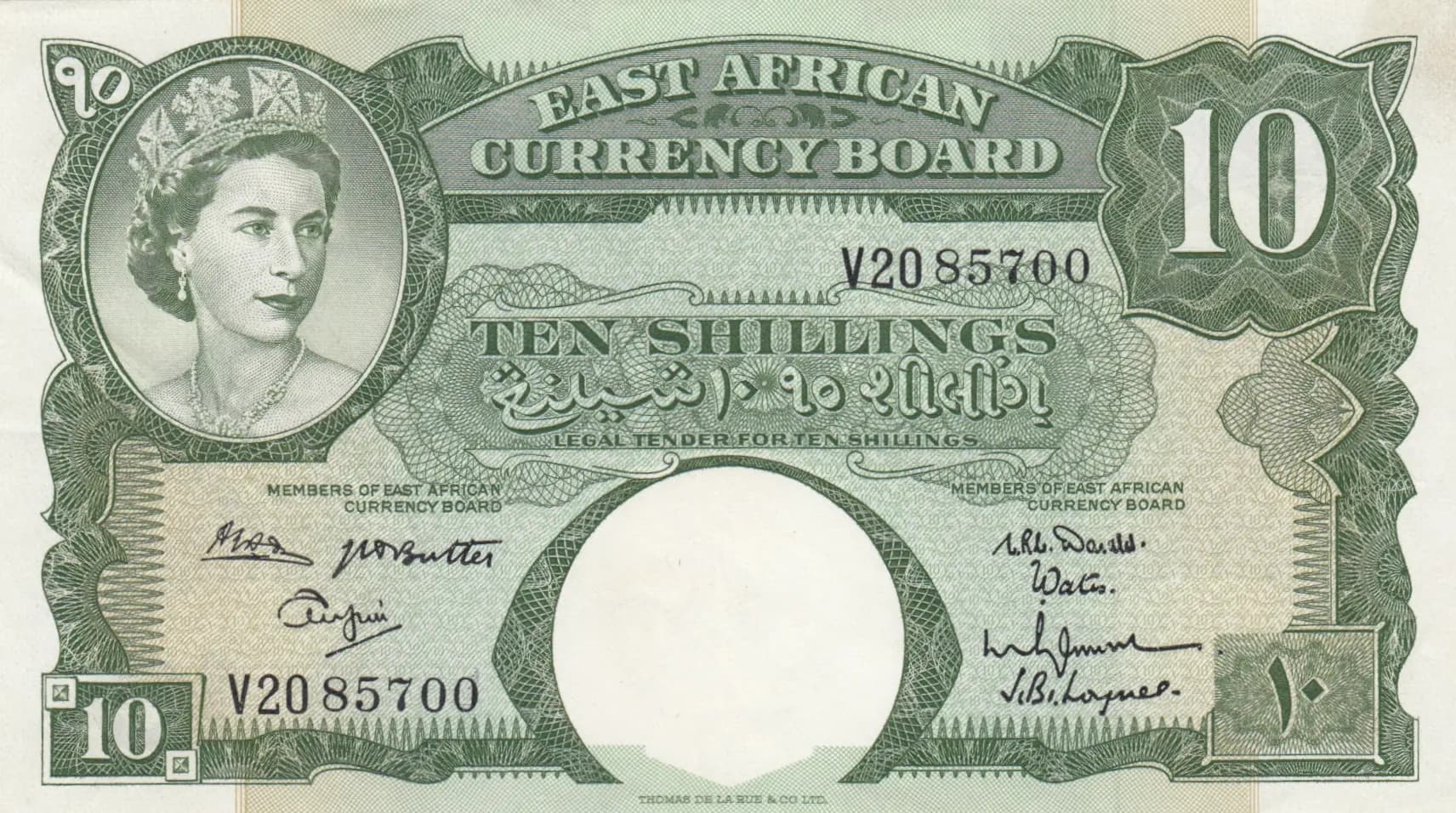
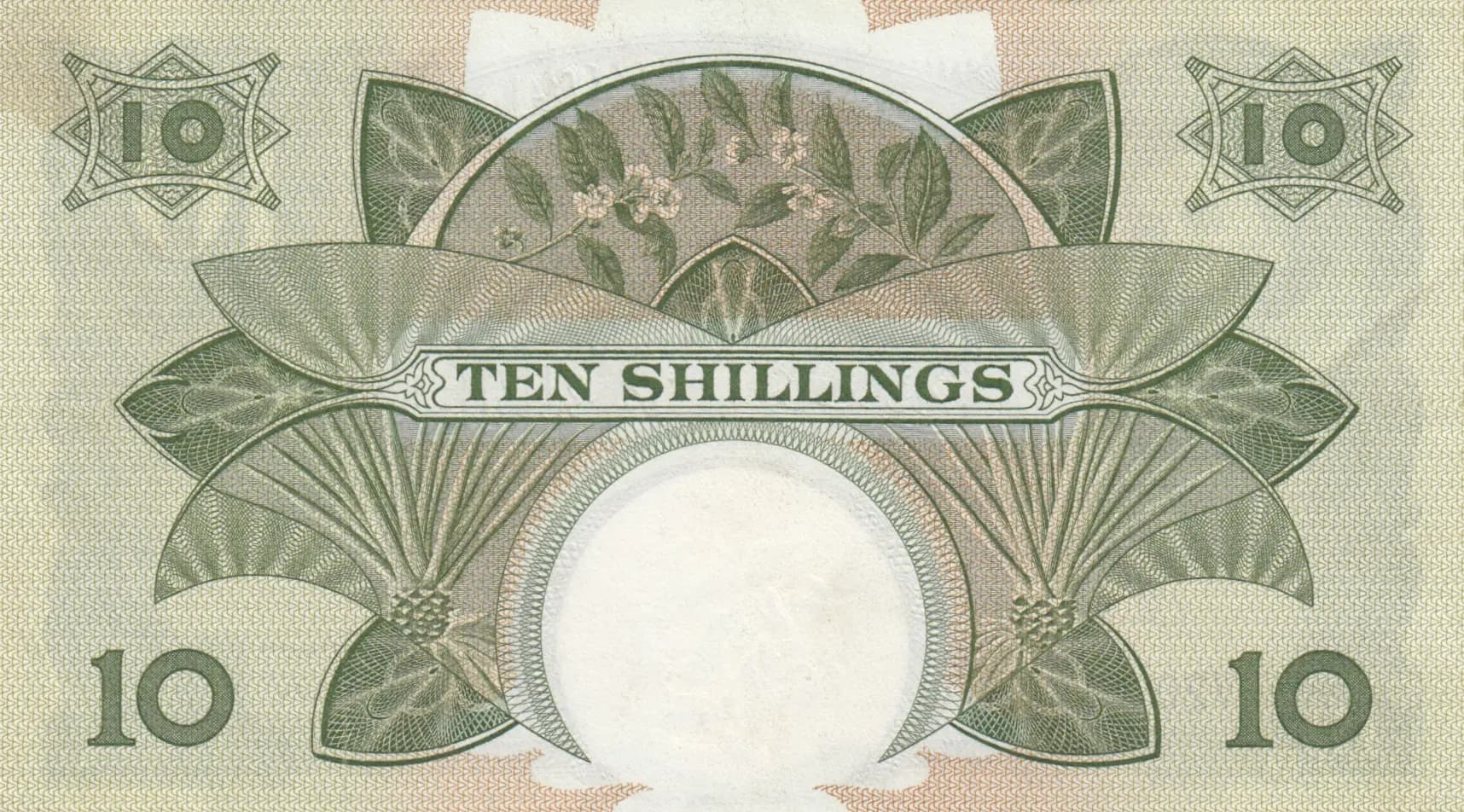
This is an exceptional example of the 1961 East African Currency Board 10 Shillings note (Pick P-42b), presented in uncirculated condition with crisp, sharp printing throughout. The note features Queen Elizabeth II in profile on the obverse with the characteristic green coloring and multicolored security printing, flanked by three signatures on the left and four on the right, alongside elegant botanical designs of tropical vegetation on the reverse. As a product of the Thomas de la Rue printing house and from the early post-independence period of East African currency, this note represents both numismatic and historical significance, particularly in premium uncirculated condition.
Common. While the catalog reference notes two variants (P-42a and P-42b), the eBay market data provides clear pricing signals: UNC examples sell in the $300 range (2019 catalogue value) with occasional market listings in the $2,850 range, but more typical circulated examples trade between $50-$150. The note was issued during 1961-1963 by an established multinational currency authority (East African Currency Board serving multiple territories), suggesting moderate to substantial print runs. The PMG population report shows this base Pick number has minimal variant distinction. No evidence of short print runs, recalls, or extreme scarcity characteristics are present in the catalog data. Standard early Commonwealth currency notes from this period are generally common in collector markets.
This banknote was issued by the East African Currency Board during 1961-1963, a transitional period following the independence movements in East Africa. The portrait of Queen Elizabeth II reflects the region's Commonwealth ties during this era, while the Arabic inscriptions visible on the obverse acknowledge the multicultural and multilingual composition of East African territories. The note's design incorporating tropical botanical elements—particularly the palm fronds and date palm imagery on the reverse—represents the regional flora and identity of East Africa, making it a cultural artifact of post-colonial African monetary sovereignty.
The obverse features a left-facing portrait of Queen Elizabeth II in formal attire with jewelry, positioned in the upper left quadrant, rendered in classical engraving style typical of Commonwealth currency of the period. The note is dominated by intricate ornamental filigree borders featuring fine line work and cross-hatching throughout, creating a protective security framework. A distinctive horizontal oval cutout occupies the center of the note, framed by decorative circular patterns. Star-shaped emblems containing the numeral '10' appear in the corners. The reverse displays symmetrical botanical illustrations of tropical vegetation, prominently featuring palm fronds and date palm motifs arranged in a mirror pattern, with denomination markers in all four corners and a corresponding central oval space. The color scheme combines deep green as the primary color with cream/off-white backgrounds and light tan accents, creating strong visual contrast and security depth.
OBVERSE: 'EAST AFRICAN CURRENCY BOARD' (issuing authority); 'TEN SHILLINGS' (English denomination); 'LEGAL TENDER FOR TEN SHILLINGS' (legal tender statement); '10' (numerical denomination in corners); Arabic script indicating 'Ten Shillings' (Arabic denomination equivalent); 'MEMBERS OF EAST AFRICAN CURRENCY BOARD' (institutional reference); Serial number 'V20 857700' (individual note identifier); Official signatures present (authority representatives, top left signature identified as A. L. Adu). REVERSE: 'TEN SHILLINGS' (English denomination); '10' (numerical denomination in all four corners).
This note was produced using traditional intaglio (engraved line) printing by Thomas de la Rue, London, a world-renowned security printer. The visual evidence of fine line work, cross-hatching, stippling, and intricate engraved border patterns confirms the use of high-security engraved plates. The multi-color printing technique visible in the interplay of green, black, cream, and tan inks indicates sophisticated multi-pass printing typical of De la Rue's currency production standards of the early 1960s. The crisp, sharp detail visible in both portraits and botanical imagery demonstrates the quality control and precision of period intaglio processes.
This note is catalogued as Pick P-42b, representing the 1961 issue variant. The catalog reference distinguishes this from P-42a by the signature configuration: this P-42b variant displays three signatures at the left and four signatures at the right. The top left signature is identified as A. L. Adu. The serial number observed (V20 857700) with the 'V20' prefix appears consistent with the documented issue period. The note corresponds to the 1962 issue date per the realbanknotes.com reference, though catalog dates are listed as ND (1961-1963), indicating the note falls within this broader issue window. No overprints or additional distinguishing characteristics beyond the standard variant signatures are noted.