10 shillings 1958
Market Prices
12 salesAbout This Note
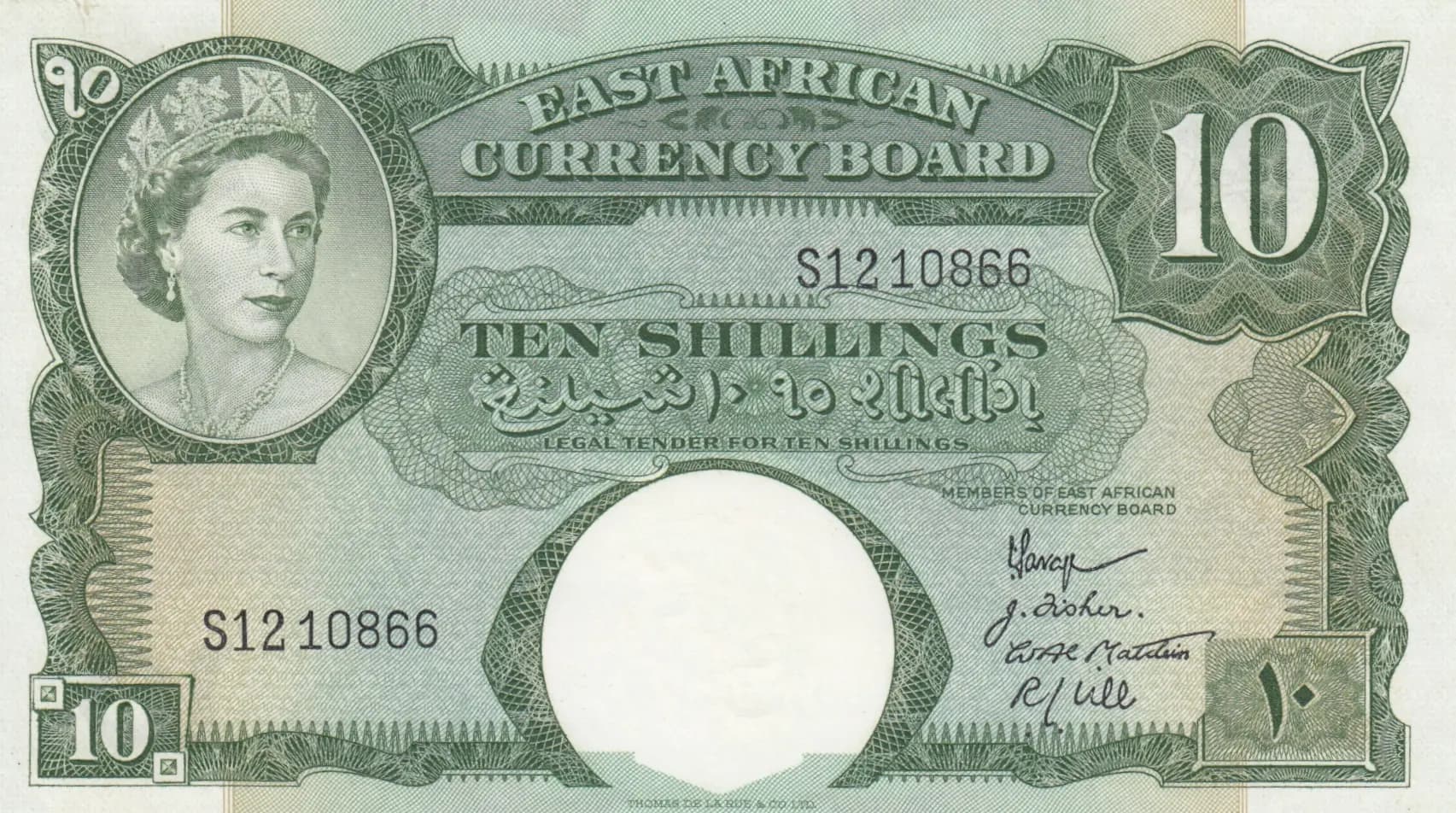
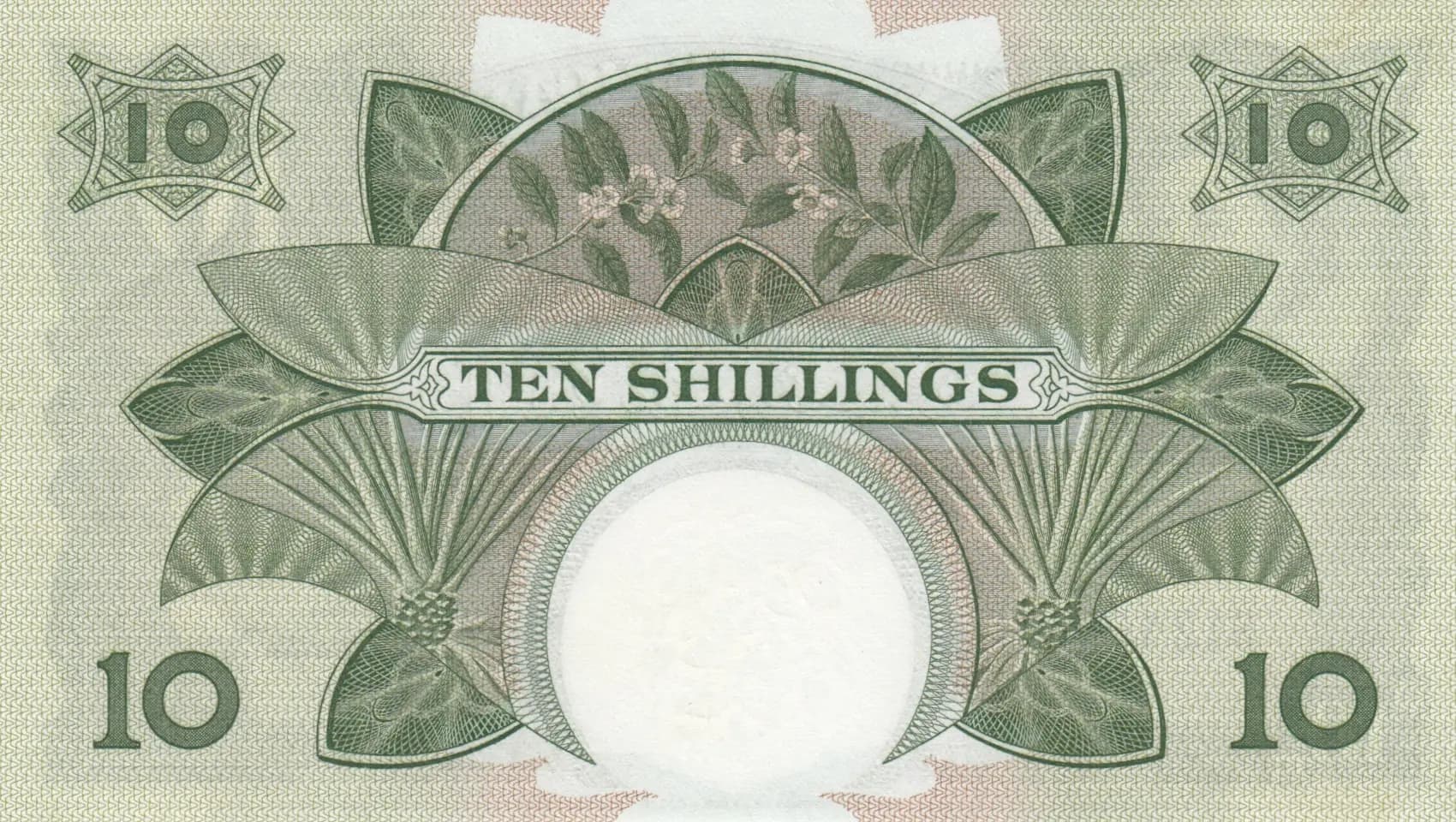
This is an exceptional example of the East African Currency Board's 1958 10 shillings note in uncirculated condition, featuring a striking green and multicolor design. The obverse displays Queen Elizabeth II in profile within an ornate circular vignette at upper left, with four signatures at lower right and intricate engraved borders throughout. The reverse showcases elegant botanical motifs including flowering plants and date palms with symmetrical decorative elements, exemplifying the high-quality craftsmanship of Thomas de la Rue's London printing facility.
Common. This is a regular issue note from a major issuing authority with substantial print runs during 1958-1960. eBay market data shows consistent availability at modest valuations: VF examples trading at $60-$107, with even UNC examples catalogued at $250 in 2016 values. Current market activity confirms regular circulation among collectors. The note's commonality is further supported by PMG's population data and its lengthy circulation period. While the UNC condition grade is more desirable than circulated examples, the underlying note itself is not scarce.
Issued during the final years of the East African Currency Board's operation (1958-1960), this note represents a transitional period in East African monetary history as the region moved toward independence. The prominent display of Queen Elizabeth II reflects the Commonwealth relationship during this era, while the botanical elements—particularly the date palms and flowering plants depicted on the reverse—celebrate the natural resources and agricultural heritage of the East African member territories (Kenya, Uganda, and Tanganyika). The multilingual inscriptions, including Arabic script, acknowledge the diverse populations within the currency union.
The obverse features a formal portrait of Queen Elizabeth II in left-facing profile, depicted wearing her regalia and crown, positioned within an ornate circular vignette in the upper left quadrant—a standard design element for Commonwealth currency of the period. The note employs elaborate engraved borders and decorative medallions with intricate scrollwork framing the composition. Four signature lines appear in the lower right, representing the Board's officials. The reverse abandons portraiture in favor of naturalistic botanical imagery: a central flowering plant with delicate blooms and accompanying foliage, flanked by fan-shaped date palm fronds in symmetrical arrangement. Star-shaped denomination markers appear in the corners, with geometric and circular decorative frames enhancing the design. The large circular white space visible in the center of both sides likely represents a watermark or security feature area specific to EACB printing standards. The overall aesthetic balances formal institutional authority with celebration of East African natural heritage.
Front side: 'EAST AFRICAN CURRENCY BOARD' (issuing authority), 'TEN SHILLINGS' (denomination in English), 'LEGAL TENDER FOR TEN SHILLINGS' (legal tender declaration), 'MEMBERS OF EAST AFRICAN CURRENCY BOARD' (designation of member territories), denomination numeral '10', serial number 'S1210866', and signatures of four officials: 'Harvey,' 'J. Astor,' 'Ernest Mathurin,' and 'R. Lill.' Reverse side: 'TEN SHILLINGS' and denomination numeral '10' positioned at corners. Arabic script on front translates to 'Ten shillings' (عشرة شلنات), accommodating Arabic-speaking populations within the currency union.
This note was produced using traditional intaglio (engraved) printing by Thomas de la Rue, London, the premier security printer of the era. The visual analysis reveals characteristic fine line work, intricate engraved patterns, and sharp detail preservation throughout the design—all hallmarks of intaglio process. The crisp printing quality, precise ornamental flourishes, and detailed botanical rendering visible in the images confirm professional-grade security printing techniques employed for this high-security currency denomination. The multicolor printing was achieved through the sequential layering of intaglio impressions.
This specific example exhibits the four-signature variant on the lower right, which distinguishes it from earlier three-signature versions of similar East African Currency Board notes (reference Pick P-42 for comparative signature varieties). The serial number 'S1210866' indicates this specimen from the standard production run. No overprints, printing variations, or error characteristics are apparent in the visual analysis. This represents the standard Nairobi printing variant catalogued as P-38 by Pick.