5 korun 1953
Market Prices
15 salesAbout This Note
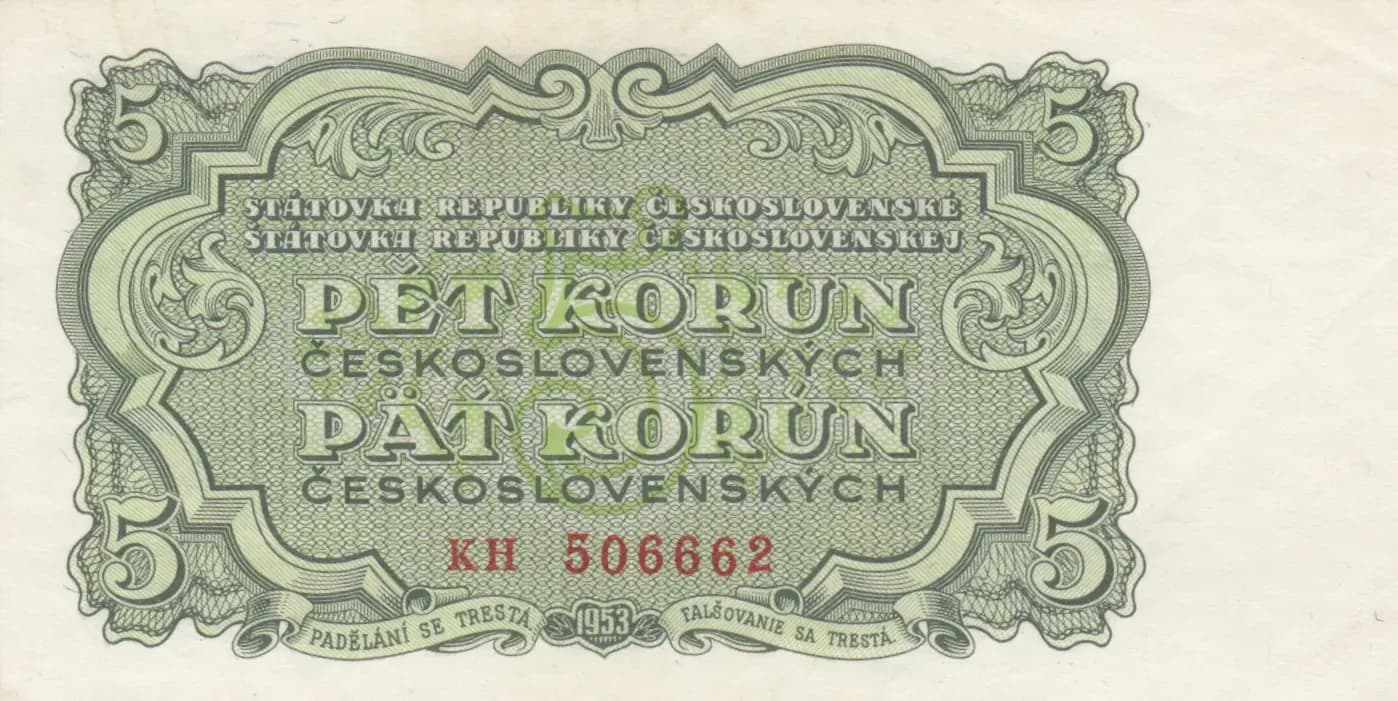
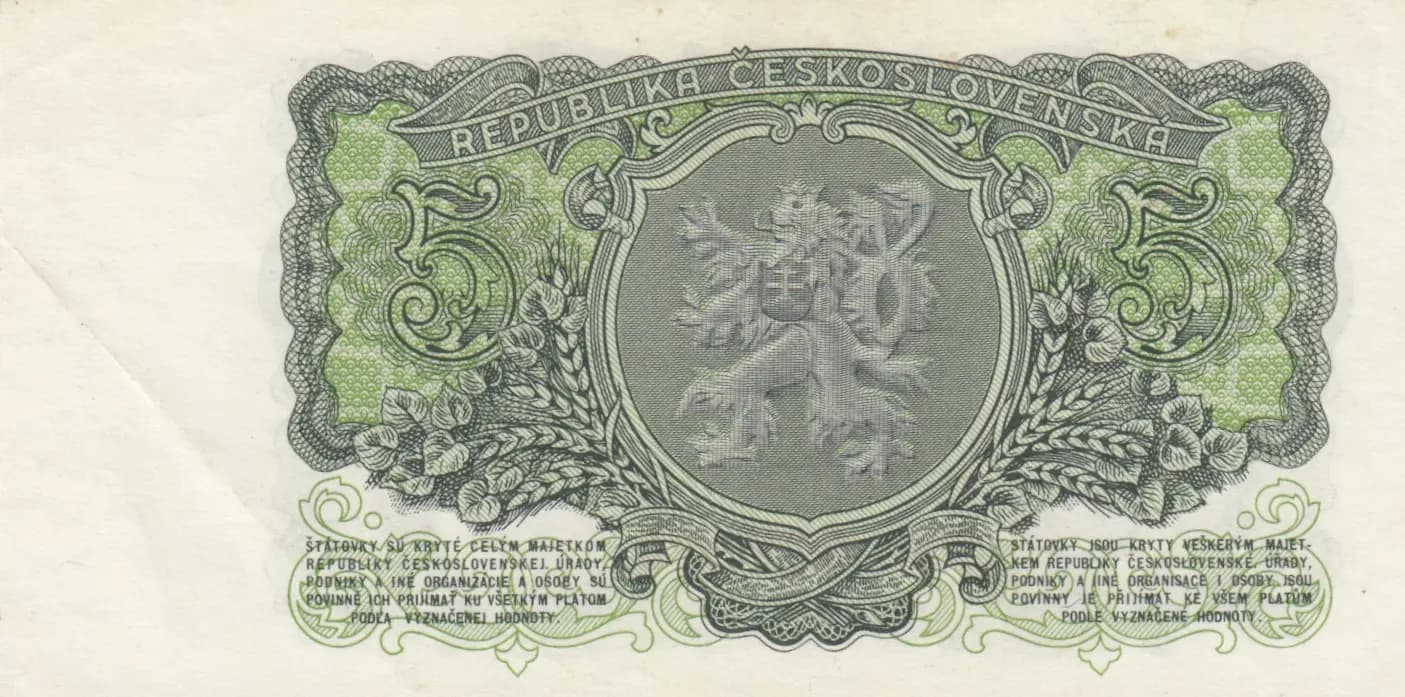
This is a Czechoslovak 5 Korun banknote from 1953 (Pick P-80b), issued by the State Bank of the Czechoslovak Republic. The note displays exceptional condition consistent with VF grading, featuring crisp, pristine appearance with no visible wear, creases, or stains. The elaborate baroque-style design with ornate scrollwork on both sides, bilingual Czech-Slovak inscriptions, and the distinctive heraldic lion in the central medallion on the reverse make this an attractive example of mid-20th century Eastern European currency design.
Common. eBay market data from 2012-2020 shows consistent sales in the $5-$26 range with most VF-graded examples selling between $9-$16, and catalog valuations listing VF examples at $1.50. The large print runs typical of Eastern Bloc banknotes, combined with these modest market prices and frequent auction appearances, confirm this as a common issue in all circulated grades. Even uncirculated examples command only $5-$6.50, indicating no scarcity premium.
This note was issued during the early years of Communist Czechoslovakia, following the 1948 consolidation of power and reflecting the Soviet sphere of influence characteristic of the Cold War era. The State Bank inscription in both Czech and Slovak languages underscores the federal structure of the Czechoslovak Socialist Republic, while the heraldic lion symbolizes the national identity maintained despite Soviet domination. The 1953 date places this within the Stalin era, when Czechoslovakia was firmly integrated into the Eastern Bloc's economic and political structures.
The 5 Korun note features a classical baroque revival design typical of mid-20th century Central European currency. The front displays the denomination numerals '5' in the top corners with bilingual text panels centered within an ornate double-lined border featuring intricate scrollwork and floral elements rendered in fine line engraving. The reverse presents as its dominant feature a heraldic lion—the symbol of Bohemia and the Czechoslovak state—depicted in a detailed circular medallion surrounded by elaborate decorative baroque cartouches with acanthus leaves and foliation. The color scheme employs green as the primary hue with black text and engraved line work on cream/beige paper stock, creating strong visual contrast. Both sides include mandatory anti-counterfeiting warnings in both Czech and Slovak languages.
FRONT SIDE: 'STÁTOVKA REPUBLIKY ČESKOSLOVENSKÉ' (Czech) / 'STÁTOVKA REPUBLIKY ČESKOSLOVENSKEJ' (Slovak) = 'State Bank of the Czechoslovak Republic'; 'ČESKOSLOVENSKÝCH KORUN' (Czech) / 'ČESKOSLOVENSKÝCH KORUN' (Slovak) = 'Czechoslovak Crowns'; 'PADĚLÁNÍ SE TRESTÁ' (Czech) / 'FÁLŠOVANIE SA TRESTÁ' (Slovak) = 'Counterfeiting is Punishable'; Serial number 'KH 506662' and date '1953'. BACK SIDE: 'REPUBLIKA ČESKOSLOVENSKÁ' = 'Czechoslovak Republic'; Legal declaration in both languages: 'Banknotes are covered by the entire property of the Czechoslovak Republic. All circulation organizations and other persons are obliged to accept them for all payments according to their marked value.'
Intaglio engraving (line engraving), the primary method for security banknotes of this era. The intricate cross-hatching, fine line work, and complex decorative borders visible throughout both sides are characteristic of intaglio printing. According to catalog data, this P-80b variant was printed by STCP (Státní Tiskárna Cenných Papírů—State Printing Works for Securities, Prague), though some 1953 variants were also produced by Gosnak in Moscow with Russian serial number prefixes. The elaborate baroque-style ornamentation served dual purposes: aesthetic appeal and security deterrent against counterfeiting.
This note is cataloged as Pick P-80b, representing a specific variety within the 1953 5 Korun issue. Known varieties include different serial number prefixes reflecting the issuing printer: 'KH' prefix (as observed on this example) indicates STCP/Prague production, while Russian serial numbers indicate Gosnak/Moscow printing. Some replacement notes carry 'Z' prefix designation. The PMG population report indicates STCP as the printer for the P-80b variant. The serial number 'KH 506662' on this example is consistent with Prague production.