25 korun 1953
Market Prices
11 salesAbout This Note
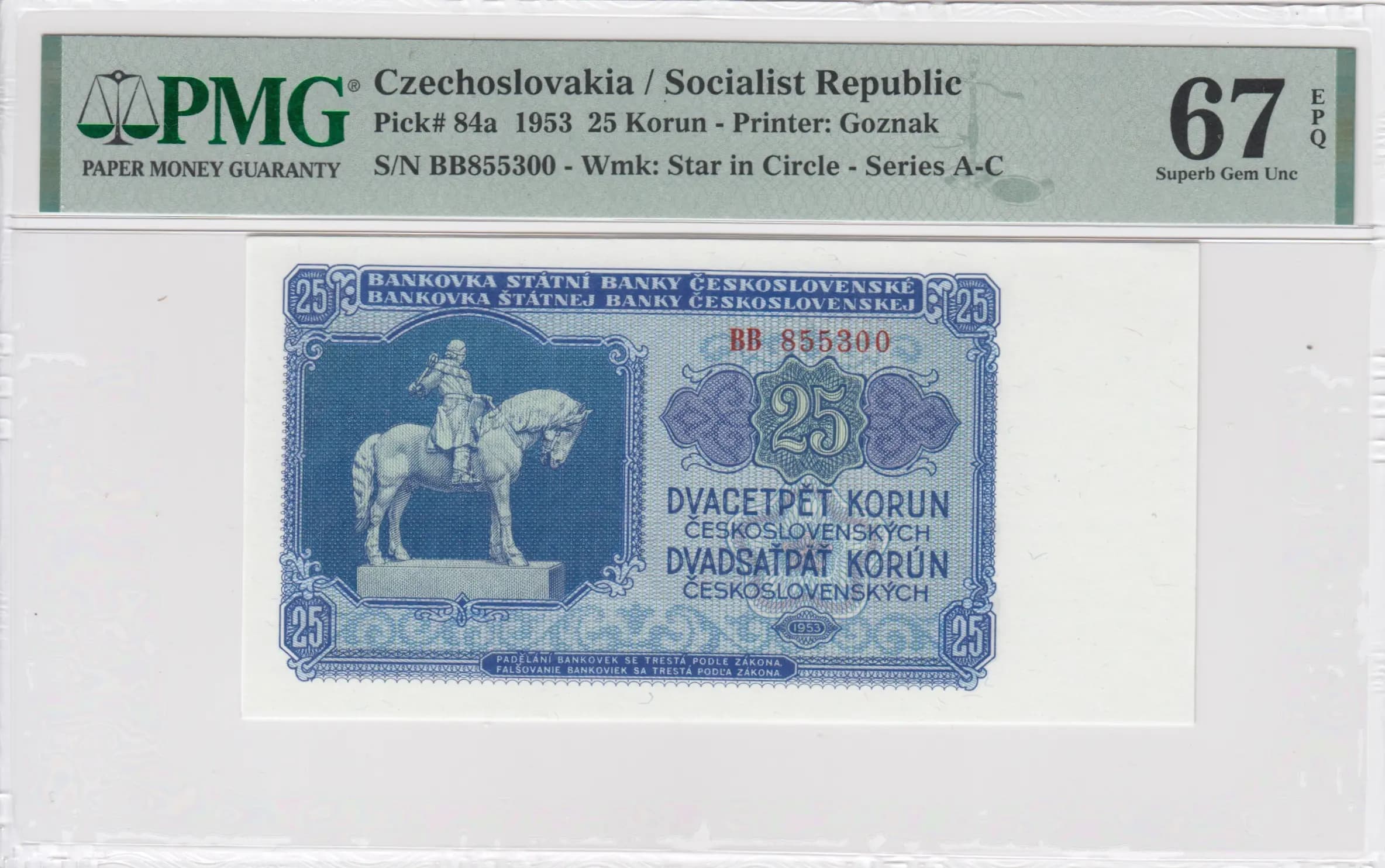
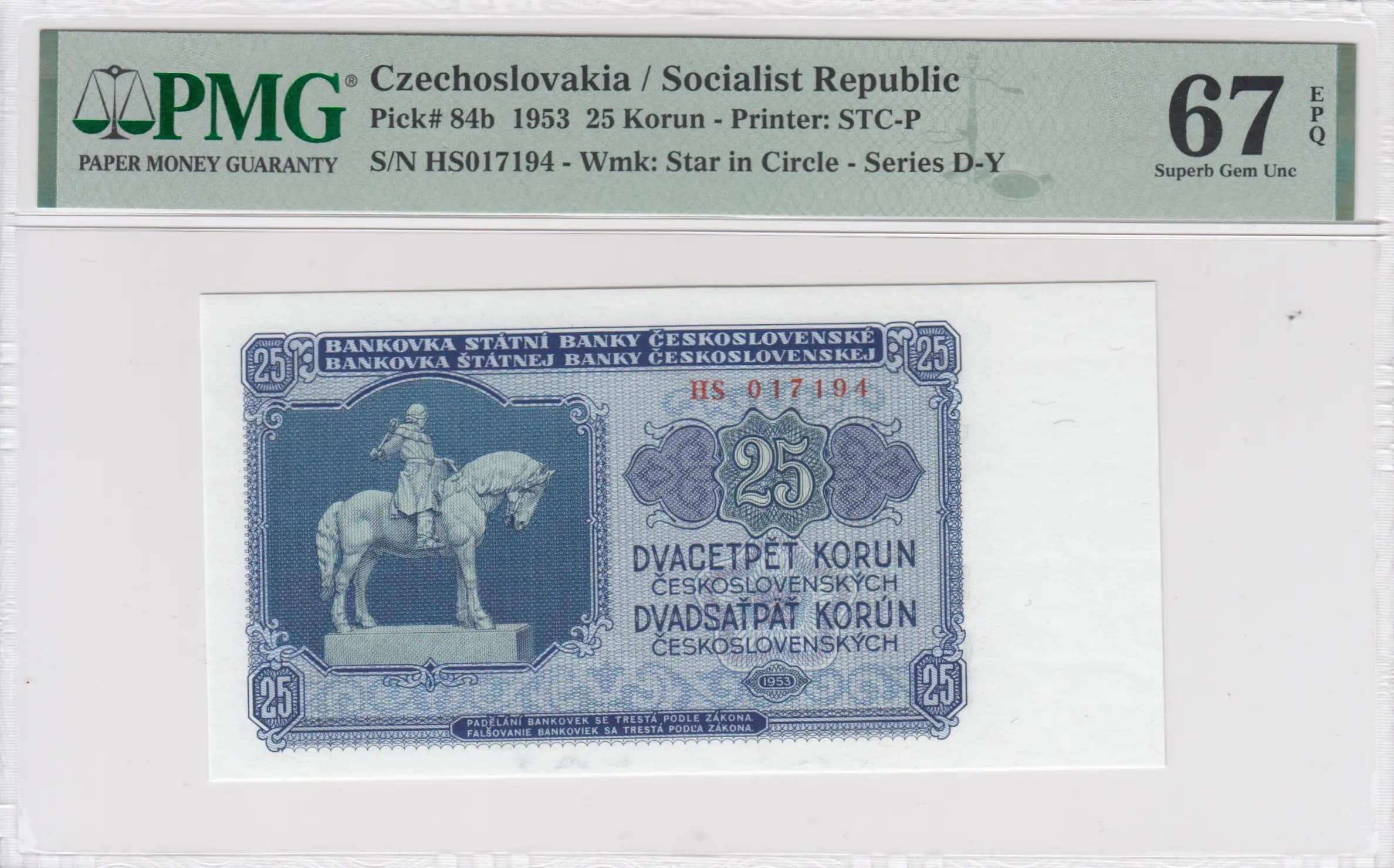
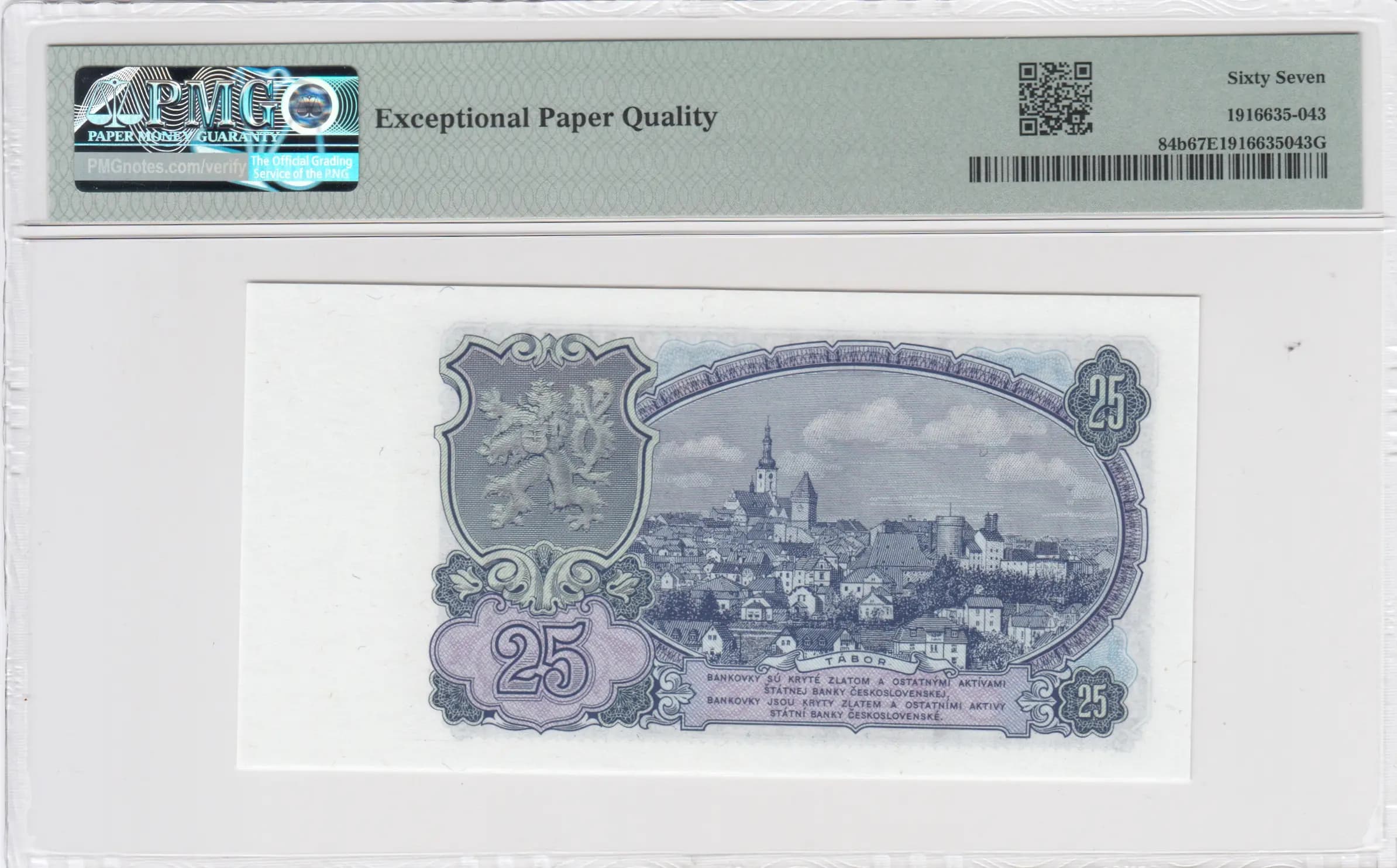
This is a PMG 67 EPQ example of the Czechoslovak 25 Korun from 1953, representing an excellent specimen of this mid-20th century issue. The note displays pristine condition with sharp printing, vibrant blue coloration, and no visible wear—characteristics that distinguish higher-grade examples. The obverse features the iconic equestrian statue of Jan Žižka, while the reverse showcases a detailed architectural landscape of Tábor, making this a visually compelling representation of Czechoslovak numismatic design.
Common. This is a standard regular-issue banknote from the 1953 Czechoslovak emission with no known print run restrictions or recall status. Market data from eBay sales demonstrates consistent circulation with multiple sales across different grades, ranging from $6 to $40, with PMG 67 examples typically selling in the $12-40 range. Catalog values from 2016 assess UNC examples at $20, and the availability of numerous graded examples in the PMG population report confirms this is a frequently encountered note in the collector market. Higher grades command modest premiums reflective of condition rarity rather than issue rarity.
This 25 Korun note was issued during the Communist era of Czechoslovakia, specifically under the Gottwald regime which controlled the country from 1948 to 1953. The reverse inscription declaring that banknotes are backed by gold and assets reflects the formal monetary claims of the Socialist Republic, while the depicted Tábor cityscape references the historical Hussite stronghold, connecting the note to Czech national heritage. The equestrian statue of Jan Žižka, the legendary 15th-century military commander, served as a symbol of national pride and resistance, making the note's imagery politically and culturally significant to its era.
The obverse features a prominent equestrian statue of Jan Žižka of Trocnov, depicted mounted on horseback within an ornate rectangular frame positioned on the left side of the note. This sculpture, created by renowned Czech artist Bohumil Kafka, is one of the most recognizable monuments in Prague. The right side displays the denomination '25' in decorative corner cartouches. The reverse showcases a detailed panoramic architectural landscape of Tábor, a historically significant Bohemian city featuring multiple church spires, particularly a prominent central church tower, and surrounding civic buildings rendered in fine engraved detail. A heraldic shield bearing a lion rampant (representing Czech heraldry) appears on the left side of the reverse. Both sides incorporate bilingual text in Czech and Slovak, reflecting the dual nature of the Czechoslovak state. The overall aesthetic employs intricate engraved borders, floral and geometric ornamental patterns, and a predominantly blue color palette with lighter blue underprinting, characteristic of mid-20th century Central European banknote design.
FRONT SIDE: 'BANKOVKA STATNÍ BANKY ČESKOSLOVENSKÉ' (Czech: Banknote of the State Bank of Czechoslovakia) / 'BANKOVKA STATNEJ BANKY ČESKOSLOVENSKEJ' (Slovak: Banknote of the State Bank of Czechoslovakia) / 'DVACETPĚT KORUN ČESKOSLOVENSKÝCH' (Czech: Twenty-five Korun Czechoslovakian) / 'DVADSATPAT KORUN ČESKOSLOVENSKÝCH' (Slovak: Twenty-five Korun Czechoslovakian) / 'PADĚLÁNÍ BANKOVEK SE TRESTÁ PODLE ZÁKONA' (Czech: Counterfeiting banknotes is punishable by law) / 'FALŠOVANIE BANKOVIEK SA TRESTÁ PODĽA ZÁKONA' (Slovak: Counterfeiting banknotes is punishable by law) / Serial number: HS 0171194. BACK SIDE: 'BANKOVKY JSOU KRYTY ZLATEM A OSTATNÍMI AKTIVY STATNÍ BANKY ČESKOSLOVENSKÉ' (Czech: Banknotes are backed by gold and other assets of the State Bank of Czechoslovakia) / 'BANKOVKY SÚ KRYTTÉ ZLATOM A OSTATNÝMI AKTÍVAMI STATNEJ BANKY ČESKOSLOVENSKEJ' (Slovak: Banknotes are backed by gold and other assets of the State Bank of Czechoslovakia).
This note (P-84b variant) was printed by STC-P (Státní tiskárna Československá - Prag/Prague), employing traditional intaglio engraving and steel plate printing methods. The fine detail work visible in both the equestrian statue and architectural landscape, combined with the complex ornamental border patterns and sharp serial number impressions in red, are hallmarks of intaglio printing. An alternate variant (P-84a) was printed by Goznak in Moscow, which is a distinguishing characteristic among specimens of this denomination.
This note is the P-84b variant, distinguished by its STC-P (Prague) printing. The alternate P-84a variant was printed by Goznak in Moscow and carries a Russian series prefix. The Pick catalog identifies these as the two primary varieties for the 1953 25 Korun denomination. Additionally, replacement notes with a 'Z' prefix exist, and other series prefixes may be encountered. The observed specimen bears serial number HS 0171194 in red text on the obverse. Examination of serial prefixes can help collectors distinguish between the Moscow-printed (Goznak) and Prague-printed (STC-P) variants, with the 'Z' prefix indicating replacement notes.