25 korun 1953
Market Prices
33 salesAbout This Note
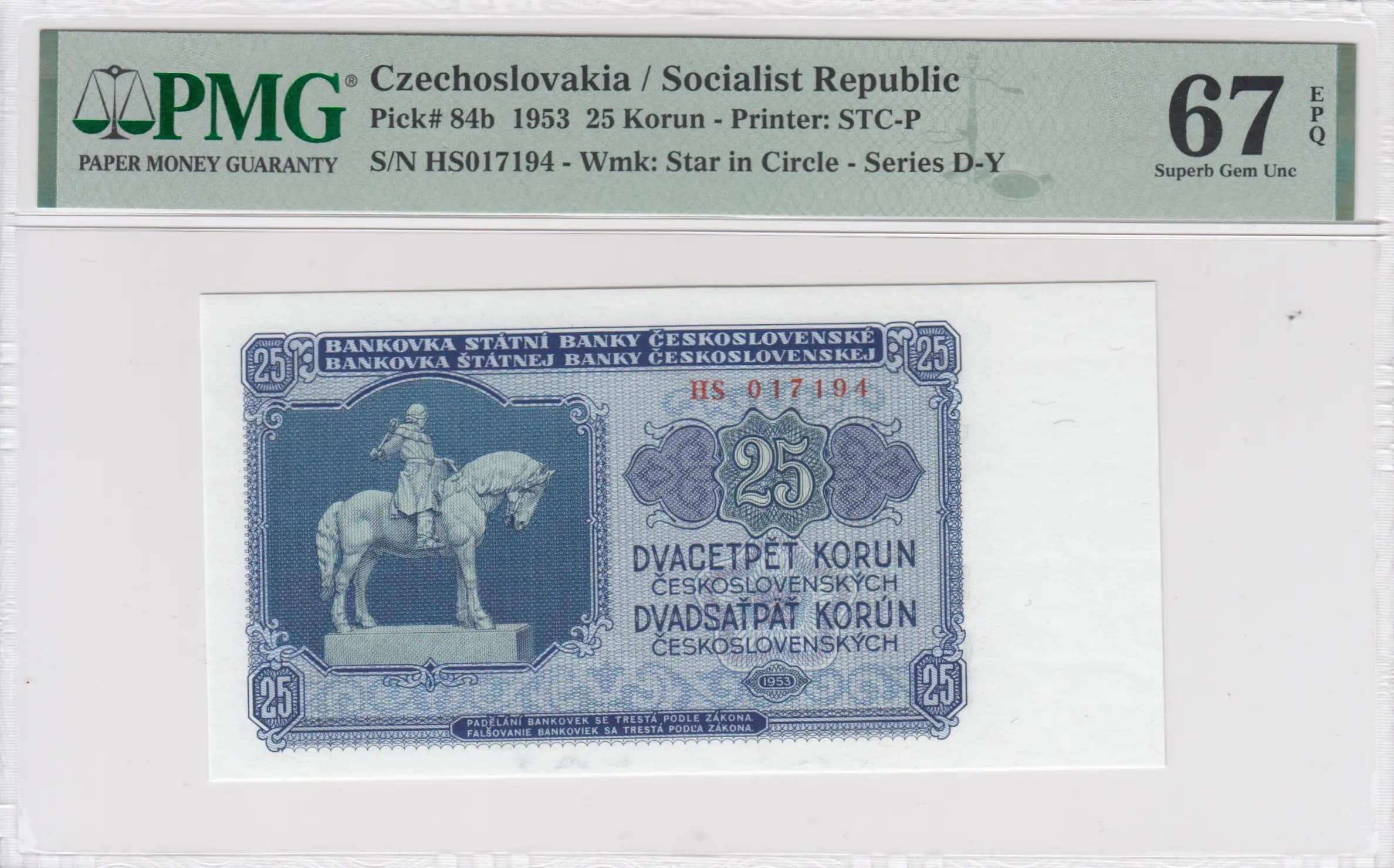
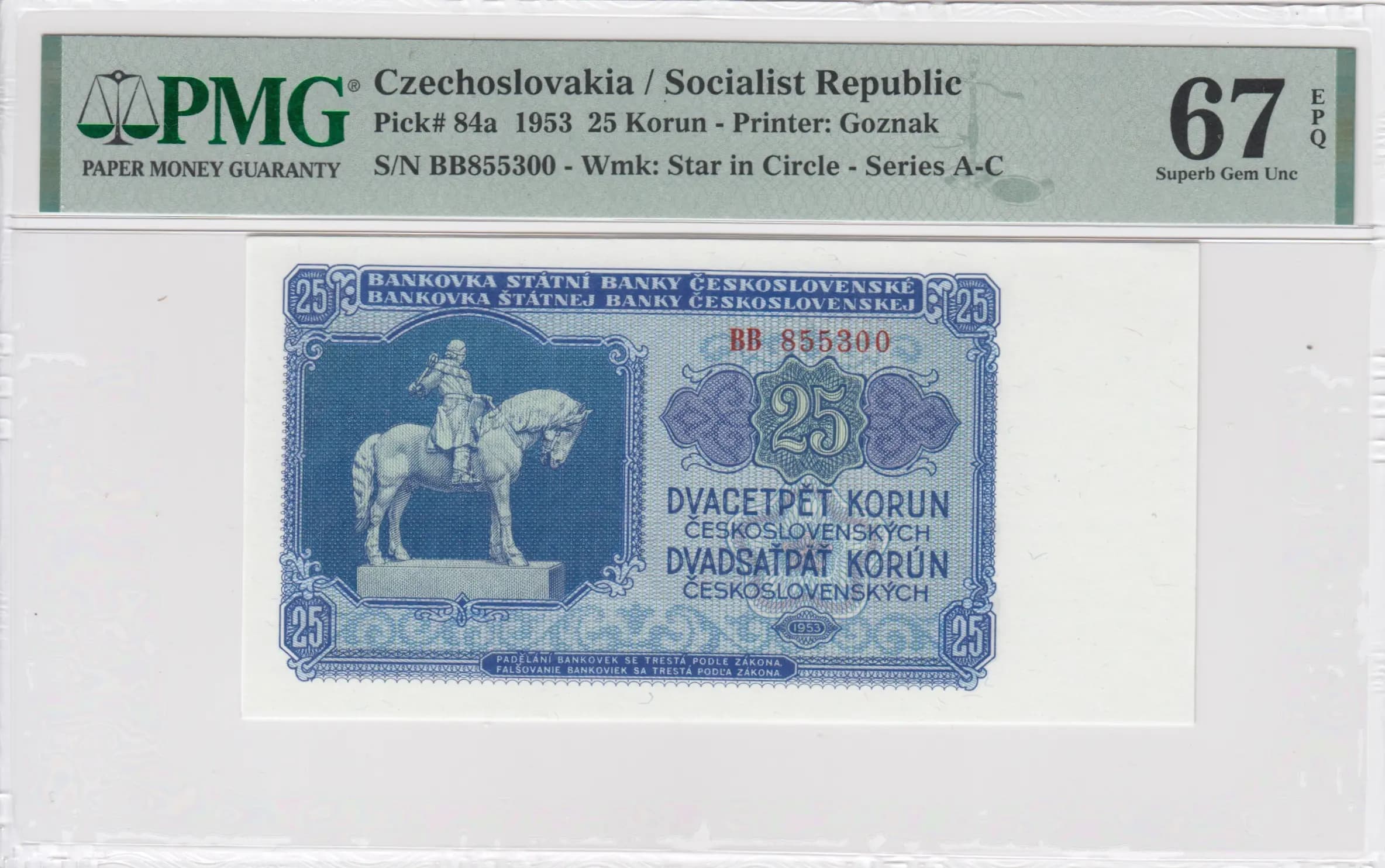
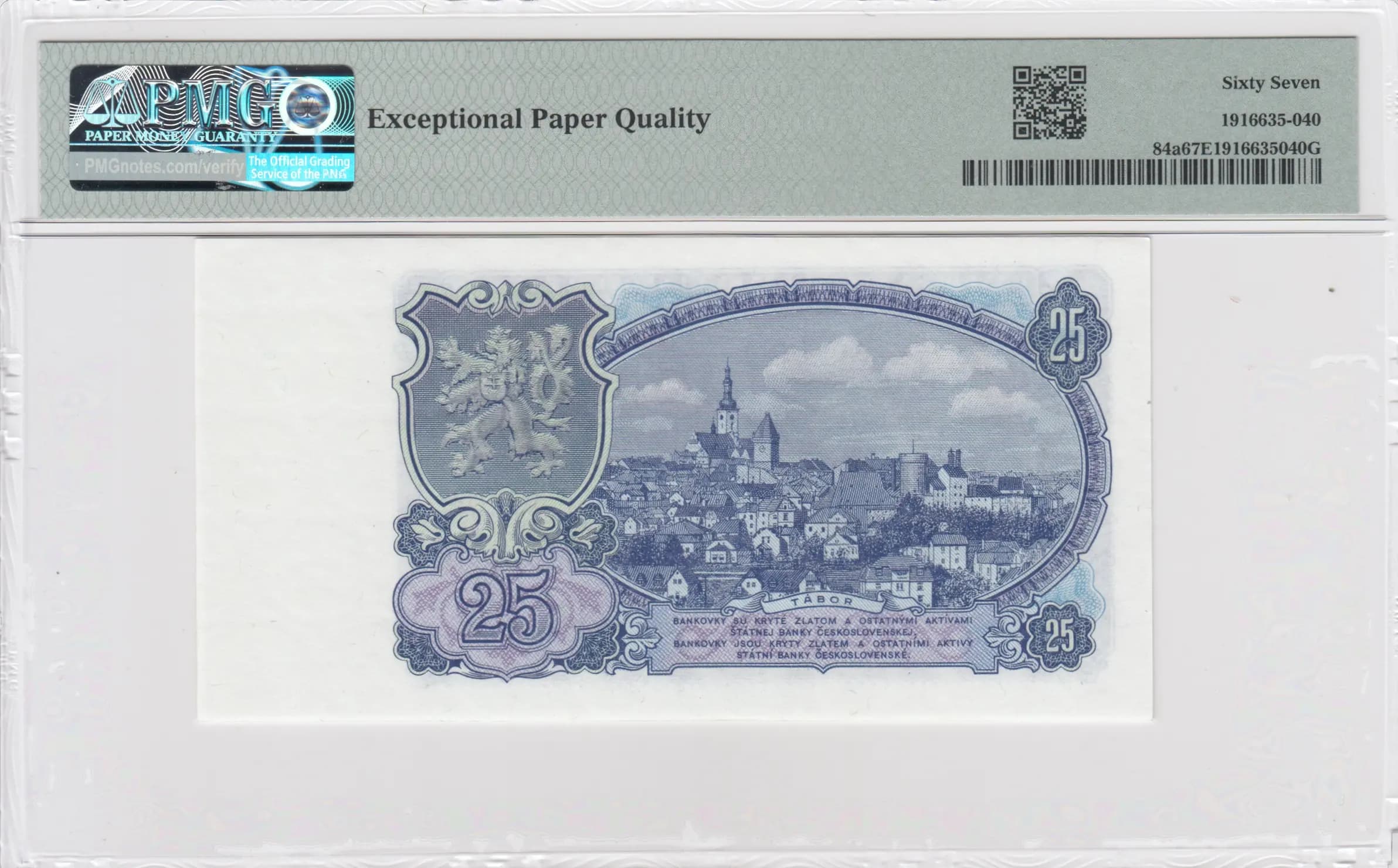
This is a PMG 67 Superb Gem Uncirculated example of the Czechoslovak 25 Korun note from 1953, featuring an impressive equestrian statue of Jan Žižka on the obverse and a detailed cityscape of Tábor on the reverse. The note exhibits exceptional paper quality with crisp blue printing, ornamental borders, and fine engraving throughout, representing a well-preserved specimen of early Cold War-era Czechoslovak currency with bilingual Czech-Slovak inscriptions reflecting the federal structure of the state.
Common. Secondary market eBay sales data demonstrates consistent availability across multiple condition grades, with PMG 67 examples selling in the $21–$78 range (2019–2020), and lower grades and uncirculated notes trading for $6–$20. The 2016 catalog value for UNC is $37.50, reflecting an accessible note with reasonable collector demand but no scarcity premium. The note was produced in standard quantities as regular-issue currency and has not been recalled or identified as having a restricted print run.
Issued by the Státní Banka Československá in 1953, this note commemorates Jan Žižka, the legendary 15th-century Hussite military commander whose equestrian monument stands in Trocnov (Žaluschi). The reverse depicts Tábor, the historic center of the Hussite movement, reflecting the new communist regime's attempt to co-opt Czech national and historical symbols. The declaration that banknotes are backed by gold and state assets reflects the immediate post-war reconstruction period before Czechoslovakia became fully integrated into the Soviet economic sphere.
The obverse features a prominent equestrian statue of Jan Žižka (the mounted military commander) within an ornamental rectangular frame, positioned centrally with the denomination 25 displayed in decorative corner cartouches. The design incorporates bilingual text reflecting Czechoslovakia's federal Czech-Slovak structure. The reverse presents a detailed landscape engraving of the city of Tábor dominated by its characteristic church with a tall spire, rendered in a hillside townscape composition. A heraldic coat of arms (Czech lion design) appears in the upper left corner of the reverse. The overall aesthetic employs fine-line engraving with ornamental scrollwork and filigree borders throughout, typical of mid-20th century European banknote design.
FRONT SIDE: 'BANKOVKA STÁTNÍ BANKY ČESKOSLOVENSKÉ' (Czech) / 'BANKOVKA STÁTNEJ BANKY ČESKOSLOVENSKEJ' (Slovak) = 'Banknote of the State Bank of Czechoslovakia'; 'DVACETPĚT KORUN ČESKOSLOVENSKÝCH' (Czech) / 'DVADSAŤPÄT KORÚN ČESKOSLOVENSKÝCH' (Slovak) = 'Twenty-five Koruna Czechoslovak'; 'PADĚLÁNÍ BANKOVEK SE TRESTÁ PODLE ZÁKONA' (Czech) / 'FALŠOVANIE BANKOVIEK SA TRESTÁ PODĽA ZÁKONA' (Slovak) = 'Counterfeiting banknotes is punished by law'; Serial number 'BB 855300'. REVERSE SIDE: 'TÁBOR' = city name; 'BANKOVKY JSOU KRYTE ZLATEM A OSTATNÍMI AKTIVY STÁTNÍ BANKY ČESKOSLOVENSKÉ' (Czech) / 'BANKOVKY SU KRYTE ZLATOM A OSTATNÍMI AKTIVAMI STÁTNEJ BANKY ČESKOSLOVENSKEJ' (Slovak) = 'Banknotes are covered by gold and other assets of the State Bank of Czechoslovakia'.
Intaglio (engraved) printing, characteristic of professional banknote production. This P-84a variant was printed by Goznak (the Soviet state security printer in Moscow), as indicated by the Pick catalog designation and confirmed by the Russian series prefix noted in the catalog reference. The fine detail, sharp lines, and complex shading observed in both the equestrian statue and architectural landscape are consistent with traditional engraving and intaglio printing methods used for high-security currency.
This note is cataloged as Pick P-84a, printed by Goznak (Moscow). A second variant, P-84b, exists printed by STC-P (Prague). The catalog reference notes series prefixes A, B, C, and Z (with Z denoting replacement notes). The observed serial number 'BB 855300' falls within the standard serial number range for this issue. The specific printer and series prefix determine the variety; this specimen represents the Russian-printed Goznak variant, which may be slightly less common than the Prague-printed version depending on production quantities, though both remain generally available to collectors.