100 korun 1945
“prison money”
About This Note
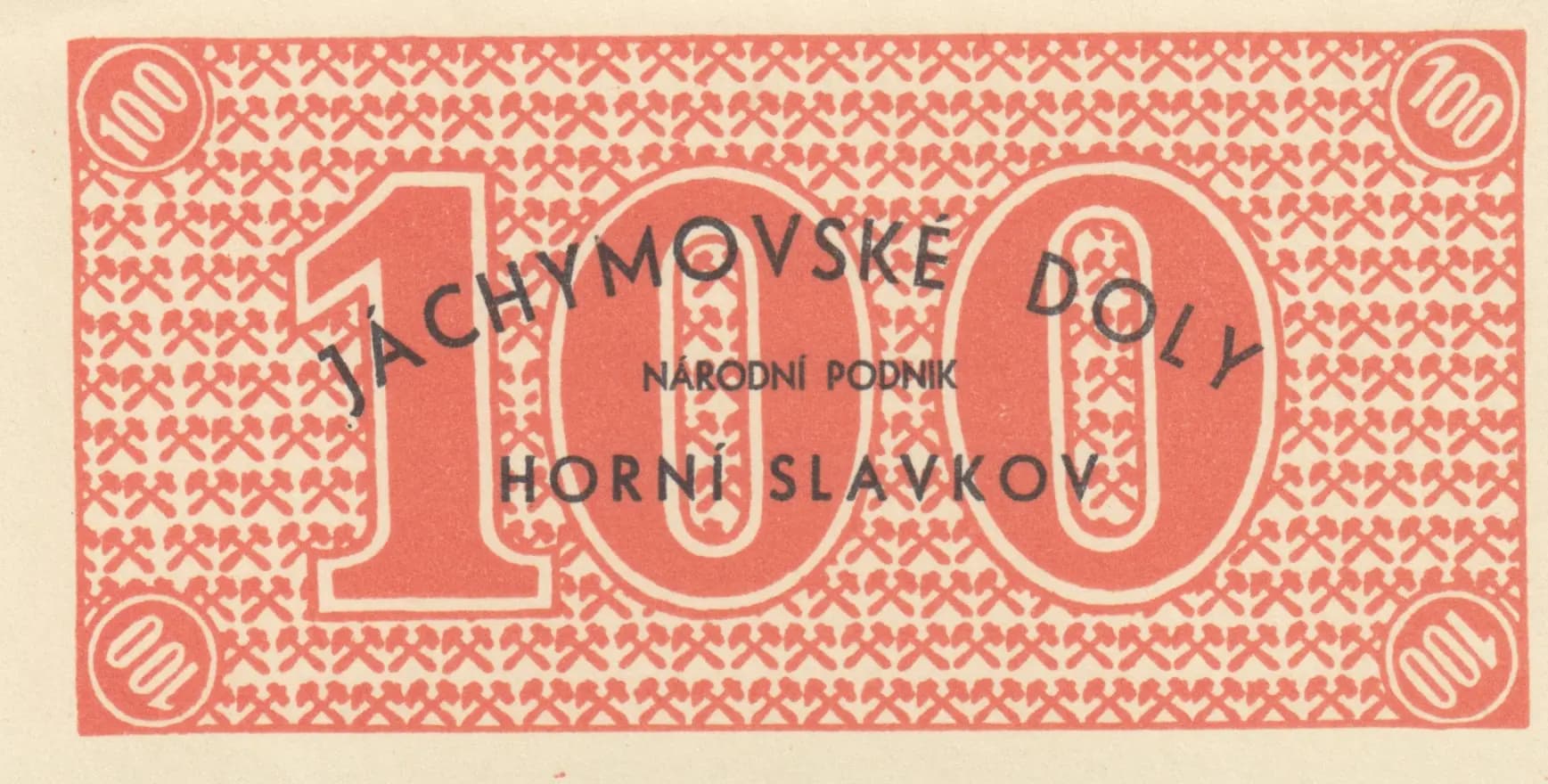
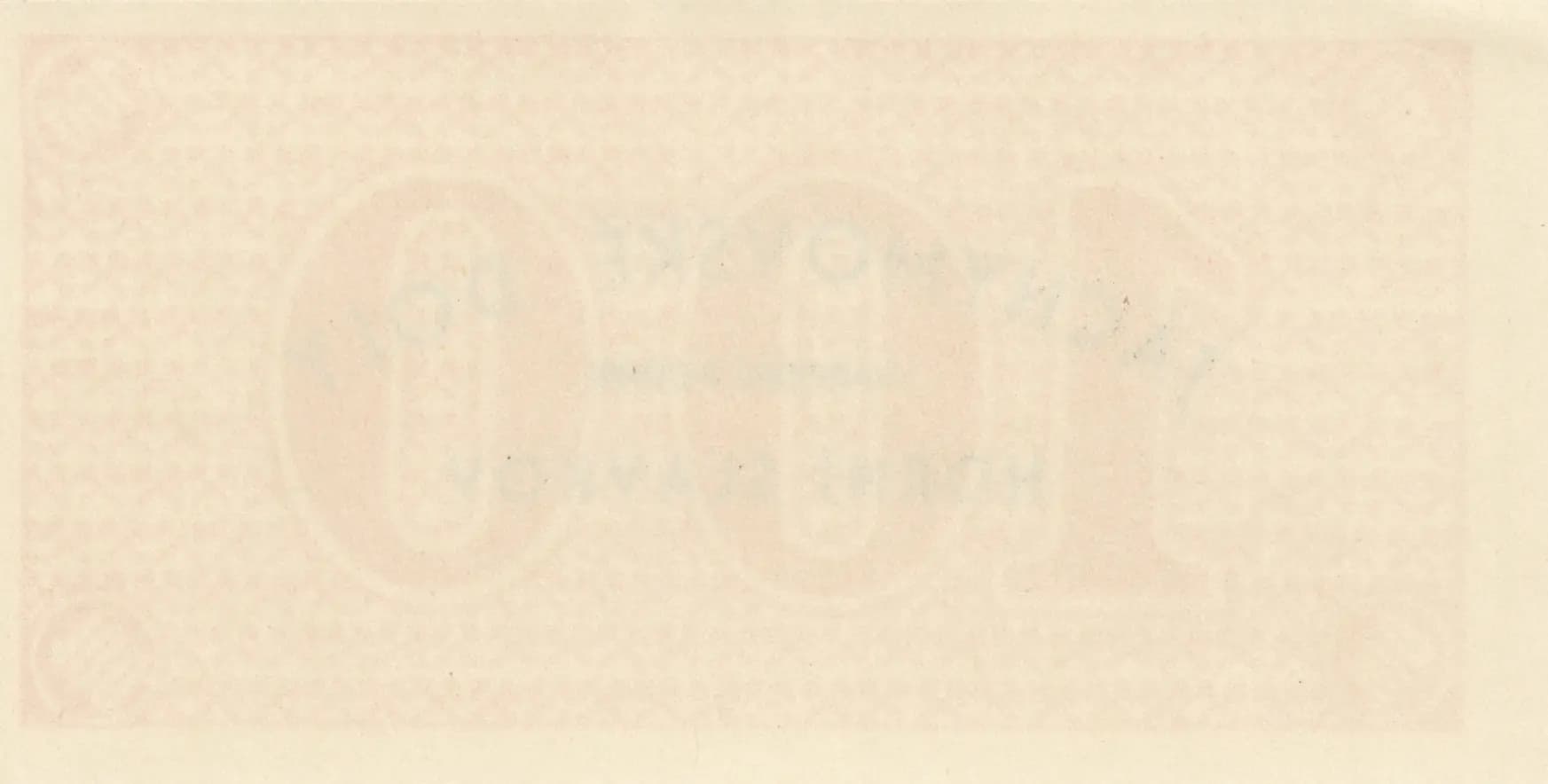
This is a 1945 100 korun banknote issued by the Jachymovske Doly (Jáchymov Mines) prison camp in Czechoslovakia, an unlisted Pick number representing wartime camp currency. The obverse features a bold central '100' denomination in serif lettering with decorative corner medallions, rendered in red/coral and cream colors with a geometric cross-hatch security pattern throughout. The note exhibits age-appropriate foxing and patina consistent with its 1945 origin, with visible period markings; the reverse is significantly faded with only ghost impressions remaining, characteristic of prison camp emergency currency from this historically significant but brief issuing period.
Rare. Jáchymov prison camp currency is seldom encountered in numismatic commerce. This note is unlisted in the Pick Standard Catalog, indicating it falls outside major cataloging systems and represents a specialized category (camp/ghetto money) with extremely limited original circulation and survival rates. Camp scrip was typically destroyed after liberation or remained in private collections; UNC examples are particularly scarce as most surviving pieces show extensive wear or damage from camp conditions. The historical significance and scarcity of this issuing authority combined with the UNC grade make this a notable acquisition for specialized collectors.
Jáchymov (Jachymov), located in the Bohemian mining region, was repurposed as a German labor camp during World War II. This 100 korun note, inscribed with 'Národní Podnik' (National Enterprise) and references to Horní Slavkov and Československy Doly (Czechoslovak Mines), represents the camp's internal economy system where prisoners were issued such currency for labor within the mining operations. The 1945 date places this note in the final year of Nazi occupation, making it a rare artifact of the camp's administrative structure and the forced labor economy that sustained it.
The obverse displays a geometric security design consisting of repeating crossed-line patterns (X-motifs) creating a dense background texture in reddish tones, a common anti-counterfeiting feature in period emergency currency. Four corner circular medallions each contain the denomination '100' with horizontal line shading, providing visual emphasis and denomination confirmation. The central design showcases the '100' in large, outlined serif numerals as the dominant focal point. The reverse is largely blank or severely faded, typical of camp scrip where production facilities and time were severely limited; faint watermark-like impressions suggest an intended but barely visible design or security feature. The overall aesthetic reflects utilitarian wartime production with minimal ornamentation.
Front side: '100' (denomination in numerals); 'NÁRODNÍ PODNIK' (National Enterprise); 'HORNÍ SLAVKOV' (Horní Slavkov - location); 'ČESKOSLOVENSKY DOLY' (Czechoslovak Mines). Back side: No clearly legible inscriptions detected; faint watermark impressions present but illegible.
Letterpress or relief printing, most likely executed with limited equipment available in wartime camp conditions. The clear, uniform impression of the geometric background pattern and corner medallions suggests a single printing pass, while the serif numerals indicate metal type. The severe fading and ghost impressions on the reverse suggest either single-sided printing or use of inferior quality paper stock and inks typical of emergency wartime currency production. The overlay stamps and markings visible on the obverse appear to be post-printing administrative marks applied by camp personnel.
This note represents the standard Jáchymov Mines 100 korun emission of 1945. No distinct varieties (such as signature variations or series prefixes) are clearly discernible from the visual analysis. The visible stamps or markings may indicate administrative varieties related to camp processing or prisoner batches, but these cannot be definitively classified without additional documentation. Further research into camp records would be required to establish whether distinct issue phases or marked varieties exist within this denomination.