100 korun 1961
Market Prices
2 salesAbout This Note
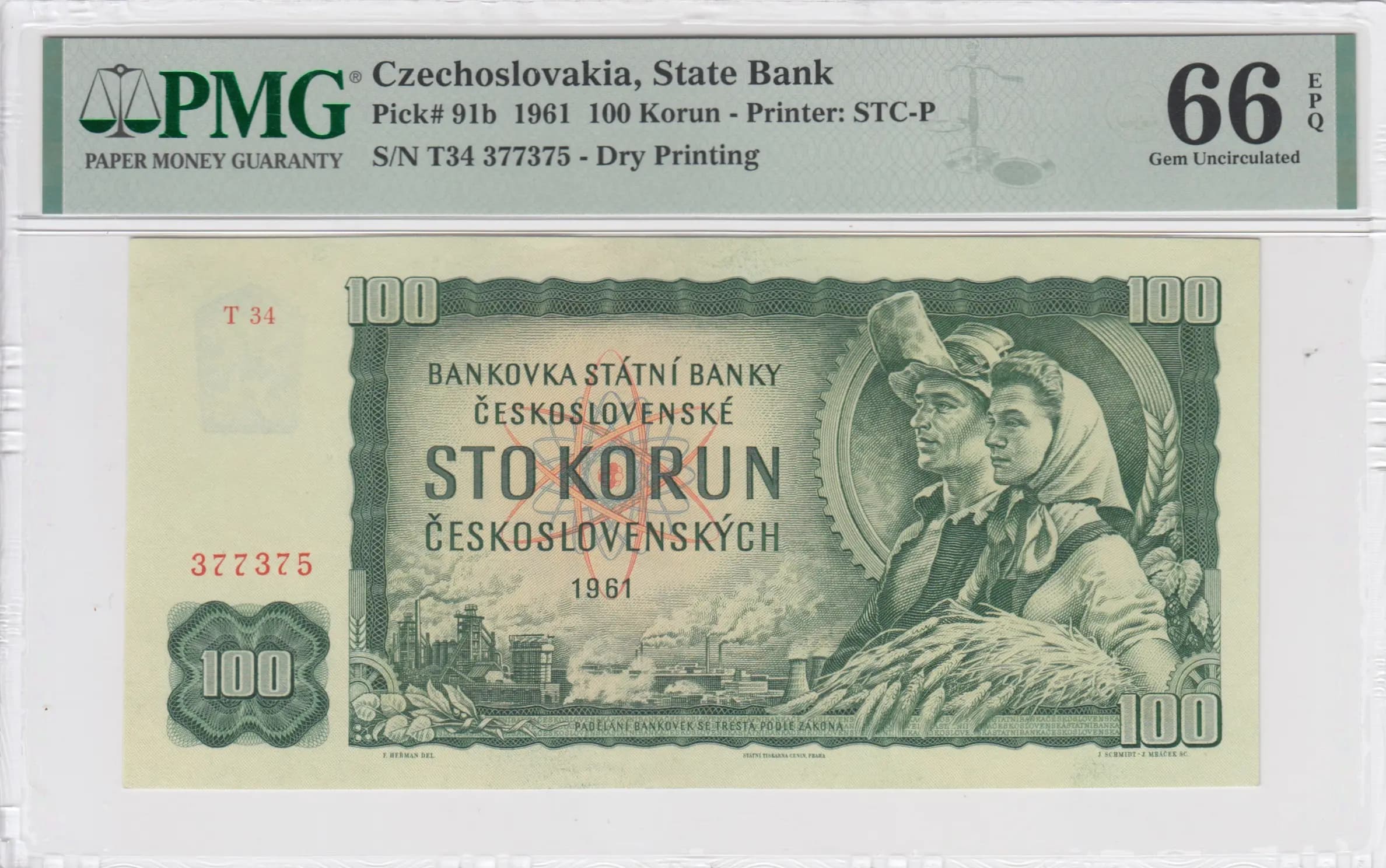
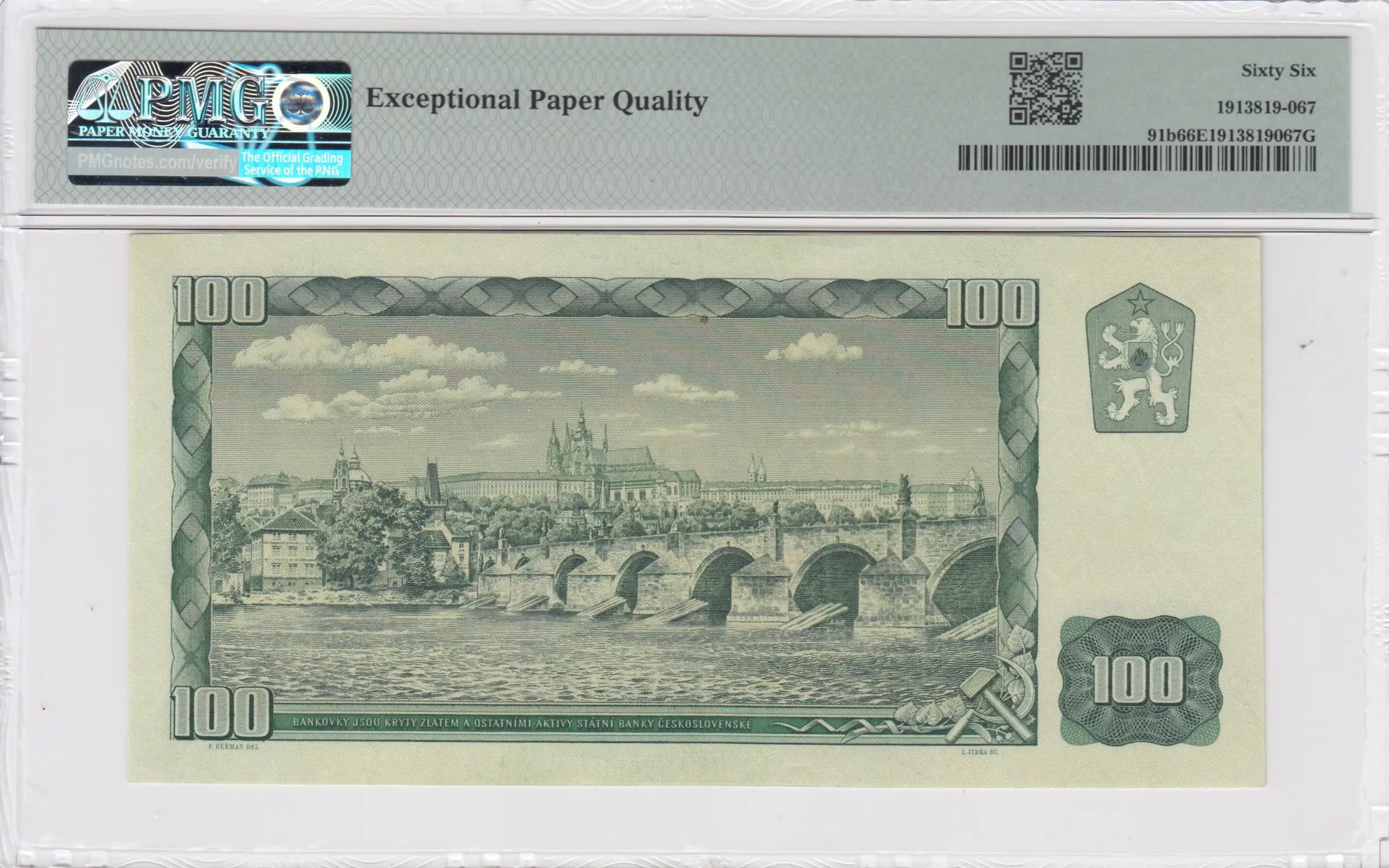
A stunning PMG 66 EPQ example of the 1961 Czechoslovak 100 Korun note, featuring vibrant green-dominated coloring and pristine condition with no visible circulation wear. The note showcases exceptional printing quality with detailed portraiture of a worker and peasant woman on the obverse, complemented by the iconic Charles Bridge and Hradčany Prague skyline on the reverse. This particular specimen displays sharp engraving, clear security details, and represents a desirable grade for this mid-20th century Eastern European issue.
Common. The 1961 100 Korun (Pick P-91b) was a regular issue of the Státní Banka Československá with substantial print runs typical of mid-century Eastern Bloc currency. Market data from realbanknotes.com shows 2019 catalog values of $20 VF and $50 UNC, with recent eBay transactions showing VF examples selling for approximately $5 and PMG 67 grades commanding around $60-65. These modest price points and the availability of multiple graded examples in PMG's population data confirm this as a common note in the collector market.
Issued in 1961 by the Státní Banka Československá during the height of the communist era in Czechoslovakia, this banknote's imagery reflects the regime's ideological emphasis on labor and agriculture through its depiction of a worker and peasant couple on the obverse. The reverse features Prague's most iconic landmarks—the Charles Bridge and Hradčany Castle—anchoring the note to Czech national identity and the capital city, while the inscription referencing gold backing reflects the centrally-planned banking system of the period.
The obverse features an allegorical representation of the socialist state through two portrait figures dressed in traditional Czechoslovak folk costume—a male worker shown in profile wearing a hat and a female peasant woman with a headscarf positioned to his right. The left side incorporates ornamental design with wheat stalks and grain imagery representing agricultural abundance, while an industrial cityscape with factories occupies the lower left, symbolizing industrial production. The reverse depicts the Charles Bridge (Karlův most) spanning the Vltava River with its distinctive multiple stone arches, backed by the Prague skyline dominated by the spires and towers of Hradčany Castle and St. Vitus Cathedral. A Czechoslovak coat of arms featuring a lion appears on the right side of the reverse. Quatrefoil security elements containing the denomination '100' frame both sides. Extensive decorative border patterns with geometric designs and fine line engraving work throughout provide security and aesthetic refinement.
FRONT SIDE: 'Bankovka Státní Banky Československé' (Banknote of the State Bank of Czechoslovakia) / 'Sto Korun Československých' (One Hundred Czechoslovak Korun) / '1961' (year of issue) / 'T 34' and '377375' (series prefix and serial number). BACK SIDE: 'Bankovky jsou krytí zlatem a ostatními aktivy Státní Banky Československé' (Banknotes are covered by gold and other assets of the State Bank of Czechoslovakia) / '100' (denomination, appearing in quatrefoil security elements).
Intaglio engraving (line engraving) as evidenced by the fine cross-hatching patterns, detailed portraiture, and the precision of the security elements visible in the visual analysis. Printed by S.T. Čenín (STC-Prague), a Prague-based security printer. The note employs multiple color passes in deep green on a multicolored underprint base, with black engraved detail work. Security features include fine line engraving throughout and watermark of stars within linden leaves repeated in the paper.
This specimen is catalogued as Pick P-91b, characterized by the watermark of stars within linden leaves and series prefixes B41-99, P, R, T, Z, and X01-24 (wet printing variants). The observed serial number prefix 'T 34' is consistent with the documented series for this variety. A variant P-91c exists with printer designation STC-P, but the current note is definitively P-91b based on its watermark characteristics and printer identification (S.T. Čenín, Prague). The PMG grade of 66 EPQ places this example in the upper range of circulated-grade specimens, with the EPQ designation indicating exceptional paper quality and eye appeal for the assigned grade.