100 korun 1953
Market Prices
13 salesAbout This Note
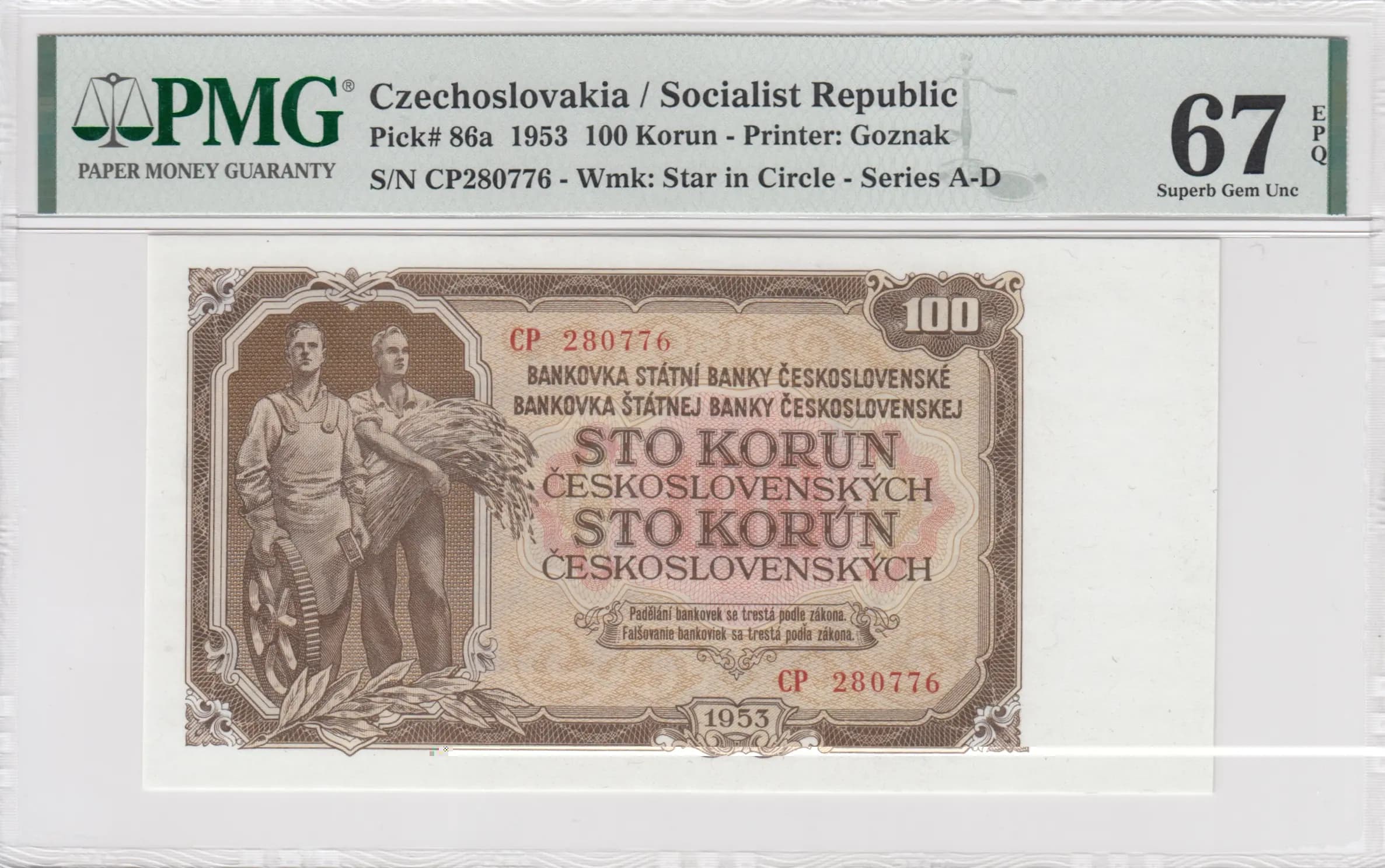
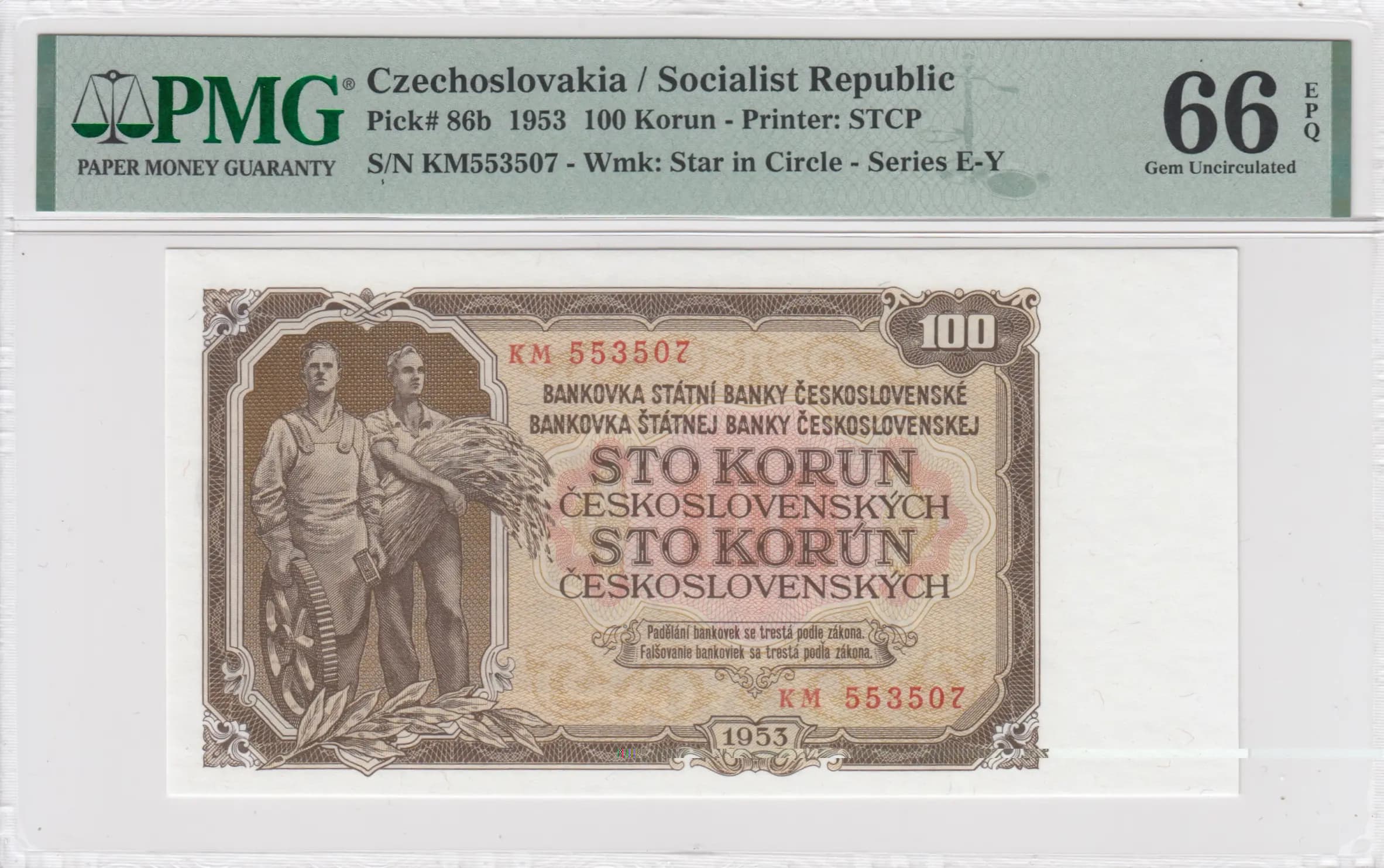
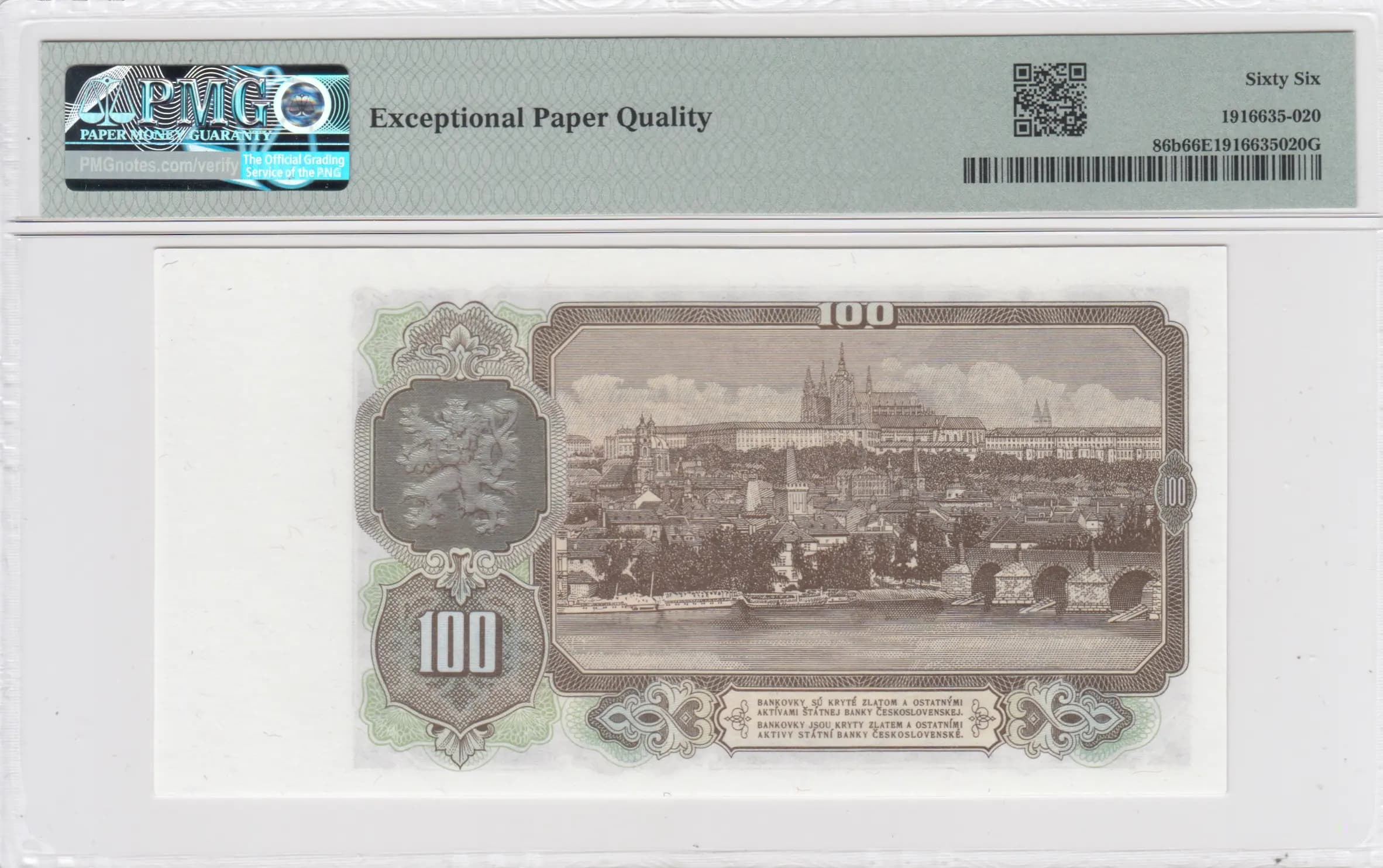
This is a PMG 66 EPQ example of the 1953 Czechoslovak 100 Korun note (Pick P-86b), representing a high-grade specimen of this post-war socialist-era banknote. The note exhibits exceptional preservation with pristine paper quality, sharp printing detail, and no visible wear or circulation marks. The STC-P printer variant is particularly desirable among collectors, and the combination of the striking socialist realist imagery on the obverse with the detailed Prague cityscape on the reverse makes this an important document of early Cold War Czechoslovak currency design.
Common. Despite the note's age and the appeal of early socialist Czechoslovak currency to collectors, the 1953 100 Korun notes had substantial print runs and remain readily available on the secondary market. eBay auction data shows consistent sales of this denomination and year across multiple grades, with UNC examples regularly selling between $7–$18 and PMG 66 examples averaging around $42. Population reports indicate multiple variants exist, further suggesting robust circulation and preservation of this issue. The note is not from a short-lived issuing authority, was not recalled, and does not have restricted print runs. While PMG 66 EPQ is a choice grade representing the top tier of uncirculated specimens, the denomination itself is common in the collector market.
Issued in 1953 by the Státní Banka Československá during the early Czechoslovak Socialist Republic period, this note commemorates post-war industrial recovery and national pride through its socialist realist iconography. The obverse features two workers—one with industrial/military equipment—emphasizing labor and production as pillars of the socialist state, while the reverse prominently displays Prague's St. Vitus Cathedral and the Vltava River cityscape, celebrating the nation's cultural and architectural heritage. The bilingual Czech and Slovak text reflects the federal structure of Czechoslovakia and the regime's commitment to equal representation of both constituent republics.
The obverse features two male figures in socialist realist style positioned on the left, representing the worker and farmer classes central to socialist ideology. One figure holds industrial or military equipment, symbolizing industrial production, while the composition emphasizes labor and manufacturing. The design employs brown and tan tones with ornate decorative borders typical of 1950s Czechoslovak currency design. The denomination '100' appears prominently in the upper right corner in large numerals. A laurel wreath in the lower left corner adds classical iconographic weight, suggesting strength and achievement. The reverse showcases a detailed panoramic engraving of Prague's historic cityscape, dominated by St. Vitus Cathedral's distinctive Gothic spires, with Charles Bridge (or similar Vltava River crossing) and multiple historical structures visible in the middle distance. The Bohemian lion coat of arms appears on the left side within an ornate square heraldic frame, framed by green decorative flourishes and scrollwork. This nationalist imagery balances the socialist labor iconography of the obverse, celebrating Czechoslovak cultural heritage.
{"front":{"czech":{"BANKOVKA STÁTNÍ BANKY ČESKOSLOVENSKÉ":"Banknote of the State Bank of Czechoslovakia","STO KORUN ČESKOSLOVENSKÝCH":"One Hundred Czechoslovak Crowns","Padělání bankovek se trestá podle zákona":"Counterfeiting banknotes is punishable by law"},"slovak":{"BANKOVKA ŠTÁTNEJ BANKY ČESKOSLOVENSKEJ":"Banknote of the State Bank of Czechoslovakia","STO KORUN ČESKOSLOVENSKÝCH":"One Hundred Czechoslovak Crowns","Falšovanie bankoviek sa trestá podľa zákona":"Counterfeiting banknotes is punishable by law"},"numerical":{"100":"Denomination","1953":"Issue year"}},"back":{"czech_slovak":{"BANKOVKY SE KRYTE ZLATEM A OSTATNYMI AKTIVY STATNEJ BANKY ČESKOSLOVENSKEJ":"Banknotes are covered by gold and other assets of the State Bank of Czechoslovakia","AKTIVI STATNEJ BANKY ČESKOSLOVENSKEJ":"Assets of the State Bank of Czechoslovakia"},"numerical":{"100":"Denomination"}}}
Steel engraving and intaglio printing processes, evidenced by the fine line work, intricate border patterns, and sharp detail throughout both obverse and reverse. The complex rendering of the Prague cityscape with multiple architectural elements and the precise geometric patterns of the decorative borders indicate high-quality recess printing by the State Printing Works. This P-86b variant was produced by STC-P (Státní tiskárna v Praze / State Printing Office in Prague), while the earlier P-86a variant was produced by Goznak in Moscow. The presence of security features including watermark (star in circle), fine engraving patterns, and color variations in the decorative elements (green tinting) represent the security technologies available in 1953.
This specimen is identified as Pick P-86b, produced by STC-P (State Printing Office, Prague). The PMG population report indicates three cataloged variants for the 1953 100 Korun: P-86a (Goznak printer, Moscow), P-86b (STC-P printer, Prague), and P-86s (unspecified). The STC-P domestic Prague printing variant (P-86b) is generally preferred by collectors over the Russian Goznak-printed P-86a variant, as it represents the domestic Czechoslovak printing authority. Additional varieties include replacement notes with Z prefix and other series prefixes noted on realbanknotes.com. The serial number on this specimen (KM 553507) appears to use standard letter-number prefixing conventions. No overprints or modifications are evident on the examined specimen.