100 korun 1953
Market Prices
31 salesAbout This Note
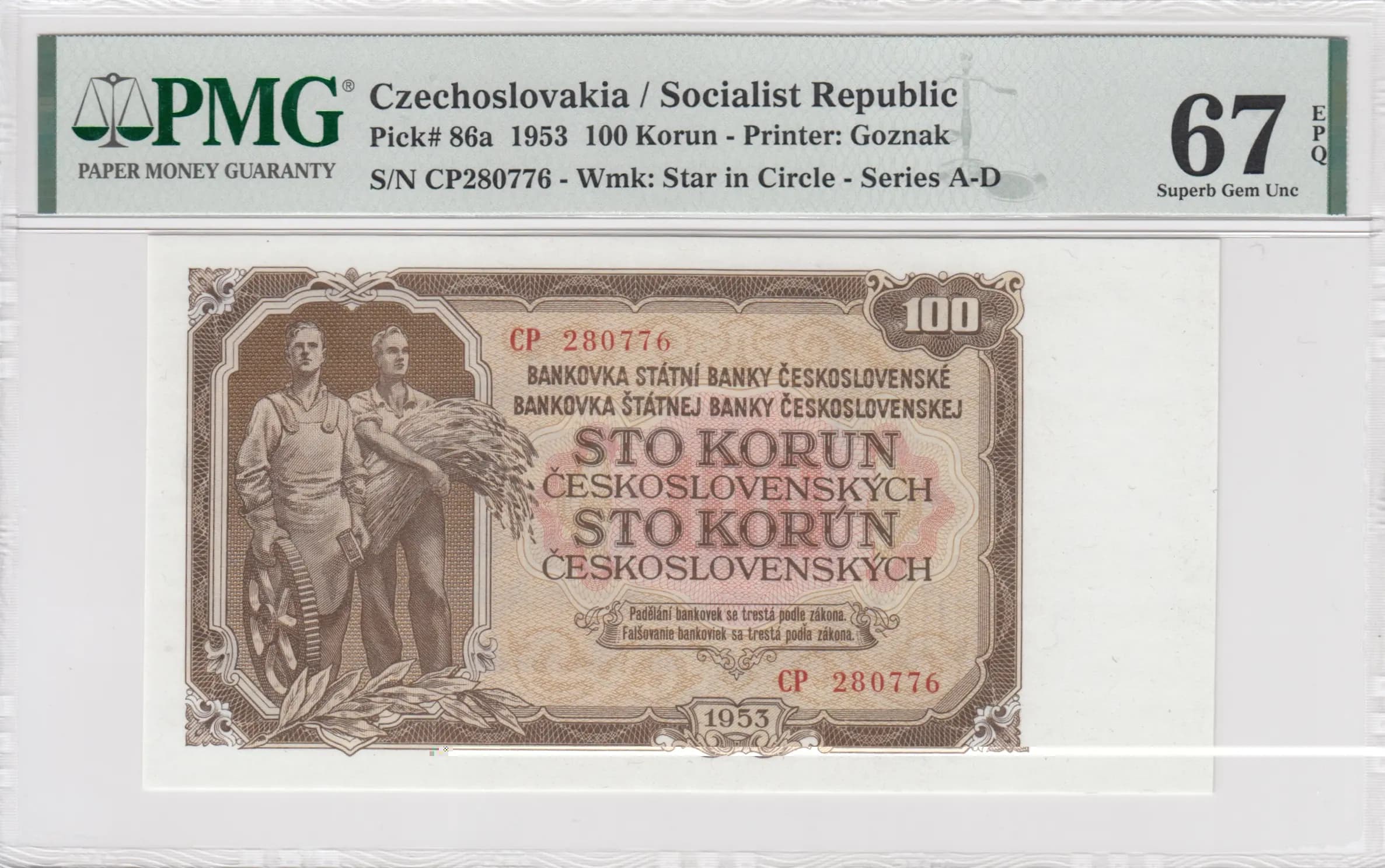
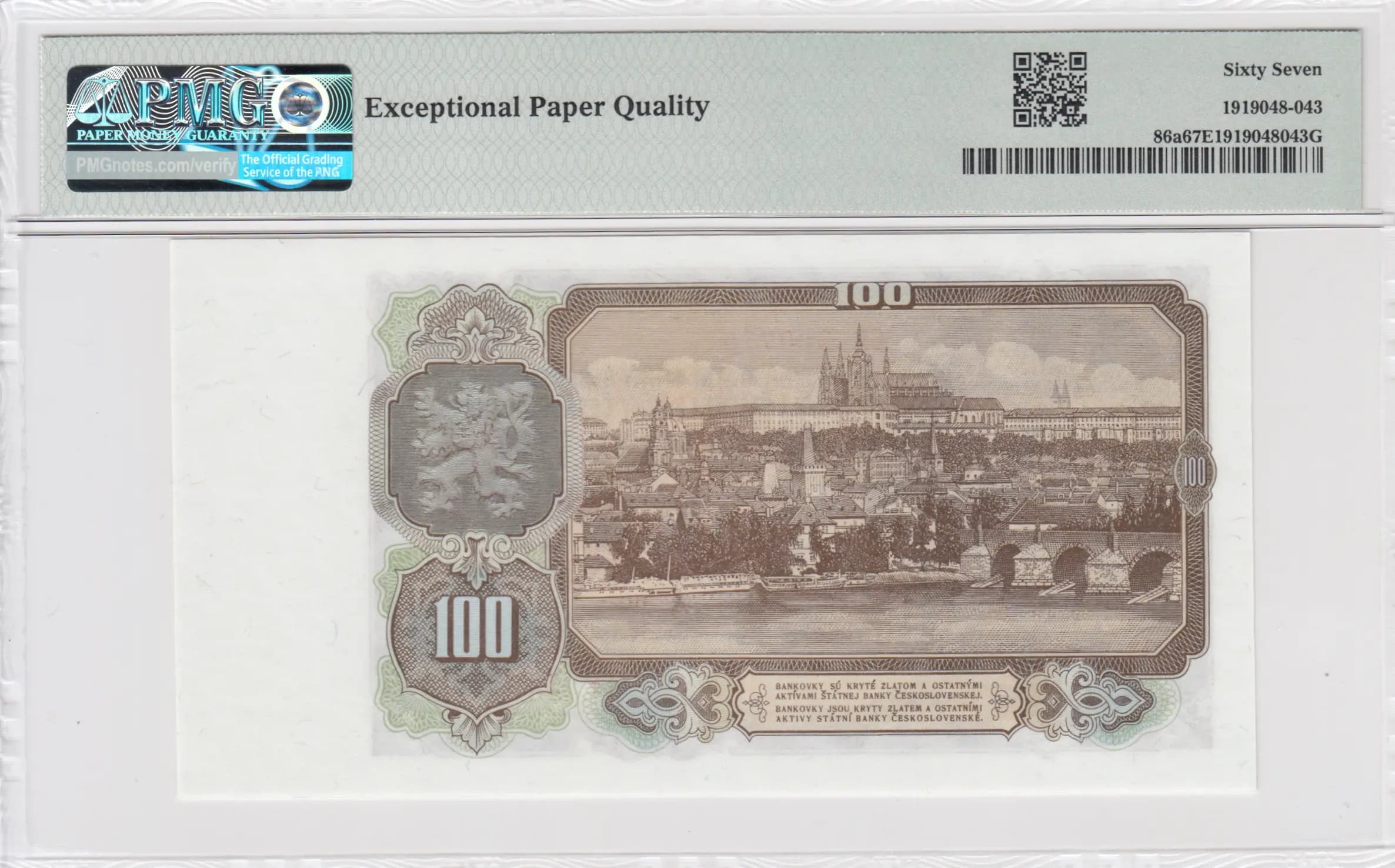
This is a PMG 67 EPQ example of the 1953 Czechoslovak 100 Korun note (Pick P-86a), featuring exceptional preservation with sharp engraving, vibrant brown and tan coloring, and crisp details throughout both obverse and reverse. The note depicts symbolic representations of workers and a celebrated Prague cityscape including the Charles Bridge and cathedral spires, rendered in fine line engraving characteristic of Goznak's work. As a mid-grade uncirculated specimen, this note represents strong collector appeal with consistent market performance in the $30-60 range for PMG 67 examples.
Common. Market data from realbanknotes.com shows consistent availability with PMG 67 examples selling regularly between $22-56 from 2015-2021, indicating adequate supply in the collector market. The 1953 100 Korun was produced in substantial quantities for regular circulation, and surviving examples in high grades are readily available. Catalog values (2016) of $20 for UNC condition further confirm common status.
Issued in 1953 by the Státní Banka Československá during the post-WWII communist period in Czechoslovakia, this note commemorates the industrial and agricultural workforce through its obverse portraits of a worker and farmer. The reverse depicts Prague's iconic Hradčany Castle district and Charles Bridge spanning the Vltava River, serving as national symbols affirming Czechoslovak identity during the early Cold War era. The inscription guaranteeing the note's backing by gold and state assets reflects the centralized economic policies of the period.
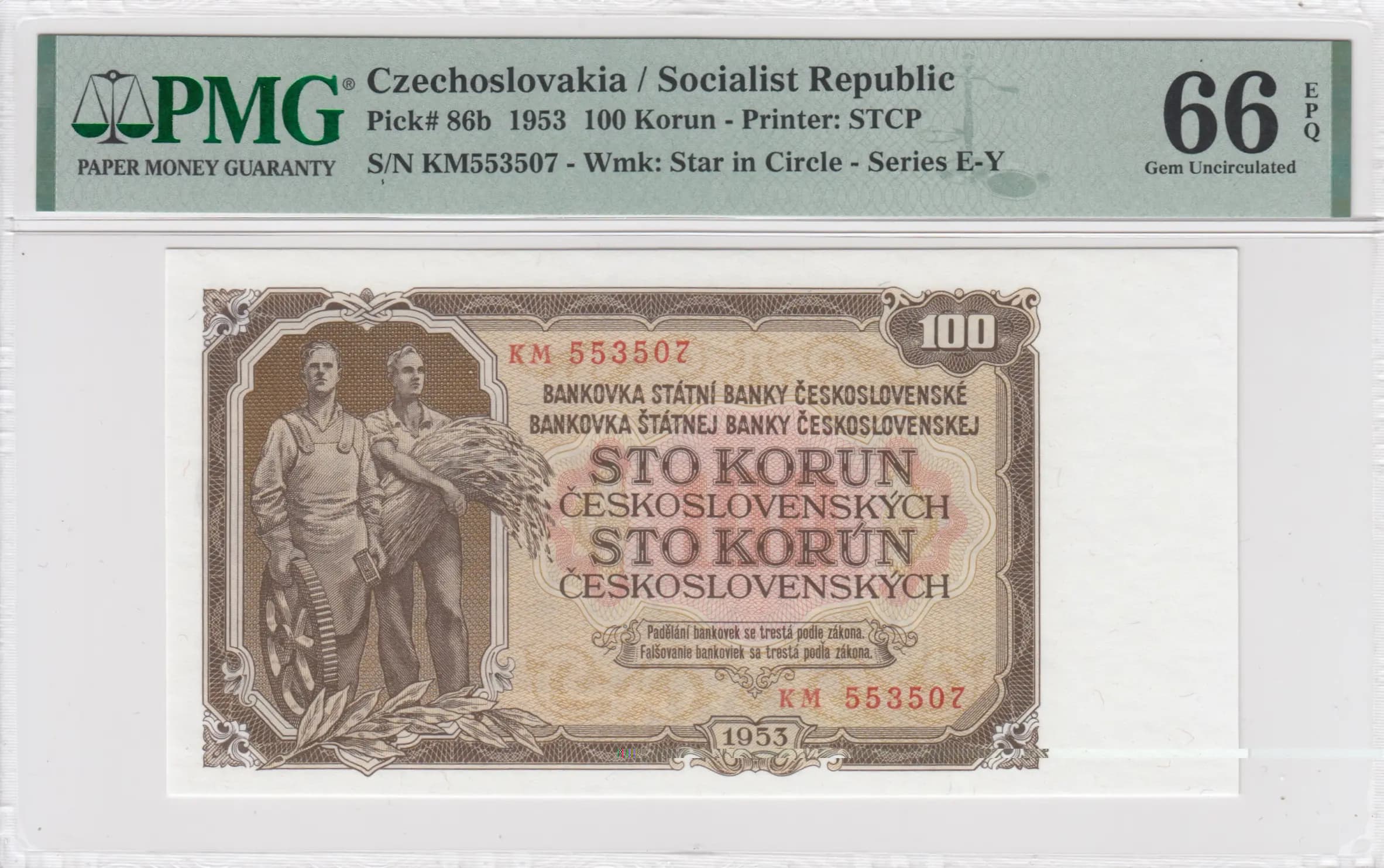
The obverse features two male figures in relief engraving positioned on the left side, representing a worker and farmer—key symbols of communist-era labor idealization—flanked by ornate baroque-style decorative borders with scrollwork and leaf motifs. The denomination '100' appears in an ornate frame in the upper right, with the note's bilingual Czech-Slovak inscriptions (reflecting Czechoslovakia's federal structure) dominating the center. A heraldic eagle with spread wings and classical flourishes ornament the composition. The reverse presents a detailed engraved cityscape of Prague dominated by the Hradčany Castle district and the iconic Charles Bridge spanning the Vltava River, with multiple church spires and historic buildings creating a recognizable silhouette. A heraldic coat of arms (Czechoslovak lion) appears in an ornate square frame on the upper left, with denomination numerals positioned in decorative corners throughout. Fine line work and careful engraving detail characterize the entire design.
Front (Obverse): '100' (denomination); 'BANKOVKA STÁTNÍ BANKY ČESKOSLOVENSKÉ' (Czech: Banknote of the State Bank of Czechoslovakia); 'BANKOVKA ŠTÁTNEJ BANKY ČESKOSLOVENSKEJ' (Slovak: Banknote of the State Bank of Czechoslovakia); 'STO KORUN ČESKOSLOVENSKÝCH' (Czech: One Hundred Czechoslovak Koruns); 'STO KORÚN ČESKOSLOVENSKÝCH' (Slovak: One Hundred Czechoslovak Koruns); '1953' (year of issue); Serial number 'CP 280776'. Back (Reverse): '100' (denomination, multiple locations); 'BANKOVKY JSOU KRYTEY ZLATEM A OSTATNIMI AKTIVY STATNEJ BANKY ČESKOSLOVENSKÉ' (Czech: Banknotes are covered by gold and other assets of the State Bank of Czechoslovakia); 'BANKOVKY SU KRYTE ZLATOM A OSTATNIM AKTIVAMI STATNEJ BANKY ČESKOSLOVENSKEJ' (Slovak: Banknotes are covered by gold and other assets of the State Bank of Czechoslovakia).
Intaglio engraving (line engraving/recess printing), executed by Gosnak (Moscow State Security Printing Works), the official security printer for Soviet-sphere currencies. The fine line detail, sharp portrait rendering, and complex engraved cityscape visible in the images confirm intaglio production. The note's series prefix 'C' and printer attribution to Goznak (variant P-86a) indicate this specific printing.
This is Pick P-86a, the Gosnak (Moscow) printing variant. The PMG Population Report identifies three cataloged variants: P-86a (Goznak printer), P-86b (STC-P printer), and P-86s. The serial number 'CP 280776' with 'C' prefix indicates a Series C note from the Goznak printing (series A-D are noted for regular issues; 'Z' prefix denotes replacement notes). The printer attribution to Goznak and series designation confirm this is the standard P-86a variety rather than the alternative P-86b printing.