10 korun 1953
Market Prices
15 salesAbout This Note
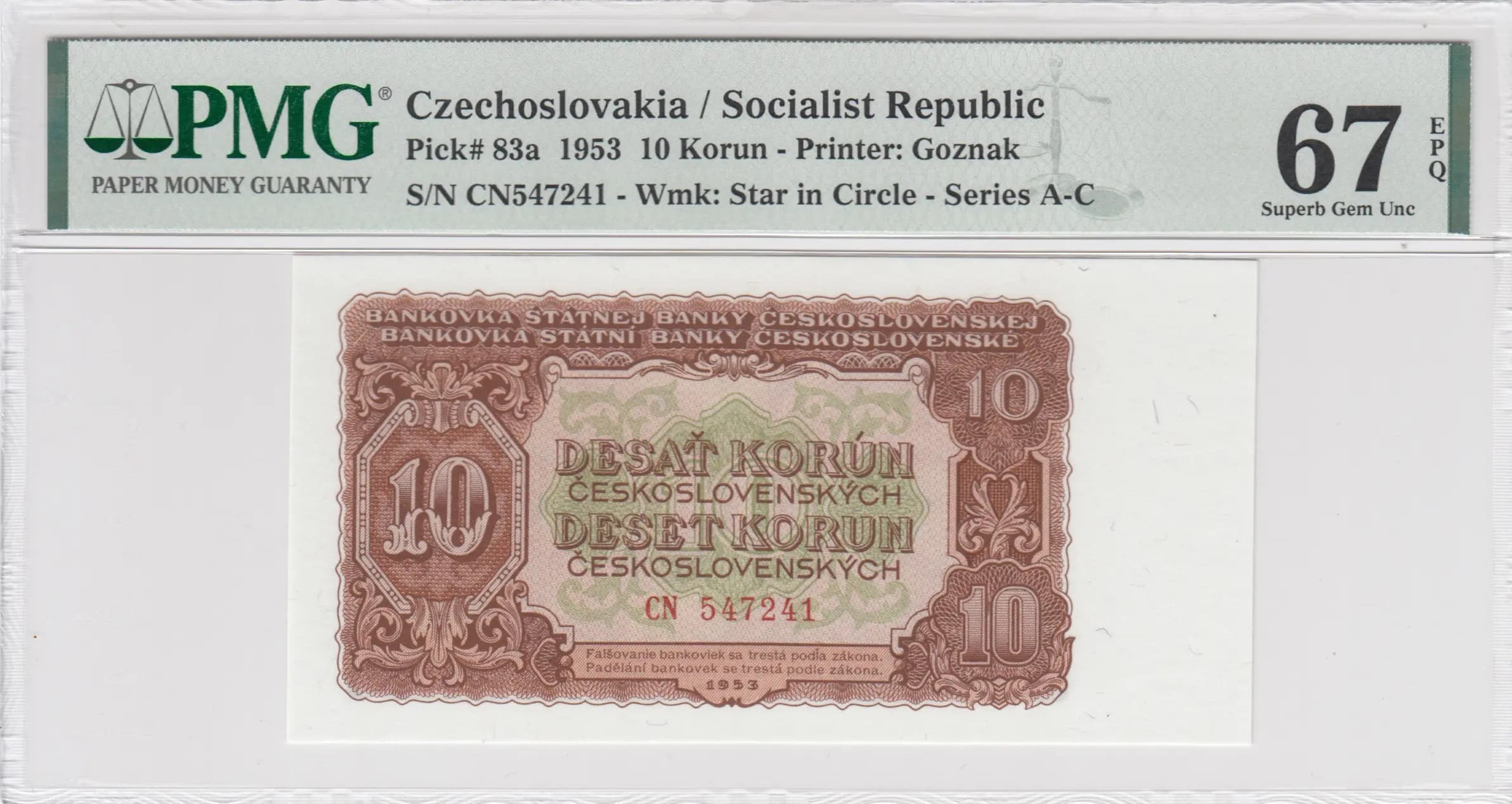
This is a PMG 67 EPQ graded 10 Korun banknote from Czechoslovakia dated 1953, representing an exceptionally well-preserved example of this post-war Socialist-era currency. The note displays crisp, sharp printing with no visible wear, creasing, or aging—characteristics typical of an uncirculated specimen. The ornate design featuring the Czechoslovak heraldic lion and bilingual Czech-Slovak inscriptions reflects the political and cultural identity of the early Socialist Czechoslovak state.
Common. This is a regular issue from a major circulation series produced by a major state printer (Goznak) in 1953. eBay market data shows consistent sales across multiple grading levels, with PMG 67 examples selling in the $18–$31 range during 2020–2024, and UNC examples trading for $2–$11. The high number of market transactions over more than a decade indicates robust supply. These notes were produced in large quantities for a major European state's circulation, and examples survive readily in all condition grades.
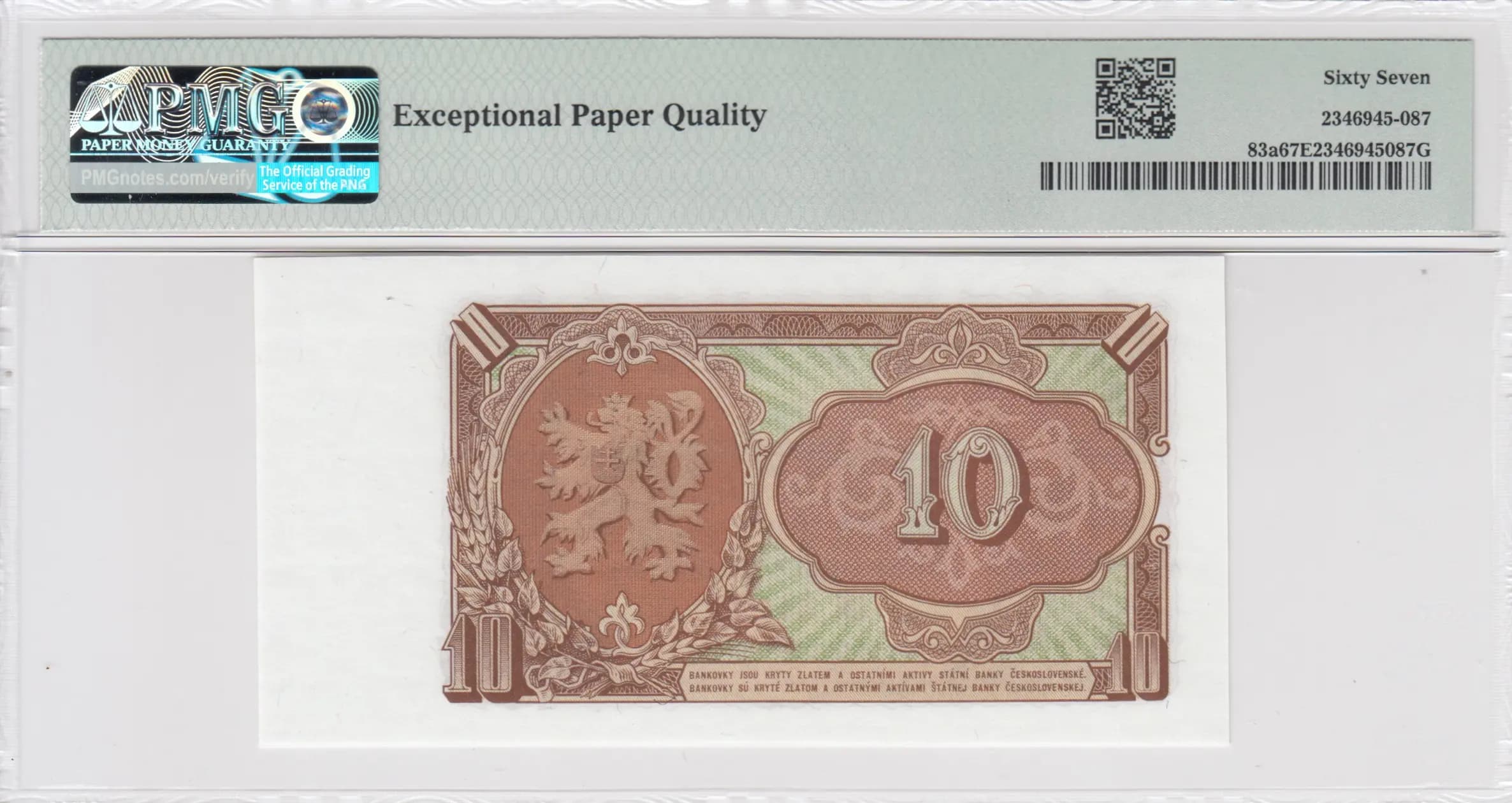
Issued by the State Bank of Czechoslovakia (Československá Socialistická Republika) in 1953, this banknote was produced during the consolidation of Communist rule in Czechoslovakia following World War II. The heraldic double-tailed lion depicted on the reverse served as a national symbol connecting the new Socialist state to Czechoslovak historical identity. The bilingual presentation in Czech and Slovak languages reflects the federal structure of the Czechoslovak Socialist Republic established in 1949, emphasizing the union of two constituent nations under Socialist governance.
The note features a classical engraved design with symmetrical Art Deco-influenced ornamentation characteristic of 1950s European currency. The obverse displays large ornamental cartouches containing the numeral '10' in each corner, with reddish-brown and green underprinting creating depth. The center features a star-in-circle watermark and bilingual institutional text. The reverse presents a heraldic double-tailed lion—the coat of arms of Czechoslovakia—set within an ornate oval medallion on the left side, flanked by additional decorative '10' cartouches. Crown-like elements and fleur-de-lis motifs frame the heraldic symbol, while a subtle diagonal line background pattern in green provides security features. Throughout both sides, fine-line engraving creates intricate scrollwork and architectural framing elements typical of mid-century Socialist-era currency design.
FRONT SIDE: 'BANKOVKA STATNÍ BANKY ČESKOSLOVENSKÉ' (Czech) / 'BANKOVKA STATNEJ BANKY ČESKOSLOVENSKEJ' (Slovak) — 'Banknote of the State Bank of Czechoslovakia'; 'DESET KORUN' (Czech) / 'DESAŤ KORÚN' (Slovak) — 'Ten Korun'; 'ČESKOSLOVENSKÝCH' — 'Czechoslovak'; Serial number: 'CN 547241'; 'Padělání bankoviek se trestá podle zákona' (Czech) / 'Falsování bankoviek sa trestá podľa zákona' (Slovak) — 'Counterfeiting banknotes is punishable by law'; '1953' — Year of issue. BACK SIDE: '10' — Denomination; 'BANKOVKY JSOU KRYTÝ ZLATEM A OSTATNÍMI AKTIVY STÁTNÍ BANKY ČESKOSLOVENSKÉ' (Czech) / 'BANKOVKY SÚ KRYTÉ ZLATOM A OSTATNÝMI AKTÍVAMI STATNEJ BANKY ČESKOSLOVENSKEJ' (Slovak) — 'Banknotes are covered by gold and other assets of the State Bank of Czechoslovakia.'
This note was produced using intaglio (engraved line) printing, evidenced by the sharp, finely detailed scrollwork, borders, and security engraving visible throughout the design. According to catalog sources, this variant (P-83a) was printed by Goznak in Moscow, the Soviet state security printer, which is consistent with the Russian production of currency for satellite Socialist states during this period. Alternative printings exist with TB (Prag) printer marks. The technique includes multi-color printing with brown, green, and orange inks on a cream base, with watermarks incorporated during paper manufacturing.
This specific note is catalogued as Pick P-83a, the Goznak (Moscow) printing variant. Series prefixes A, B, C, and Z are documented for this issue, with Z-prefix notes being replacement notes. The observed serial number 'CN 547241' places this note in the regular circulation series. The PMG population report indicates one catalogued variant for this base Pick number, confirming the Goznak printing as the primary identified variant.