5 yuan 1940
About This Note
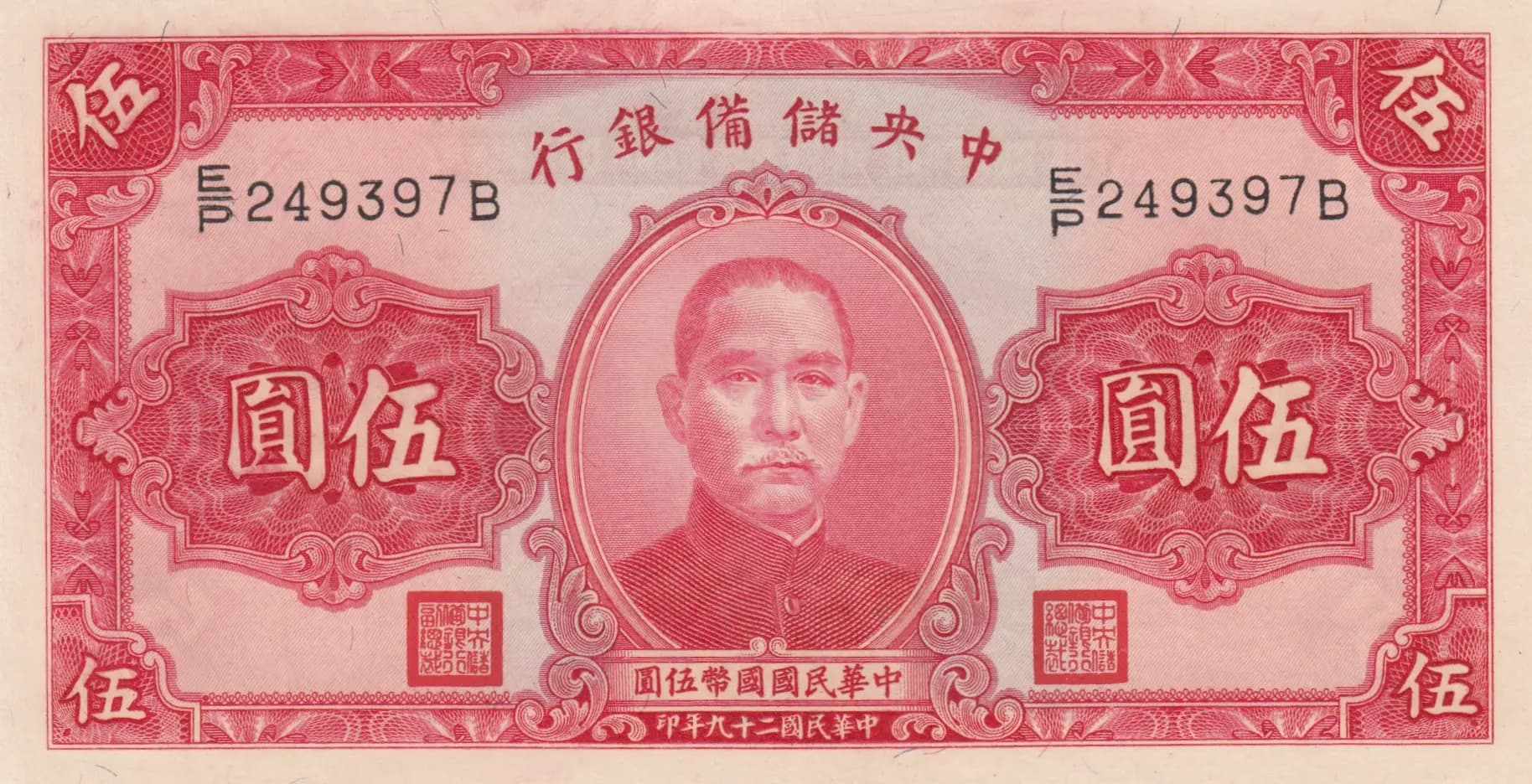
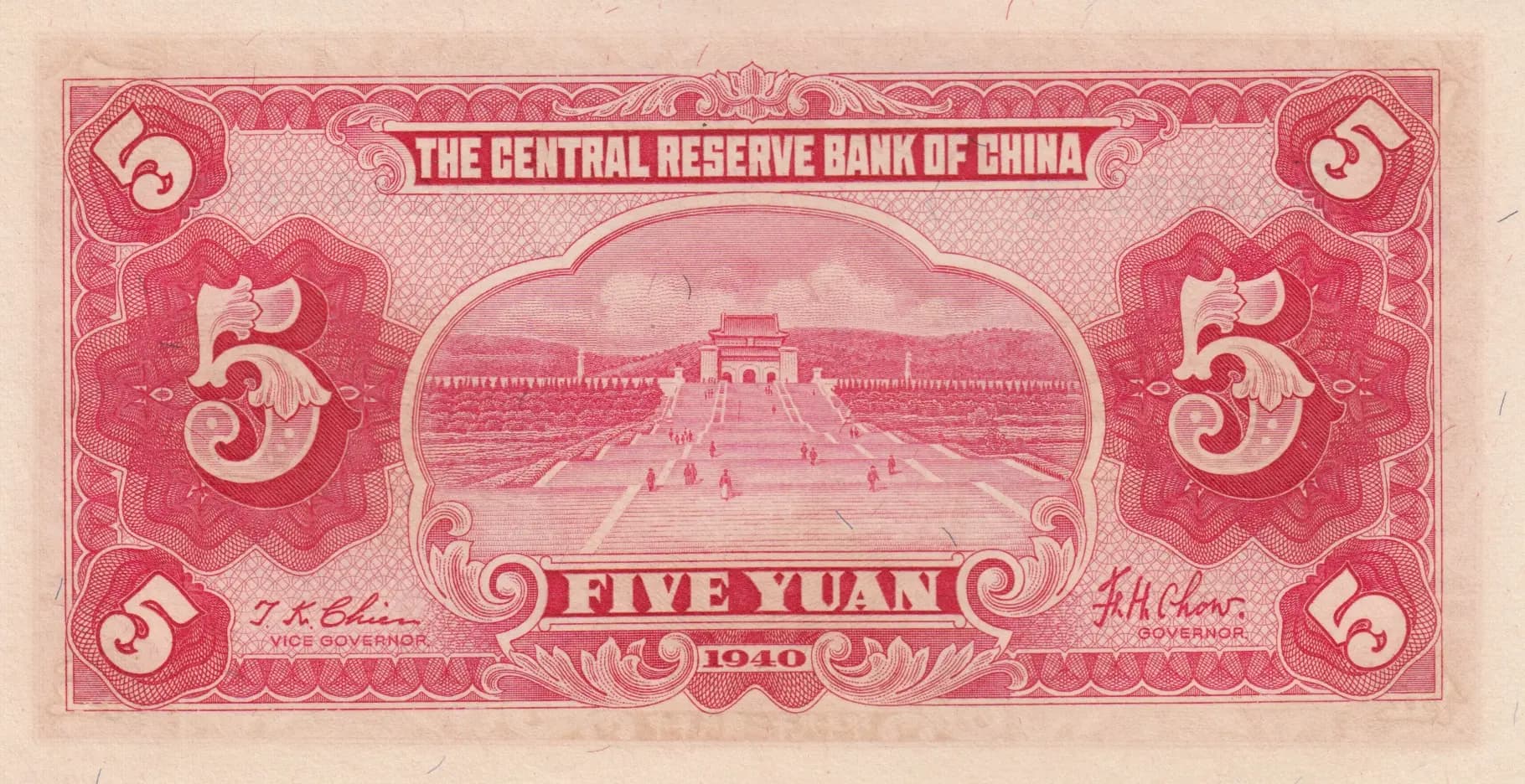
This is a 1940 Central Reserve Bank of China 5 Yuan note (Pick P-J10e) in Uncirculated condition according to catalog data, though visual inspection reveals significant aging characteristics including foxing, discoloration, and handling marks inconsistent with a true UNC grade. The note features an elegant pink/rose color scheme with a formal male portrait in traditional dress on the obverse and a fortified gateway structure on the reverse, both rendered in fine line engraving. This bilingual note (Chinese and English) represents an important transitional period in Chinese banking during the Second Sino-Japanese War.
Common. The 1940 Central Reserve Bank of China 5 Yuan notes were issued in substantial quantities during wartime currency production. While the Pick catalog lists this as P-J10e (indicating multiple varieties exist), this denomination and issuer combination appears regularly in the collector market at modest valuations. No evidence suggests limited print runs or recall circumstances that would elevate scarcity. Wartime Chinese currency from this issuer, while historically significant, remains relatively accessible to collectors.
The Central Reserve Bank of China issued this note during 1940, when the Chinese government had relocated to Chungking (Chongqing) following Japanese invasion. The bilingual inscription 'THE CENTRAL RESERVE BANK OF CHINA' and Chinese characters '中央銀行儲備' reflect the bank's attempt to maintain international credibility during wartime. The fortified gateway depicted on the reverse symbolizes national defense and territorial strength during this period of military conflict and territorial consolidation.
The obverse features a formal portrait of a male figure with dark hair and mustache, wearing a high-collared garment typical of early 20th century Chinese formal dress, presented in an ornate oval medallion frame. The portrait is likely that of a significant financial or political figure of the period, though not specifically identified in available materials. The reverse depicts a fortified gateway or fortress entrance with defensive walls extending into a distant landscape, symbolizing national strength and sovereignty. Both sides employ elaborate baroque-style decorative borders with floral and scrollwork motifs, cartouches displaying the denomination numeral 5, and official red stamps/seals. The bilingual presentation (Traditional Chinese and English) reflects the international nature of Chinese banking institutions during this era.
FRONT SIDE: '中央銀行儲備' (Central Bank Reserve / Central Reserve Bank), '五圓' (Five Yuan), '中華民國' (Republic of China), '中華民國二十九年' (Year 29 of the Republic of China [corresponding to 1940 in the Western calendar]), Serial number '249397B' (appears in upper left and right corners). BACK SIDE: 'THE CENTRAL RESERVE BANK OF CHINA' (English institutional name), 'FIVE YUAN' (English denomination), 'T.K. Shao' (Vice Governor signature), 'VICE GOVERNOR' (title in English), '秋山島' (Governor's name in Chinese characters), 'GOVERNOR' (title in English), '1940' (year in Western numerals).
The note was produced using fine line engraving and intaglio printing techniques, as evidenced by the precise detail work in the portrait, landscape architecture, and decorative borders. The complex linear patterns and crisp fine lines visible throughout are characteristic of intaglio printing from engraved steel plates. The red official seals and stamps appear to have been applied separately, possibly using letterpress or lithographic techniques. This note was likely produced by a foreign security printer; Central Reserve Bank notes from this period were frequently printed by firms such as De La Rue or similar specialized security printers contracted by the Chinese government.
This note is identified as Pick P-J10e, indicating it is variant 'e' within the P-J10 family of 5 Yuan notes from the Central Reserve Bank of China dated 1940. The specific variety designation likely refers to differences in signatures (this example bears T.K. Shao as Vice Governor and the Chinese-named Governor), serial number prefix patterns (this example shows '249397B'), or minor design variations. The bilingual format and English date of 1940 are standard for this series. Serial number 249397B suggests this falls within a specific production batch, though without access to comprehensive serial number range documentation, precise batch identification is not possible. The PMG population report reference suggests additional variants exist within this Pick number classification.