1000 francs 1974
Market Prices
25 salesAbout This Note
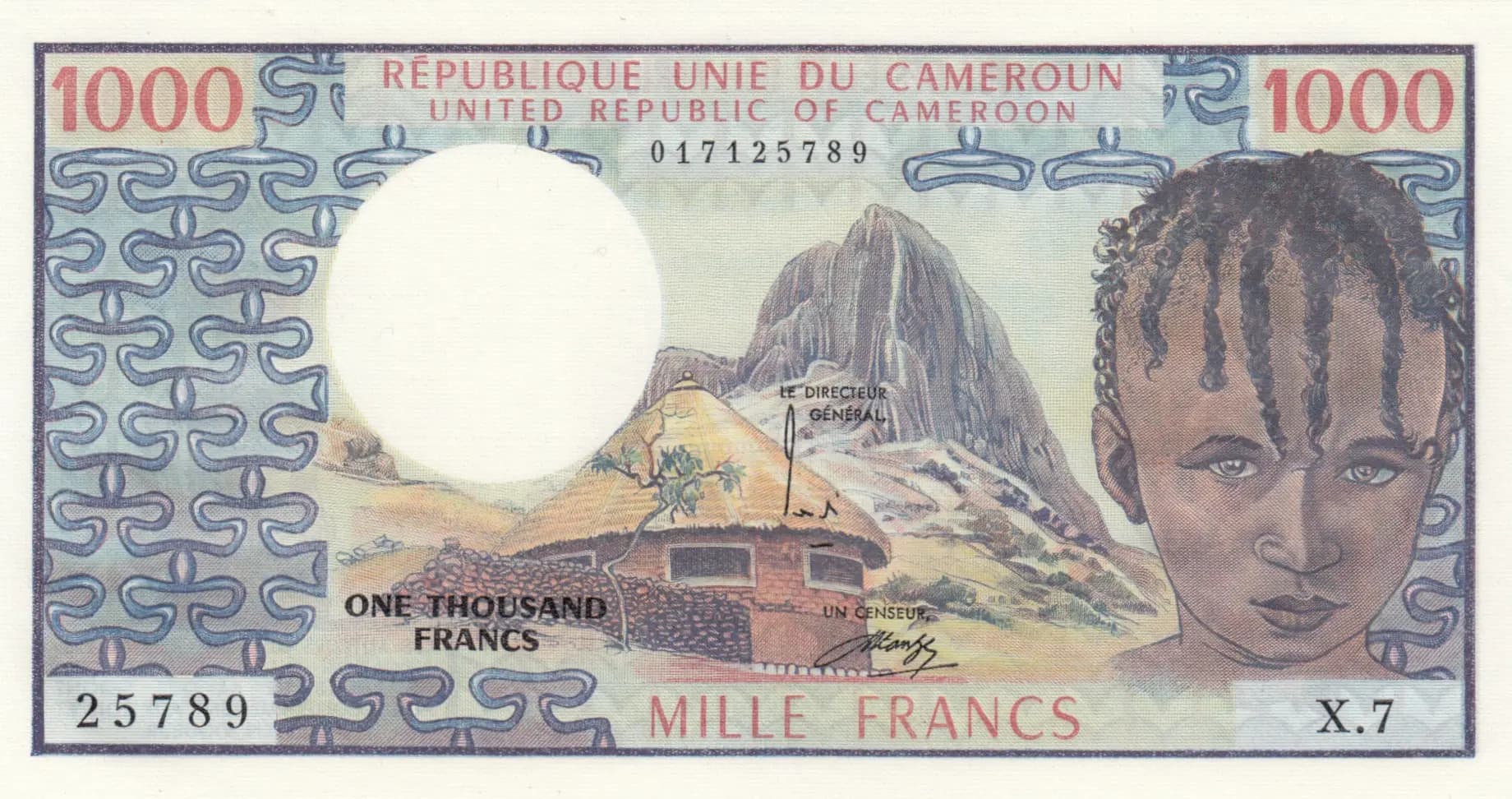
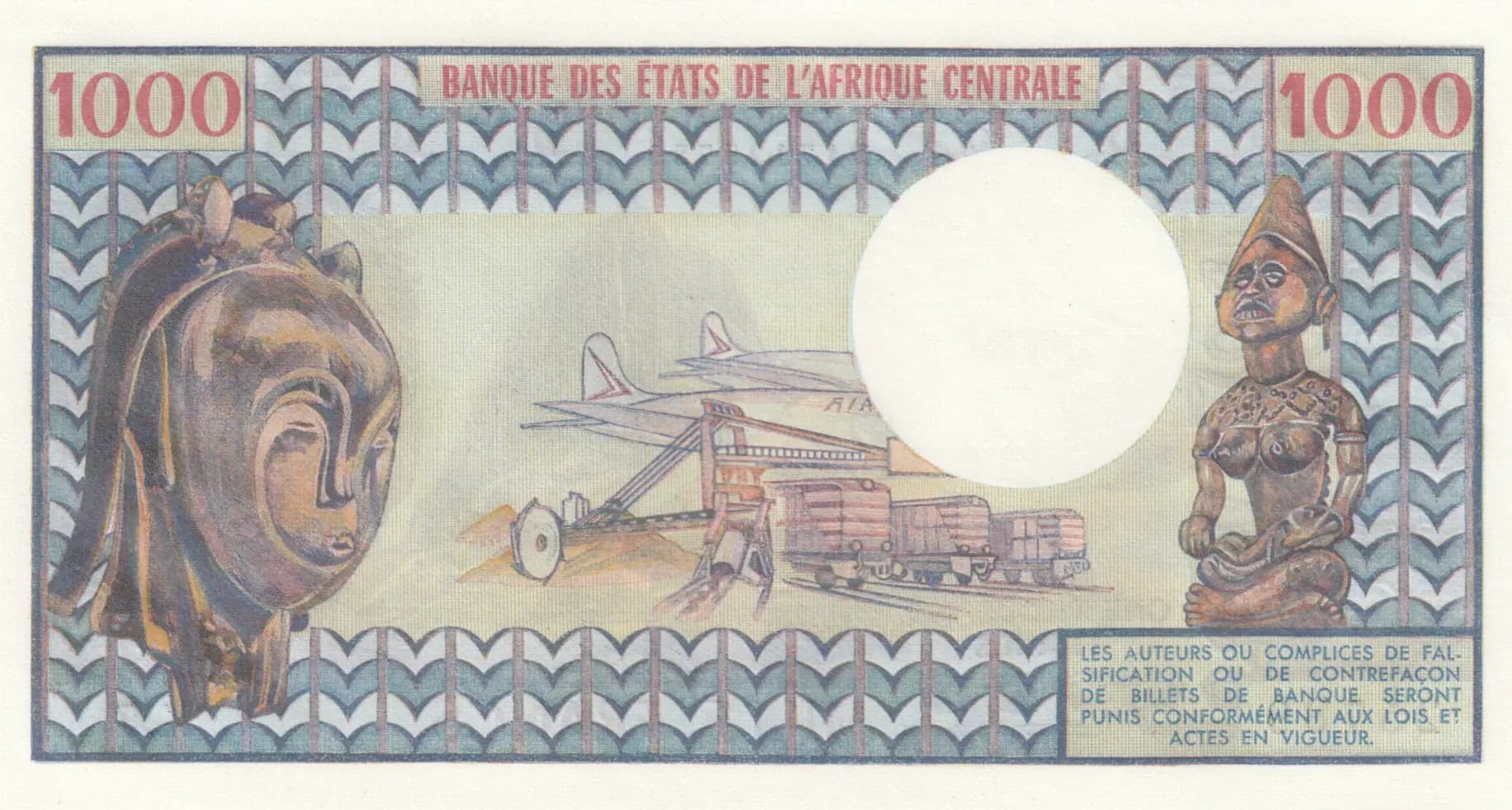
This is an uncirculated 1000 Francs banknote from Cameroon issued in 1974 by the Banque des États de l'Afrique Centrale, representing the Pick-16a variety with signature #5. The note exhibits pristine condition with vibrant multicolored printing in light blue, beige, and brown tones, featuring Rhumsiki Peak and traditional imagery on the obverse, and modern transportation infrastructure (airplane, train) with sculptural African heads on the reverse. The exceptional clarity of all design elements and complete absence of wear make this an excellent specimen for collectors of Central African currency.
Common. Despite being from 1974, this note trades regularly on secondary markets with consistent eBay sales data showing common-grade examples (F to VF) averaging $7-$22 throughout the 2010s-2020s, and UNC examples averaging $60-$85 (2017 sale at $84.11). The catalog value for UNC is listed at $60 (2019), and PMG population reports show multiple variants in circulation, indicating substantial print runs. The abundance of trading history and stable, modest pricing across all grades confirms this is a common date and denomination in the BEAC currency series.
Issued during the early post-colonial period of the United Republic of Cameroon (1974), this note reflects the nation's modernization aspirations through its depiction of contemporary transportation infrastructure—the airplane, train, and industrial elements symbolizing economic development. The sculptural portraits and traditional hut imagery on the obverse represent Cameroon's cultural heritage, while Rhumsiki Peak (a notable geographic landmark in the Far North Region) anchors the design to Cameroon's natural identity. The bilingual (French-English) inscriptions underscore Cameroon's dual colonial legacy and post-independence bilingual policy.
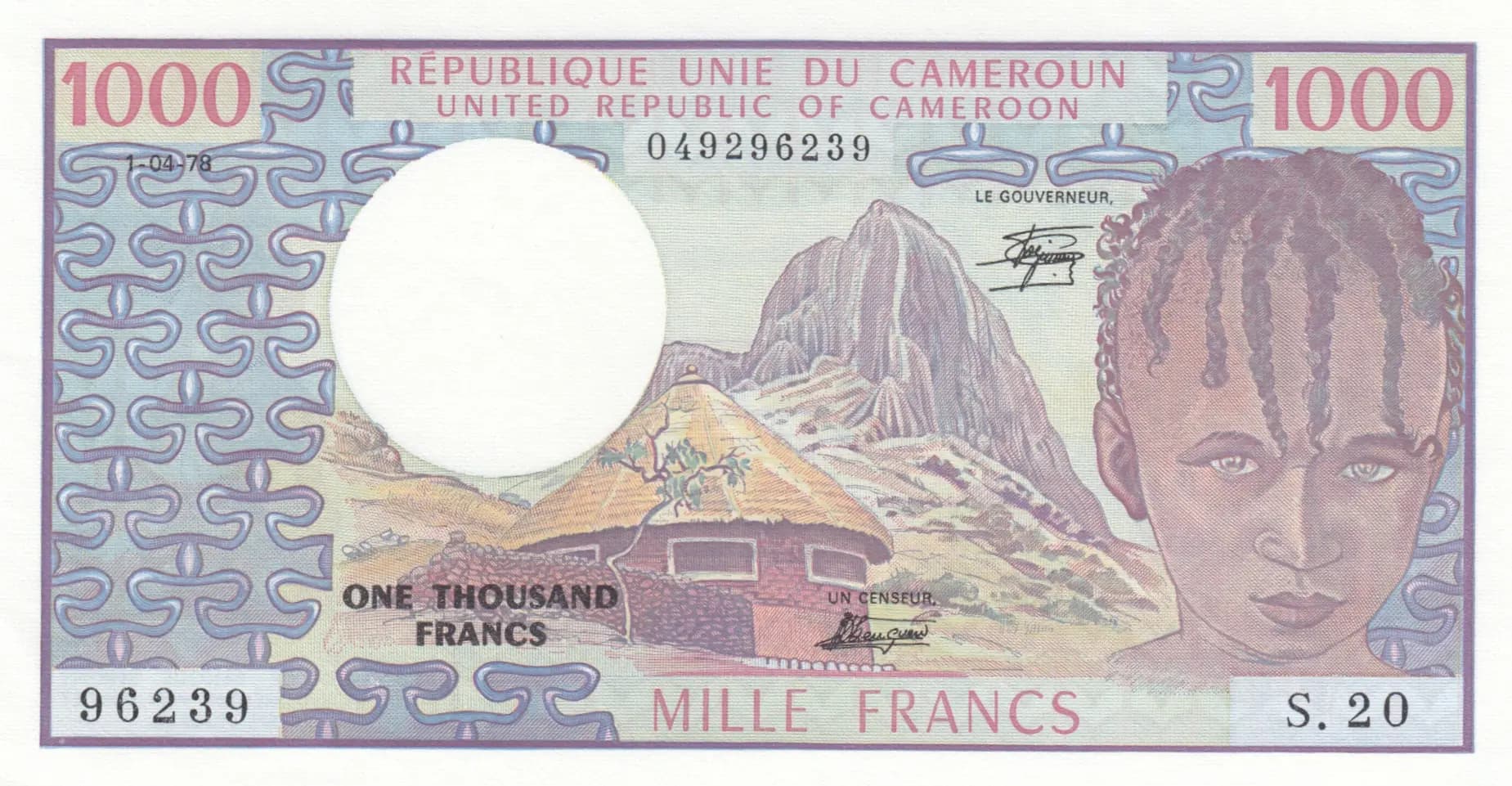
The obverse features a girl with plaits at right, a traditional hut at center, and the iconic Rhumsiki Peak in the background—a distinctive volcanic formation in Cameroon's Far North Region. A large circular watermark area occupies the center-left, with decorative geometric cross-like patterns forming the left border, providing both aesthetic and security function. The reverse depicts modernization themes through an airplane in flight, a multi-car train, and industrial/transportation infrastructure in the central scene. Two stylized African sculptural heads flank this central composition—one on the left and one on the right (the latter appears to wear a headdress or crown)—representing traditional African artistry. A repeating chevron or leaf-like geometric pattern forms the background across both sides. The overall design palette employs light blue, beige, brown, red, and gray tones in a carefully balanced composition.
FRONT SIDE: 'RÉPUBLIQUE UNIE DU CAMEROUN' (United Republic of Cameroon) / 'UNITED REPUBLIC OF CAMEROON' / '1000' (denomination numeral) / 'ONE THOUSAND FRANCS' / 'MILLE FRANCS' (One Thousand Francs) / 'LE DIRECTEUR' (The Director) / 'UN CENSEUR' (A Censor) [signature titles] / Serial number: 017125789 / Printer mark: X.7. BACK SIDE: 'BANQUE DES ÉTATS DE L'AFRIQUE CENTRALE' (Bank of the Central African States) / '1000' (denomination numeral) / 'LES AUTEURS OU COMPLICES DE FALSIFICATION OU DE CONTREFAÇON SERONT POURSUIVIS ET PUNIS CONFORMÉMENT AUX LOIS ET ACTES EN VIGUEUR.' (The authors or accomplices of falsification or counterfeiting will be prosecuted and punished in accordance with applicable laws and acts in force.)
Engraved printing, as confirmed by both the catalog data (P-16a designation) and the fine detail visible in the security features. The sharp definition of the geometric patterns, portrait details, and inscription clarity are characteristic of engraved banknote production. This note represents the engraved variant (P-16as also exists as an engraved variant), distinct from later lithographic versions (P-16b, P-16c variants). The printer is identified by the mark 'X.7' visible on the note.
This note is the P-16a variety, characterized by Signature #5 (LE DIRECTEUR GENERAL and UN CENSEUR signature titles visible). The engraved printing technique and 1974 date distinguish it from later lithographic variants P-16b (Signature #8), P-16c (Signature #10), and P-16d (Signature #12). The serial number 017125789 and printer mark X.7 are specific to this specimen. Per PMG records, seven variants exist for this Pick number base, with P-16a and P-16as (engraved) being the earliest 1974 issue.