20 francs 1970
Market Prices
6 salesAbout This Note
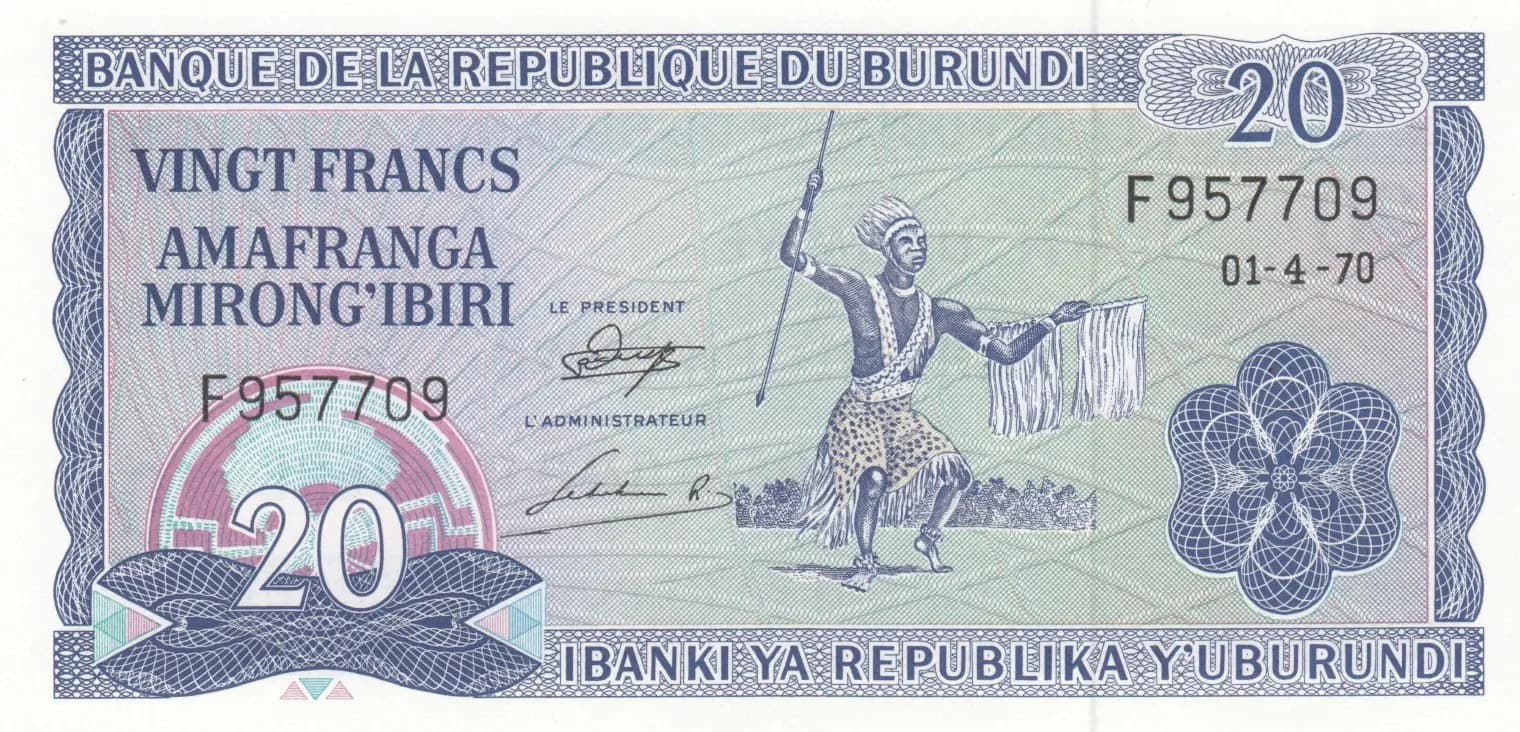
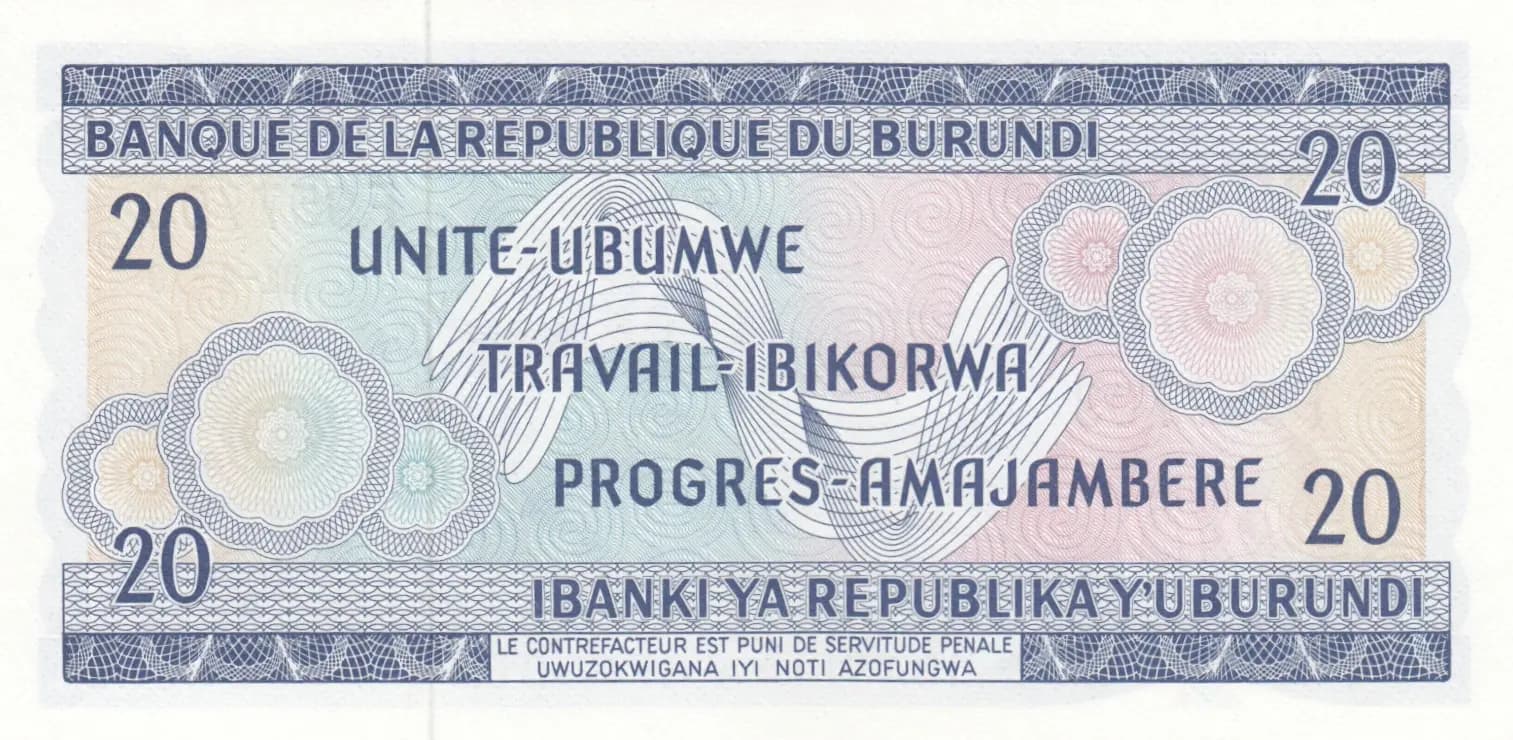
This 1970 Burundi 20 Francs (Pick P-21b) presents a striking design featuring a warrior figure in traditional dress with spear and flag on the obverse, rendered in blue, green, and violet inks with exceptional clarity and detail. The reverse displays a forward-facing portrait in a circular radiating vignette, accompanied by the national motto 'Unité-Travail-Progrès' in both French and Kirundi. In uncirculated condition with no visible wear, creases, or damage, this note exemplifies the fine engraving and security printing characteristic of early Burundian currency.
Common. This note is part of a regular issue spanning 1968-1973 with presumably substantial print runs to meet Burundi's circulation needs during its early post-independence consolidation period. eBay market evidence supports this assessment: recent comparable sales range from $8-$60 depending on condition, with UNC examples cataloging at $60 (2019 estimate) and having sold at auction for $52 (2013). The high circulation of this denomination and broad availability in the secondary market confirm common status.
Issued in 1970 by the Banque de la République du Burundi, this note reflects the newly independent nation's assertion of cultural identity through numismatic imagery. The warrior figure holding a spear and flag represents Burundi's indigenous Hutu and Tutsi traditions and military heritage, while the bilingual inscriptions in French and Kirundi underscore the post-colonial emphasis on vernacular language alongside the colonial administrative language. The reverse's national motto—'Unité, Travail, Progrès' (Unity, Work, Progress)—encapsulates the aspirational ideology of African nations consolidating statehood in the 1960s-70s.
The obverse centers on a historically significant portrayal of a Burundian warrior or soldier in traditional regalia, depicted in three-quarter view at center-right, complete with elaborate headdress, holding a spear and what appears to be a flag or standard—symbols of national sovereignty and martial prowess. The background features a distant landscape or settlement, providing geographic context. Ornamental security elements dominate the composition: decorative geometric borders frame the left and right edges in typical 1960s-70s currency design style, a large denomination numeral '20' appears in a circular cartouche (lower left in pink), and rosette-pattern ornaments and intricate lace-like engraving fill remaining space. The reverse features a formal portrait of a Burundian dignitary (likely a national leader or founding figure) in a circular vignette with radiating lines suggesting authority and prominence, surrounded by four corner rosettes and additional geometric ornamental borders top and bottom. The color palette of blue, green, violet, pink, and cream creates visual hierarchy and aids in counterfeit deterrence.
OBVERSE: 'Banque de la République du Burundi' / 'Ibanki ya Republika y'Uburundi' (Bank of the Republic of Burundi — bilingual); 'Vingt Francs' / 'Amafranga Mirong'ibiri' (Twenty Francs — bilingual); 'Le Président' (The President — signature title); 'L'Administrateur' (The Administrator — signature title); Serial number 'F957709'; Issue date '01-4-70' (1 April 1970). REVERSE: 'Banque de la République du Burundi' (repeated); 'Ibanki ya Republika y'Uburundi' (repeated); 'Unité-Ubumwe' (Unity — bilingual); 'Travail-Ibikorwa' (Work — bilingual); 'Progrès-Amajambere' (Progress — bilingual); 'Le Contrefacteur est puni de servitude pénale / Uwuzokwigana iyi noti azofungwa' (The counterfeiter is punished with penal servitude / Counterfeiter of this note will be imprisoned — bilingual warning).
Intaglio (steel engraving) printing, as evidenced by the fine-line engraving patterns, intricate geometric borders, detailed rosette designs with radiating lines, and the overall crispness and depth of impression visible throughout both obverse and reverse. The security printing exhibits the hallmarks of professional currency production from a specialized security printer, likely from Belgium or another Western European facility common for African central bank issues in the 1970s. The multi-color intaglio process (blue, green, violet, pink underprinting) demonstrates sophisticated chromatic separation and layered registration typical of high-security banknote production.
This specimen shows the 1970 issue date variant (01-4-70), representing the earliest dated example within the 1968-1973 series. Per realbanknotes.com reference data, signature varieties exist within this Pick number (signature titles 'Le Président' and 'Le Vice-Président' noted), though the present note displays 'Le Président' and 'L'Administrateur.' Serial number prefix 'F957709' indicates standard production numbering with no apparent overprints or remarkable varieties. The 1970 date distinguishes this from later 1971 and 1973 dated impressions of the same design.