100 francs 1960
Market Prices
4 salesAbout This Note
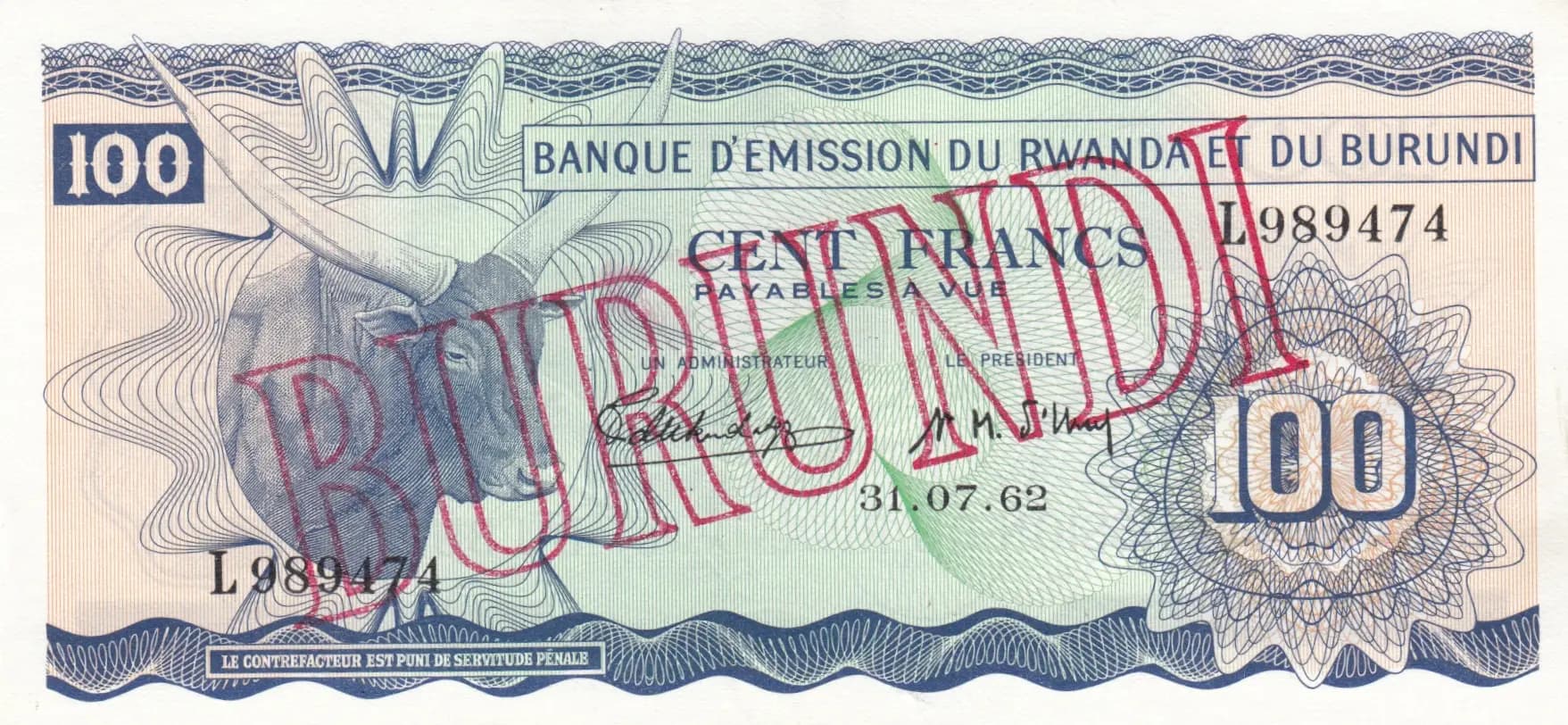
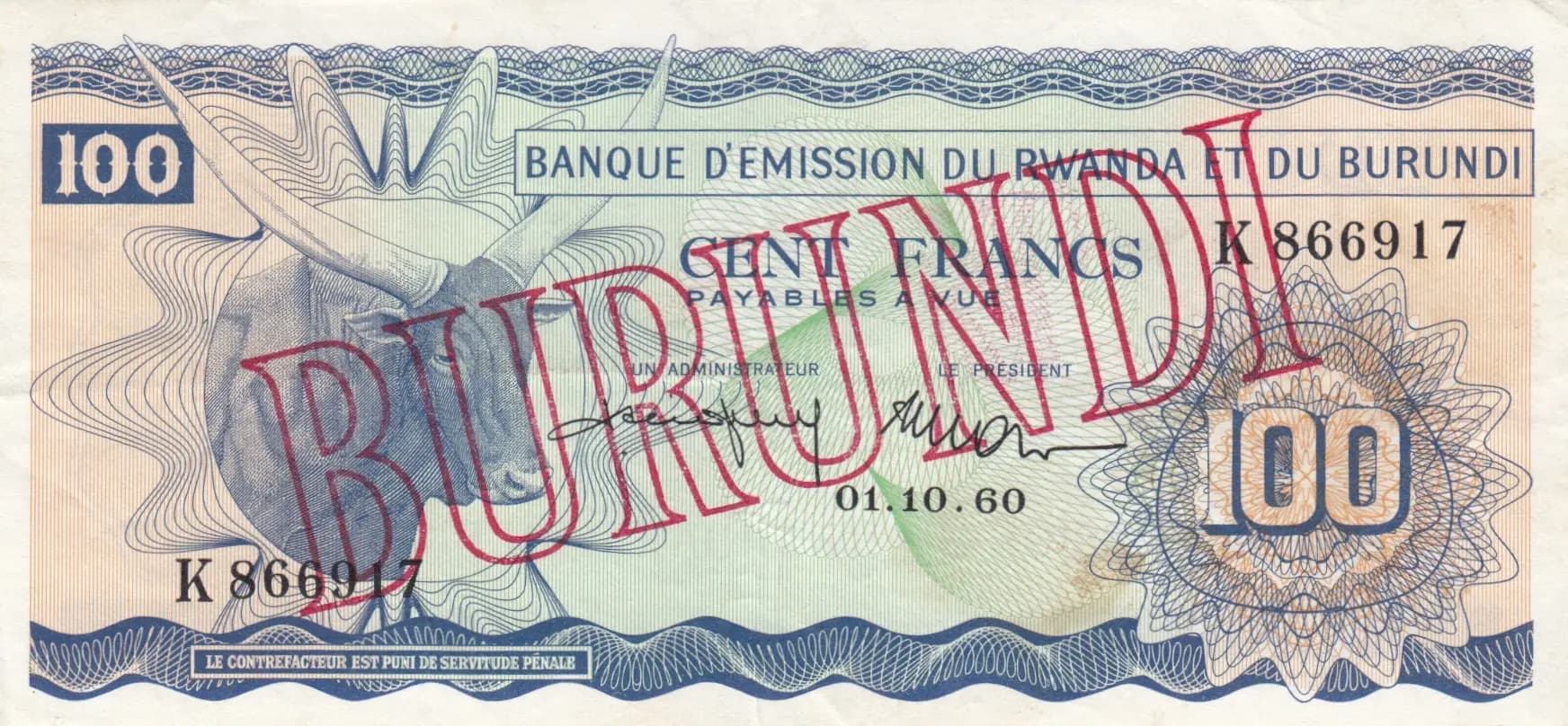
This is a 1960 Burundi 100 Francs specimen note (Pick P-5) issued by the Banque d'Emission du Rwanda et du Burundi, graded VF. The note features exceptional intaglio engraving with elaborate guilloche patterns in blue and green on cream-colored paper, bearing a bold red diagonal 'SPECIMEN' overprint across the face. Despite visible creasing and aging patina consistent with storage and handling, the note preserves the fine detail of its ornamental design and remains a notable example of early Burundian currency from the nation's independence period.
Common. While this is an early issue from Burundi's independence period, the Banque d'Emission du Rwanda et du Burundi maintained this denomination in circulation for several years across both Rwanda and Burundi, resulting in substantial print runs. eBay market data shows VG examples selling for under $50 and F-grade notes around $80-120, with even PMG 53 graded specimens reaching only $315—price points typical of readily available notes. The specimen overprint visible on this example further increases availability, as specimen notes were often distributed to banks and institutions rather than destroyed. No evidence suggests this Pick number had a limited print run or was recalled.
This note was issued on October 1, 1960, coinciding with Burundi's independence from the Belgian-administered UN trust territory. The Banque d'Emission du Rwanda et du Burundi served as the joint central bank for both Rwanda and Burundi immediately following independence, before the two nations established separate monetary authorities. The ornate design aesthetic and French inscriptions ('PAYABLES A VUE,' 'LE PRESIDENT,' 'L'ADMINISTRATEUR') reflect the institutional formality and Franco-Belgian colonial administrative heritage of the newly independent state.
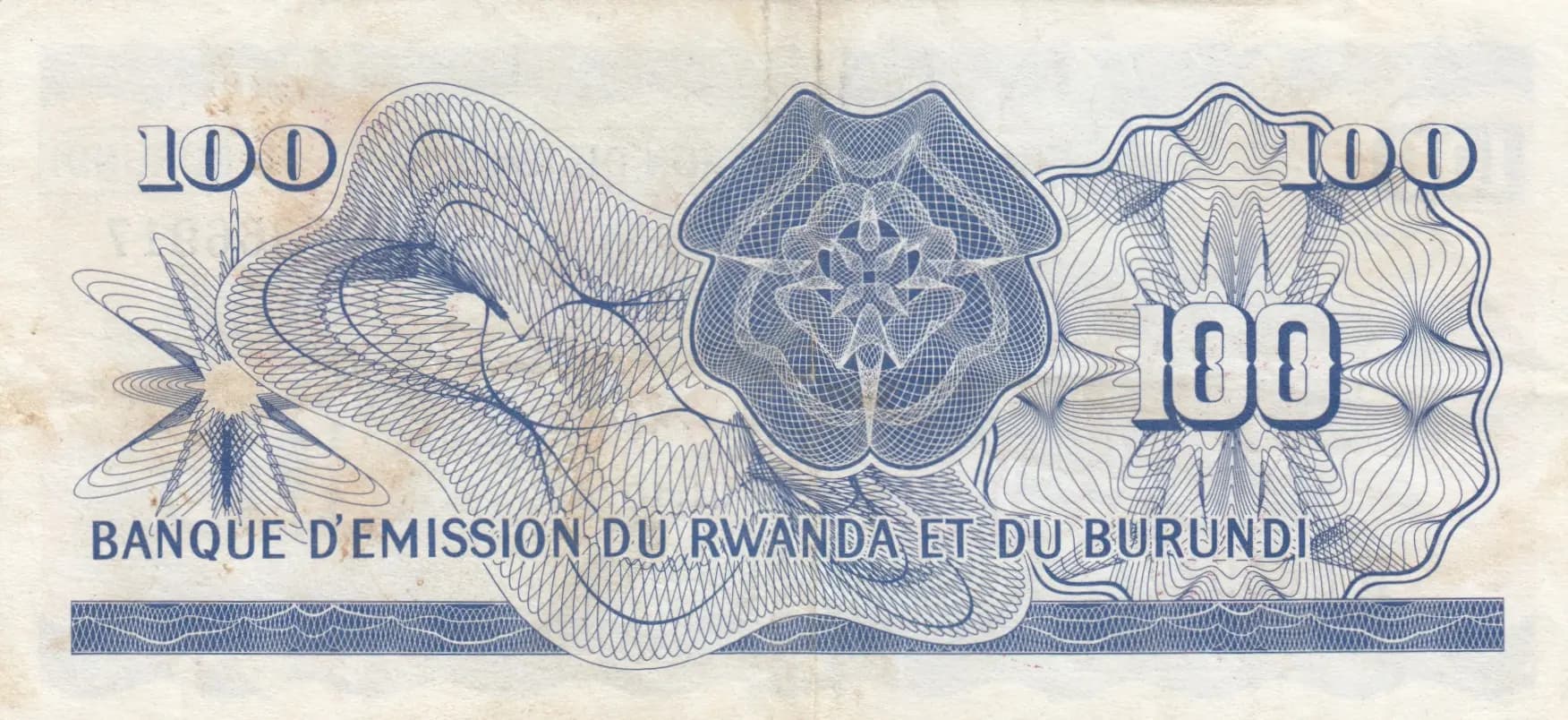
The 100 Francs features a purely ornamental design with no portrayed portraits or identifiable landmarks, which was typical of early Central African currency design. The front utilizes elaborate symmetrical guilloche patterns with wave-like border designs at top and bottom, denomination numerals positioned in top left and bottom right corners, and centered bank identification text with signature lines below. The reverse displays a dominant central decorative shield or cartouche element with intricate geometric grid patterns, flanked by symmetrical ornamental designs, further surrounded by complex guilloche wave borders. The multi-colored intaglio printing (primarily blue and green on front, predominantly blue on reverse) creates depth through fine-line engraving, with all design elements serving security rather than representational purposes—a hallmark of early post-colonial African currency design philosophy.
FRONT SIDE: 'BANQUE D'EMISSION DU RWANDA ET DU BURUNDI' (Emission Bank of Rwanda and Burundi); 'CENT FRANCS' (One Hundred Francs); 'PAYABLES A VUE' (Payable on Sight); 'L'ADMINISTRATEUR' (The Administrator); 'LE PRESIDENT' (The President); '01.10.60' (Issue date: October 1, 1960); 'SPECIMEN' (Specimen overprint); 'K 866917' (Serial number); 'LE CONTREFACTEUR EST PUNI DE SERVITUDE PENALE' (The counterfeiter is punished with penal servitude). BACK SIDE: 'BANQUE D'EMISSION DU RWANDA ET DU BURUNDI' (Emission Bank of Rwanda and Burundi); Multiple '100' denomination numerals.
Intaglio engraving (taille-douce), characterized by the extensive guilloche patterns, fine-line detail work, and multi-color capability observed throughout both sides of the note. The technique's complexity, particularly in the geometric shield design on the reverse and the intricate border patterns, indicates work by a specialized security printer, likely a European security printing firm contracted by the newly independent Burundian state. The quality and consistency of the engraving is consistent with 1960s-era security printing standards.
This example is a SPECIMEN variety, as indicated by the prominent red diagonal 'SPECIMEN' overprint text across the front. Specimen notes of this type were officially distributed for circulation verification and archival purposes. The serial number prefix 'K' and number sequence '866917' are visible on both front and back. The date '01.10.60' (October 1, 1960) confirms this as the initial 1960 issue type, distinguishing it from later 1962/1964 printings of the same Pick number, which may show date variations or different security features.