5 francs 1965
Market Prices
4 salesAbout This Note
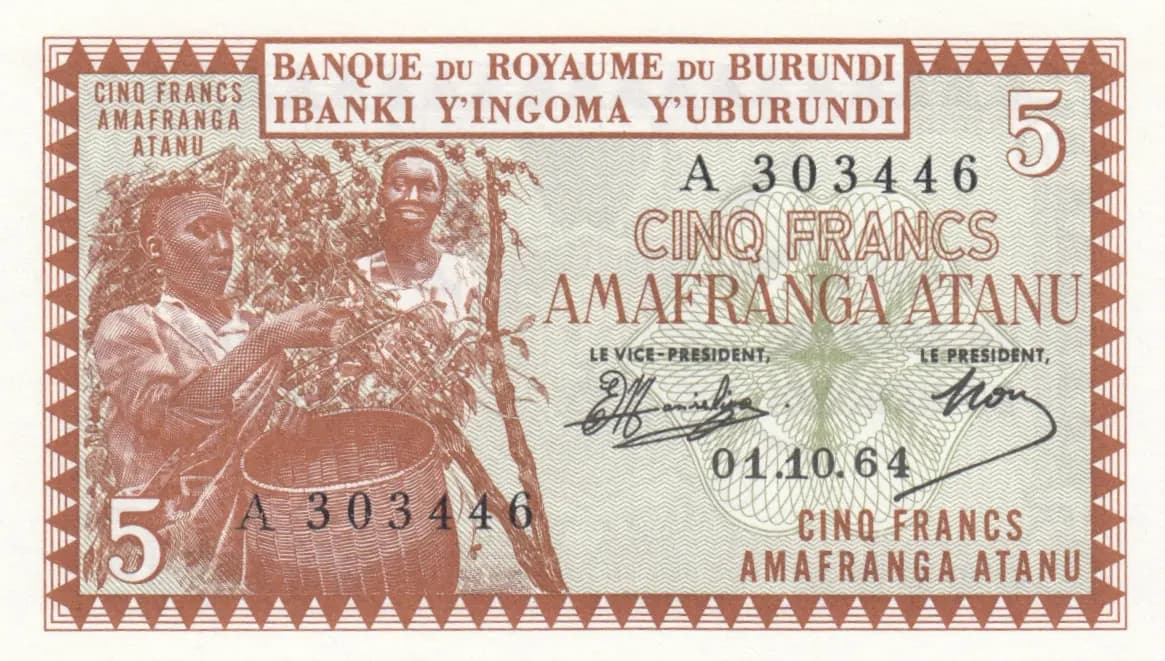
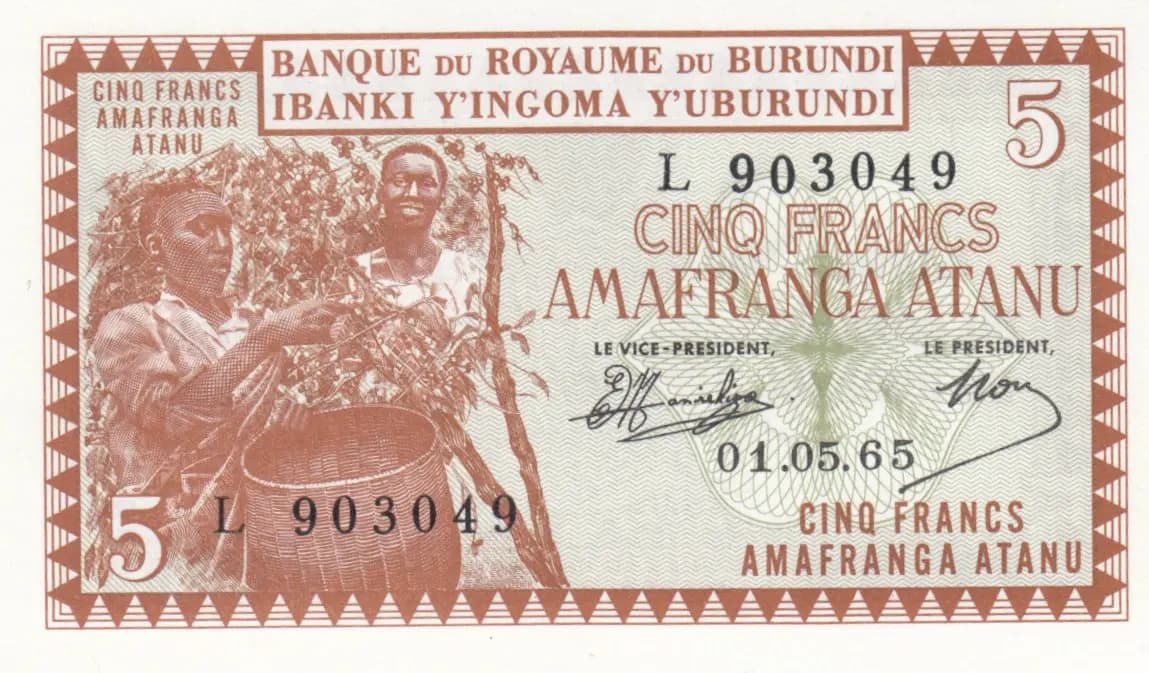
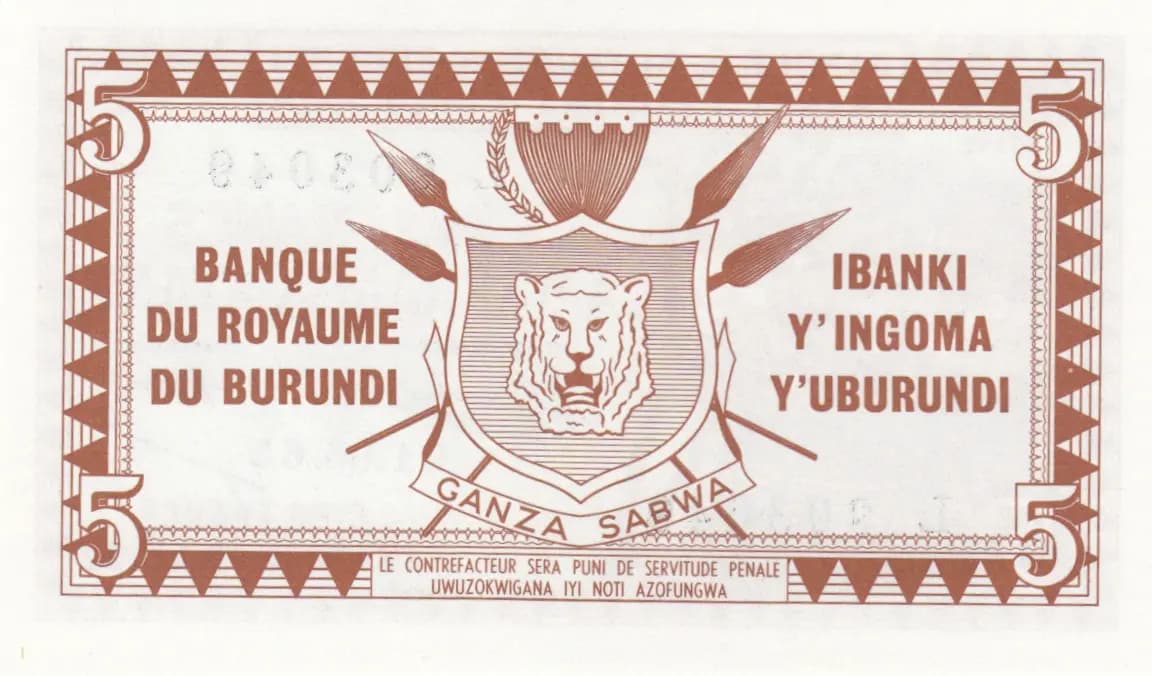
This is a pristine, uncirculated example of Burundi's 5 Francs note from 1965 (Pick P-8), issued by the Banque du Royaume du Burundi. The obverse features a beautifully engraved scene depicting two African figures—an adult woman and child—harvesting coffee beans, rendered in reddish-brown tones with intricate guilloché security patterns and dual serial numbers. The reverse displays Burundi's national coat of arms featuring a lion's head within an ornate shield, accompanied by bilingual French-Kirundi inscriptions and counterfeiting warnings, presenting an excellent example of early post-independence Burundian currency design.
Common. The catalog reference data shows this note regularly appears on secondary markets with consistent pricing in the $18–$165 range depending on condition, with numerous sales recorded from 2016–2025. The UNC catalog value of $100 (2019) and multiple UNC-grade sales documented indicate this is a regularly traded note with adequate supply. The Pick P-8 designation suggests this was a standard regular issue with no indication of limited print runs or recall. Market pricing and transaction frequency confirm this as a common early post-independence African banknote, not scarce or rare.
Issued in 1965, just four years after Burundi's independence from Belgium in 1961, this note reflects the kingdom's early efforts to establish its own monetary identity under the Banque du Royaume du Burundi. The coffee harvest motif on the obverse represents one of Burundi's primary agricultural exports and economic foundations, while the national coat of arms on the reverse—featuring the lion symbolizing strength and sovereignty—emphasizes the nation's newly established royal authority under King Mwami Ntare V. The bilingual French-Kirundi presentation demonstrates the post-colonial linguistic integration within the fledgling nation's institutional framework.
The obverse depicts a carefully engraved scene of coffee harvesting, showing an adult woman and child figure gathering coffee beans into a basket amid stylized foliage, rendered in fine detail with reddish-brown coloration against a cream background. This imagery celebrates Burundi's agricultural heritage and economic foundation. The reverse features Burundi's national coat of arms at center: a lion's head within an ornate shield topped by a decorative spear and laurel wreath, flanked by what appear to be ceremonial flags or heraldic elements. Both sides are framed by distinctive triangular border patterns and decorative corner frames typical of mid-20th-century East African currency design. Bilateral text in French and Kirundi appears prominently on both sides, reflecting the nation's post-colonial institutional integration. Dual serial numbers appear on the obverse (upper right and lower left positions), and official signatures for the President and Vice-President are present on the right side of the front.
FRONT SIDE: 'BANQUE DU ROYAUME DU BURUNDI' (Bank of the Kingdom of Burundi) / 'IBANKI Y'INGOMA Y'UBURUNDI' (Bank of the Kingdom of Burundi in Kirundi) / 'CINQ FRANCS AMAFRANGA ATANU' (Five Francs in French and Kirundi) / 'LE VICE-PRÉSIDENT' (The Vice-President) / 'LE PRÉSIDENT' (The President) / Serial number: 'L 903049' / Date: '01.05.65' (May 1, 1965). BACK SIDE: 'BANQUE DU ROYAUME DU BURUNDI' (Bank of the Kingdom of Burundi) / 'IBANKI Y'INGOMA Y'UBURUNDI' (Bank of the Kingdom of Burundi in Kirundi) / 'GANZA SABWA' (National Emblem/Coat of Arms in Kirundi) / 'LE CONTREFACTEUR SERA PUNI DE SERVITUDE PENALE' (The counterfeiter will be punished with penal servitude) / 'UWUZOKWIGANA IYI NOTI AZOFUNGWA' (Whoever counterfeits this note will be imprisoned in Kirundi).
This note was produced using intaglio (engraved) printing, evidenced by the fine line work, intricate guilloché security patterns visible in the background, and the precise detail in both the coffee harvest scene and coat of arms depiction. The deep, crisp impressions and fine parallel line patterns characteristic of security printing are consistent with work produced by a European security printer, likely Waterlow & Sons or De La Rue, who were primary contractors for East African central banks during this period. The dual-language bilingual design and technical quality suggest professional European security printing standards applied to early post-independence African currency.
This specific example is dated 01.05.65 (May 1, 1965) with serial number L 903049. The catalog data indicates this pick number exists with multiple date varieties: 1.12.1964 and 1.5.1965 are documented. The 'L' prefix on the serial number may indicate a specific printing batch or series, though no formal variety designation is established in major catalogs for this Pick. No signatures are legible enough in the provided images to positively identify the specific officials, which could distinguish additional varieties, but the bilingual design and May 1965 date confirm this as the later of the two documented issue dates.