100 francs 1962
Market Prices
4 salesAbout This Note
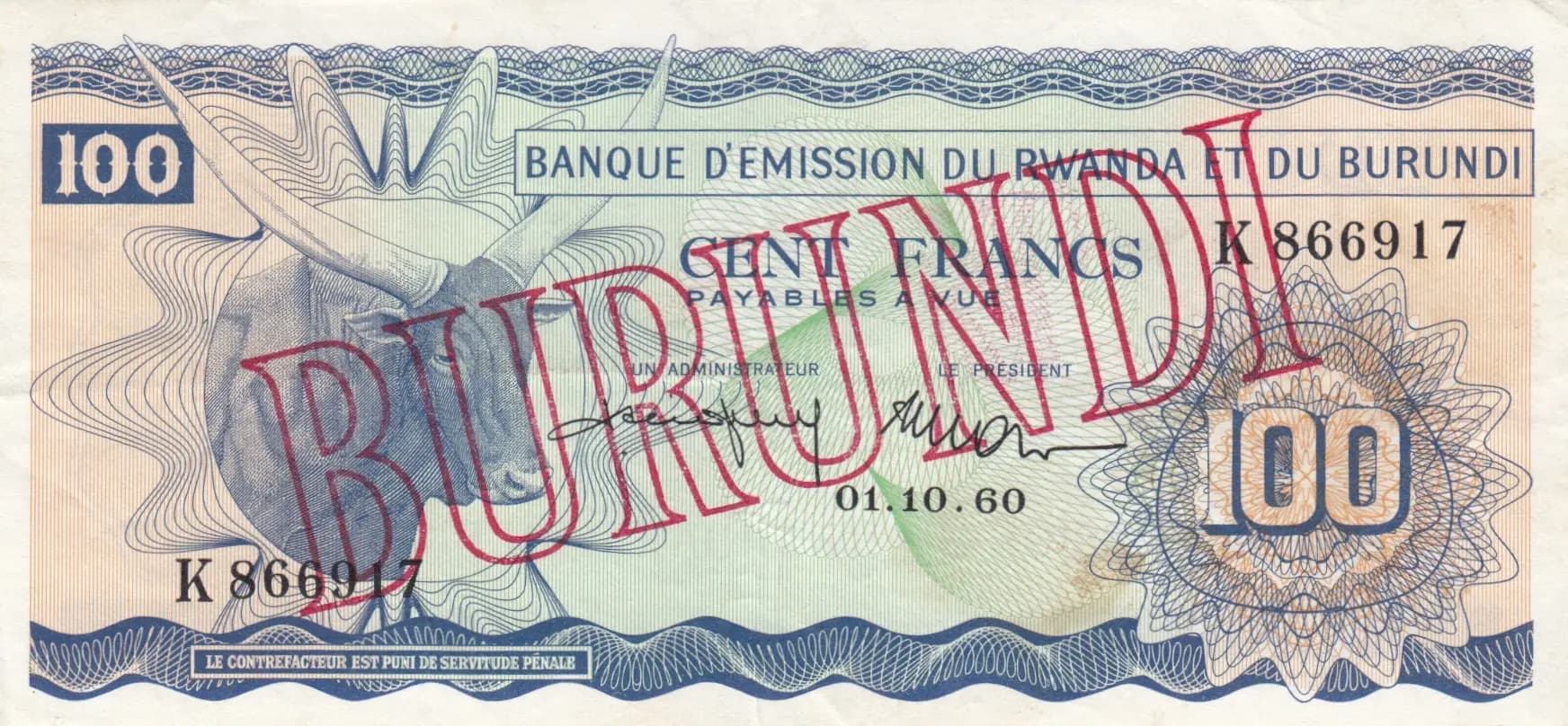
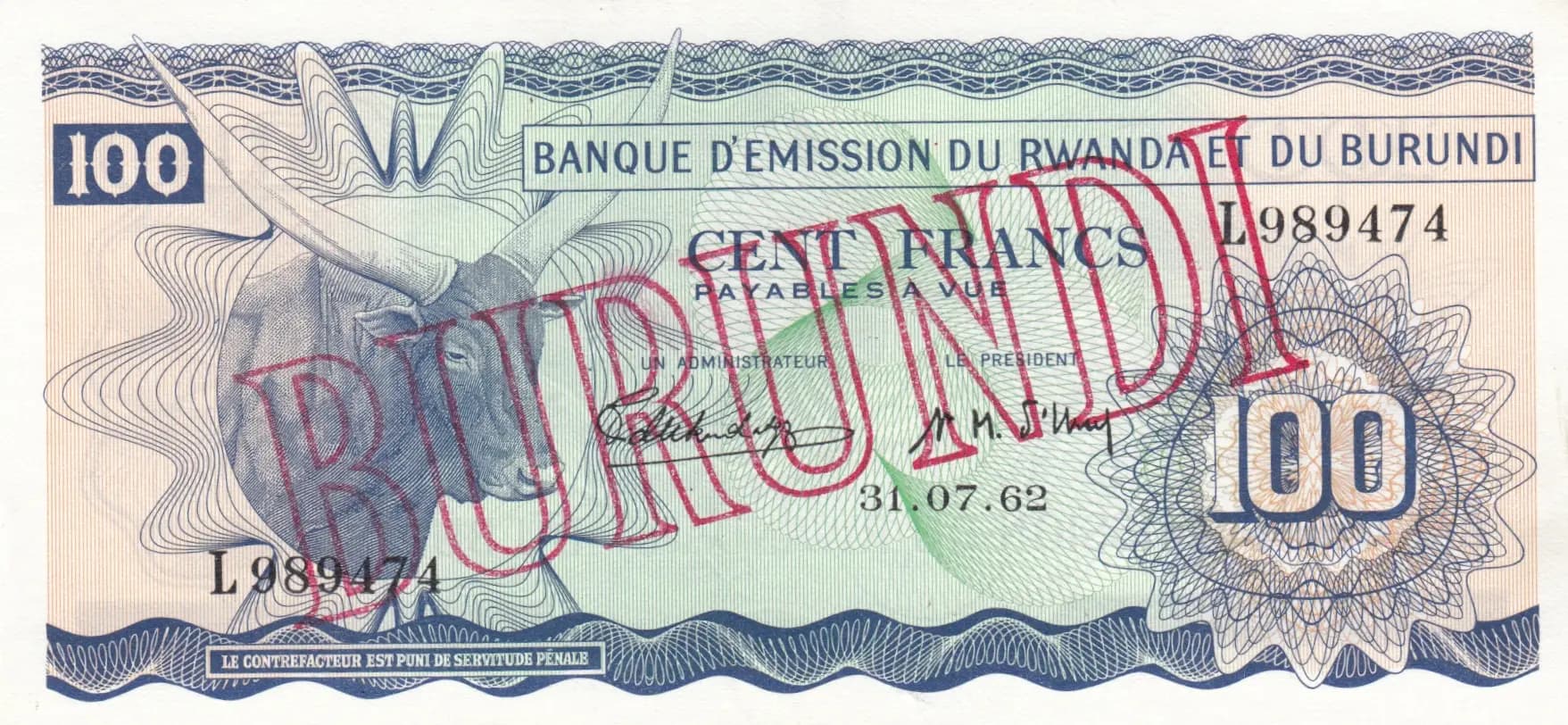
This is a 1962 100 Francs banknote from Burundi issued by the Banque d'Emission du Rwanda et du Burundi, graded EF (Extremely Fine). The note features a striking blue and purple portrait of a horned antelope in profile on the obverse, complemented by intricate guilloche patterning throughout. This specimen note bears diagonal red overprinting and carries the date 31 July 1962, representing an important early emission from the joint Rwanda-Burundi monetary authority during the post-independence period.
Common. While this note represents an early emission from a historically significant but short-lived issuing authority (the joint Rwanda-Burundi bank ceased operations in 1964), the eBay market data shows consistent availability with multiple sales ranging from $48.88 (VG) to $315 (PMG 53), with catalogue valuations of $600 for EF condition. The presence of multiple sales records and the relatively modest premium for high grades indicate adequate supply in the collector market. Specimen notes were often produced in larger quantities than standard circulation issues, further supporting a common classification.
This banknote was issued during the transitional period immediately following Rwanda and Burundi's independence from Belgian trusteeship (1962). The Banque d'Emission du Rwanda et du Burundi served as the joint central bank for both territories before their monetary separation in 1964. The imagery of the horned antelope reflects the Central African wildlife heritage and was a common symbolic choice for new African nations establishing their post-colonial identity during this era.
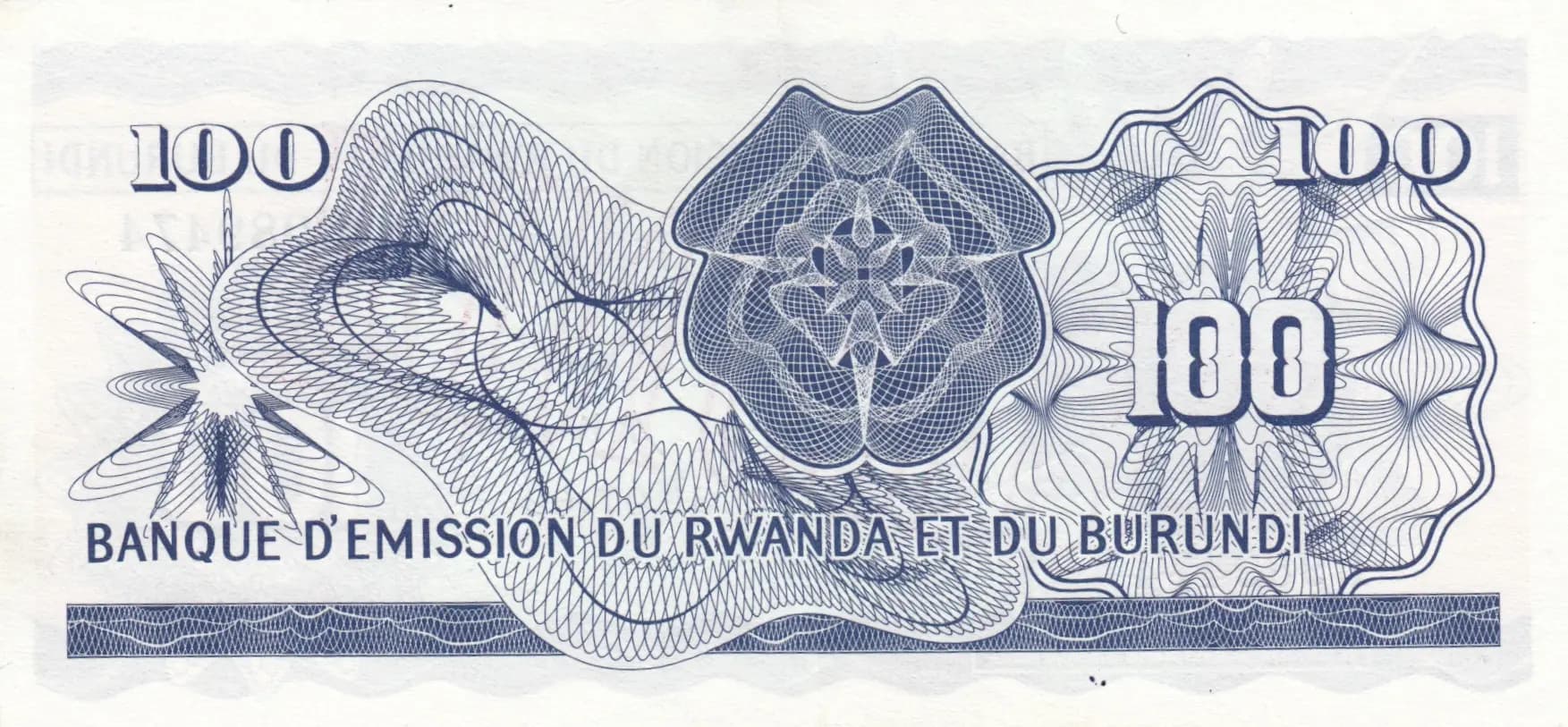
The obverse features a horned antelope (likely a kudu or similar Central African species) rendered in blue and purple tones on the left side, symbolizing the region's natural heritage. The design is anchored by extensive guilloche patterning with wavy decorative elements throughout, providing both aesthetic appeal and anti-counterfeiting protection. The reverse displays a highly symmetrical composition centered on an ornate geometric rosette or mandala-like pattern executed in fine blue line work, flanked by floral motifs on both sides. Denomination numerals '100' appear prominently in the top left and bottom right of the obverse, and again on both sides of the reverse. The overall aesthetic reflects the refined engraving standards of early 1960s African banknote design.
FRONT SIDE: 'BANQUE D'EMISSION DU RWANDA ET DU BURUNDI' (Emission Bank of Rwanda and Burundi), 'CENT FRANCS' (One Hundred Francs), 'PAYABLES A VUE' (Payable on Demand), '31.07.62' (31 July 1962), 'L989474' (Serial Number), 'LE CONTREFACTEUR EST PUNI DE SERVITUDE PENALE' (The counterfeiter is punished by penal servitude), 'SPECIMEN' (Specimen - red overprint), '100' (denomination numeral). BACK SIDE: 'BANQUE D'EMISSION DU RWANDA ET DU BURUNDI' (Emission Bank of Rwanda and Burundi), '100' (denomination numerals, appearing on both left and right sides).
Intaglio engraving (recess printing), the standard security printing method for this era. The extensive guilloche patterning, fine-line decorative borders, and intricate rosette design on the reverse are characteristic of high-security intaglio work. The sharp, crisp detail visible in both the obverse portrait and reverse geometric patterns indicates professional engraving plates typical of established security printers producing for African central banks in the early 1960s. The specimen overprinting in red was applied separately post-printing.
This is a SPECIMEN note, as indicated by the prominent red diagonal 'SPECIMEN' overprint across the obverse. Specimen notes from this series were not released into circulation and represent a distinct variety from standard issued notes. The serial number L989474 and the date 31.07.62 (31 July 1962) are consistent with the P-5 Pick catalog listing. No signature varieties have been identified from the visual analysis, though the signature areas are visible on the obverse.