5 francs 1964
Market Prices
4 salesAbout This Note
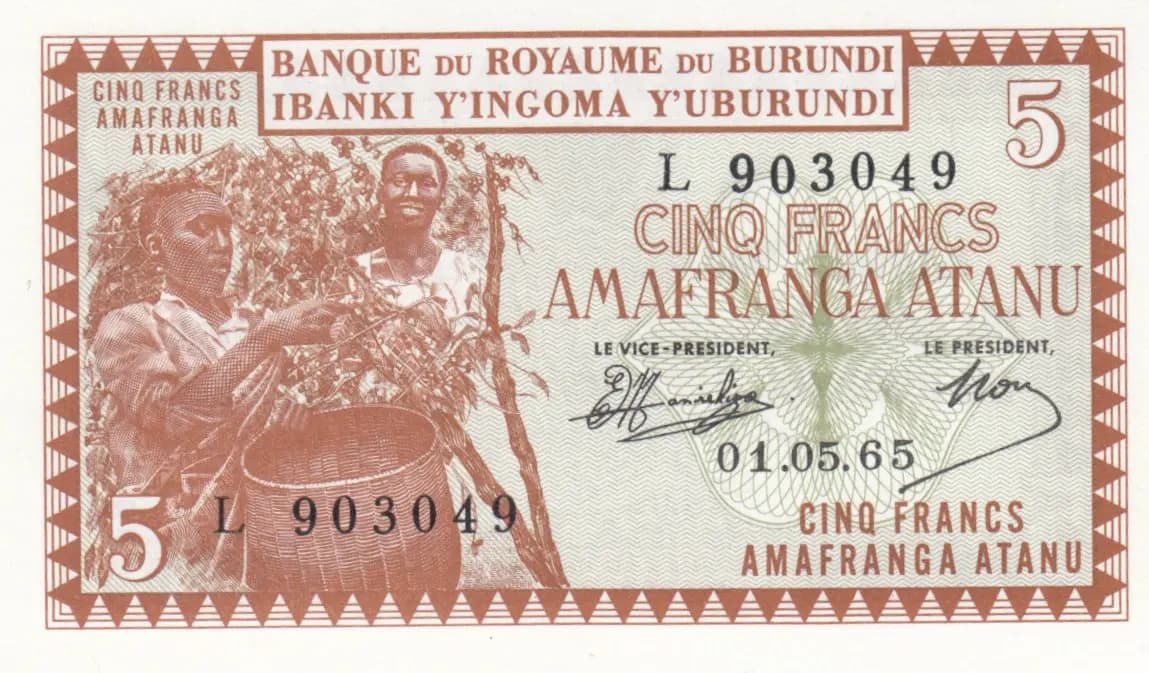
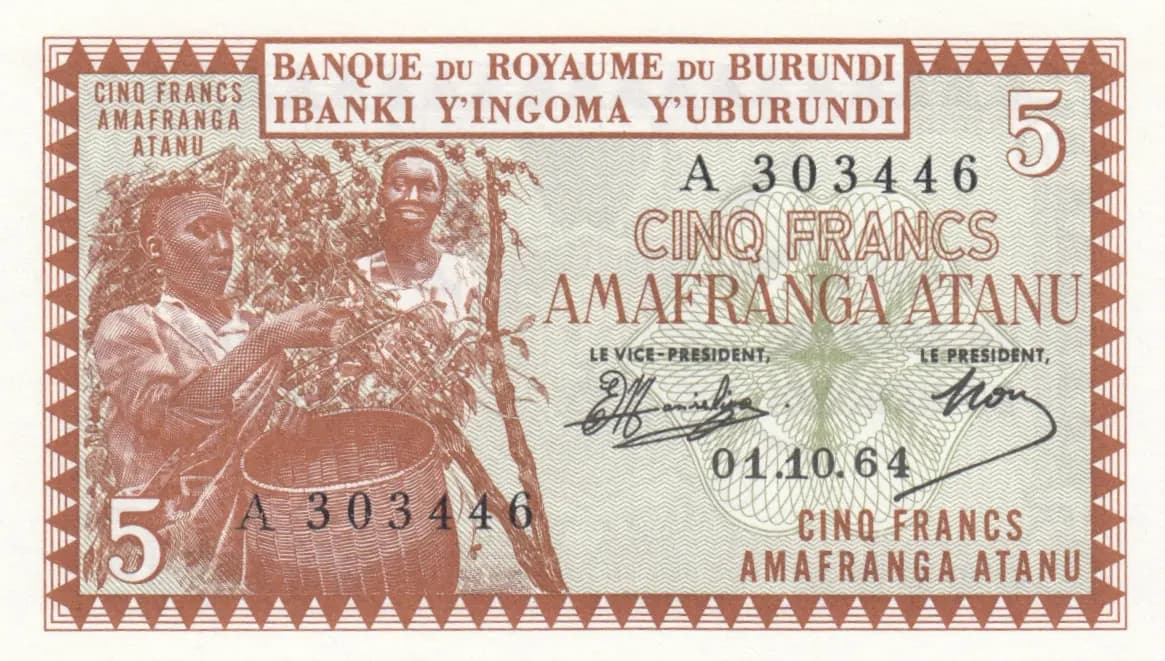
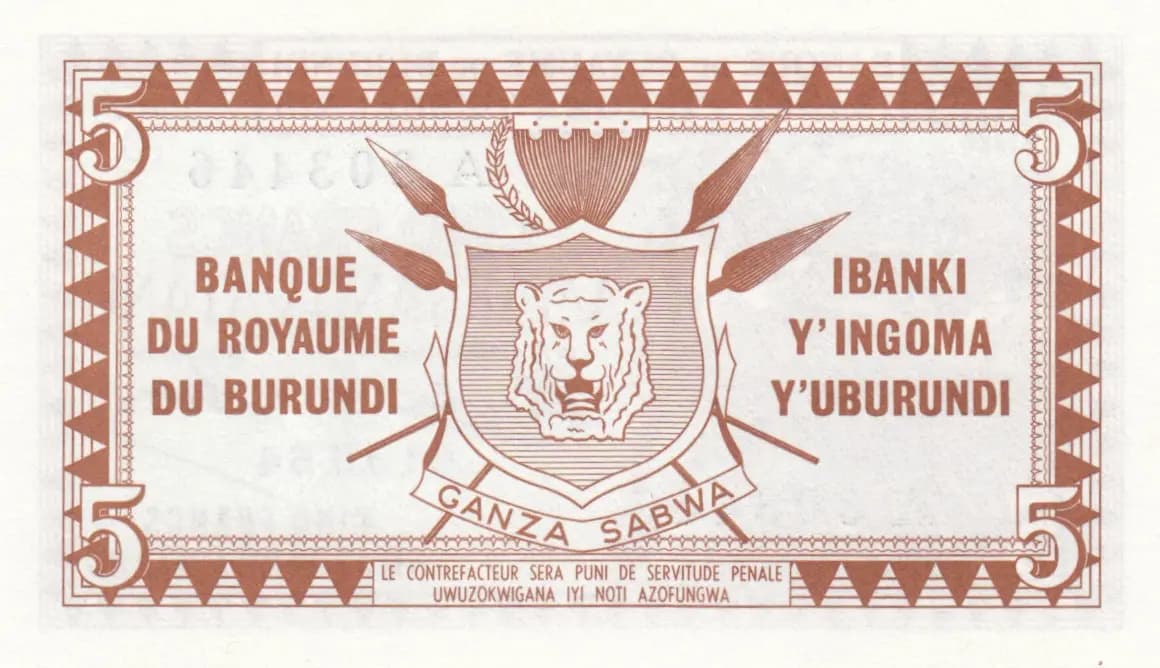
An exceptionally well-preserved example of Burundi's first independent currency, the 5 Francs 1964 issued by the Banque du Royaume du Burundi. This UNC specimen displays crisp, vibrant brown and cream coloration with no signs of circulation, featuring detailed engravings of coffee harvesters on the obverse and the royal coat of arms on the reverse. The note's bilingual French-Kirundi inscriptions and October 1964 date mark a significant moment in Burundi's post-independence monetary history.
Common. While this is the first issue of Burundi's currency, eBay market data shows UNC examples trading in the $44–$100 range (2019 catalog value: $100 UNC), with multiple documented sales demonstrating consistent availability. The 1964 issue had a substantial print run as the nation's foundational currency. No evidence of short print runs, recalls, or scarcity conditions exists. The denomination (5 Francs) and issue year (1964 & 1965) are standard catalog entries rather than limited variants.
Issued in 1964, immediately following Burundi's independence from Belgian trusteeship in July of that year, this banknote represents the kingdom's establishment of its own monetary authority. The coffee harvest imagery on the obverse reflects Burundi's primary agricultural export and economic foundation, while the heraldic lion and royal regalia on the reverse symbolize the newly sovereign Kingdom of Burundi under the Mwami (King). The bilingual presentation in French and Kirundi underscores the nation's post-colonial identity during a transitional period before the 1966 coup transformed governance.
The obverse depicts two figures engaged in coffee harvesting—a woman on the left wearing traditional geometric-patterned dress and a man on the right in lighter clothing, set against a textured foliage background suggesting the coffee plantations central to Burundi's economy. The reverse features the heraldic coat of arms of the Kingdom of Burundi at center, prominently displaying a lion's head on a shield flanked by spear or ceremonial leaf motifs, enclosed within a decorative banner. Both sides employ an ornamental triangular border pattern and wavy guilloche background elements. Denomination numerals '5' appear in all four corners of the reverse. The design reflects mid-20th century African banknote aesthetics with emphasis on national symbols and economic themes.
OBVERSE: 'BANQUE du ROYAUME du BURUNDI' (Bank of the Kingdom of Burundi) and 'IBANKI Y'INGOMA Y'UBURUNDI' (Bank of the Kingdom of Burundi in Kirundi); 'CINQ FRANCS AMAFRANGA ATANU' (Five Francs); Serial number 'A 303446' appears top right and bottom left; 'LE VICE-PRESIDENT' (The Vice-President) and 'LE PRESIDENT' (The President) marking signature lines; Date '01.10.64' (October 1, 1964). REVERSE: 'BANQUE DU ROYAUME DU BURUNDI' and 'IBANKI Y'INGOMA Y'UBURUNDI' (Bank of the Kingdom of Burundi); 'GANZA SABWA' (Royal Seal/Emblem in Kirundi); 'LE CONTREFACTEUR SERA PUNI DE SERVITUDE PENALE UWUZOKWIGANA IYI NOTI AZOFUNGWA' (Counterfeiters will be punished with penal servitude in French and Kirundi).
Intaglio (engraved) printing, evidenced by the detailed guilloche patterns, fine line work in the background texturing, and the precision of the heraldic engraving on the reverse. The consistent, crisp impression and security features including repeated serial numbers and intricate background patterns are characteristic of high-security intaglio production. For this Pick number, Belgian security printers—likely Giesecke+Devrient or similar European security printing firms contracted by newly independent African nations—would have produced these notes using traditional engraved steel plate methodology.
This specimen is dated 01.10.64 (October 1, 1964) with serial number A 303446. The catalog notes both 1964 and 1965 dates for Pick 8, indicating multiple printings throughout these two years. Varieties exist based on date (1.12.1964 vs. 1.5.1965 variants noted in references) and serial number prefixes. This particular example with the 'A' prefix and October 1964 date represents the earliest known printing. Further research into the full range of serial prefix letters (A through Z or beyond) and specific date variations would establish the complete variety spectrum for this Pick number.