10 rupees 1938
Market Prices
26 salesAbout This Note
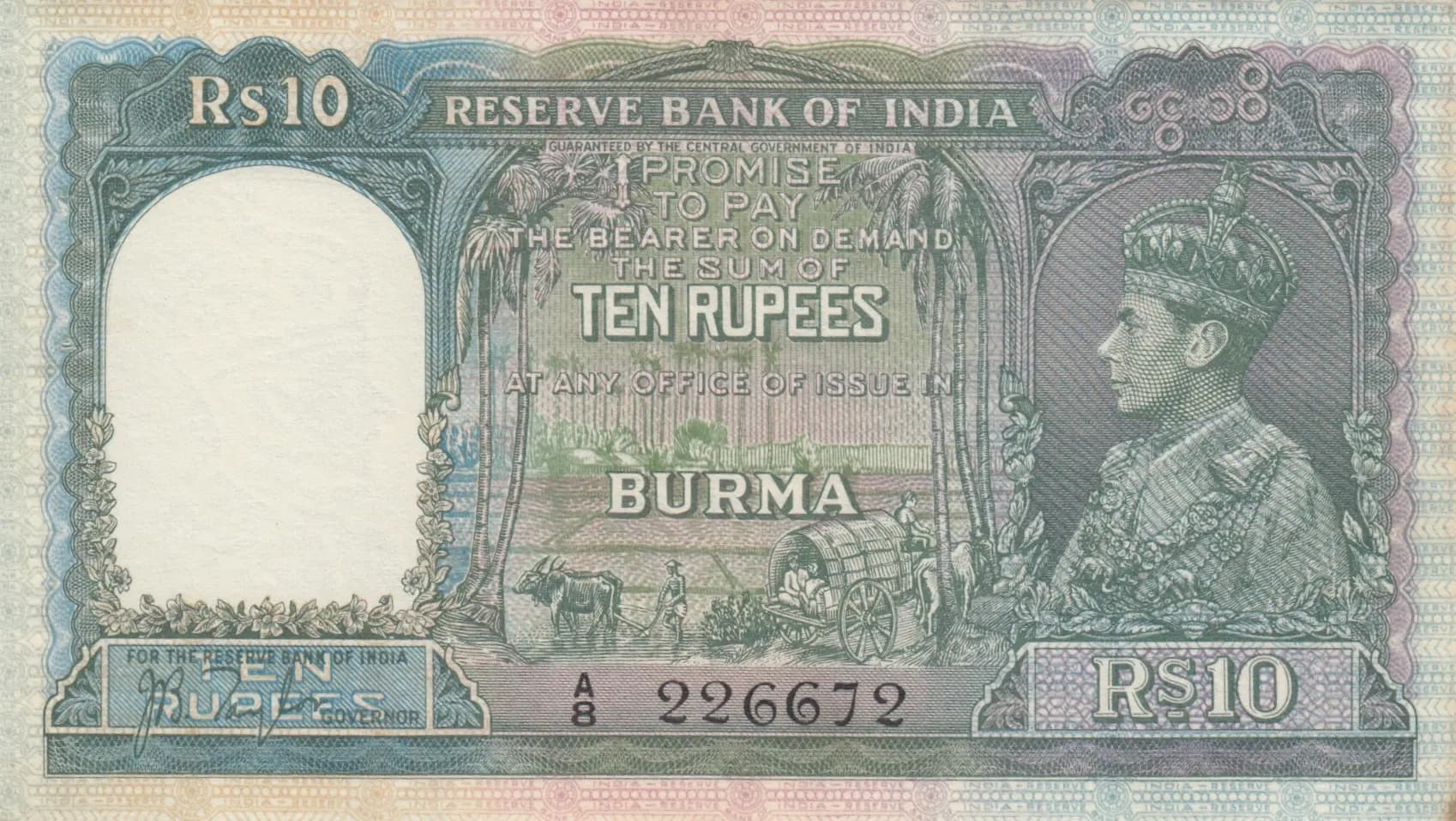
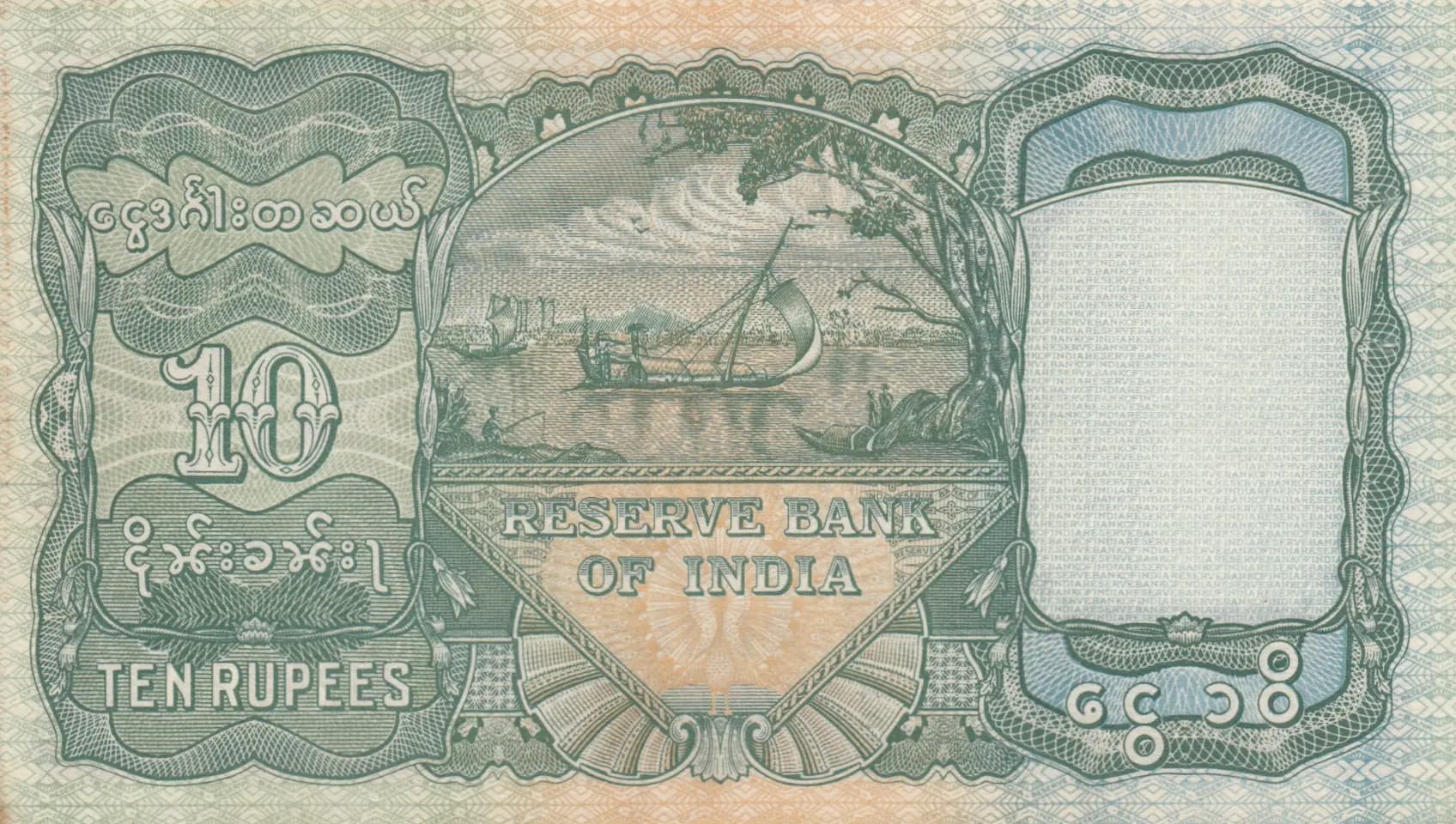
This is a Reserve Bank of India 10 rupees note from Burma, Pick-5, dated 1938, graded AU (About Uncirculated). The note features King George VI in formal profile on the obverse with rural agricultural imagery including oxen and carts, while the reverse displays a romantic river scene with traditional dhow-style sailing vessels characteristic of Burma's waterways. Despite its AU grade, the note shows significant age-related patina with foxing and discoloration typical of an 86-year-old note, lending it authentic historical character while maintaining structural integrity.
Common. This is a standard circulating issue from a major, stable printing authority (Reserve Bank of India) with substantial print runs for Burma during 1938. The eBay market data confirms common status: prices typically range from $30-$100 for VF-EF grades, with AU examples selling in the $150-$200 range based on recent sales. No evidence of short print runs, recalls, or limited distribution exists. The serial number 'A 8' falls within standard production ranges. While 1938 Burma notes have legitimate historical interest, they were printed in quantities sufficient to make individual examples readily available to collectors.
This note was issued during the final decade of Burma under British colonial rule, before independence in 1948. The imagery deliberately reflects Burma's economic identity: the agricultural scenes with oxen and carts on the obverse represent the rural economy, while the river dhow scene on the reverse depicts the Irrawaddy River trade that was central to Burma's commerce. King George VI's portrait signifies Burma's status as part of the British Commonwealth at this time, and the parallel Burmese script acknowledges the local population despite colonial governance.
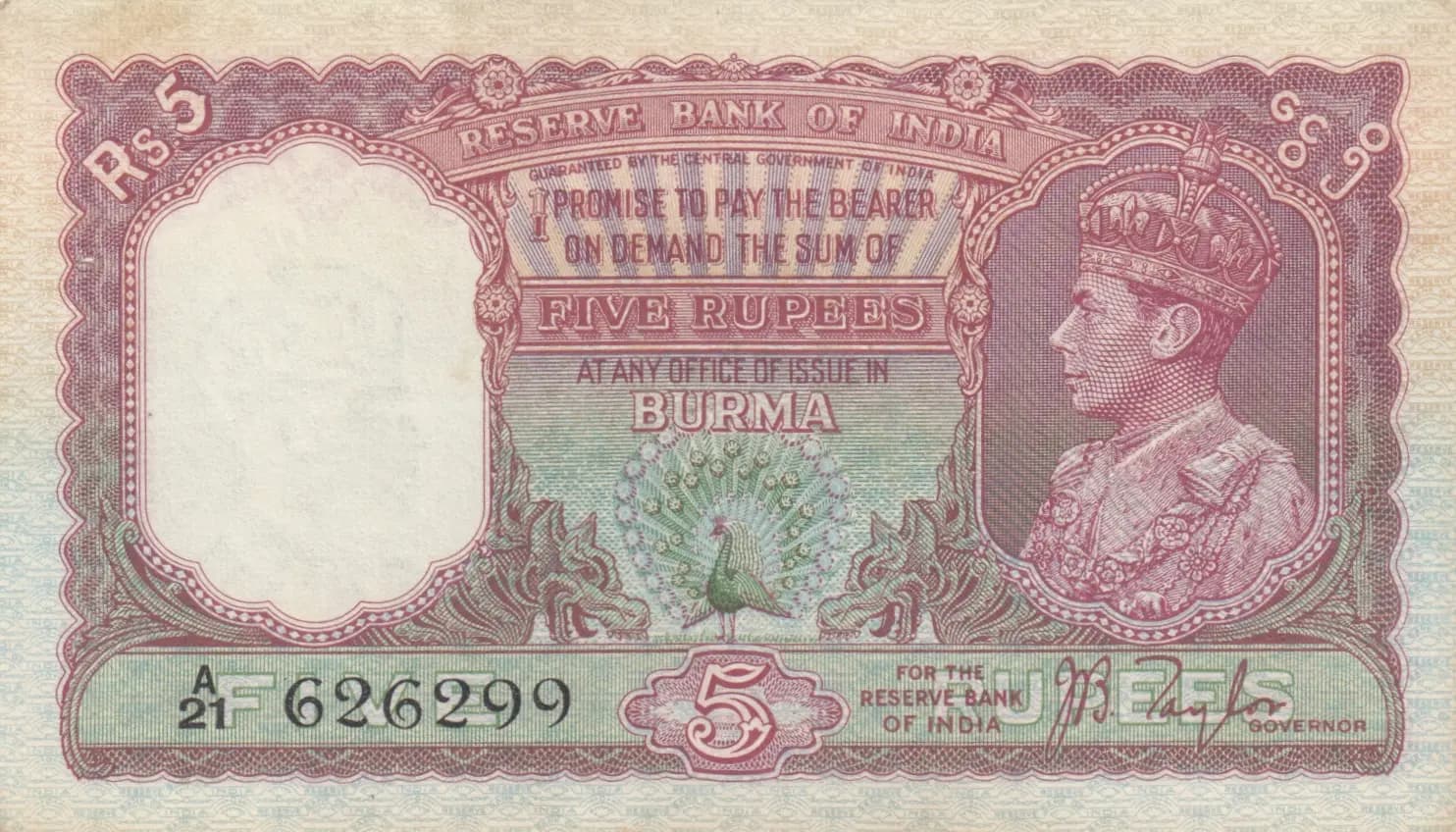
The obverse features a three-quarter profile portrait of King George VI wearing formal coronation regalia with crown and decorative orders, positioned on the right side within an ornamental oval frame. The central design incorporates a rural Burmese agricultural landscape with oxen-drawn wooden carts and palm trees, symbolizing the agrarian economy. The reverse showcases a detailed vignette of traditional Burmese river commerce featuring two or more traditional dhow-style sailing vessels on the Irrawaddy River with tropical vegetation and settlement structures visible along the banks. Both sides are framed with elaborate ornamental borders featuring floral patterns and geometric flourishes consistent with early 20th-century security printing aesthetics. The note employs a multi-color palette of green, blue, pink/mauve, and cream tones distributed across engraved vignettes.
OBVERSE: 'Promise to pay the bearer on demand, the sum of ten rupees at any office of issue in Burma' (central promise clause); 'Reserve Bank of India' (issuer); 'Guaranteed by the Central Government of India' (government backing); 'Rs 10' (denomination, appears twice); 'For the Reserve Bank of India' (issuing authority attribution); Serial number 'A 8 226679'. REVERSE: '၁၀' (Burmese numeral for 10); 'Ten Rupees' (English denomination); 'Reserve Bank of India' (issuer identification); Ornamental Burmese script at top left (decorative text, specific content requires Burmese expertise).
This note was produced using traditional intaglio (engraved) printing on security paper, evidenced by the fine detailed line work visible throughout both sides, the complex background dot patterns and geometric designs, and the dimensional depth characteristic of hand-engraved currency plates. The Reserve Bank of India's notes from this era were typically printed by the Bank Note Press in Nashik or by Waterlow & Sons, a major security printer for British Commonwealth currencies during this period. The ornamental borders, portrait rendering, and vignette detailing all show the hallmarks of high-quality intaglio currency production from the 1930s.
Serial number prefix 'A 8' indicates standard production issue. This is the base variety for Pick-5 with no known overprints, error varieties, or signature variants documented. The note exhibits the standard George VI portrait and Burmese river scene imagery consistent with all 1938 10 rupees Burma notes. No prominent placement variations or printing errors are evident from the visual analysis. Collectors should note that signature varieties on Reserve Bank notes from this period are minimal, as printed signatures of the Governor and Secretary were standardized during production runs rather than hand-signed.