50 kyats 1958
Market Prices
26 salesAbout This Note
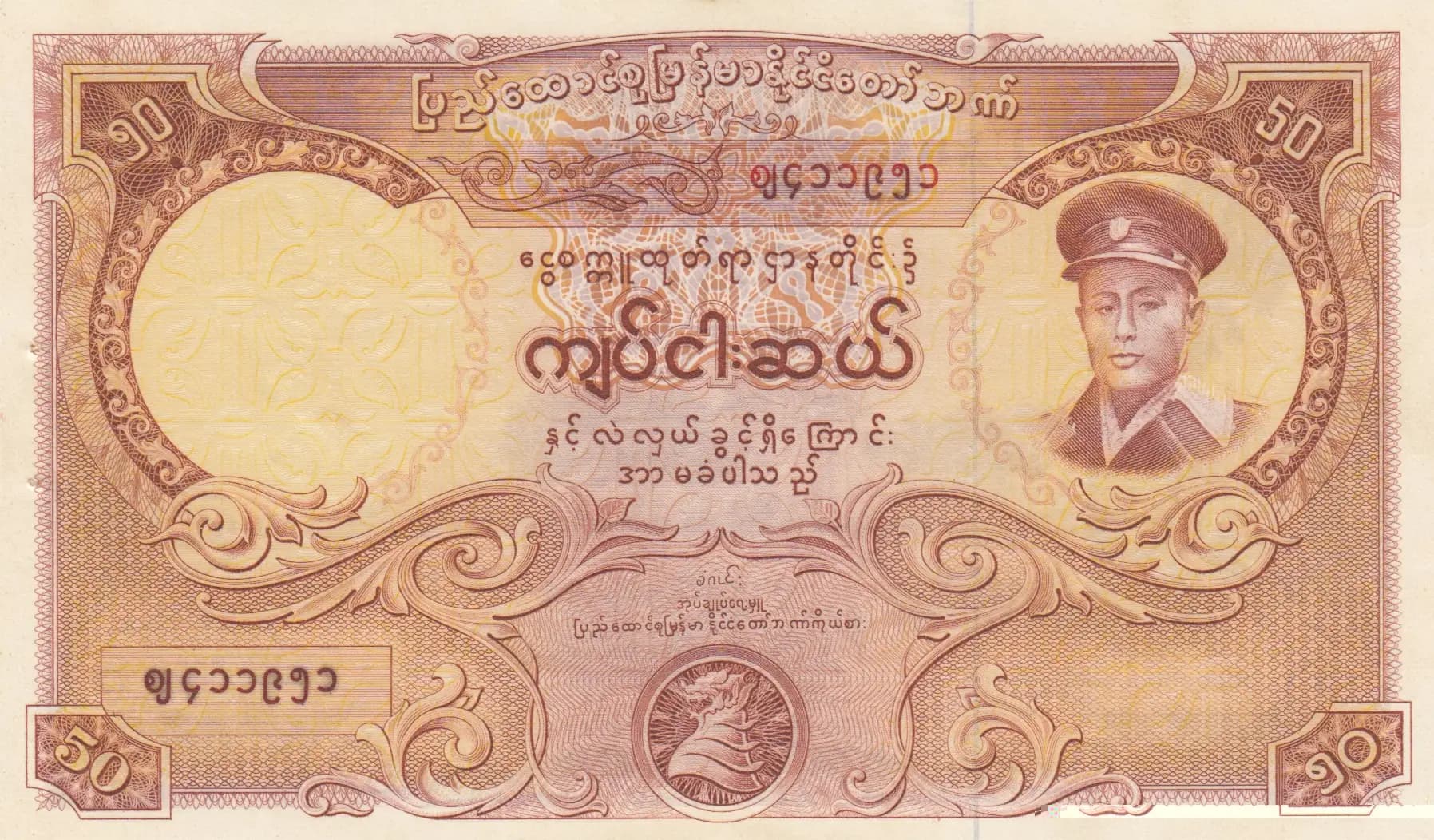
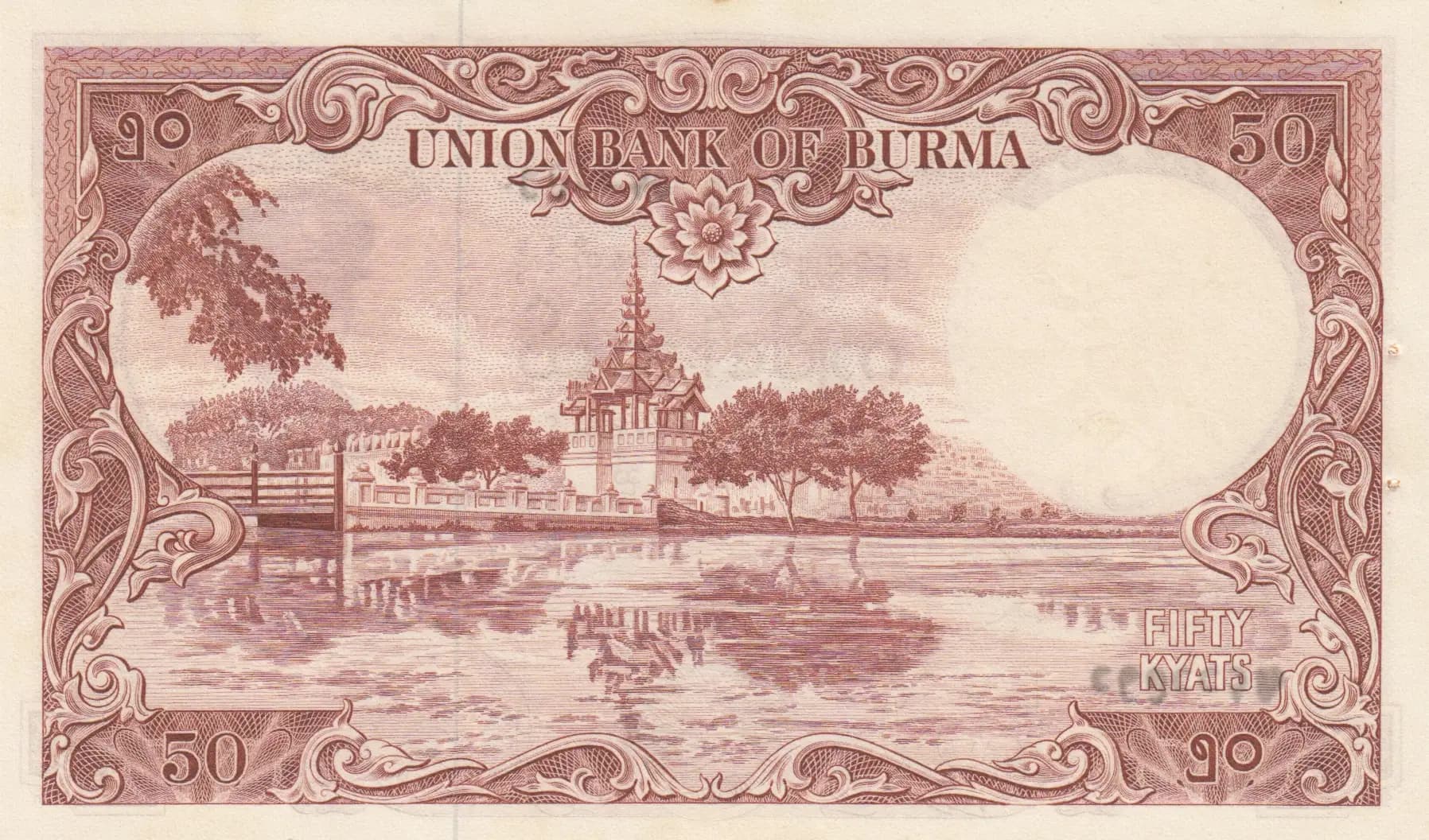
This is an exceptionally well-preserved example of the 1958 Union Bank of Burma 50 Kyats note in uncirculated condition, as confirmed by the absence of wear, creases, or foxing visible across both sides. The note features a striking color palette of cream and burgundy with intricate engraved borders, displaying General Aung San in military cap on the obverse and a detailed landscape of a traditional Burmese temple reflected in water on the reverse. The fine line work, cross-hatching, and ornate circular emblems demonstrate the sophisticated security printing techniques of the era.
Common. Market data from eBay auction results shows consistent sales ranging from $2.25 to $131.50 depending on condition grade (PMG 66 being the highest recorded at $131.50 in 2019). The note regularly appears in auction listings with reasonable frequency and bidding activity. Catalogue values from 2016 list UNC specimens at approximately $5, while various condition grades have sold for modest prices consistently. The abundance of transaction data and consistent availability indicate this is a widely-held example with adequate supply in the collector market.
This note was issued during the early years of the Union of Burma's independence and monetary stability, approximately a decade after the country gained independence from British colonial rule in 1948. The portrait of General Aung San, the revered founder of modern Burma, on the obverse reflects his central role in Burmese nationalism and independence, while the temple depicted on the reverse—characteristic of Mandalay's religious and cultural significance—represents the nation's Buddhist heritage and cultural identity during this formative period.
The obverse features a left-facing portrait of General Aung San wearing a formal military-style cap with insignia, positioned prominently on the right side of the note against a cream background. The reverse depicts a classical Burmese temple (identified as the Mandalay temple based on external references) with multi-tiered spires characteristic of Southeast Asian Buddhist architecture, set within a landscape featuring water with visible reflections and framing vegetation. Both sides are enclosed by ornate decorative borders featuring intricate scrollwork, floral patterns, and circular emblems positioned at the center-bottom of the obverse. The design employs a burgundy and brown color scheme with fine engraved detailing throughout.
Front side: 'နိုင်ငံတကာ ဘဏ်' (Union Bank of Burma or Central Bank in Burmese); 'ငါးဆယ်' (Fifty); 'ကျပ်' (Kyats); '50' (50 in Arabic numerals). Back side: 'UNION BANK OF BURMA' (English); 'FIFTY' (English); 'KYATS' (English); '50' and '90' (Arabic numerals, where 90 likely indicates a series or catalog designation).
Intaglio (engraved) printing on cotton-based banknote paper. The fine line work, cross-hatching patterns, and intricate scrollwork visible in the visual analysis are characteristic of security intaglio printing. The specific printer is not definitively documented in standard catalogues for this Pick number, though Union Bank of Burma notes from this period were typically produced by established security printers of the era. The watermark featuring General Aung San (visible in the upper left circular section) indicates sophisticated watermarking technology integrated into the paper production.
No specific signature varieties or notable printing variants are documented for this Pick number in standard catalogues. The visual analysis does not reveal any obvious overprints, date variations, or significant design alterations that would indicate distinct varieties. This appears to be a standard issue of the 1958 50 Kyats denomination (Pick-50). Serial numbers and specific printer marks, if present, cannot be definitively analyzed from the provided visual description. Further examination of the serial number prefix (if any) might reveal additional variety information, but no such details are evident from the current analysis.